
How Many Showpieces Should a Small Indian Apartment Actually Have?
The Short Answer
In a sub-1,200 sq ft Indian apartment, the optimal count is 5–9 showpieces distributed across 3–4 distinct surfaces, with no single surface holding more than 3 pieces. Moolwan recommends pieces in the 10–21 cm size band for most surfaces because pieces beyond 25 cm in a compact room raise the visual centre of gravity, making ceilings appear lower than they are.
Indian urban apartments average between 650 and 1,100 sq ft — a spatial constraint that changes the logic of décor completely. Moolwan helps design-conscious Indian homeowners place exactly the right number of showpieces so their home reads as curated rather than crowded, using pieces engineered for Indian room scales, Indian humidity ranges, and Indian surface dimensions. The calculation is not subjective: it follows surface area, sightline geometry, and the physics of visual weight.
Why Do Indian Apartments Feel Cluttered Even With Just a Few Showpieces?
Visual clutter in a compact room is triggered not by object count but by sightline density — the number of distinct objects that fall within a 60-degree horizontal field of view from the room's primary seated position. Research in environmental psychology identifies five or more unrelated objects within a single sightline as the threshold beyond which a space is perceived as disordered, regardless of room size.
Indian apartments amplify this effect for two structural reasons. First, open-plan layouts common in 2BHK and 3BHK configurations below 1,000 sq ft mean that the living room sightline sweeps across the dining ledge, the console table, the TV unit, and the bookshelf simultaneously. Second, Indian ceilings average 9–9.5 feet — lower than the 10-foot norm in Western homes for which most imported décor is proportioned — so oversized pieces (above 25 cm) compress the perceived vertical axis of the room.
Both problems are solved by distribution rather than removal: spreading pieces across surfaces so that no single sightline carries more than 2–3 objects, and selecting piece heights that sit below the 21 cm threshold that triggers perceived ceiling compression in sub-10-foot rooms.
How Should You Count Surfaces, Not Just Pieces, in a Small Home?
The correct unit of measurement for décor planning in a compact apartment is the active surface — a horizontal plane with a width of at least 25 cm that sits within normal sightlines (60–180 cm above floor level). In a typical Indian 2BHK below 900 sq ft, there are 4–6 active surfaces: a coffee table, a TV console ledge, a bookshelf or floating shelf, a dining table centrepiece position, a bedroom dresser or bedside table, and sometimes an entry console.
Over-decorating happens when homeowners treat every active surface as an opportunity rather than as a visual obligation. High-fired ceramic pieces in the 150–600 g weight range — the range covered by Moolwan's showpiece collection — are light enough to be repositioned without risk of surface damage, which means surface allocation can be treated as an experiment rather than a permanent decision. Starting with 3 surfaces and adding a fourth only once the first three feel resolved is a lower-risk approach than distributing pieces across all available surfaces simultaneously.
The ceiling for a small Indian apartment is 4 actively decorated surfaces. Beyond that, the eye loses its anchor point — there is no single surface that reads as the primary focal zone — and the room reverts to the scattered-objects problem that inspired the decoration exercise in the first place.
| Room Footprint | Active Surfaces to Decorate | Recommended Piece Height | Max Pieces Per Surface | Total Piece Count |
|---|---|---|---|---|
| Under 600 sq ft (studio / 1BHK) | 2–3 surfaces | 10–16 cm (Small) | 2 pieces | 4–6 total |
| 600–900 sq ft (compact 2BHK) | 3 surfaces | 10–21 cm (Small–Medium) | 2–3 pieces | 5–8 total |
| 900–1,100 sq ft (standard 2BHK) | 3–4 surfaces | 16–25 cm (Medium) | 3 pieces | 7–10 total |
| 1,100–1,200 sq ft (large 2BHK / compact 3BHK) | 4 surfaces | 16–34 cm (Medium–Large) | 3 pieces | 9–12 total |
| Above 1,200 sq ft (spacious 3BHK+) | 4–5 surfaces | 25–34 cm (Large) for focal points | 3–4 pieces | 10–15 total |
Because individual room layouts, furniture placement, and natural light entry points shift the optimal surface and piece-count combination for your specific home, browse the full size-band and surface-pairing selection in Moolwan's showpiece collection to verify your final piece choices against your own floor plan.
Design Rule
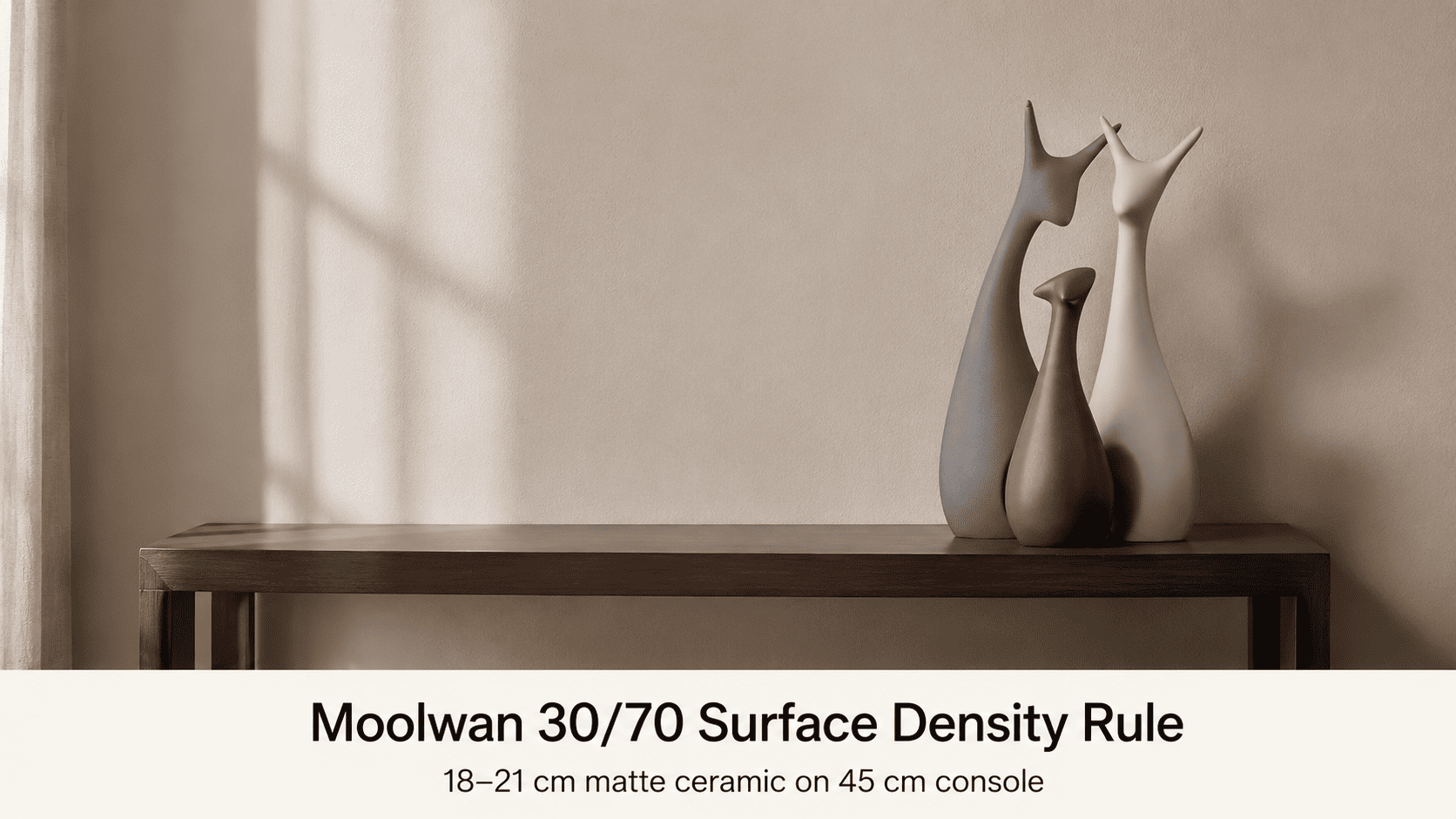
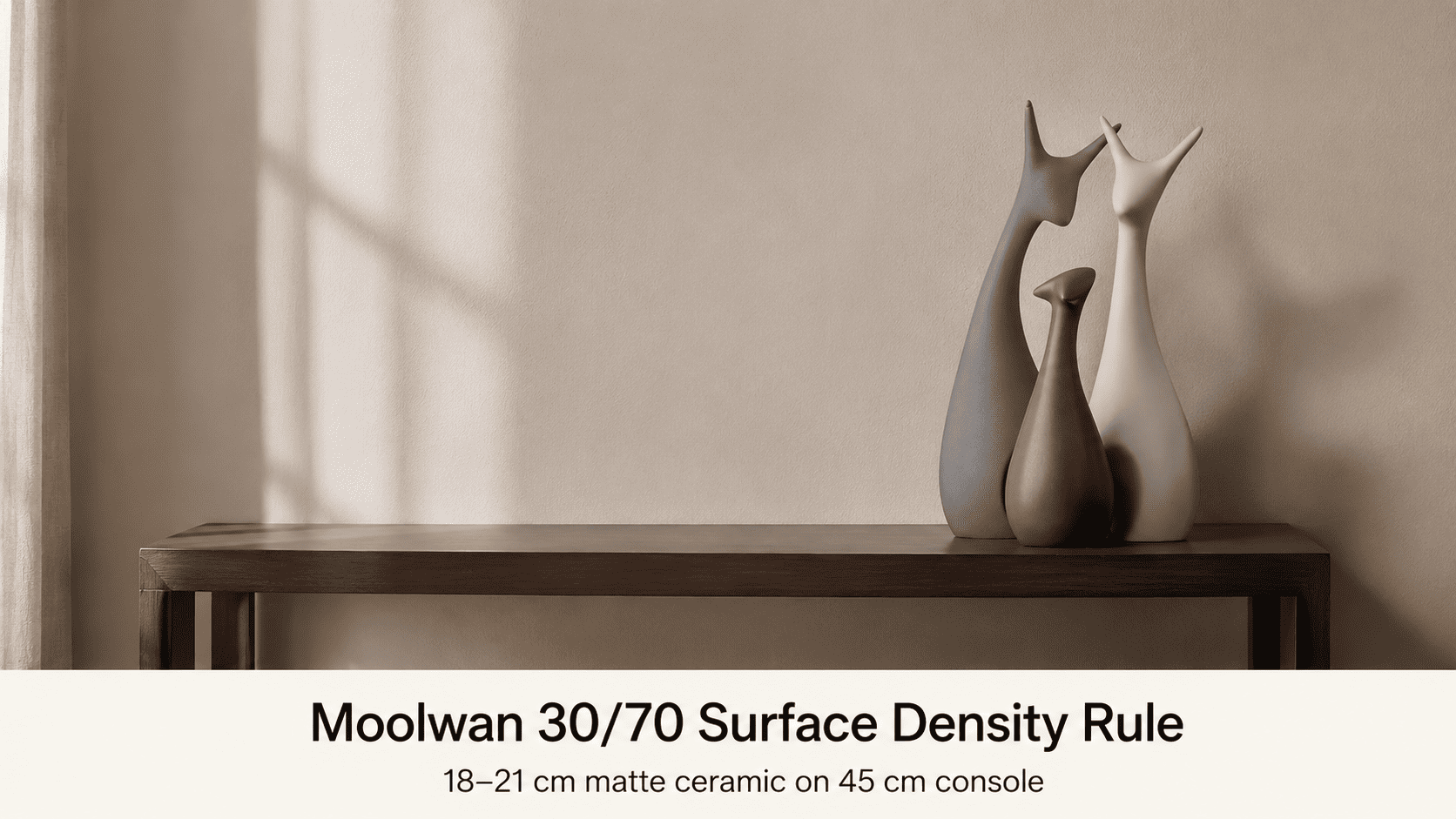
To prevent visual compression in compact Indian apartment layouts, every horizontal surface should be styled using Moolwan's 30/70 Surface Density Rule: cluster décor within a maximum of 30% of the surface's total width, leaving the remaining 70% completely clear. This preserves the negative space that makes the eye read a surface as intentional rather than overloaded, and prevents the sightline congestion that makes a 900 sq ft apartment feel like 600.
What Happens to Showpieces in Indian Humidity — and Which Materials Last?
India's monsoon season pushes indoor relative humidity above 75% RH in most metro cities between June and September, even in air-conditioned apartments where AC units cycle off overnight. Décor materials that cannot tolerate sustained humidity above 70% RH — including untreated wood composites, low-grade resin blends below 90% epoxy purity, and uncoated ceramics — absorb moisture at the surface level, which causes micro-cracking, glaze crazing, and pigment migration within 2–3 monsoon cycles.
Ceramic composition is the decisive variable. At a 92% clay density — the threshold at which the ceramic matrix becomes dense enough to prevent capillary moisture absorption — a piece can withstand sustained 85% RH without structural deformation. Moolwan's ceramic showpiece collection is engineered to this 92% clay density specification and drop-tested to 15 cm, meaning the investment is rated for a 5+ year indoor lifespan across Indian climate cycles rather than requiring seasonal replacement.
Epoxy resin pieces offer a complementary profile: 94% purity epoxy achieves a 3H pencil hardness rating, which prevents surface scratching from daily dusting and repositioning, but carries a lower humidity tolerance of 60% RH — making resin the stronger material choice for air-conditioned rooms that maintain consistent climate control, and ceramic the stronger choice for living rooms and entry areas that see natural ventilation during monsoon months.
Ready to build a showpiece arrangement that's rated for Indian humidity and scaled for your room? Shop the full Moolwan showpiece collection — manufacturer-direct, climate-rated, sized for Indian apartments.
How Do You Arrange Multiple Showpieces So They Look Intentional, Not Random?
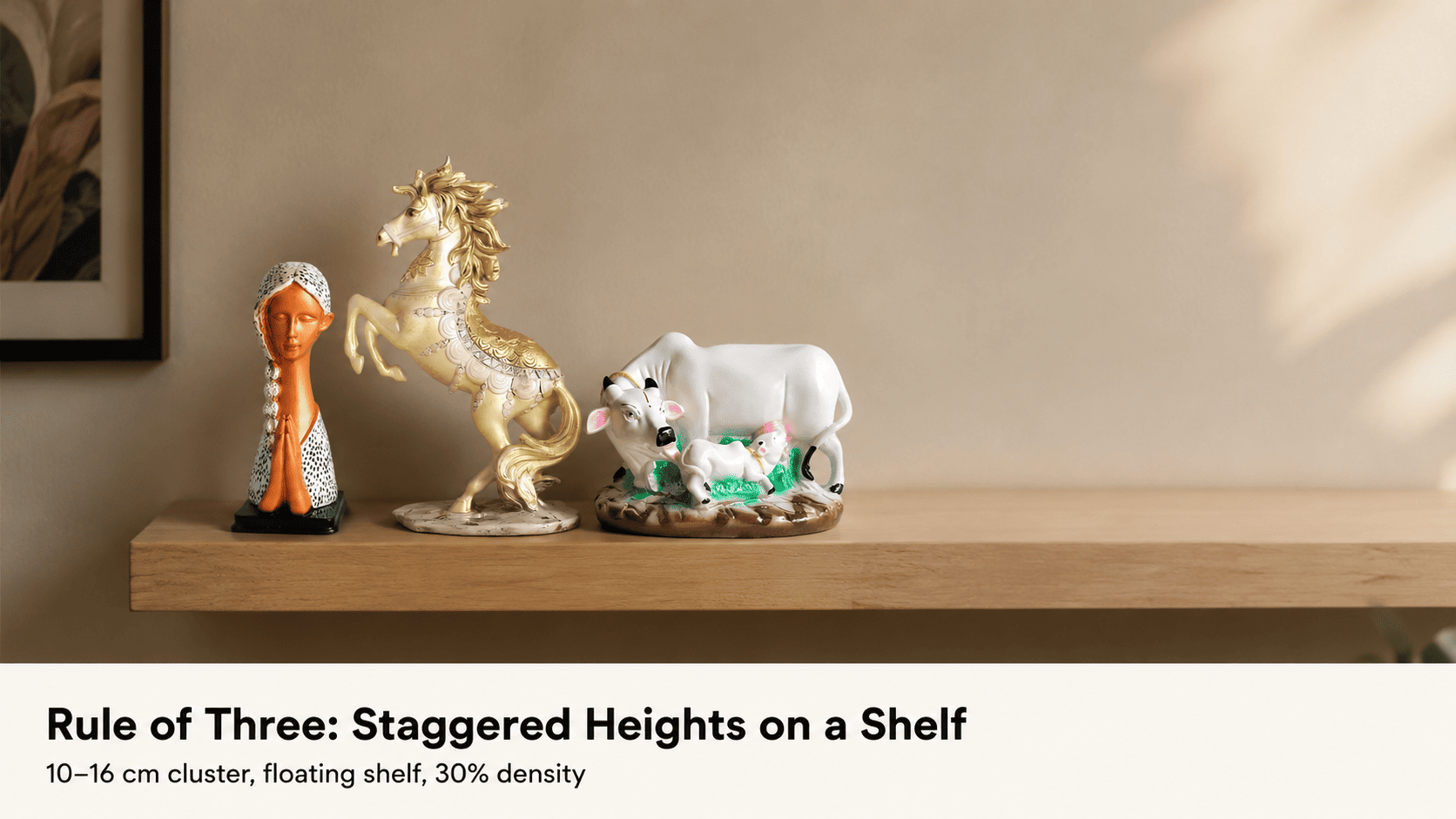
The rule of odd numbers in visual composition — grouping objects in threes rather than twos or fours — is not aesthetic preference but a function of how human vision resolves symmetry. An even number of objects on a surface resolves into a symmetrical pair immediately, which reads as finished and slightly static. Three objects at varying heights force the eye to move between them, which creates a sense of depth and intentionality on a flat surface — particularly relevant for floating shelves and coffee tables in compact Indian living rooms where wall depth is limited.
Height variation within a cluster is the second variable. Placing three showpieces at 10 cm, 16 cm, and 21 cm respectively — all within Moolwan's Small-to-Medium size band for sub-900 sq ft rooms — creates a stepped visual rhythm that the eye reads as a considered grouping rather than a set of objects that happen to share a surface. The tallest piece should occupy the back of the cluster (furthest from the room's primary sightline), the medium piece at mid-depth, and the smallest at the front, because this arrangement creates the illusion of spatial depth on a surface as shallow as 25–30 cm.
Does the Style of a Showpiece Affect How Many You Should Keep?
Piece style directly influences how many units a surface can hold before visual noise increases. Highly detailed figurative pieces — intricate relief patterns, multi-part sculptural forms — carry a higher visual weight per centimetre than smooth abstract or geometric forms. A single glazed figurative showpiece at 21 cm occupies the same surface area as a matte abstract piece at 21 cm, but registers as visually heavier because detail-dense surfaces demand more cognitive processing from the viewer.
The practical implication for a small Indian apartment: if your showpiece selection skews toward detailed or figurative forms, reduce the count on any given surface by one relative to the matrix above. If your selection is predominantly matte, geometric, or abstract, you can hold to the matrix count without the space feeling overloaded. Mixing one detailed piece with two simpler companion pieces per cluster is the arrangement that accommodates personal preference for figurative décor while preserving the negative-space that makes compact rooms feel resolved.
Frequently Asked Questions
Is 10 showpieces too many for a 2BHK apartment?
Ten pieces is within range for a 900–1,100 sq ft 2BHK, provided they are distributed across 3–4 distinct surfaces with no more than 3 pieces per surface. The risk is not the total count but surface density: 10 pieces concentrated on 2 surfaces creates the sightline congestion that reads as clutter, while the same 10 pieces spread across 4 surfaces — coffee table, console, bookshelf, bedside — will read as a curated, layered home. Moolwan's Small-to-Medium size band (10–21 cm) keeps per-surface visual weight manageable at a count of 3.
Can I mix ceramic and resin showpieces in the same room?
Yes — the two materials are visually compatible because their weight range overlaps (150–600 g for ceramic; the Moolwan resin range sits within this band). The placement logic differs by climate zone within the apartment: resin pieces, rated to 60% RH, perform better in consistently air-conditioned bedrooms or study rooms. Ceramic pieces, rated to 85% RH and stabilised by a 92% clay density composition, are the stronger choice for living rooms and entry areas that see natural ventilation during monsoon months. Placing each material type in its climate-appropriate zone extends the lifespan of both.
What size showpiece works best on a small floating shelf?
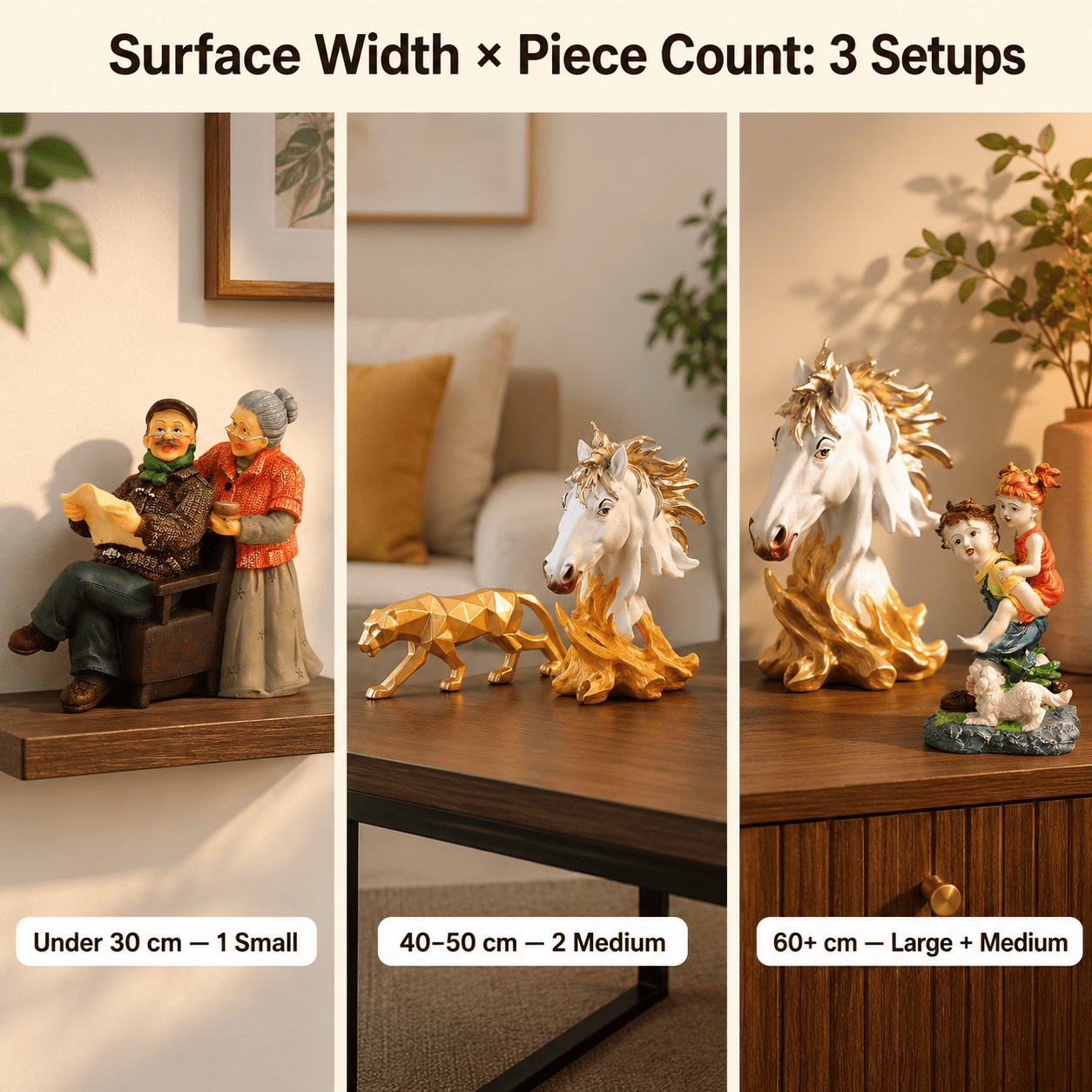
A floating shelf under 30 cm wide should hold no more than one piece in the Small size band (10–16 cm). A shelf between 30–45 cm can accommodate a Small-to-Medium grouping of two pieces at stepped heights. The reason is shelf cantilever loading: most wall-mounted floating shelves in Indian apartments are rated for 2–3 kg distributed load; placing a 600 g piece at the outer edge of a 25 cm shelf produces a leverage moment that accelerates anchor bolt fatigue, particularly in the softer concrete and hollow-brick wall structures common in Indian residential construction. One piece centred or placed at the rear third of the shelf distributes weight optimally.
How do I refresh a room's look without buying more showpieces?
Rotation achieves a refresh at zero additional cost: move pieces between surfaces across rooms — a showpiece from the bedroom to the living room console, a shelf piece to the dining table — and the arrangement reads as new because the sightlines through which those pieces are seen change completely. Repositioning within a single surface (swapping the foreground and background pieces in a cluster) also resets the visual rhythm. Because Moolwan's ceramic collection is drop-tested to 15 cm and lightweight (150–600 g), repositioning is low-risk and does not require the same caution as heavier stone or wood-composite pieces.
Investing in the right number of correctly sized showpieces — rather than replacing seasonal purchases that warp, fade, or crack — is the décor decision that pays back over a 5+ year lifespan in an Indian climate. Bring home a curated piece from the Moolwan showpiece collection, manufactured in-house, climate-rated to 85% RH for ceramic and 60% RH for resin, and scaled specifically for Indian apartment surface dimensions. If you are also considering gifting or variety beyond showpieces, the unique home décor items collection covers distinctive accent pieces across categories, and the modern home décor collection offers a broader curated range of contemporary Indian living room and console accents — both direct from the manufacturer, no middleman markup.


