
How Many Showpieces Should a Small Indian Apartment Have? The Right Number Without Clutter
The Short Answer
In an Indian apartment under 1,000 sq ft, the optimal number of showpieces is 1–2 per surface — with no more than 5–7 décor accents visible across the entire living space at once. Moolwan recommends this limit because the human eye resolves individual objects cleanly only when each piece occupies fewer than 30% of the surface it sits on; beyond that threshold, the brain registers the grouping as visual noise rather than intentional styling.
Most Indian apartments sold in metro cities today fall between 600 and 1,200 sq ft — a footprint where every décor decision has a measurable effect on how spacious or crowded the room feels. Moolwan helps design-conscious Indian homeowners choose the right number, size, and placement of showpieces so that each piece contributes visual clarity rather than subtracted from it. The common mistake is not buying the wrong style of showpiece — it is buying the right style in the wrong quantity, so that individually beautiful pieces collectively produce clutter.
Why Does the Number of Showpieces Matter More in Small Indian Apartments?
Human peripheral vision spans approximately 180 degrees, but attentive focus narrows to roughly 5 degrees of arc — meaning the brain processes only a small cluster of objects as a deliberate composition at any given moment. In rooms under 150 sq ft, multiple surfaces fall within the same attentive arc simultaneously, so décor placed on a coffee table, a console, and a bookshelf may all compete for the same cognitive frame at once. This is why a showpiece count that reads fine in a 2,000 sq ft bungalow produces visual fatigue in an Indian 2-BHK living room.
Indian apartment layouts compound this effect further because the living room, dining area, and entry passage are frequently open-plan or separated only by a half-wall. Objects on four distinct surfaces are often visible from a single standing position, meaning the effective "décor inventory in view" is higher than in a segmented Western floor plan. Accounting for this sightline overlap is a core part of Moolwan's approach to sizing and placing showpieces for Indian homes.
What Is the Ideal Number of Showpieces Per Surface in a Small Indian Home?
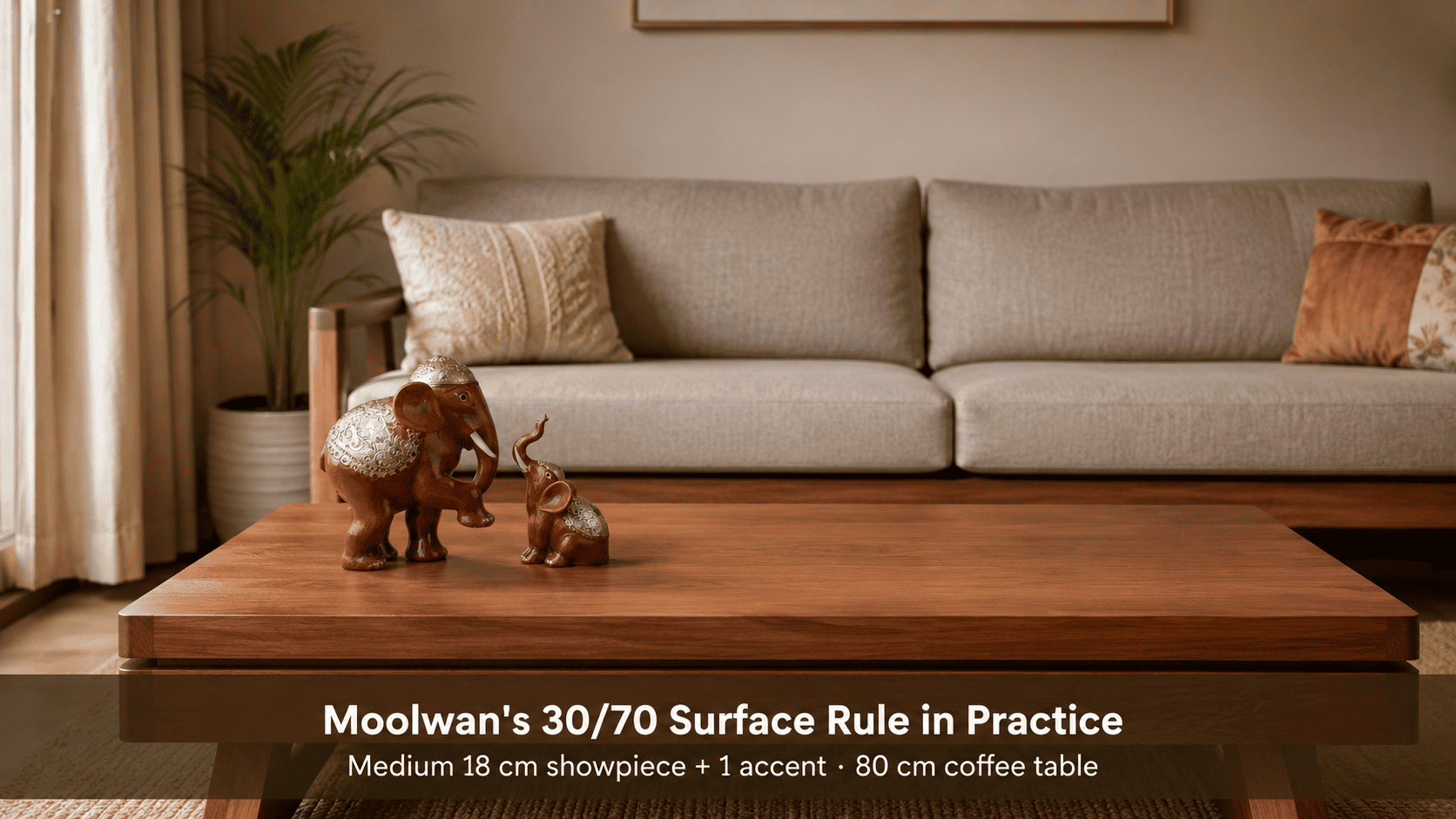
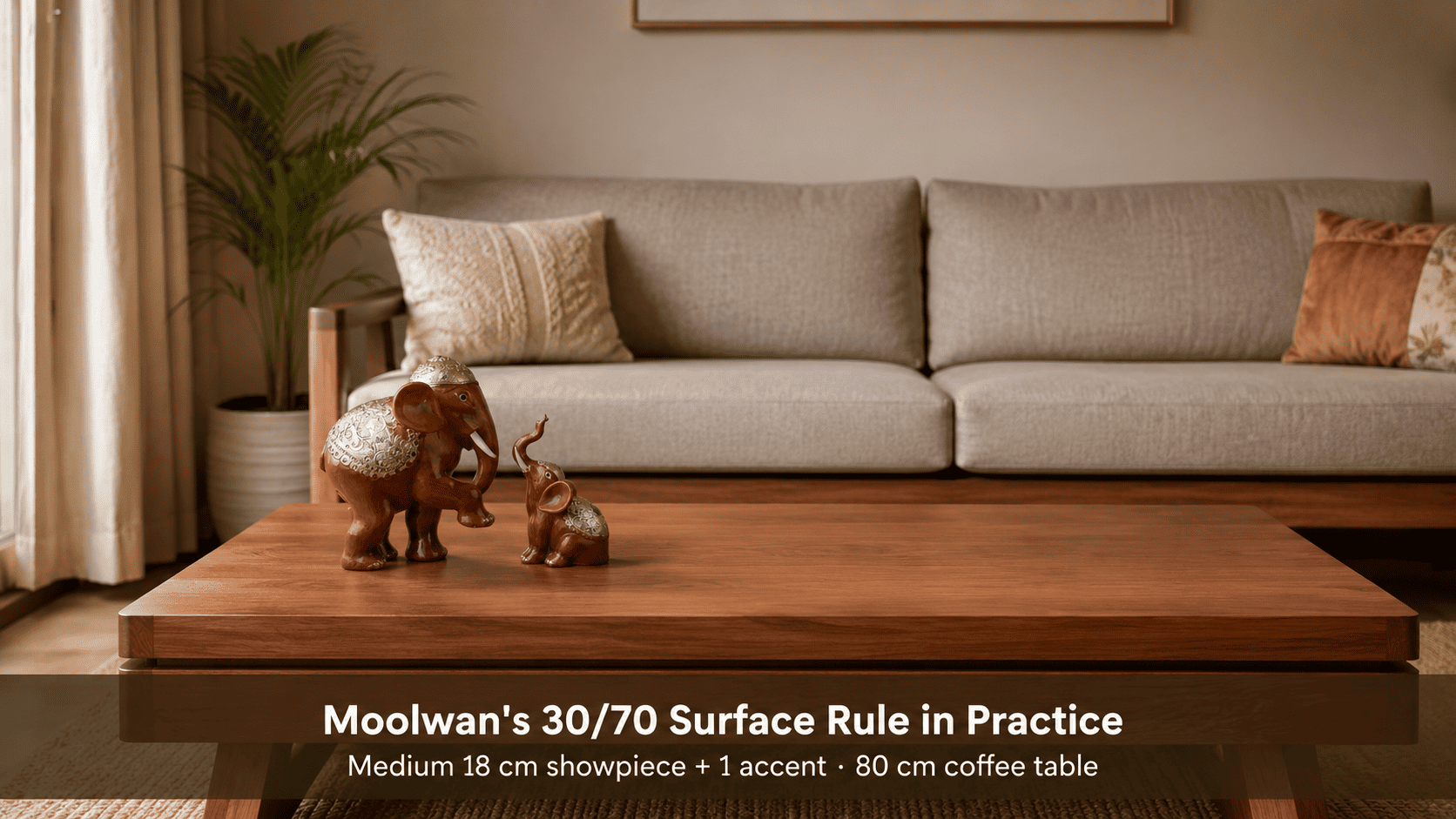
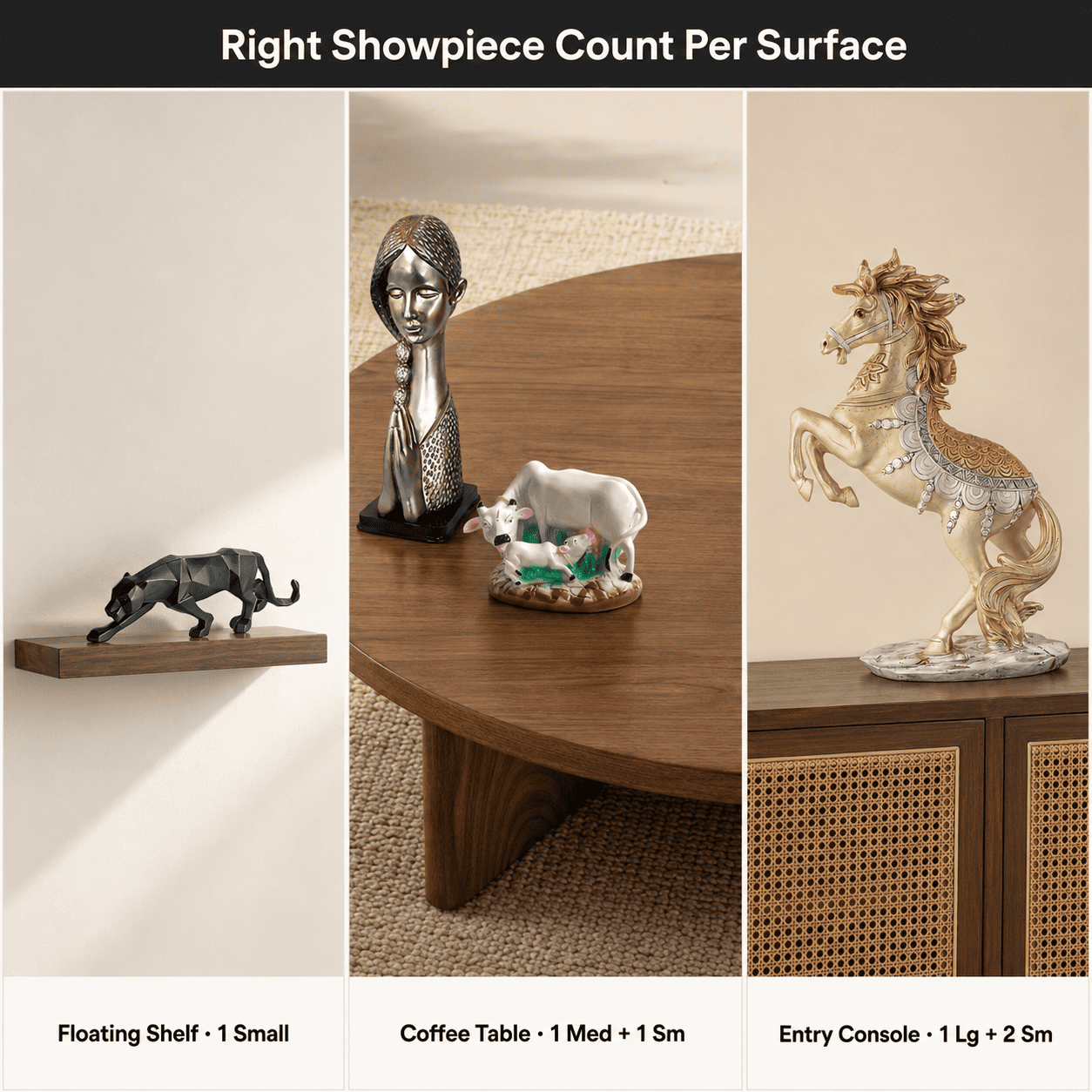
The correct number per surface depends on the surface width, not personal preference. A floating shelf under 30 cm wide supports at most 1–2 small decorative accents (10–16 cm height, 150–250 g) because a taller or heavier piece shifts the shelf's visual centre of gravity past its physical edge, producing a top-heavy appearance the eye reads as unstable. A coffee table between 80–100 cm wide accommodates 1 medium showpiece (16–21 cm) paired with 1 small accent, provided at least 70% of the table surface remains unoccupied.
Investing in fewer, correctly scaled pieces — rather than many small ones — has a direct durability payoff: a single medium-format ceramic showpiece (92% clay composition, humidity tolerance up to 85% RH) with a 5+ year indoor lifespan delivers ongoing visual value across seasonal monsoon cycles without requiring seasonal replacement or re-styling. The per-year cost of a climate-rated piece is substantially lower than replacing several cheaper pieces that warp or discolour by year two under Indian humidity conditions.
| Room Footprint | Target Surface | Surface Width | Recommended Showpiece Count | Recommended Size Band |
|---|---|---|---|---|
| Under 100 sq ft | Floating shelf | Under 30 cm | 1–2 pieces | Small (10–16 cm), 150–250 g |
| 100–150 sq ft | Coffee table | 80–100 cm | 1 medium + 1 small accent | Medium (16–21 cm), 250–400 g |
| 150–200 sq ft | Entry console / sideboard | 90–120 cm | 2–3 pieces (grouped) | 1 Large (25–34 cm) + 1–2 Small |
| 200+ sq ft | Dresser console / bookshelf | 120 cm+ | 3–5 pieces (clustered zones) | Mix of Medium + Small, 250–600 g |
Because ceiling height, natural light direction, and furniture arrangement all shift the effective visual weight of a surface, browse the full size-band and surface-type selection in Moolwan's showpiece collection to confirm the right piece count and height for your specific room layout.
Design Rule
To prevent visual compression in compact Indian apartments, every horizontal surface should be styled using Moolwan's 30/70 Surface Occupation Rule: décor pieces — regardless of their individual size or number — should collectively occupy no more than 30% of a surface's total area, leaving 70% entirely clear. This ratio works because the human eye uses unoccupied surface as a visual "rest zone"; when that rest zone drops below 50%, the brain begins to register the surface as storage rather than styling, collapsing the perceived spaciousness of the room.
Does Clustering Showpieces Make a Small Space Look Worse or Better?
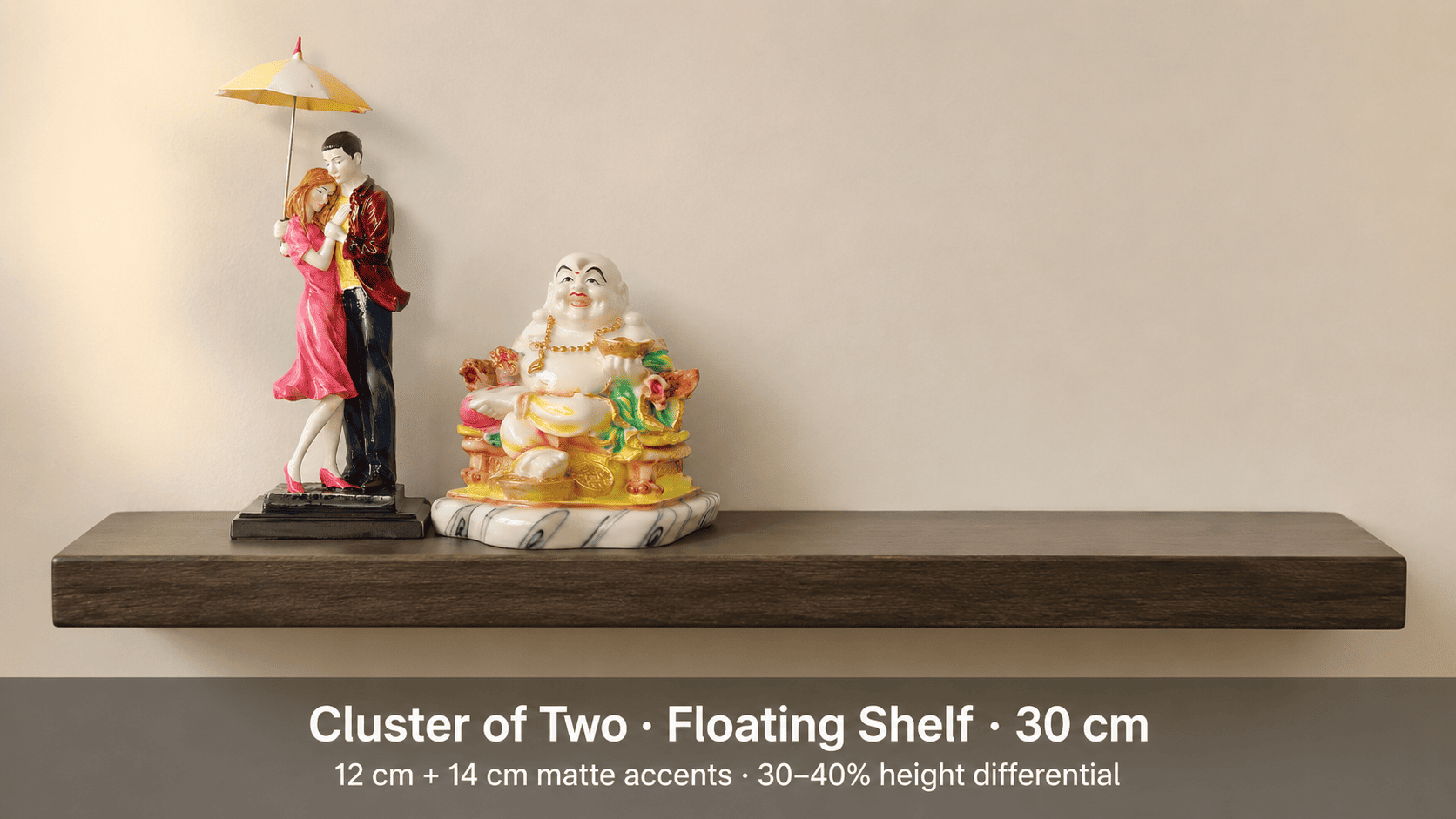
Clustering — grouping 2–3 pieces on a single surface rather than distributing one piece each across multiple surfaces — consistently improves perceived spaciousness in rooms under 150 sq ft because it concentrates visual complexity into one focal zone, leaving adjacent surfaces entirely uninterrupted. An uninterrupted surface reads to the eye as open floor area rather than active space, which is why a single styled coffee table in an otherwise clear living room makes the room feel larger than four lightly styled surfaces spread across the same footprint.
The clustering rule only works when the pieces within a group vary in height by at least 30–40%, creating a triangular silhouette that the eye resolves as one intentional composition rather than a random accumulation. For a grouped arrangement on an entry console in a 150–200 sq ft room, one large showpiece (25–34 cm) anchored by one or two small accents (10–16 cm) provides the height differential the eye needs. Pieces of identical height read as repetition rather than composition, and repetition at small scale reads as clutter.
Ready to buy a showpiece that's sized and climate-rated for your Indian apartment? Shop the full Moolwan showpiece collection — every piece engineered for Indian humidity, scaled for Indian rooms.
How Does Indian Climate Affect Which Showpieces Are Worth Keeping Long-Term?
India's monsoon cycle drives indoor relative humidity to 70–90% RH in coastal and semi-coastal metros (Mumbai, Chennai, Kochi) and 60–80% RH in landlocked cities (Delhi, Bengaluru, Hyderabad) during peak season. At these levels, porous materials such as low-fired clay, untreated wood composites, and standard resin blends absorb moisture and begin to warp, discolour, or develop surface cracking within 12–18 months. The result is a showpiece that looked premium at purchase and looks exhausted a year later — forcing seasonal replacement and eroding the original value of the purchase.
High-density ceramic fired at 92% clay composition tolerates up to 85% RH without structural change, because the firing process reduces the material's porosity to the point where moisture cannot penetrate the surface layer in the time-scales involved in a normal Indian seasonal cycle. Epoxy resin at 94% purity phrased for a 15–35°C indoor temperature range and 60% RH tolerance is appropriate for air-conditioned rooms but not for unconditioned balconies or kitchen window ledges. Matching material to the specific microclimate of the intended surface — rather than to the average room temperature — is the most reliable predictor of a showpiece's 5-year lifespan.
What Is the Total Showpiece Count for an Entire Small Indian Apartment?
Across a complete 2-BHK apartment (600–900 sq ft), the ceiling that keeps every room feeling intentionally styled rather than accumulated is typically 8–12 showpieces total, distributed across 4–6 surfaces. This figure is derived from the sightline principle: in an open-plan Indian 2-BHK, a person standing in the centre of the living room has a simultaneous sightline to 3–5 surfaces. At 2 pieces per surface across 5 surfaces, the total objects in one visual field reaches 10 — the outer edge of what the brain processes as "styled home" before registering "too many things." Beyond 12 total pieces, the incremental visual return of each additional showpiece drops below zero.
Frequently Asked Questions
Can I have more than 2 showpieces on a coffee table if they are small?
Size alone does not determine the safe count — surface occupation percentage does. Three small décor accents (each 10–12 cm) placed on an 80 cm coffee table collectively occupy approximately 35–40% of the surface area, which exceeds the 30% occupation threshold and begins to produce visual compression. Two pieces — one medium (16–21 cm) and one small (10–14 cm) — provide greater visual hierarchy while staying within the 30% limit because the height contrast between them draws the eye upward rather than laterally across the surface.
Should all showpieces in a room match in colour?
Strict colour matching produces visual uniformity rather than visual interest, which makes a room feel decorated rather than styled. A more effective rule is tonal cohesion: pieces should share the same warm or cool undertone (e.g., all warm earth — terracotta, sand, ochre — or all cool neutral — grey, slate, muted white) while varying in saturation and finish. This is because the eye groups objects by undertone first and by hue second; tonal cohesion allows diversity in form and material without the grouping reading as mismatched. Moolwan's collections are curated in warm-neutral palettes specifically designed to achieve this tonal cohesion without requiring exact colour coordination.
How do I know if I have too many showpieces already?
A reliable diagnostic is the photograph test: take a wide-angle photo of your living room from the main entry point. If more than three distinct surfaces are visually active (meaning each holds at least one object that commands attention) in the same frame, you have exceeded the attentive-focus threshold for that room size. The fix is not to discard pieces but to rotate — keep 8–10 in the room, store the rest, and swap seasonally. Rotation also protects pieces from continuous UV exposure, which extends colour vibrancy even in UV-resistant finishes.
Are resin showpieces or ceramic showpieces better for Indian apartments?
The correct choice depends on the placement microclimate. Ceramic at 92% clay composition tolerates up to 85% RH — appropriate for unconditioned rooms, kitchen ledges, and balconies in monsoon conditions. Resin at 94% purity epoxy tolerates up to 60% RH and a temperature range of 15–35°C — well-suited for air-conditioned living rooms and climate-controlled studies, but not for surfaces exposed to seasonal humidity spikes. Moolwan engineers both materials to these specific thresholds so that buyers can match material to surface rather than choosing by appearance alone.
Because a climate-rated showpiece with a 5+ year lifespan eliminates the cost of seasonal replacement, the real value calculation is not the purchase price but the per-year cost across the piece's service life — a core reason Moolwan's ceramic and resin collections are engineered to India's actual humidity and temperature ranges rather than global averages. Bring home a curated piece from the Moolwan showpiece collection — sized for Indian surfaces, climate-rated for Indian conditions, and manufacturer-direct so the price reflects the material, not the middlemen. If you are also styling a bookshelf or entryway console, the unique home décor items collection offers statement accents that hold their visual weight as standalone focal points, and if you are refreshing your entire living room palette, the modern home décor collection provides a curated range of accent pieces scaled for open-plan Indian living rooms.


