
How Many Showpieces Should You Keep on a Living Room Coffee Table?
The Short Answer
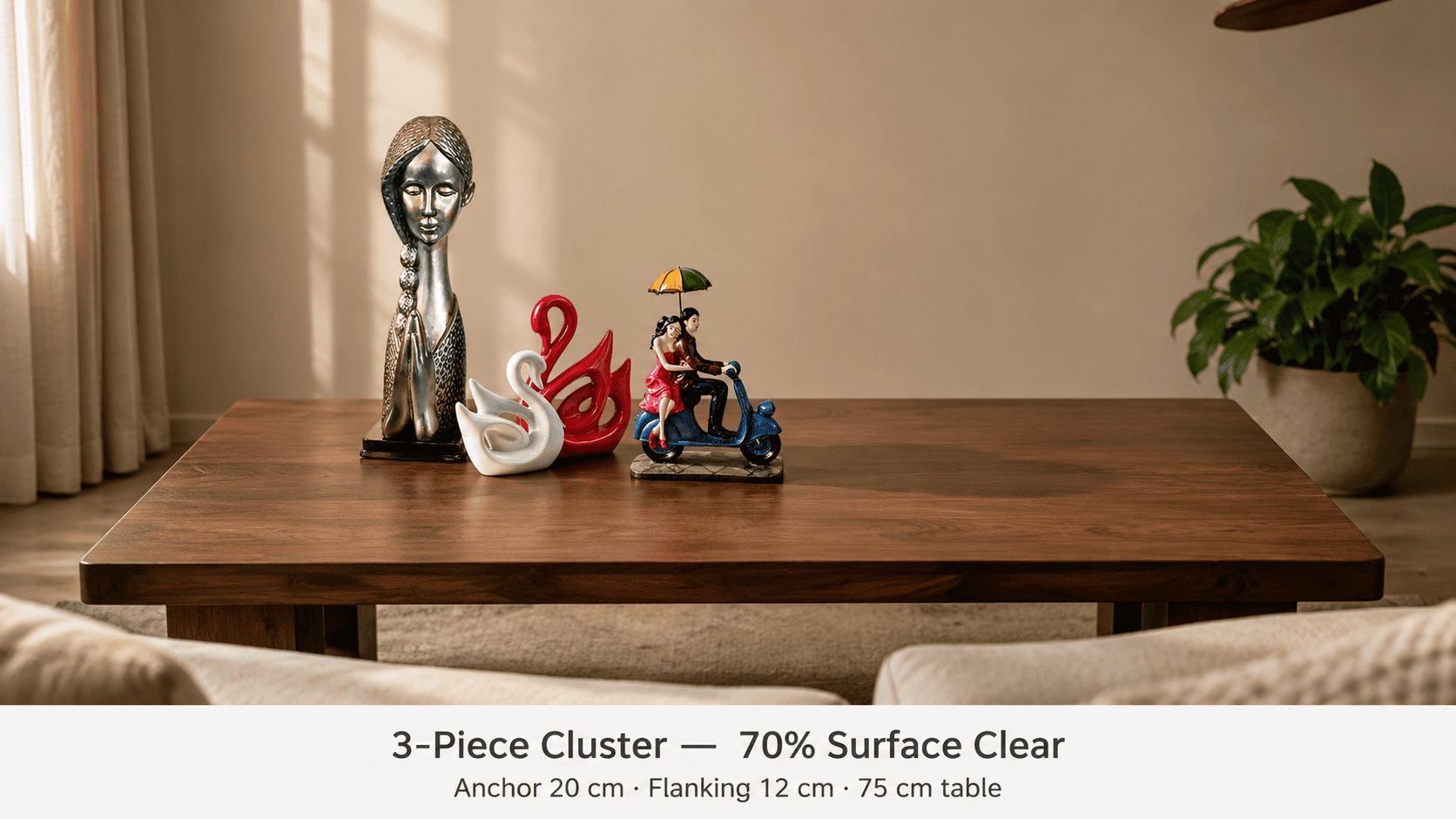
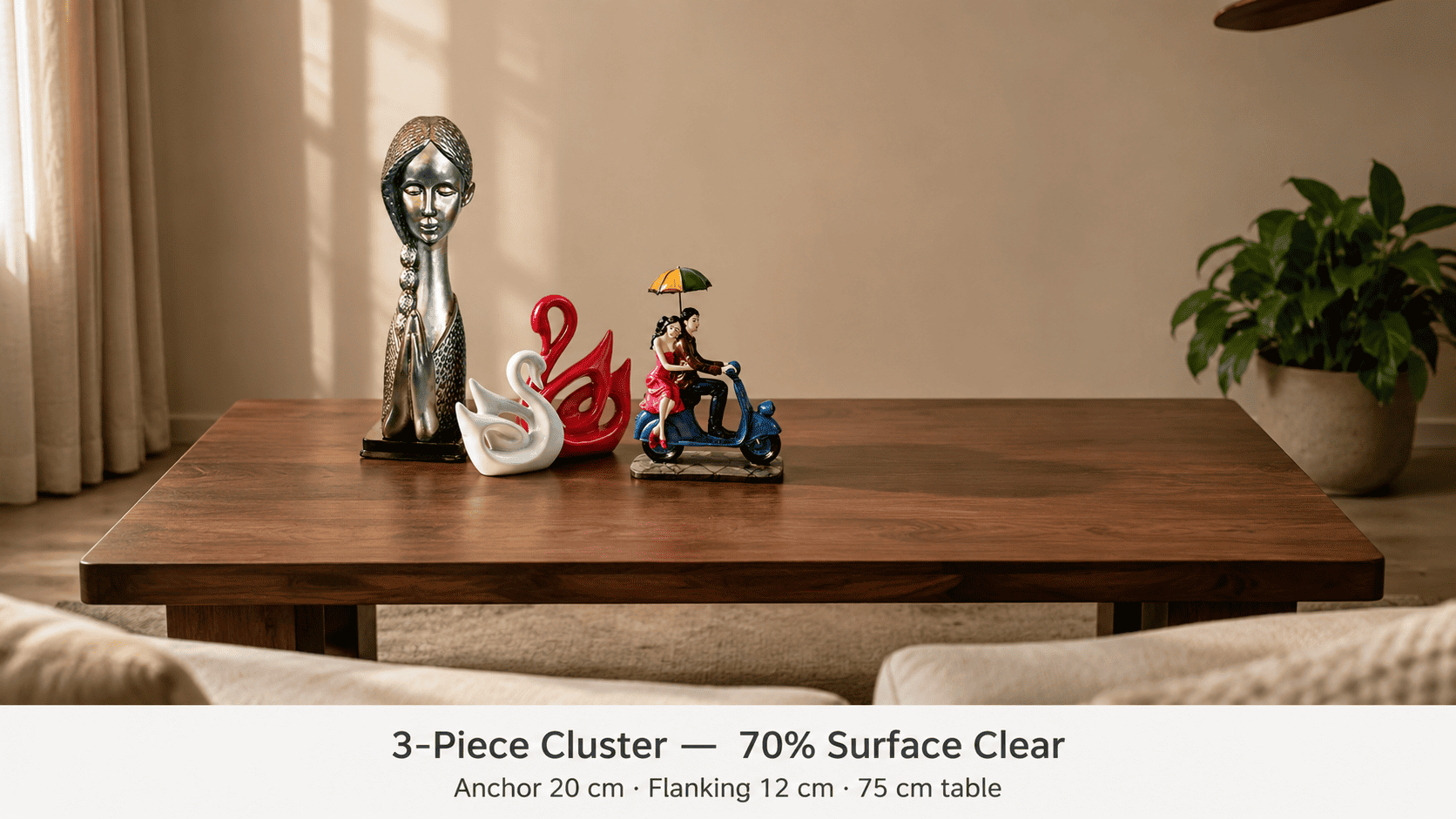
Keep 3 showpieces on a living room coffee table: one medium anchor piece (16–21 cm) and two small flanking pieces (10–16 cm). An odd number creates visual tension that the eye resolves as balanced, while keeping surface fill under 30% prevents the spatial compression that makes compact Indian living rooms feel cluttered. Moolwan's ceramic and resin showpieces are engineered to this exact size and weight range.
A standard Indian apartment coffee table measures 60–90 cm in width — a surface area that becomes visually chaotic at over 30% décor fill or visually barren with a single isolated piece. Moolwan helps design-conscious Indian homeowners choose the right number, size, and grouping of showpieces so that every coffee table surface feels intentional, not accidental. The answer is not a style preference; it is a function of surface geometry, visual weight, and the spatial compression physics of sub-150 sq ft Indian living rooms.
Why 3 Showpieces — and Not 2, 4, or 5?
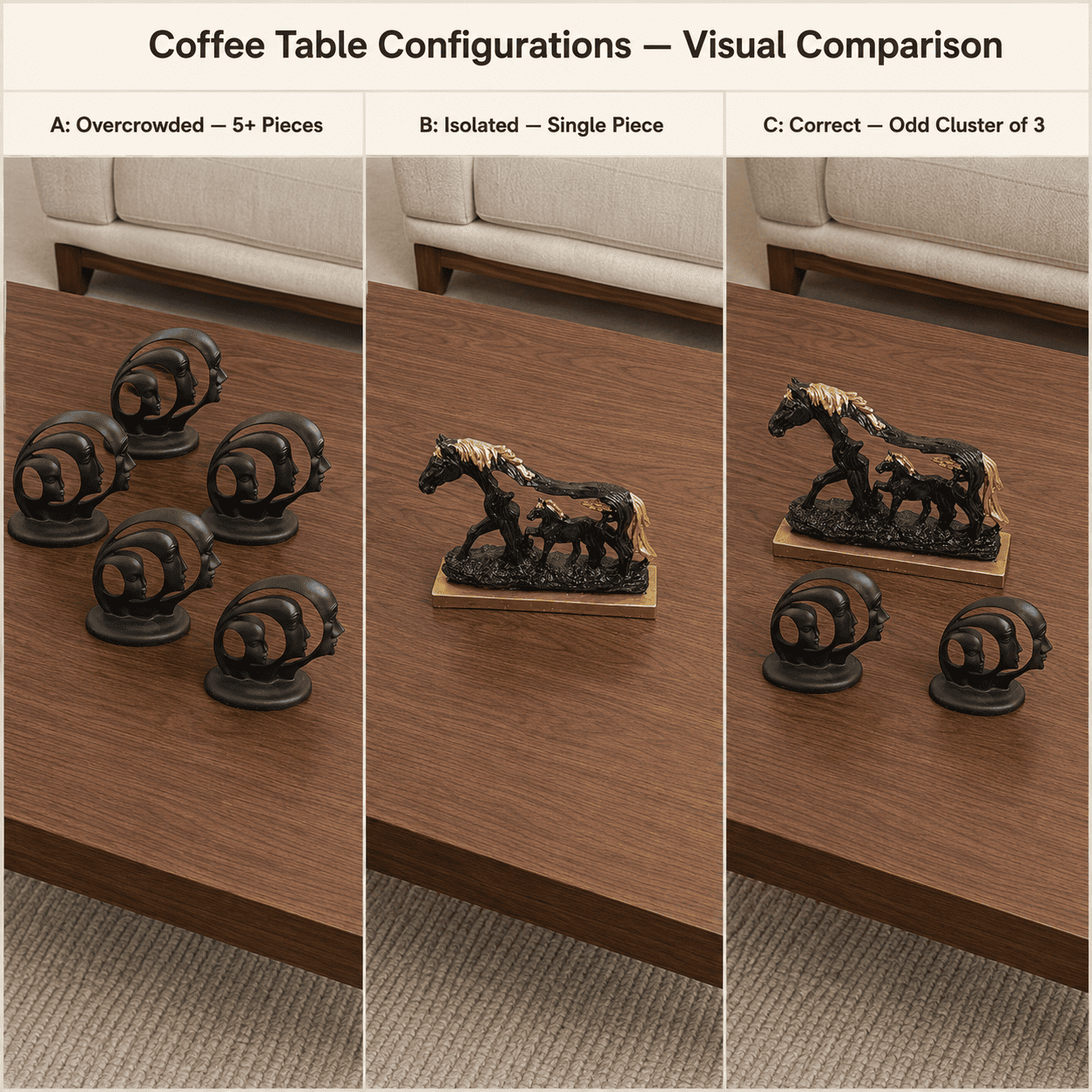
Three is the minimum odd number that creates a compositional triangle — a closed visual path the eye follows across the three pieces and back to the start, producing a sense of completeness without requiring more objects. Two pieces produce a symmetrical pairing that feels static and hotel-lobby formal, which conflicts with the relaxed informality of a lived-in Indian living room. Four or five pieces push total surface coverage beyond the 30% fill threshold on a 60 cm coffee table, which research in environmental psychology identifies as the tipping point where visual density triggers a perception of disorder rather than richness.
The physical constraint is equally clear: a standard 60 cm coffee table has a usable surface area of roughly 1,800 sq cm after accounting for a tray, remote, or book. Three showpieces with an average base footprint of 8–10 cm diameter collectively occupy approximately 180–230 sq cm — just under 13% fill — leaving space to function. Five pieces of the same size would occupy 22% fill and begin crowding the ergonomic working zone of the table.
What Size Showpieces Work on a Coffee Table?
A showpiece's height must not exceed approximately one-third of the distance between the tabletop and the eye level of a seated adult (roughly 60–65 cm in Indian seating norms), which sets a practical ceiling of 20–22 cm for the tallest piece on a standard-height coffee table. Pieces taller than this interrupt sightlines across the table and create an enclosing effect that makes the seating area feel smaller — a critical error in sub-150 sq ft Indian living rooms where sightline continuity is the primary spatial expansion tool.
Across Indian apartment living rooms, the most spatially neutral configuration pairs one medium piece (16–21 cm, 250–400 g) as the vertical anchor with two small pieces (10–16 cm, 150–250 g) set at varied distances from the anchor. The weight differential — heavier anchor, lighter flanking — distributes physical mass in a way that prevents the table from looking front-heavy when viewed from the sofa. Moolwan's modern home décor collection is engineered to this exact weight range: ceramic showpieces at 150–600 g and resin showpieces at the same band, both tested to 85% relative humidity tolerance to prevent warping or finish degradation through Indian monsoon cycles.
| Coffee Table Width | Recommended Piece Count | Anchor Piece Height | Flanking Piece Height | Max Weight Per Piece |
|---|---|---|---|---|
| Under 60 cm | 1–2 pieces (no grouping) | 10–16 cm (Small) | N/A — single or paired | 150–250 g |
| 60–75 cm | 3 pieces (odd cluster) | 16–21 cm (Medium) | 10–16 cm (Small) × 2 | 400 g anchor / 250 g flanking |
| 76–90 cm | 3 pieces (wider spacing) | 21–25 cm (Medium-Large) | 10–16 cm (Small) × 2 | 500 g anchor / 250 g flanking |
| 90 cm+ | 3–5 pieces (two clusters) | 25–34 cm (Large) as focal | 10–21 cm across two sub-clusters | 600 g anchor / 400 g flanking |
Because sofa depth, tray placement, and AC airflow direction introduce additional surface-constraint variables specific to each home, browse the full size-band and material selection in Moolwan's living room showpiece collection to verify your final piece selection against your actual coffee table dimensions.
Design Rule
To prevent visual compression on compact Indian coffee tables, surface arrangements should follow Moolwan's Odd-Cluster Surface Rule: keep décor fill to a maximum of 30% of total table surface area, always group in odd numbers of 3 or 5, and position the tallest piece no closer than 10 cm to the table's nearest edge — so the composition reads as deliberate from every seat in the room.
Matte vs Glazed Finish: Which Ages Better on a Coffee Table?
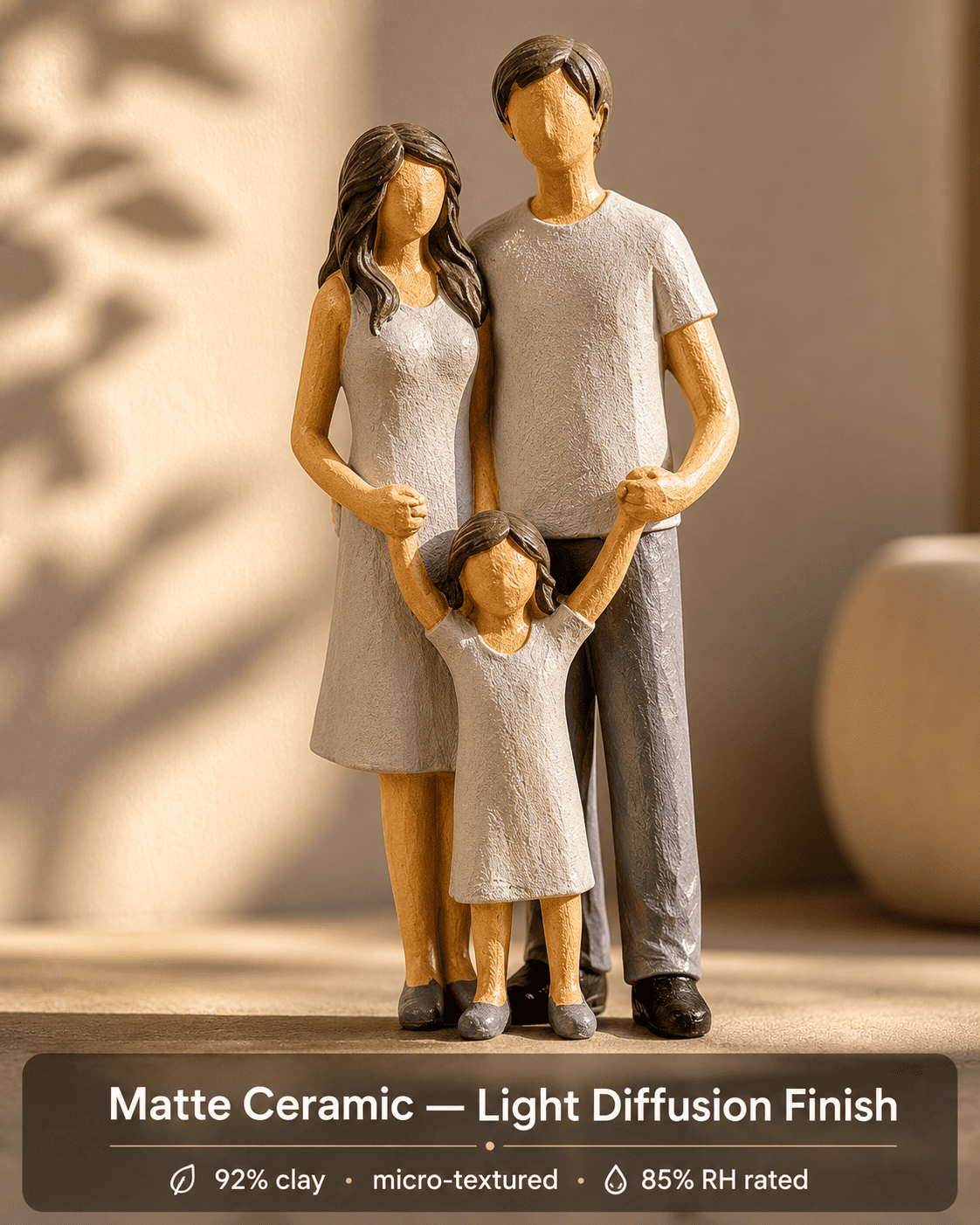
Coffee table surfaces in Indian homes accumulate micro-scratches from daily use — cups, remotes, magazines — at a rate that renders a glazed showpiece visually degraded within 18–24 months because glazed surfaces reflect ambient light uniformly and highlight every surface abrasion. Matte surfaces scatter incident light at multiple angles due to their micro-textured topography, rendering surface wear optically invisible to the naked eye at the same stage of use. This is not an aesthetic preference — it is a measurable difference in light-scattering geometry between a smooth reflective surface and a textured one with average roughness above 1.5 microns.
Indian living rooms with west-facing windows receive strong late-afternoon sunlight between 3–6 PM, which falls directly onto coffee table surfaces. A glazed showpiece in this light path creates a glare hotspot that draws the eye away from the composition as a whole, undermining the visual grouping effect of the odd-number cluster. Moolwan's matte ceramic showpieces use a high-density 92% clay composition fired to a micro-textured surface that eliminates this glare response while retaining colour saturation through UV-resistant kiln glazing applied below the surface layer — a finish engineered to hold at 5+ years without seasonal fading in Indian sunlight conditions.
Ready to bring the right number and size home? Shop the full Moolwan living room showpiece collection — climate-rated, manufacturer-direct, sized for Indian coffee tables.
Should You Use a Tray to Group Showpieces on a Coffee Table?
A tray visually consolidates the cluster into a single perceived object, which allows the brain to process the group as one unit of composition rather than three separate competing items. This matters in small living rooms because visual complexity is additive — each independent object on a surface is a separate processing demand. A tray containing three pieces reads as one statement, reducing the perceived object count from three to one and making the room feel quieter and more considered.
The tray's interior dimensions must accommodate the cluster with at least 3–4 cm of clearance on all sides from the tray's inner edge to the nearest piece base — tighter than this and the tray amplifies rather than reduces visual density because the pieces appear squeezed. For a medium anchor piece (16–21 cm) flanked by two small pieces (10–16 cm) in a triangular arrangement, a rectangular tray of 35–40 cm × 25 cm provides the correct containment geometry. Material consistency between the tray and the showpieces — ceramic-with-ceramic or resin-with-complementary-finish — reinforces the single-statement read because material contrast between tray and pieces re-introduces the separate-objects perception.
Does Showpiece Material Matter for Humidity in Indian Living Rooms?
Indian living rooms operate across a humidity range of 40–85% RH across seasons — air-conditioned interiors drop to 40–55% RH during summer months while the same room during monsoon can reach 75–85% RH without AC. This 30–45 percentage-point swing is a structural stress cycle for décor materials: porous or low-density materials absorb and release moisture, causing micro-expansion and contraction that cracks glazing, warps bases, and degrades adhesive joints over 2–3 years. The threshold for safe décor operation across this full seasonal range is a material density that prevents moisture ingress above 60% RH.
Moolwan's ceramic showpieces are manufactured to a 92% clay composition that achieves this threshold at 85% RH tolerance — the full upper limit of Indian monsoon interior conditions — because high-density clay fired at elevated temperatures closes the micro-pore structure of the material, blocking moisture absorption pathways. The resin showpieces in the same collection use 94% purity epoxy rated to 60% RH and 15–35°C, which covers the conditioned living room range. Choosing the ceramic option specifically for living rooms without consistent AC coverage adds a material durability margin that prevents the need for seasonal replacement — a measurable investment return over a 5+ year lifespan.
Frequently Asked Questions
Is it better to use an odd or even number of showpieces on a coffee table?
Odd numbers — specifically 3 — are more effective on coffee table surfaces because they prevent the bilateral symmetry that even-number groupings default to. Bilateral symmetry (2 or 4 pieces equidistant from centre) creates a static, formal composition that reads as decorative rather than lived-in. Three pieces allow an asymmetrical triangular arrangement where one piece serves as a visual anchor and the other two create depth by sitting at different distances from the anchor — a composition the eye moves through rather than simply registers.
How much of a coffee table surface should showpieces cover?
Décor fill should stay below 30% of total coffee table surface area. On a 60 cm × 90 cm coffee table (5,400 sq cm), that is approximately 1,620 sq cm of décor footprint — far more than three showpieces will occupy in practice. The 30% ceiling exists because human peripheral vision begins interpreting surfaces above this fill ratio as cluttered, triggering a low-level stress response that makes a room feel smaller than its actual dimensions. Keeping fill under 30% preserves sightline continuity across the table, which optically extends the perceived length of the room.
What height showpiece is right for a standard Indian coffee table?
For a standard Indian coffee table at 40–45 cm height, the tallest showpiece in the cluster should not exceed 20–22 cm — roughly one-third of the seated eye-level height of 60–65 cm. Exceeding this threshold interrupts cross-table sightlines when seated, which creates an enclosing effect that reduces perceived room volume. Moolwan's medium-format showpieces at 16–21 cm height are calibrated to this exact constraint, making them the correct size class for the anchor position in a three-piece coffee table cluster.
Can I keep showpieces on a coffee table in a humid city like Mumbai or Chennai?
Yes — provided the showpiece material is rated for the humidity range those cities produce during monsoon. Mumbai and Chennai interiors without consistent AC can reach 80–85% RH from June through September. Standard resin or low-fired ceramic pieces rated below 60% RH will show finish cracking or base warping within one to two monsoon cycles at this exposure level. Moolwan's ceramic collection is rated to 85% RH because its 92% clay composition closes the micro-pore structure that allows moisture ingress — making it the appropriate material choice for unconditioned or intermittently conditioned coastal living rooms.
A coffee table styled with the right number of climate-rated showpieces is a 5+ year investment in a room that feels finished — not one that requires seasonal replacement as finishes degrade. Buy the correct-size cluster for your coffee table dimensions from Moolwan's living room showpiece collection — manufacturer-direct, humidity-tested, sized for Indian homes. If you are styling with a specific colour direction, also consider Moolwan's black room accessories for modern living room styling as a tonal anchor option, or browse Moolwan's unique décor items that transform an elegant living room for statement pieces that move beyond the standard coffee table format.


