
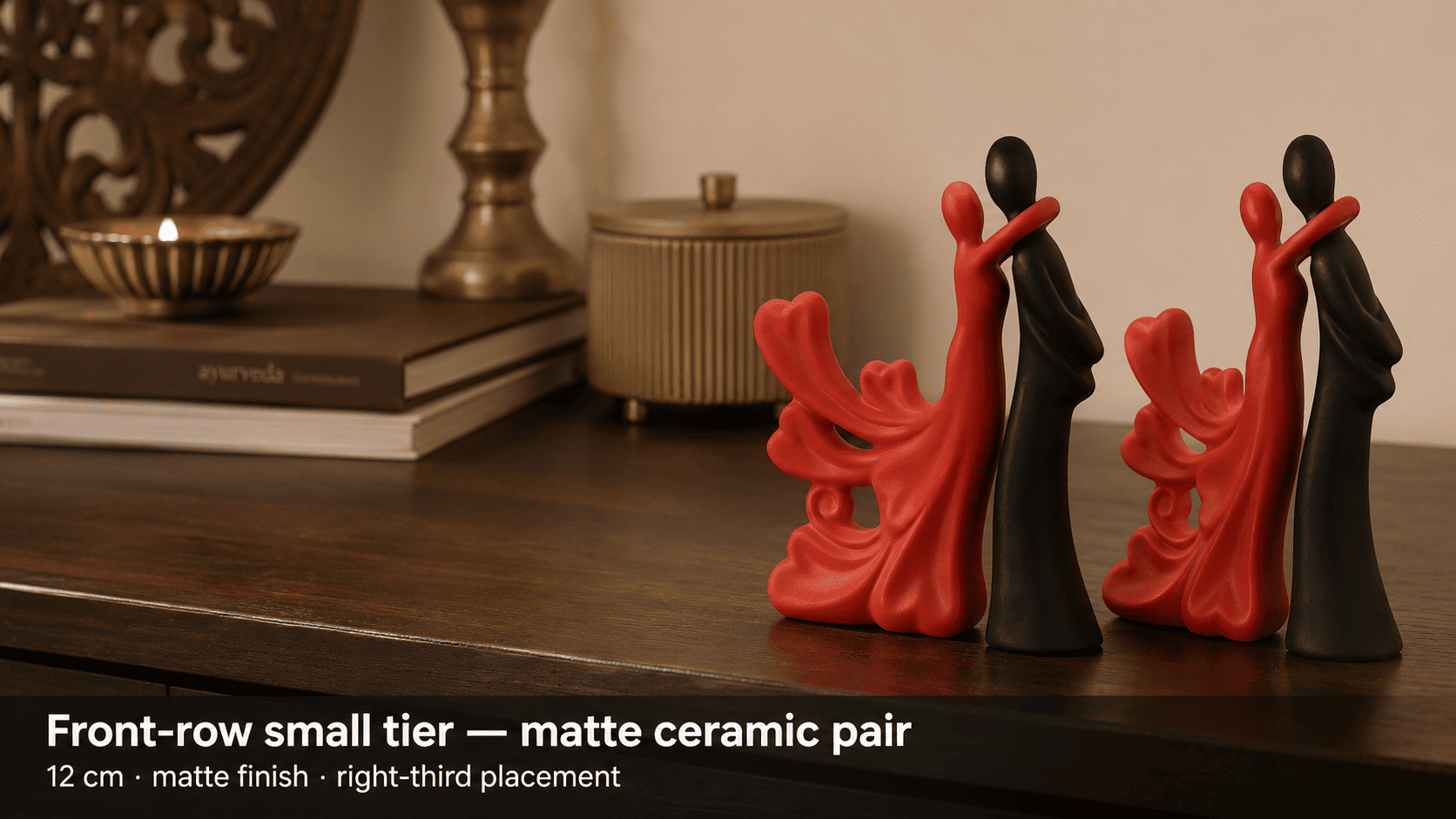
How Many Showpieces to Cluster on a Large Living Room Console Table
The Short Answer
On a console table 120 cm or wider, cluster 5–7 showpieces in an asymmetric triangle formation — one Large piece (25–34 cm) anchoring the rear, two Medium pieces (16–21 cm) at mid-height, and two to four Small pieces (10–16 cm) at the front. Moolwan's collection recommends odd-numbered groupings because symmetrical even counts create mirror tension that registers as static and unresolved to the human eye.
Visual weight perception is governed by the relationship between surface area, object height, and negative space — not by the number of objects alone. Moolwan helps design-conscious Indian homeowners translate these spatial principles into console table arrangements that feel curated and intentional, not cluttered or sparse. A console table in an Indian living room is rarely a passthrough surface; in apartments under 1,200 sq ft, it functions as the room's primary visual anchor, which means cluster composition directly affects how spacious and considered the entire room reads.
Why Odd-Numbered Clusters Look More Intentional Than Even-Numbered Ones
The human visual cortex resolves asymmetric compositions faster than symmetric ones because asymmetry introduces micro-variation that the eye reads as deliberate curation rather than mechanical repetition. A cluster of 6 identical-height showpieces triggers a "paired" pattern recognition response — the eye groups them into three pairs, each pair appearing redundant, and the overall arrangement reads as an uncurated collection rather than a considered display. Odd clusters — 3, 5, or 7 — resist automatic pairing, keeping the eye moving across the full arrangement and extending visual engagement with each individual piece.
This principle becomes functionally important on a console table because the surface typically spans 90–150 cm in Indian living rooms — long enough that even-numbered clusters tend to gravitate toward the centre, leaving both ends visually abandoned. An odd-numbered arrangement distributes naturally off-centre, activating the full surface width without requiring deliberate placement effort. Moolwan's modern home décor collection is sized specifically across three tiers — Small (10–16 cm), Medium (16–21 cm), and Large (25–34 cm) — so that odd-numbered clusters can be built with natural height differentiation built in.
How Console Table Width Determines the Right Cluster Count
Surface width is the primary constraint, not personal preference. A showpiece cluster requires a minimum of 8–10 cm of clear surface between each piece to prevent visual compression — when objects touch or overlap on a flat surface, the eye cannot resolve them as individual statements; they merge into a single undifferentiated mass. This 8–10 cm breathing gap is the key variable that determines maximum cluster count for any given console table width.
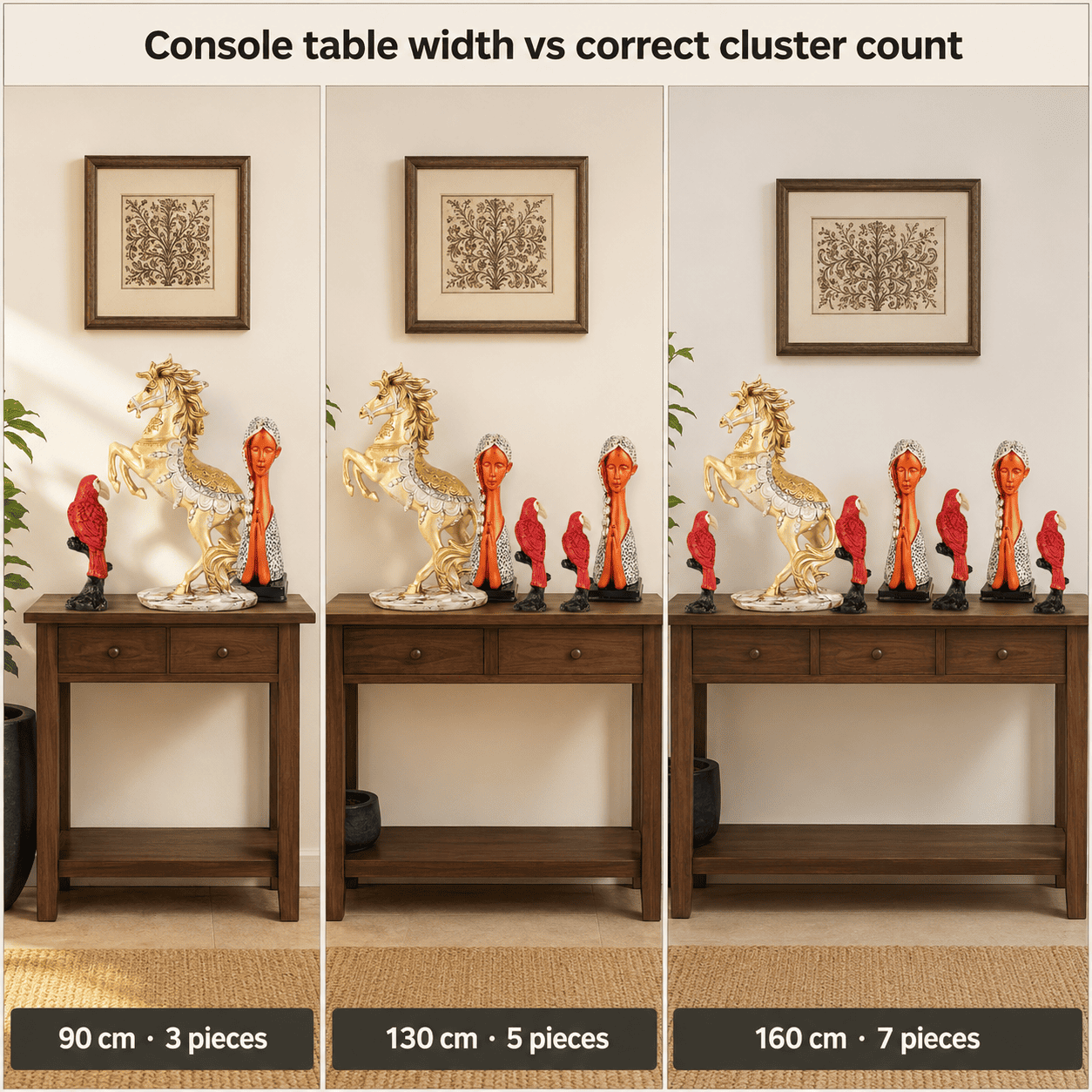
A 90 cm console table accommodates 3 showpieces comfortably: one Large anchor piece occupying approximately 12–16 cm of its footprint, two Small or Medium pieces flanking it at the 8–10 cm minimum gap. Attempting 5 pieces on a 90 cm surface compresses the gaps to 4–5 cm, which eliminates the negative space that gives each piece its individual visual weight. A 120–140 cm console table — the most common width in urban Indian living rooms — is the threshold at which a cluster of 5 becomes coherent. A 150 cm or wider console table, typically found in larger apartments or open-plan layouts, can support up to 7 pieces while retaining the visual breathing room that prevents overcrowding.
| Console Table Width | Recommended Cluster Count | Anchor Piece Height | Min. Gap Between Pieces | Surface Left Clear |
|---|---|---|---|---|
| Under 90 cm | 3 showpieces | 25–30 cm (Large) | 8–10 cm | ~40% of surface width |
| 90–110 cm | 3–5 showpieces | 28–34 cm (Large) | 8–10 cm | ~35% of surface width |
| 120–140 cm | 5 showpieces | 30–34 cm (Large) | 9–11 cm | ~30% of surface width |
| 150–170 cm | 5–7 showpieces | 30–34 cm (Large) | 10–12 cm | ~28–30% of surface width |
| 180 cm and above | 7 showpieces (max) | 34 cm (Large) | 10–14 cm | ~25% of surface width |
Because console table depth, wall colour contrast, and adjacent furniture scale introduce additional placement variables not captured in this width-based grid, browse the full size-band and material selection in Moolwan's living room showpiece collection to verify your final cluster composition before purchasing.
Design Rule
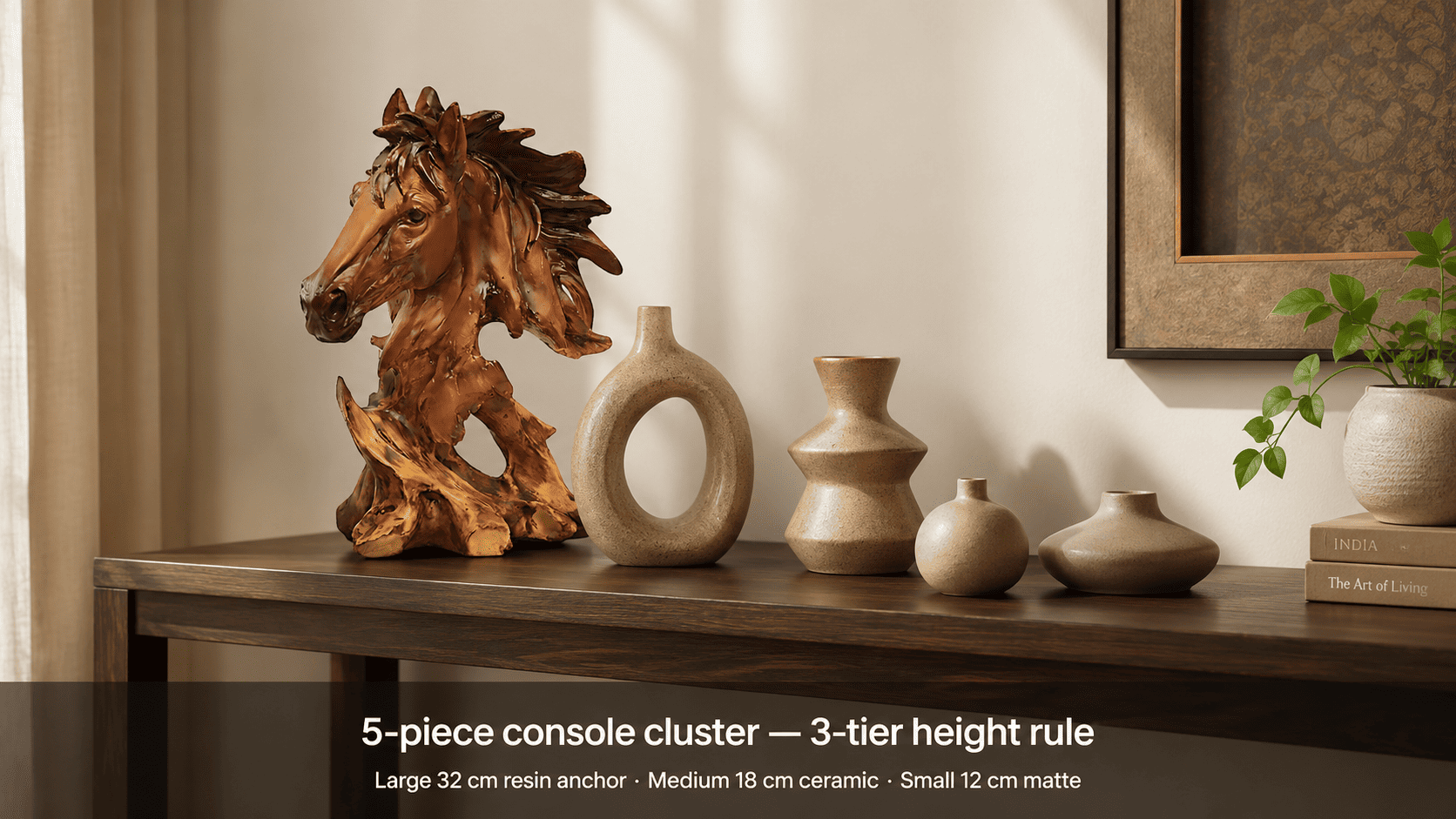
To prevent visual compression on any console table surface, Moolwan's 3-Tier Cluster Rule mandates building every grouping across three distinct height bands: one Large showpiece (25–34 cm) at the rear forming the apex, one or two Medium showpieces (16–21 cm) at mid-height flanking the anchor, and two to four Small showpieces (10–16 cm) at the front forming the base — creating a triangular silhouette that guides the eye upward and outward simultaneously, activating the full depth of the console surface rather than flattening it into a single visual plane.
How to Build Height Variation Inside a Cluster So It Doesn't Look Random
Height variation without a structural logic reads as random accumulation rather than curation. The triangular silhouette principle — tallest piece at the rear, progressively shorter pieces toward the front — works because it mirrors the natural depth cue the human eye uses to read three-dimensional space: objects closer to the viewer are lower in the visual field, objects further away are higher. Translating this depth cue onto a flat console table surface creates the perception of spatial depth even in a 2D arrangement, making the cluster feel larger and more considered than its physical footprint.
In practical terms, this means the Large anchor piece (25–34 cm) should sit toward the wall at the rear of the console, with Medium pieces (16–21 cm) positioned 8–10 cm in front of it, and Small pieces (10–16 cm) closest to the table's front edge. The weight distribution also matters: Moolwan's ceramic pieces in the medium range weigh 250–400 g, which means they provide enough physical stability to anchor the mid-tier without risk of toppling in Indian households with ceiling fans creating airflow across open surfaces. Resin pieces at 3H pencil hardness in the same size range provide identical stability at marginally lower weight, which is the better choice for console tables positioned near high-traffic zones where incidental contact is likely.
Ready to build your console table cluster with pieces engineered for Indian living rooms? Shop the full Moolwan living room showpiece collection — manufacturer-direct, climate-rated, sized across three tiers for intentional grouping.
Why Material Mix Matters in a Cluster — Ceramic vs Resin on the Same Surface
Clustering two or more pieces of the same material finish creates surface uniformity that reduces visual interest — the eye resolves a uniform-finish cluster as a single object rather than a composition of individual pieces. Mixing one matte ceramic piece with one glazed ceramic piece, or pairing a textured resin piece with a smooth ceramic piece, introduces finish contrast that gives each piece its own visual identity within the cluster. This finish contrast is the mechanism by which a cluster of five reads as five distinct statements rather than one undifferentiated group of five objects.
Climate tolerance is the practical filter for material choice in Indian living rooms. Moolwan's ceramic collection is rated to 85% relative humidity — the threshold required for unconditioned rooms during the Indian monsoon season (June–September), when indoor RH routinely reaches 75–80% in coastal metros and 65–70% in Bangalore. The resin collection is rated to 60% RH, making it better suited to air-conditioned living rooms where humidity is actively regulated. A mixed-material cluster that places resin pieces as the front-row Small tier and ceramic pieces as the rear Large anchor tier works with both climate profiles: the more humidity-sensitive resin pieces are positioned away from direct window airflow, while the higher-humidity-rated ceramic anchor holds the structural rear position.
How Wall Colour and Console Table Finish Affect How Many Pieces You Should Display
A high-contrast wall — deep charcoal, forest green, terracotta — visually competes with the showpiece cluster, which means fewer, bolder pieces with simpler silhouettes read more clearly against the background than a dense cluster of varied forms. Against a high-contrast wall, a 3-piece cluster of Large and Medium matte showpieces with strong silhouettes will have greater visual impact than a 7-piece cluster of small varied pieces, because the wall's visual energy demands competing mass rather than competing detail. Against a neutral wall — off-white, greige, warm ivory — which characterises the majority of Indian apartment interiors, the wall provides no visual competition, and a 5–7 piece cluster reads cleanly because each piece's silhouette is resolved individually against the flat background.
Console table finish introduces a second contrast variable. A dark-stained wood console table absorbs the visual footprint of Small dark-finish showpieces, making them disappear rather than register as distinct cluster members. Moolwan's glazed ceramic pieces in warm earth or neutral tones are the correct choice for dark console surfaces because the glaze creates a light-reflective contrast layer that lifts each piece off the surface visually, even in low ambient light — a common condition in Indian living rooms where natural light is asymmetric and window-direction-dependent.
Frequently Asked Questions
What is the minimum number of showpieces needed to make a console table look styled rather than empty?
A minimum of 3 showpieces is required to register as a deliberate cluster rather than incidental placement. Fewer than 3 pieces on a console surface wider than 90 cm leave more than 65% of the surface area visually unactivated, which the eye reads as incompleteness rather than minimalism. True minimalist styling requires the 3 pieces to span three height tiers — one Large (25–34 cm), one Medium (16–21 cm), one Small (10–16 cm) — so that even the smallest cluster carries triangular depth.
Should all showpieces in a console table cluster be the same colour or palette?
Monochromatic clusters — all pieces within the same tone family — are the safer choice for Indian apartments with mixed-source lighting (tubelight, warm LED, and natural light simultaneously), because tonal consistency reads correctly across all light temperatures. A cluster that mixes warm earth tones with cool greys introduces a colour conflict that becomes more pronounced under tubelight, which shifts the spectrum toward cool tones and makes warm-earth pieces appear dull and the cool-grey pieces visually dominant. Moolwan's modern home décor collection recommends building within one tone family — warm neutral, cool neutral, or earth — rather than mixing across families, to ensure the cluster reads correctly in all lighting conditions present in a typical Indian living room.
How far from the wall should the tallest showpiece in the cluster be placed?
The Large anchor piece should be positioned 5–8 cm from the wall, not flush against it. Placing a 30–34 cm piece directly against the wall eliminates the shadow gap between the piece and the wall surface, causing the piece's rear silhouette to visually merge with the wall — reducing its perceived height and three-dimensionality. The 5–8 cm gap allows ambient light to create a distinct shadow behind the piece, which optically separates it from the wall and restores the full visual presence of the piece's silhouette.
Can you mix showpieces with plants or candles in a console table cluster?
Yes, but the plant or candle must occupy one of the three height tiers rather than being added as an additional element outside the tier structure. A trailing plant in a Small decorative vase (10–16 cm) functions as a Small-tier cluster member; a tall pillar candle in a 28 cm holder functions as a Large-tier anchor. The discipline is to count the plant or candle as part of the cluster total — so if the target is a 5-piece cluster and you are adding one plant and one candle, the remaining 3 positions are filled with showpieces. Mixing organic and manufactured elements in the same cluster improves visual interest because the irregular form of a plant or candle flame introduces a non-repeating texture that manufactured showpieces cannot replicate.
A cluster of 5 showpieces on a 120–140 cm console table — built across three height tiers, in a single tone family, with a ceramic-resin finish mix rated for Indian humidity — represents a 5+ year décor investment that eliminates the seasonal replacement cycle of lower-grade pieces that warp or fade under monsoon humidity or direct sunlight. Bring home a curated grouping from the Moolwan living room showpiece collection — manufacturer-direct, climate-rated, and sized precisely for Indian apartment console tables. If you prefer pieces with a more artisanal character, browse the Moolwan handmade showpiece collection for living rooms — each piece hand-finished, available in the same three size tiers for cluster-ready selection. For clustering pieces across multiple rooms in a single décor refresh, the Moolwan home décor showpiece range offers the broadest surface-pairing selection across the full collection.


