
How Much to Spend on Decorating Each Room in a New Indian Home
The Short Answer
Allocate 50% of your total décor budget to the living room, 30% to the master bedroom, and split the remaining 20% across the kitchen, bathroom, and entry foyer — because these proportions mirror how much visual and functional use each space receives daily. Moolwan's climate-rated ceramic and resin showpieces, priced for direct-to-consumer efficiency, make the most of every rupee in each zone.
Interior decorating decisions in Indian apartments are consistently complicated by one structural reality: the average urban Indian flat sits under 1,200 sq ft, which means every room competes for visual and budget attention simultaneously. Moolwan helps design-conscious Indian homeowners build room-by-room décor that looks intentional rather than accidental — without overspending on surfaces that return the least visual value. Understanding how to divide a decorating budget before you buy prevents the most common new-homeowner mistake: spending 80% on the living room, then running dry before the bedroom or entry foyer receives any attention.
Why Room Function Determines Décor Budget Weight
The correct way to allocate a room decorating budget is not equal distribution across all rooms — it is proportional allocation based on the frequency of use, social visibility, and square footage of each space. A living room in a 3BHK Indian apartment is statistically used by every occupant and every guest, making it the highest-return investment surface in the home. A second bathroom, by contrast, may be used by guests only occasionally, meaning a lower spend per visible surface produces proportionally equivalent results.
Visual impact in small Indian rooms is governed by what interior designers call "focal compression": when a room is under 100 sq ft, a single well-placed décor accent on the primary horizontal surface — a console table, a coffee table, a TV unit — draws the eye with the same force as a large installation in a 200 sq ft Western living room. This is why spending more in a compact Indian living room on fewer, higher-quality pieces outperforms spreading the same budget thinly across the room. Material longevity compounds this logic: a ceramic showpiece rated for 5+ years at 85% relative humidity delivers roughly 5x the per-year value of a mass-produced piece that warps or chips within 12 months of an Indian monsoon season.
In unconditioned or semi-conditioned Indian rooms subject to seasonal humidity swings, décor material selection directly affects lifespan and therefore total cost of ownership. Ceramic objects with a 92% clay composition tolerate up to 85% RH without structural degradation, while lower-density ceramics and untreated resins begin to show surface cracking or cloudiness above 60% RH — a threshold routinely exceeded in coastal Indian cities from June through September. Investing in humidity-rated material from the outset eliminates the replacement cost cycle that erodes the perceived savings of cheap décor.
How to Set a Total Decorating Budget for a New Home
A widely applied rule among Indian interior consultants is to budget between 10% and 15% of the property's purchase value for total interior decoration — encompassing furniture, lighting, textiles, and décor accents. Within that total envelope, décor accents (showpieces, wall art, vases, candle holders, accent objects) typically account for 10–20% of the decoration budget, depending on how furnished the buyer's existing inventory is. For a ₹60 lakh apartment with a 12% decoration budget of ₹7.2 lakh, the décor accent allocation at 15% of that figure is approximately ₹1.08 lakh — a number that must then be distributed intelligently across five to seven distinct room surfaces.
The core error most new homeowners make is treating décor as an afterthought — a category funded only by whatever money survives furniture and lighting spend. This produces the "sparse shelf" problem: expensively furnished rooms with no visual warmth because the budget was exhausted before accent objects were purchased. Reserving a fixed percentage for décor upfront — and deciding its room-by-room distribution before any single purchase is made — prevents this outcome. Moolwan's direct-to-consumer pricing removes the 3–5x distributor markup typically embedded in Indian retail décor, which extends the effective reach of the same décor budget.
Room-by-Room Budget Allocation: A Practical Breakdown
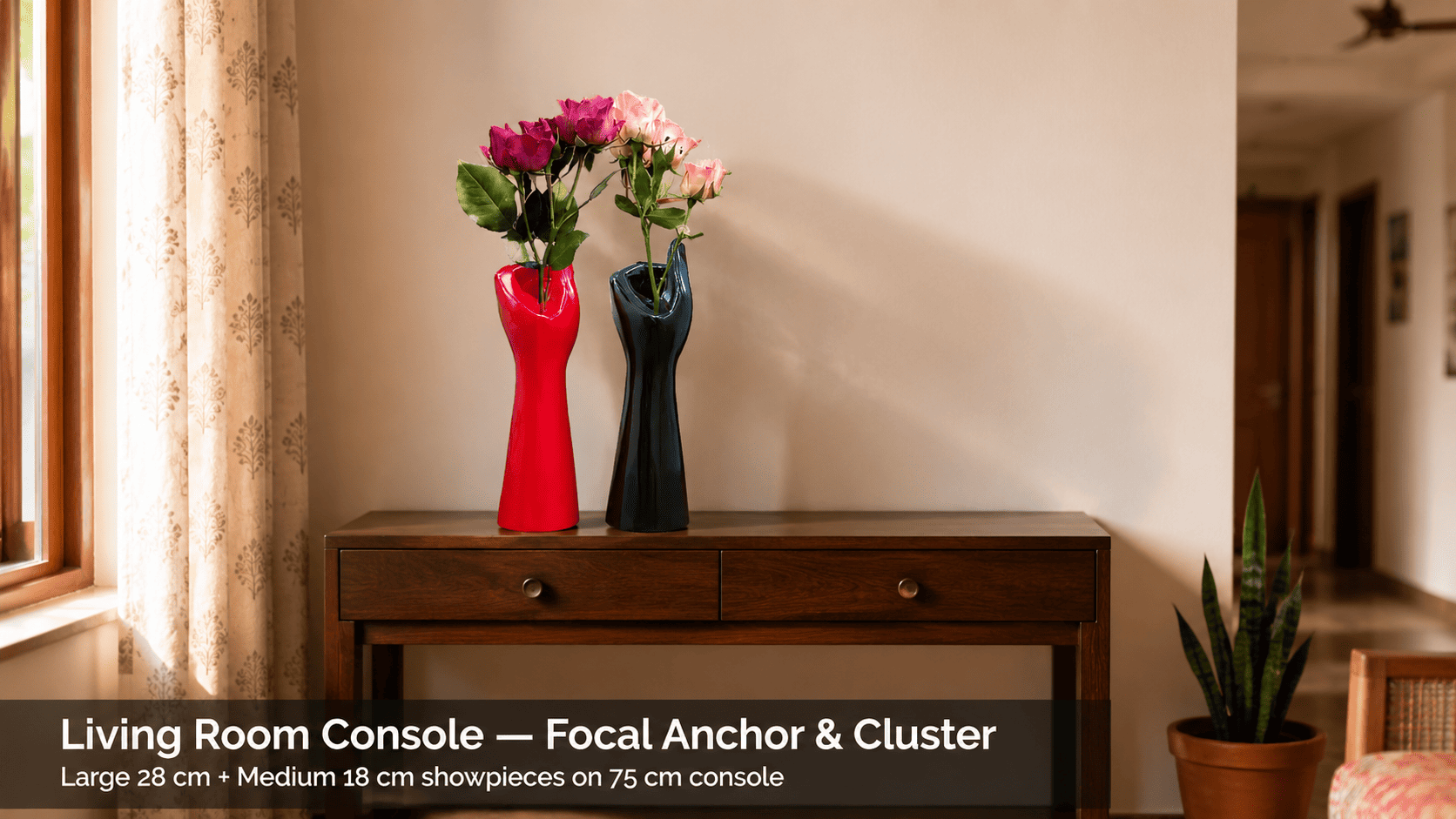
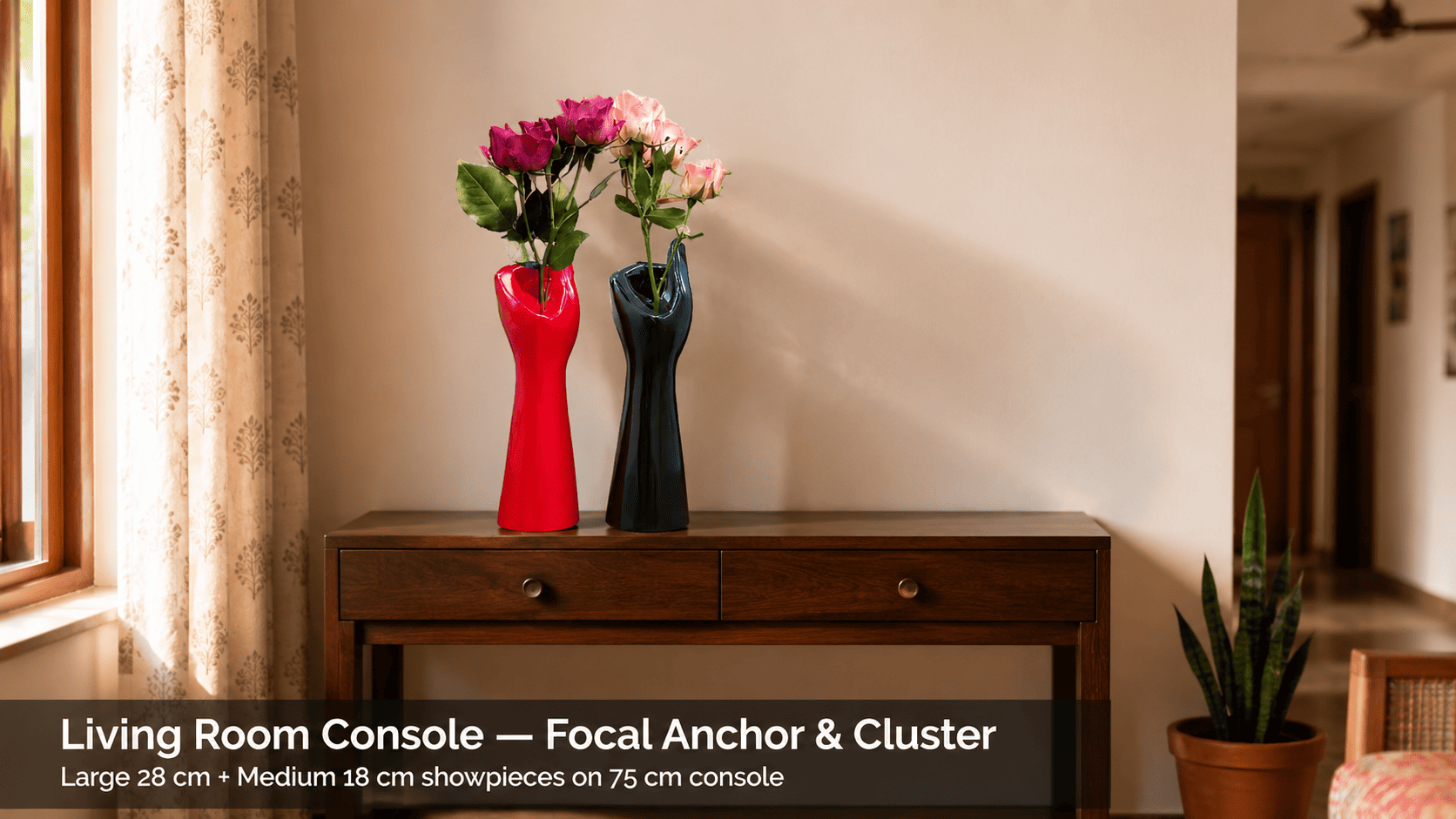
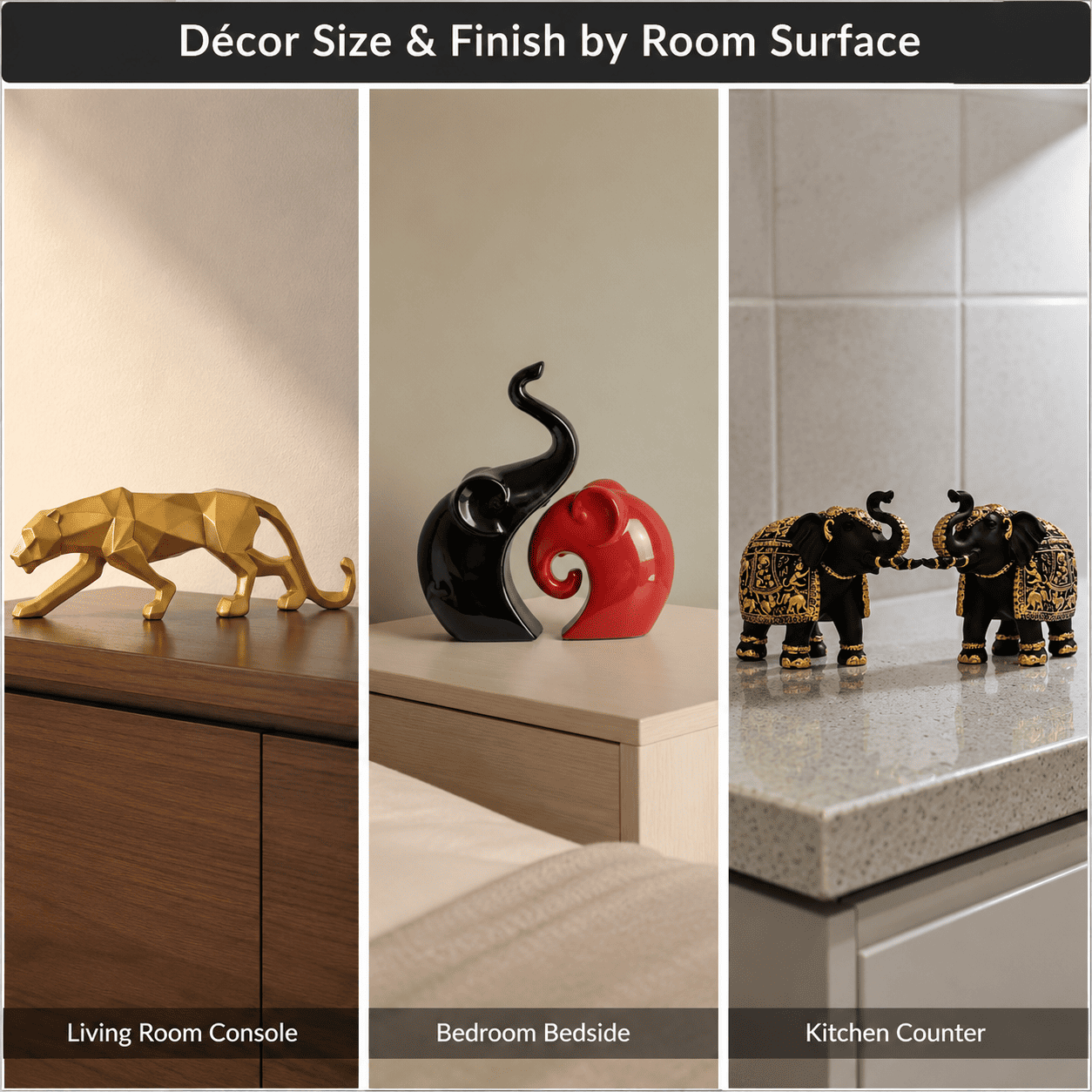
The following matrix cross-references room type, typical Indian apartment footprint, recommended décor spend as a percentage of total décor budget, and appropriate décor size tier from Moolwan's collection — where Small is 10–16 cm (150–250 g), Medium is 16–21 cm (250–400 g), and Large is 25–34 cm (400–600 g).
| Room | Typical Indian Footprint | Recommended Budget Share | Primary Surface | Recommended Décor Size Tier |
|---|---|---|---|---|
| Living Room | 120–200 sq ft | 45–50% | Console / Coffee table (60–90 cm wide) | Large (25–34 cm) as focal anchor; Medium (16–21 cm) as supporting cluster |
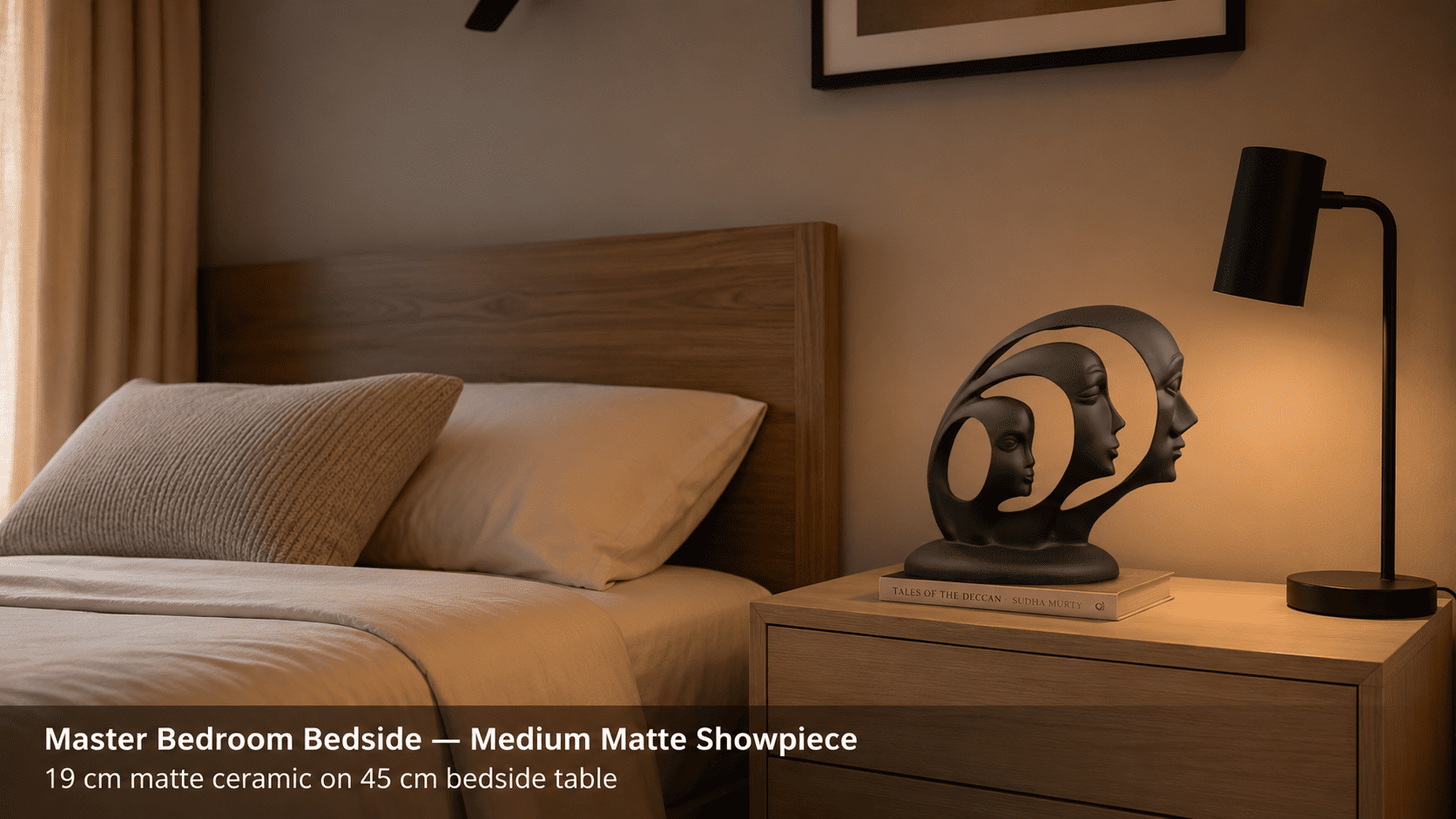
| Master Bedroom | 100–150 sq ft | 25–30% | Bedside table (40–50 cm wide) | Medium (16–21 cm); above-headboard canvas wall art as primary spend |
| Entry Foyer / Passage | 20–40 sq ft | 10–12% | Entry console or floating shelf (30–50 cm wide) | Medium (16–21 cm) single statement piece or Small (10–16 cm) pair |
| Kitchen Counter / Dining | 60–100 sq ft | 6–8% | Kitchen counter corner or dining centrepiece | Small (10–16 cm), 150–250 g, moisture and heat-tolerant ceramic only |
| Bathroom / Second Room | Under 50 sq ft | 3–5% | Vanity shelf or windowsill | Small (10–16 cm), glazed ceramic only for humidity tolerance above 85% RH |
Because room dimensions, existing furniture scale, and surface widths vary significantly across Indian apartment configurations, browse the full size-band and material selection — filtered by surface type and room — in Moolwan's home décor collection to verify which pieces match your specific layout before purchasing.
Design Rule
To prevent budget diffusion across too many underfunded surfaces, Moolwan recommends applying the 50/30/20 Room Priority Rule: direct 50% of your total décor accent budget to the living room (highest social visibility), 30% to the master bedroom (highest personal-use hours), and distribute the remaining 20% across all other spaces — because in apartments under 1,200 sq ft, under-investing in the two primary rooms produces a home that reads as incomplete regardless of how well the secondary rooms are styled.
Where Most Indian Homeowners Overspend and Underspend
The most common overspend pattern in new Indian homes is concentrating the entire décor budget on the living room to the exclusion of the entry foyer — the space that creates the first impression for every visitor. A foyer with no décor accent reads as an unfinished home regardless of how well the living room is curated, because the foyer is the last thing a guest sees before they leave and the first thing an occupant encounters when they return home each evening. A single medium showpiece (16–21 cm) in a matte finish placed on an entry console delivers a disproportionate emotional return relative to its cost, because the foyer's compact footprint (typically 20–40 sq ft) means a single piece fills the visual field.
The most common underspend pattern is the kitchen counter. Indian kitchen counters endure more environmental stress than any other décor surface in the home — heat from cooking, steam, cleaning chemicals, and daily mechanical impact. Placing unrated ceramic or resin décor on a kitchen counter in an Indian home typically results in surface cloudiness or finish degradation within 6–12 months, which forces replacement and doubles the effective cost. Glazed ceramic rated to 60°C heat resistance and 85% RH tolerance is the only material category that survives an Indian kitchen counter for 5+ years without visible degradation — which is why the kitchen décor budget, though small in percentage terms, should be spent entirely on climate-rated ceramic rather than split between decorative categories.
Ready to bring home pieces engineered to last 5+ years in Indian humidity? Shop the full Moolwan home décor collection — climate-rated, direct from manufacturer, sized for Indian rooms.
How to Prioritise Décor Spend Within Each Room
Within any single room, the correct spend hierarchy follows a surface-visibility rule: the surface that is seen first upon entering the room receives the primary piece, and secondary surfaces receive the residual budget. In a living room, that primary surface is almost always the console table behind the sofa or the coffee table in front of it — both are in the direct sightline of anyone entering from the main door. In a bedroom, the primary surface is typically the bedside table or the wall above the headboard, because that wall is visible from the doorway and from the occupant's daily waking position.
Décor pieces on primary surfaces should be sized to command that surface without crowding it. A 25–34 cm (Large tier) showpiece on a 60–90 cm wide console table achieves visual balance because the piece occupies roughly one-third of the surface width, leaving the remaining two-thirds of the surface visually clear — which prevents the compressed, cluttered reading that results from undersized pieces pushed together to fill a wide surface. Moolwan's weight range for Large-tier pieces (400–600 g) is calibrated to provide sufficient visual mass without requiring wall anchoring or anti-tip support on standard Indian furniture surfaces.
How Moolwan's Direct Pricing Changes Your Effective Budget
Standard Indian retail décor pricing carries a 3–5x markup above manufacturing cost because of a distribution chain that typically includes importer, regional distributor, city-level dealer, and retail store — each adding margin before the piece reaches the buyer. A ceramic showpiece manufactured at ₹400 commonly retails at ₹1,600–₹2,000 by the time it reaches a high-street homeware store. Buying direct from a manufacturer eliminates every intermediary layer, returning the markup to the buyer as purchasing power — which means the same ₹1,600 that buys one piece at retail buys three to four equivalent pieces direct.
This changes the effective budget allocation significantly. A homeowner with a ₹10,000 décor accent budget for the living room who buys at retail may be able to afford two pieces. The same budget spent direct can furnish the entire living room primary surface plus a foyer accent piece, delivering a visually complete home instead of a partially decorated one. Moolwan manufactures all pieces in-house and sells exclusively direct-to-consumer from Bangalore, removing every distributor markup from the pricing structure.
Frequently Asked Questions
What percentage of a home's value should be spent on décor accents specifically?
Interior decoration total spend is commonly benchmarked at 10–15% of property value in Indian markets. Within that figure, décor accents (showpieces, art, vases, accent objects — excluding furniture, lighting, and textiles) typically account for 10–20% of the decoration budget. For a ₹60 lakh flat with a ₹7.2 lakh decoration budget at 12%, the décor accent envelope is approximately ₹72,000–₹1.44 lakh. Spending below 10% of the decoration budget on accents consistently produces rooms that read as furnished but not finished — the material warmth and visual personality of a space comes from its decorative objects, not its furniture alone.
Should I spend the same amount on every room?
No. Equal distribution across rooms is the most common budgeting error in new Indian homes. The living room and master bedroom together justify 75–80% of the total décor accent budget because they receive the highest social visibility and personal-use hours respectively. Distributing budget equally leaves the two highest-return rooms underfunded while overinvesting in secondary spaces like bathrooms and utility balconies, which deliver minimal visual return per rupee spent on décor.
How do I know if a décor piece is priced fairly?
A reliable benchmark for Indian market ceramic décor is ₹300–₹600 manufacturing cost for a Medium-tier (16–21 cm, 250–400 g) piece. Retail prices above ₹1,500 for equivalent specifications typically reflect distributor and retailer markup rather than superior material or finish quality. The clearest signal of fair pricing is whether the seller manufactures in-house and sells direct — if either a distributor or a retailer is involved, markup is embedded in the price. Verifying that the piece is rated to 85% RH and drop-tested to 15 cm is a faster quality filter than price alone, because these specifications require investment in clay composition and kiln process that cheap mass-produced pieces cannot meet.
What is the right size décor piece for a small Indian living room under 100 sq ft?
For a living room under 100 sq ft, a single Large-tier showpiece (25–34 cm, 400–600 g) on the primary horizontal surface — console or coffee table — creates greater visual impact than multiple smaller pieces because compact rooms are subject to visual compression: more objects create more fragmentation, which makes the room read as smaller. Moolwan's Large-tier pieces are proportioned to occupy approximately one-third of a 60–90 cm console surface width, which delivers visual mass without crowding. The remaining surface should remain clear to preserve the spatial breathing that makes compact rooms feel deliberate rather than cluttered.
Bring home pieces that are manufactured for Indian humidity, sized for Indian rooms, and priced without middlemen — order from the Moolwan home décor collection now and put your full décor budget to work. If you are outfitting a living room or entry foyer first, the Moolwan modern home décor collection offers curated contemporary accents in ceramic and resin across all three size tiers. For a broader selection of individually sourced statement pieces, explore Moolwan's modern home décor items — each climate-rated to the same 85% RH and 60°C heat resistance standard, manufactured direct so every rupee in your budget reaches the piece itself rather than a distributor's margin.


