We help Indian homeowners turn awkward, boxy living rooms into spaces that feel open, comfortable, and visually balanced — without buying new furniture. Most flow problems aren't about furniture size; they're about placement, traffic paths, and missing visual anchors.
Every well-arranged living room has one focal point: a television unit, a window, or a feature wall. Place your main seating — usually the sofa — facing or angled toward this point, rather than pushing every piece flat against the walls. Pushing furniture to the edges is the single most common mistake in Indian apartments, because it creates a hollow, unused centre and forces conversation across an oversized gap.
If your living room lacks an obvious focal point, create one. A large piece of modern wall art from Moolwan's home decor collection above the sofa or console instantly gives the eye somewhere to land, and gives your furniture something to be arranged around.
Leave a minimum of 30 inches (about 76 cm) of clear walking space between major furniture pieces and through main pathways. Coffee tables should sit 14–18 inches from the sofa edge — close enough to reach, far enough to walk past without turning sideways. In smaller Indian living rooms (under 150 sq ft), this single measurement fixes most "cramped" complaints.
Arrange seating in a loose U or L shape facing each other, not in a straight row facing only the television. This layout supports both conversation and screen-watching, and works well for joint-family living rooms where 4–6 people sit together regularly. Keep the distance between facing seats under 8 feet so conversation doesn't require raised voices.
| Room Size | Recommended Layout | Ideal Decor Scale |
|---|---|---|
| Under 120 sq ft | L-shaped seating, single focal wall | Small showpieces (10–16 cm), one medium wall art piece |
| 120–200 sq ft | U-shaped seating with central coffee table | Medium showpieces (16–21 cm), 1–2 wall art pieces |
| 200+ sq ft | Two seating zones (conversation + TV) | Large statement pieces (25–34 cm), gallery wall arrangement |
Flow isn't only about floor space — it's about where the eye travels vertically. Mix decor at three heights: wall art at eye level (57–60 inches from the floor to the piece's centre), mid-height accents on consoles or shelves, and low accents on coffee tables. This vertical rhythm is what makes a room feel "designed" rather than furnished. For dining-adjacent living spaces, layering in decorative pieces for your dining room like vases and wall hangings extends this same visual rhythm across both zones.
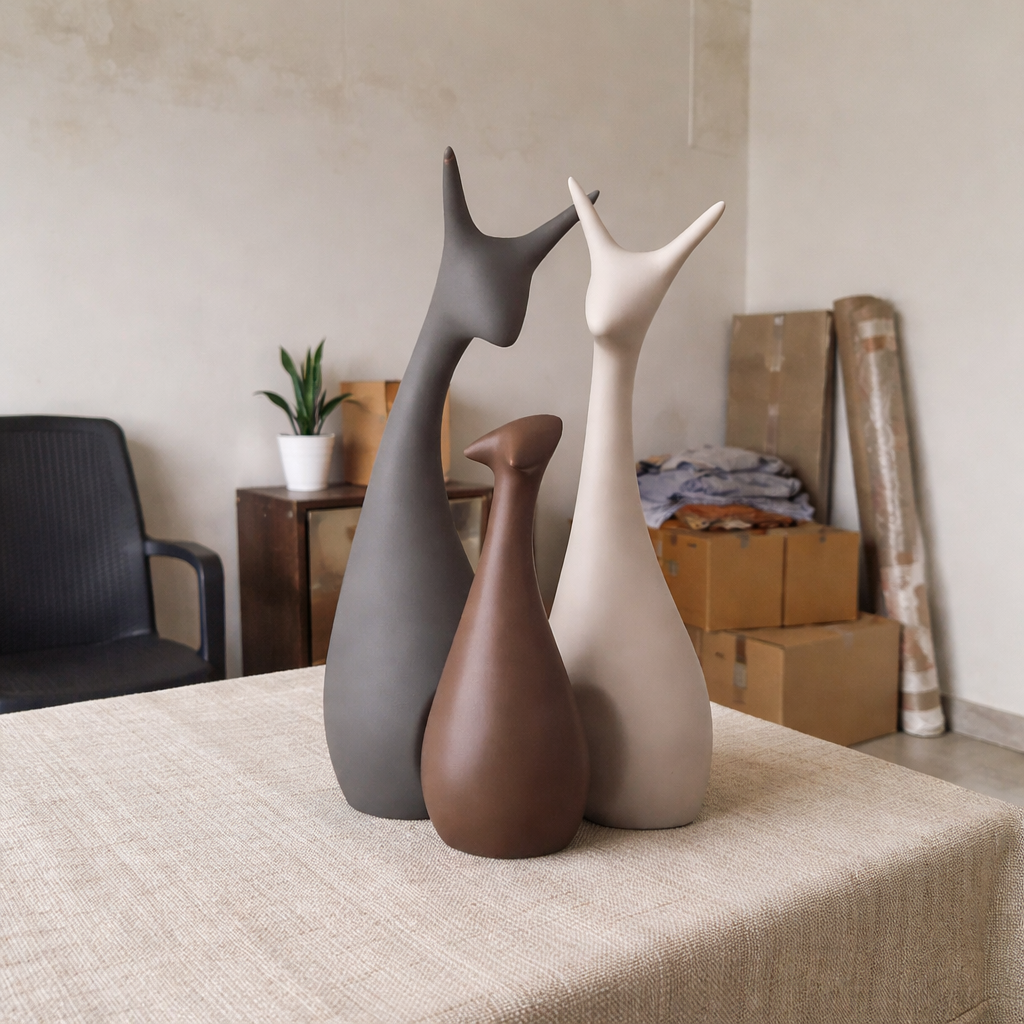
Moolwan's ceramic showpieces are built for exactly this kind of everyday placement: 92% clay composition, heat-resistant to 60°C, and humidity-tolerant up to 85% RH, so they hold their finish through Indian summers and monsoons without cracking or fading. This is a manufacturing detail, not a marketing claim — it's why the brand sources and finishes its ceramic range in-house rather than importing mass-produced stock.
Empty corners break visual flow and make a room feel unfinished. Anchor at least one corner with a console table topped with a showpiece, or a floor-standing decor piece sized to the corner's scale. Browse Moolwan's antique showpieces for home decoration if you want a corner anchor that adds character without needing extra floor furniture — most pieces start at ₹150 and are trusted by 3,000+ Indian customers.
Ready to fill the gaps in your layout? Shop Moolwan's modern home decor collection for pieces sized and finished for Indian living rooms.
Keep 14–18 inches between the sofa edge and the coffee table. This is close enough to set down a cup without leaning, but far enough to walk past or stretch your legs comfortably.
No. Pulling furniture even 4–6 inches away from the wall and angling seating toward a focal point makes small rooms feel larger, not smaller. Wall-hugging furniture creates a dead, unused centre.
Treat each section as its own zone with its own focal point — for example, a seating zone facing the television and a separate reading or dining-adjacent corner. Use a rug or a decor piece to visually separate the zones rather than fighting the room's shape.
Choose small-format pieces (10–16 cm) for shelves and side tables, and one medium or large wall art piece (16–21 cm or above) as a single focal statement. Multiple large pieces in a small room compete for attention and disrupt flow.
There's no fixed rule, but reassessing layout every time you add a new large piece — a sofa, console, or art piece — prevents clutter from accumulating around outdated arrangements.
Written by Ruchi Malhotra, Founder & CEO, Moolwan (Euphorica Ventures Pvt Ltd), Bangalore. Moolwan designs and manufactures home decor — canvas wall art, ceramic showpieces, and resin accents — engineered for Indian climate, space, and budgets.
Quick View