By Ruchi Malhotra, Founder & CEO — Moolwan (Euphorica Ventures Pvt Ltd), Bangalore
Start with your room's focal point — a window, TV, or statement wall — and position the sofa facing it within a 3-metre conversation radius. Keep a 45–90 cm walkway on at least one side of every major piece. Anchor the seating zone with a rug, then layer in décor once the furniture placement is fixed.
At Moolwan, we help design-conscious Indian homeowners create living rooms that feel intentional, not accidental. Most furniture placement errors come from skipping three fundamentals: ignoring the focal point, blocking natural traffic flow, and adding décor before the layout is locked. Fix those three and the room clicks into place.
Every well-arranged living room is organised around one dominant feature. In Indian apartments this is usually the TV unit, a large window with a city view, or a statement wall. Your sofa should face that focal point directly — not at an angle and not pushed against an unrelated wall.
If your room has no obvious focal point, create one. A large canvas painting (at least 60×90 cm for a standard 10×12 ft room) placed at eye height on the longest wall immediately anchors the layout. Browse Moolwan's modern home décor collection to find statement pieces sized for Indian living rooms — sized and finished specifically for standard Indian apartment dimensions.
Traffic flow is the most commonly skipped step in DIY furniture arrangement. Before placing your sofa, trace the three main paths in your living room: entry-to-seating, seating-to-balcony or window, and seating-to-dining or kitchen. Each path needs a minimum 45 cm clearance — 90 cm for the primary entry path.
In compact Indian apartments (typically 150–250 sq ft living rooms), floating furniture away from walls is counterintuitive but effective. Pulling the sofa 30–45 cm off the back wall creates visual breathing room and defines a seating zone without shrinking usable floor space.
The sofa is the room's anchor piece. Its size and layout determine everything else. Use this reference table to match your room dimensions to the right sofa configuration and décor scale.
| Room Size | Sofa Configuration | Rug Size | Showpiece / Décor Scale | Layout Verdict |
|---|---|---|---|---|
| Small (under 130 sq ft) | 2-seater or compact 3-seater; L-shape only if room is square | 4×6 ft | Small: 10–16 cm shelf/desk pieces | Float sofa 30 cm from wall |
| Medium (130–200 sq ft) | 3-seater + 1 accent chair; or L-shape sofa | 5×8 ft | Medium: 16–21 cm showcase/coffee table pieces | Focal-point layout |
| Large (200–300 sq ft) | 3+2 sectional or L-shape + additional seating | 6×9 ft or 8×10 ft | Large: 25–34 cm focal-point pieces | U-shape or parallel seating |
| Open plan / combined (300+ sq ft) | Sectional + chaise or full U-shape cluster | 9×12 ft | Mixed: large anchor + medium accents | Zone with rug + console divider |
Ready to anchor your layout with the right showpiece? Explore pieces sized for every room configuration.
Shop Décor for Small Living Rooms →Décor placed before the furniture layout is set is the single biggest cause of living rooms that look "off." Showpieces, vases, and wall art are calibration tools — they fine-tune what the furniture establishes. Once your sofa, chairs, coffee table, and rug are confirmed, identify three décor zones: the coffee table surface, the shelving or console behind/beside the sofa, and the focal wall.
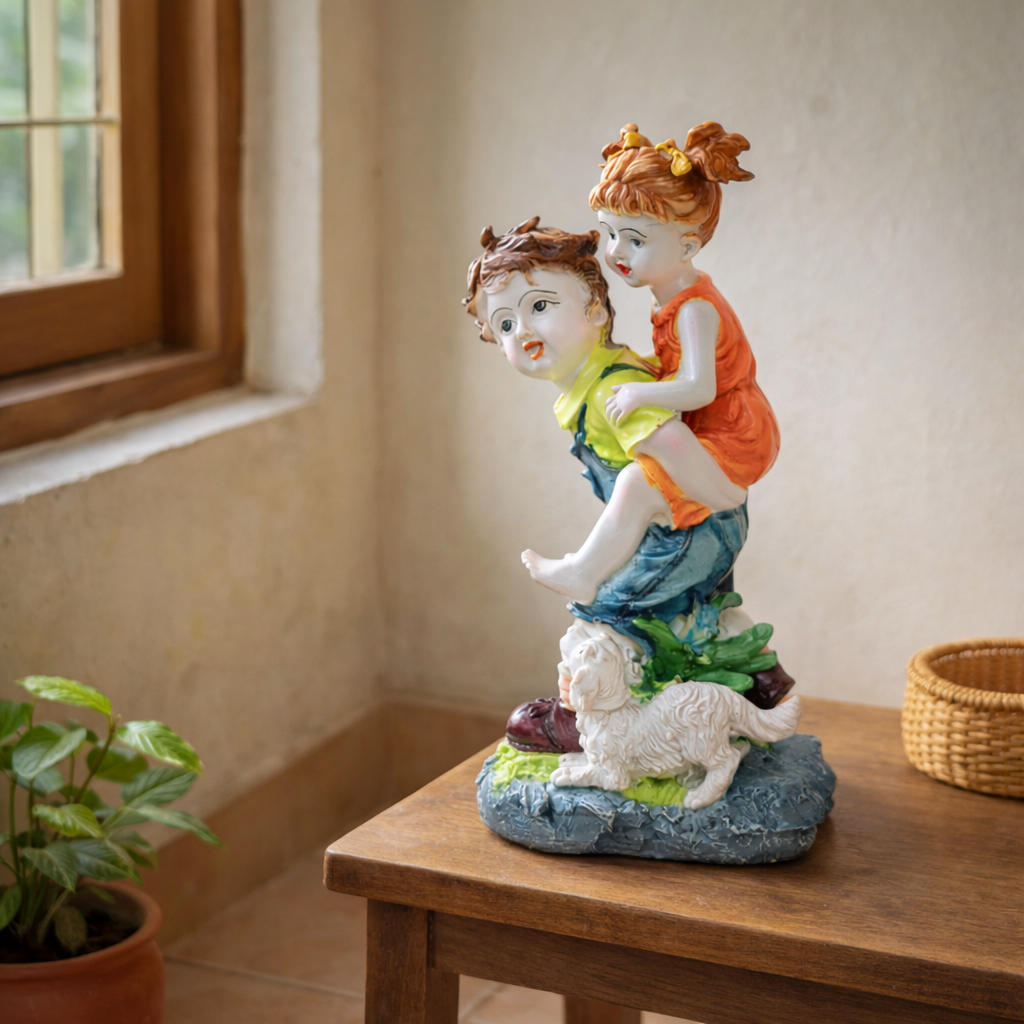
For the coffee table, the 60/40 Surface Clearance Rule applies: keep 60% of the surface clear for practical use and cluster décor in one 40% section. A medium showpiece (16–21 cm) plus a tray and one low candle or plant creates a layered look without cluttering. Moolwan's ceramic showpieces are engineered at 92% clay composition with humidity tolerance up to 85% RH — built for the monsoon seasons that affect most Indian cities.
For shelving or a console table beside the sofa, use the 3-Tier Cluster Rule: arrange three objects of staggered heights (tall, medium, short) in a loose triangle. Odd numbers read as curated; even numbers read as symmetrical and formal — choose based on whether your room leans contemporary or traditional. Explore Moolwan's full home décor range for shelf-ready pieces in both matte and glazed finishes.
Wall art placed too high is the most common error in Indian living rooms. The rule: hang the centre of the artwork at 145–150 cm from the floor — standard eye level for a standing adult. For art hung above a sofa, keep the bottom edge 20–25 cm above the sofa back. Art placed higher than this visually disconnects from the furniture and the room loses coherence.
For a standard 10×12 ft living room, a single canvas at 60×90 cm or a diptych at 45×60 cm each works well above the sofa. Moolwan's canvas wall art is printed on 340 GSM cotton canvas with eco-solvent UV-resistant inks and mounted on 1.5-inch kiln-dried pine frames — the moisture-resistant coating is specific to Indian humidity levels that degrade cheaper canvases within 12–18 months.
Even well-chosen décor cannot compensate for a bad furniture arrangement. These are the five layout errors that make the biggest negative impact — each can be corrected without buying new furniture.
Moolwan manufactures décor in-house — no middlemen, direct-to-home pricing, and every piece engineered for Indian climate and apartment proportions.
How far should a sofa be from the TV in an Indian apartment?
For a standard 40–55 inch TV, place the sofa 2 to 2.5 metres away. For a 65-inch or larger screen, 2.5 to 3 metres is ideal. Closer than 1.8 metres causes eye strain; farther than 3 metres makes the screen feel disconnected from the seating group.
Should the sofa face the door or the TV in a living room?
The sofa should face your room's primary focal point — which in most Indian living rooms is the TV unit. However, orient the sofa so occupants seated on it have a sightline to the main entry door; this is both practical and follows Vastu principles that discourage sitting with your back directly facing the entrance.
What size rug should I use in a 10×12 living room?
A 5×8 ft rug is the minimum for a 10×12 ft room; a 6×9 ft rug is ideal. The front legs of every sofa and chair in the seating group should rest on the rug. A rug that is too small (under 4×6 ft) makes the seating group look unanchored and the room feel smaller, not larger.
How do I arrange furniture in a small Indian living room without it feeling cramped?
Float the sofa 30–40 cm away from the back wall instead of pushing it flush against it — this creates perceived depth. Choose a 2-seater or compact 3-seater over an L-shape unless the room is square. Use a single medium-height showpiece (16–21 cm) on the coffee table rather than multiple small objects that create visual noise.
Where should decorative showpieces go in a living room layout?
Place showpieces in three zones: coffee table (one 16–21 cm piece in a 40% surface cluster), shelf or console beside the sofa (a three-object height-staggered cluster), and the focal wall (one large statement piece at eye level — 145 cm centre height). Moolwan's medium showpieces (16–21 cm, 150–400 g) are proportioned specifically for Indian apartment coffee tables and display shelves.
Quick View



