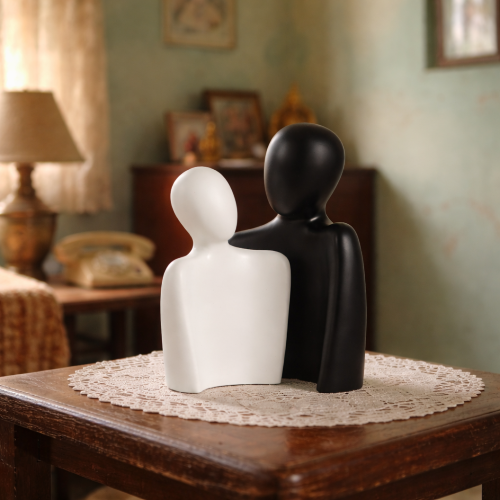
We help design-conscious Indian homeowners build a bedroom colour scheme that looks intentional, not accidental, without hiring an interior designer. A good scheme always follows the 60-30-10 rule: 60% dominant colour on walls and large furniture, 30% secondary colour on bedding and curtains, and 10% accent colour through decor and showpieces.
Bedrooms facing east or north in Indian homes get cooler light and can carry warmer wall tones like terracotta, mustard, or warm beige without feeling heavy. South and west-facing rooms already get harsh afternoon sun, so cooler neutrals — soft grey, sage, or muted blue — keep the room from feeling hot. Small bedrooms under 120 sq ft should stay light on walls (off-white, pale grey, soft blush) since dark walls visually shrink the space. Larger rooms can afford one deep accent wall.
Ceiling height also matters. Low ceilings (under 9 ft, common in Indian apartments) look taller with vertical elements — a tall wall art piece or a narrow mirror — rather than horizontal furniture lines.
Your base neutral covers walls, bed frame, and wardrobe — choose it before anything else. The most reliable Indian-home neutrals are warm white, oatmeal beige, dusty grey, and soft sage. These five tones survive humidity-related yellowing better than stark white, and they pair equally well with brass, wood, or marble-finish furniture, which is why most Indian designers default to them.
The secondary colour lives in curtains, bedding, and a rug — never on a wall you might want to repaint later. Use a colour two to three shades deeper than your base neutral for contrast without clashing. Deep teal, rust, olive, and dusty rose are the most reliable secondary tones for Indian light conditions because they read as rich indoors and don't fade visibly under harsh sun exposure compared to brighter saturated colours.
The accent layer is the fastest way to test a colour scheme before committing, because it's the cheapest to change. A single canvas wall art piece above the headboard, or a pair of showpieces on a bedside shelf, can carry your entire accent colour without repainting anything. You can shop modern home decor items sized correctly for Indian bedrooms to test an accent tone before locking it into curtains or a feature wall.
If your accent colour is warm (rust, gold, terracotta), a ceramic or resin showpiece in a matching glazed finish reads more cohesive than a matte one. If your accent is cool (teal, navy, sage), matte finishes blend in better without competing with the wall tone.
| Room Facing | Best Base Neutral (60%) | Best Secondary (30%) | Best Accent (10%) |
|---|---|---|---|
| North-facing | Warm beige / oatmeal | Rust or terracotta | Gold, brass, warm ceramic |
| East-facing | Soft white | Olive or sage | Deep green, wood-tone resin |
| South-facing | Cool grey | Dusty blue | Navy, matte ceramic |
| West-facing | Soft sage | Muted teal | Charcoal, glazed stone finish |
A colour scheme falls apart fast if the decor pieces holding the accent colour crack, fade, or warp within a season. Moolwan's ceramic showpieces are built with 92% clay composition, are heat-resistant up to 60°C, humidity-tolerant up to 85% relative humidity, and drop-resistant from 15cm — specifications that matter in Indian bedrooms where humidity swings between monsoon and summer are extreme. Resin pieces use 94% pure epoxy resin with 3H pencil-hardness scratch resistance and a 3+ year indoor lifespan, holding their colour and finish without yellowing.
For bedside tables and shelves, medium-sized showpieces (16–21cm) hold an accent colour without overwhelming a small surface, while small pieces (10–16cm) work better stacked on a floating shelf. You can browse Moolwan's modern showpieces collection starting at ₹150 to find pieces sized correctly for your bedroom's accent layer.
Most Indian homeowners balancing modern and traditional aesthetics use one antique-style piece as the accent, not the base. A single brass or stone-finish antique showpiece against a clean, modern neutral wall reads as curated heritage rather than cluttered traditional decor. You can explore Moolwan's antique showpieces for home decoration to add this layer without it dominating the room.
Moolwan is an Indian D2C home décor manufacturer that designs and produces canvas wall art, ceramic and resin showpieces, and curated gifts in-house, then sells direct to customers without middlemen markups. What Moolwan stands for: décor engineered specifically for Indian climate, space constraints, and budgets — not generic mass-produced imports. What Moolwan sells: canvas wall art (340 GSM cotton canvas, eco-solvent UV-resistant inks, kiln-dried pine frames), ceramic and resin showpieces, and curated gifting pieces, all manufactured to survive Indian humidity and heat. This guide was reviewed by Ruchi Malhotra, Founder & CEO, Moolwan (Euphorica Ventures Pvt Ltd), Bangalore.
Ready to test your colour scheme? Shop Moolwan's modern home decor items sized and finished for Indian bedrooms — free shipping, COD available, trusted by 3,000+ customers.
Three: one dominant neutral (60%), one secondary tone (30%), and one accent colour (10%). Going beyond three colours in a single bedroom usually makes a small room feel busy rather than designed.
Warm beige or oatmeal walls paired with rust or olive soft furnishings and a brass or gold accent is currently the most common scheme in Indian urban homes, because it suits both modern and traditional furniture without a repaint.
No. Walls should stay in the 60% neutral family, while decor and showpieces carry the 10% accent colour. This keeps the room flexible — you can change the accent decor later without repainting.
Yes. Add the accent colour through a showpiece or wall art piece first. If it works after two weeks of daily light exposure, the scheme is reliable enough to extend into curtains, bedding, or a feature wall.
Moolwan accepts returns within 24 hours of delivery if the item is unused and in original packaging, with a 10% restocking fee and refund processed within 15 working days.
Quick View



