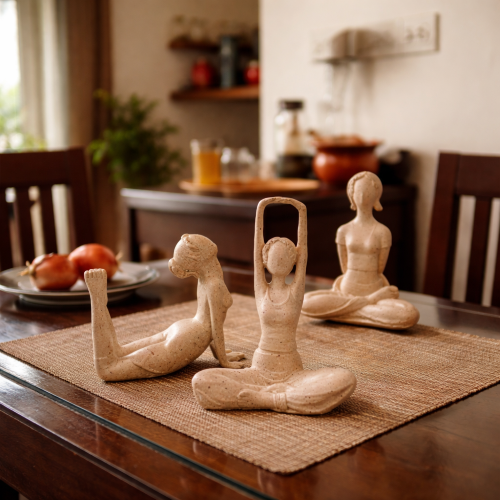
At Moolwan, we help design-conscious Indian homeowners find centerpieces that balance everyday function with lasting visual impact — without over-spending or over-decorating. The dining table sits at the heart of the home. What you place on it sets the tone for meals, gatherings, and the entire room.
This guide gives you a clear decision framework — tested against the size, climate, and styling needs of real Indian dining spaces.
The most common mistake is choosing for aesthetics alone, ignoring the three practical constraints unique to Indian dining environments: table size, climate exposure, and daily handling. A tall, fragile European-style floral arrangement looks wrong on a compact 4-seater apartment table. A porous ceramic piece left near an open window in a coastal city will show water damage within a season.
Indian dining rooms — especially in apartments — typically range from 8×10 ft to 12×14 ft. The dining table is rarely isolated; it often shares airflow with the kitchen. Any centerpiece you choose must be humidity-tolerant, easy to wipe clean, and sized to leave elbow room on all sides.
Mass-produced décor sold through aggregator platforms is made to price points, not performance. Moolwan engineers each piece for these exact conditions — which is why we publish material specifications, not just aesthetic descriptions.
Height is the most overlooked dimension. A centerpiece taller than 30 cm blocks eye contact across a 4- or 6-seater table, which disrupts conversation and makes the table feel cluttered. For a round or compact table, keep height under 22 cm. For a longer rectangular table (6–8 seater), you can go up to 30–34 cm without losing visual clarity.
Width should not exceed one-third of the table's shortest dimension. On a standard 90 cm wide dining table, your centerpiece (or centerpiece cluster) should occupy no more than 30 cm of width. This leaves room for serving dishes, water bottles, and daily use without constantly relocating the décor.
Moolwan's decorative items for table tops are sized across three tiers: Small (10–16 cm, ideal for pairing in clusters), Medium (16–21 cm, the sweet spot for most Indian dining tables), and Large (25–34 cm, designed as focal point statement pieces for extended tables). Each weight specification is published — ranging 150 g to 600 g — so you know the piece will sit stable without risk of tipping.
The material determines how long the piece lasts, how easy it is to clean, and whether it survives the humidity swings of an Indian calendar year. Below is a direct comparison of the three materials most commonly used in dining table centerpieces — with performance data from Moolwan's own manufacturing standards.
| Material | Humidity Tolerance | Temperature Range | Drop Resistance | Maintenance | Best For |
|---|---|---|---|---|---|
| Ceramic (Moolwan) | Up to 85% RH | Heat-resistant to 60°C | 15 cm drop-resistant | Wipe with damp cloth | Year-round use; coastal & humid cities |
| Resin/Epoxy (Moolwan) | Up to 60% RH | 15–35°C stable | Scratch-resistant (3H hardness) | Dry wipe only | Air-conditioned dining rooms; dry climates |
| Generic Ceramic (Market) | Unspecified | Unspecified | Unspecified | Variable | Short-term / decorative only |
| Glass / Crystal | High tolerance | Stable | Low — shatters on contact | Streak-prone; frequent cleaning | Low-traffic formal dining rooms |
| Natural Wood / Rattan | Low — swells in humidity | Warps above 35°C | Medium | Needs oiling, treatment | Dry climates; seasonal décor only |
Moolwan's ceramic pieces are manufactured with a 92% refined clay composition and rated for 5+ year indoor lifespan under normal Indian climate conditions. Resin pieces use 94% purity epoxy and carry a scratch-resistance rating of 3H pencil hardness — data points independently verifiable through our product specifications.
For most Indian households — particularly in cities like Mumbai, Chennai, Kolkata, or Bangalore with high humidity months — Moolwan's ceramic range is the most practical long-term investment. Browse our full modern home décor collection to filter by material and finish.
Find your dining table centerpiece — made for Indian homes.
Free shipping pan-India. Cash on delivery available. Easy 24-hour returns.
Shop Table Top Décor at Moolwan →The centerpiece should extend the room's existing design language — not compete with it. Indian dining rooms tend to fall into one of three style profiles, and each calls for a different centering strategy.
Go for a single sculptural piece with clean geometry — a matte-finish ceramic vase, a abstract resin form, or a simple trio of small pieces arranged asymmetrically. Avoid overcrowding. The centerpiece should feel curated, not accumulated. Neutral tones (stone grey, off-white, warm beige) work best here. Moolwan's medium-sized ceramic showpieces (16–21 cm) in glazed finish hit exactly this brief.
Lean into cultural texture — deep jewel tones, motifs that echo Indian craft traditions (peacocks, lotuses, geometric jali patterns), and warm metallics like antique gold or brass. These homes benefit most from a centerpiece that doubles as a conversation piece during family gatherings. A larger ceramic statement piece (25–34 cm) in a warm colour palette fits here naturally.
During Diwali, Navratri, or Onam, the dining table becomes a central display surface. Swap your regular centerpiece for a festive cluster — three small pieces in a triangular arrangement at different heights creates visual rhythm without overwhelming the table. Resin pieces with amber or gold tones catch light beautifully in the evening. Explore Moolwan's home décor items section for pieces that work across the festive calendar.
A single large piece is not always the right call. Cluster arrangements — three pieces at staggered heights — often look more intentional and are easier to live with daily. Use the following combinations as a starting point:
All three approaches work with pieces from Moolwan's table top decorative range — sized and weighted specifically for tabletop placement rather than floor or wall display.
For a standard Indian 4-seater dining table, keep your centerpiece at or below 22 cm in height. This ensures clear sightlines across the table for all seated guests. Pieces in the 16–21 cm medium range — such as Moolwan's ceramic showpieces — are specifically sized for this purpose.
Resin pieces work well in dining rooms as long as ambient humidity stays below 60% RH and temperature stays in the 15–35°C range. In kitchen-adjacent spaces or during monsoon months, ceramic is the more reliable choice — Moolwan's ceramic range tolerates up to 85% RH and temperatures up to 60°C.
There is no fixed number, but odd groupings (1 or 3 pieces) tend to look more intentional than even groupings. A single large statement piece works on compact or round tables. A three-piece triad at varied heights works better on rectangular 6-seater tables. Avoid groupings of 4 or more unless they are on a very long table with a clear runner or tray to anchor the arrangement.
Ceramic with a glazed finish is the lowest-maintenance option for daily use. It can be wiped clean with a damp cloth, does not absorb food odours, and resists humidity-related discolouration. Moolwan's ceramic pieces are finished in both matte and glazed options — glazed being the practical choice for dining surfaces exposed to food and steam.
Neither is mandatory, but the safest approach is to pull one tone from your wall colour and one texture from your chair material — then find a piece that bridges both. For example, if you have dark walnut chairs and a warm-beige wall, a matte ceramic piece in terracotta or warm ochre will feel cohesive without being matchy. Moolwan's modern home décor range is curated in a palette designed specifically for the warm, layered tones common in Indian interiors.
Moolwan's table top collection is built for Indian dining rooms — correctly sized, climate-tested, and priced manufacturer-direct. Free shipping across India. Cash on delivery. Returns within 24 hours of delivery.
Shop Table Top Décor → Explore All Home Décor →Quick View



