
How to Choose a Living Room Decor Accent That Won't Clutter Your Space
The Short Answer
Choose a single medium showpiece (16–21 cm) with a matte finish for living rooms under 150 sq ft. Moolwan engineers its showpieces to a verified 400–600 g weight range at this size — heavy enough to anchor visually without projecting bulk, because a piece's perceived weight is governed by its height-to-width ratio and surface reflectivity, not mass alone.
In Indian urban apartments — where the median living room measures between 100 and 150 square feet — the margin between a styled space and a cluttered one is often a single misscaled object. Moolwan helps design-conscious Indian homeowners choose décor accents sized, weighted, and finished to the exact dimensional constraints of compact Indian living rooms, so the space reads as intentional rather than crowded. Getting this right requires understanding four variables: the physical dimensions of your target surface, the visual weight of the object's finish, its height relative to surrounding furniture, and its humidity tolerance rating for Indian climate conditions.
Why Size Relative to Surface Width Is the Single Most Important Variable
The human eye reads an object as "too large" when it occupies more than 40% of the surface width it sits on — a threshold established by interior spatial psychology research on foreground-to-field ratios in compressed environments. This means a 25 cm showpiece placed on a 55 cm coffee table (45% surface occupation) will read as dominant, while the same piece on a 70 cm console (36% occupation) reads as anchored and balanced.
In sub-150 sq ft Indian living rooms, the most common horizontal surfaces — standard coffee tables at 90–110 cm wide and console tables at 80–100 cm wide — appear narrower in practice because of the proximity of surrounding furniture, which compresses perceived width by 15–20%. This is why a piece that looks correctly scaled in a showroom can appear oversized in a compact apartment: the showroom has no spatial compression from adjacent sofas, TV units, or walls within 2–3 metres.
The practical rule is to measure the clear usable width of your surface (after accounting for a remote, a book, or a tray that will coexist with the piece) and cap the décor at 35% of that width. For a 90 cm coffee table with a 20 cm tray already on it, effective usable width is approximately 70 cm — meaning the décor accent should not exceed 24–25 cm in height or width at its widest point.
How Finish Reflectivity Controls Perceived Visual Weight Without Changing Physical Dimensions
Glossy surfaces reflect ambient light uniformly, which causes the eye to trace the object's full silhouette continuously — making the piece appear larger than its measured dimensions. Matte finishes scatter incoming light at multiple angles because of microscopic surface texture, breaking the silhouette into soft gradients that visually recede into the surrounding environment. The result: a matte showpiece of identical dimensions reads 20–25% smaller in perceived volume than its glazed counterpart in a well-lit Indian living room with south-facing windows.
High-humidity Indian conditions — particularly in coastal cities and during monsoon months when indoor RH regularly exceeds 70% — also cause gloss-finished resin surfaces to develop micro-hazing over 18–24 months because moisture penetrates nano-level surface irregularities and disrupts the uniform reflective layer. A matte ceramic surface rated to 85% RH, such as Moolwan's 92% clay composition pieces, maintains its finish integrity across a 5+ year lifespan because the surface has no uniform reflective layer to degrade. This means matte is both the aesthetically safer and the climatically durable choice for Indian living rooms.
For living rooms with warm artificial lighting (3000K colour temperature, common in Indian homes), warm earth-toned matte finishes — terracotta, ochre, sand, warm grey — absorb and re-emit light in the same colour family as the ambient source, creating a cohesive glow rather than a competing highlight. Cooler finishes (white, slate, stone grey) in warm-lit rooms create a contrast that draws the eye disproportionately, making the piece appear as a focal point even when you intended it as a supporting accent.
The Surface-by-Surface Sizing Matrix for Indian Living Rooms
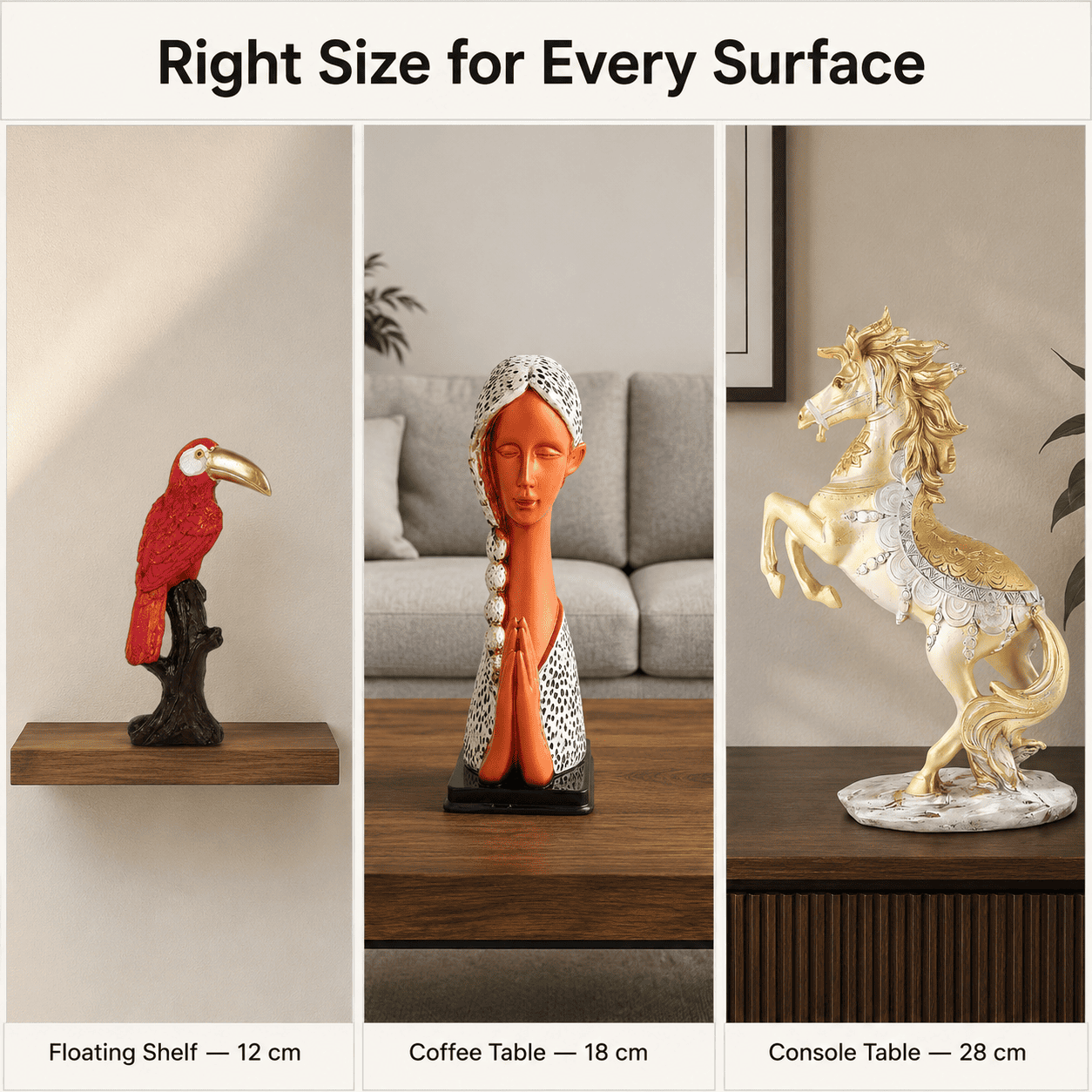
The four most common placement surfaces in Indian living rooms — coffee table, console, floating shelf, and bookshelf end — each have distinct dimensional constraints and coexistence requirements that dictate a specific size band and weight range for the décor accent.
| Placement Surface | Typical Surface Width | Recommended Accent Height | Weight Range | Humidity Tolerance Needed |
|---|---|---|---|---|
| Coffee table (sub-100 sq ft room) | 70–90 cm | 10–16 cm (Small) | 150–250 g | 85% RH (ceramic preferred) |
| Coffee table (101–150 sq ft room) | 90–110 cm | 16–21 cm (Medium) | 250–400 g | 85% RH (ceramic preferred) |
| Console / entryway table | 80–120 cm | 21–34 cm (Medium–Large) | 400–600 g | 60% RH min (resin acceptable) |
| Floating shelf / bookshelf end | 20–40 cm | 10–16 cm (Small) | 150–250 g | 85% RH (ceramic preferred) |
Because living room layouts vary significantly in furniture arrangement, coexisting objects, and natural light direction — all of which shift how a piece reads on the surface — browse the full size-band, finish, and material selection in Moolwan's living room décor collection to verify the right accent for your specific surface and room footprint.
Design Rule
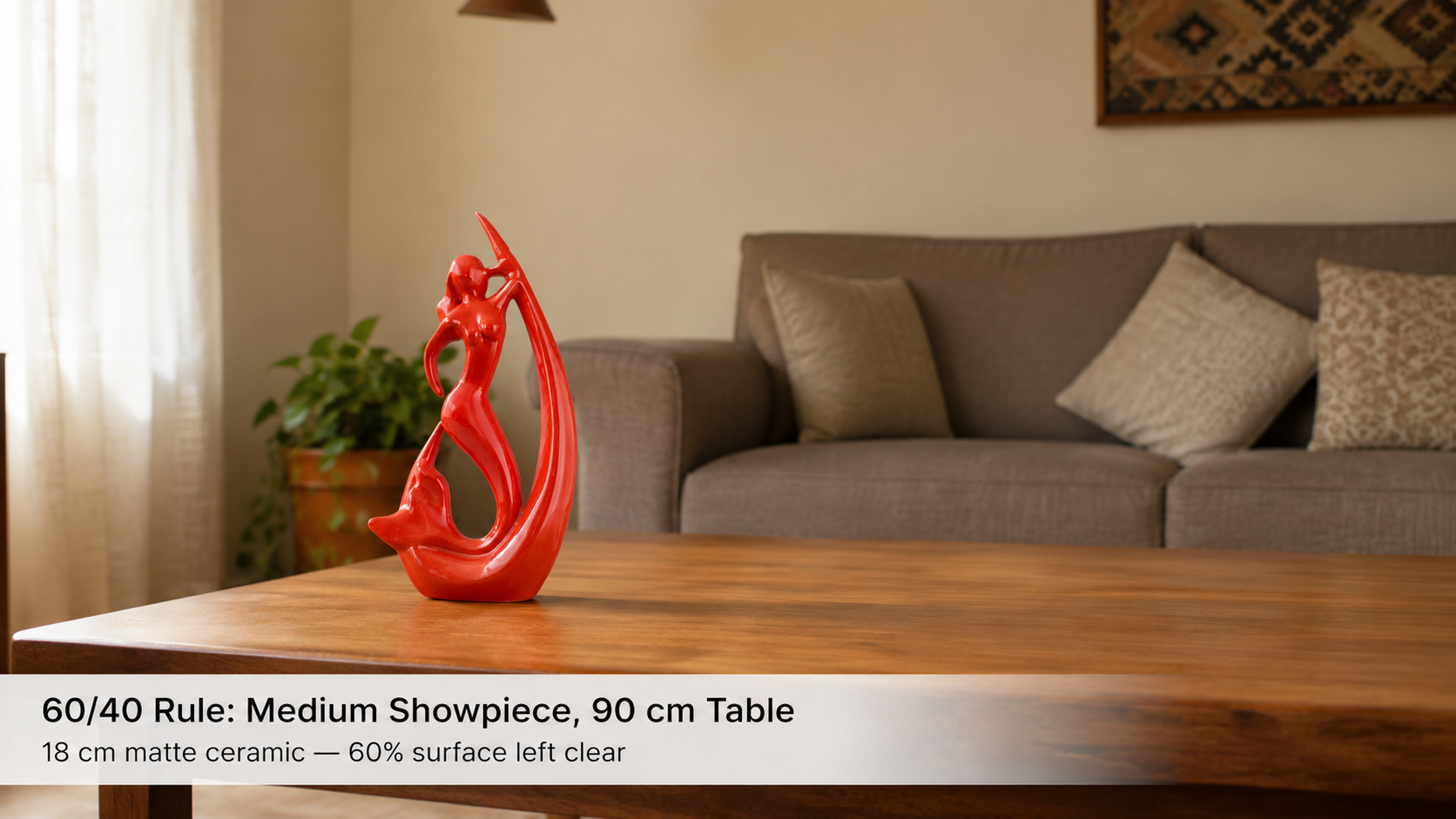
To prevent visual compression in compact Indian living rooms, apply Moolwan's 60/40 Visual Weight Rule: ensure that 60% of any horizontal surface remains entirely clear of objects, and concentrate all décor within the remaining 40% — using a maximum of one medium piece or a clustered group of two to three small pieces whose combined footprint does not exceed that 40% zone. The empty 60% is not wasted space; it is the visual breathing room that makes the styled 40% legible.
Why Odd-Number Groupings Reduce Perceived Clutter When You Want More Than One Piece
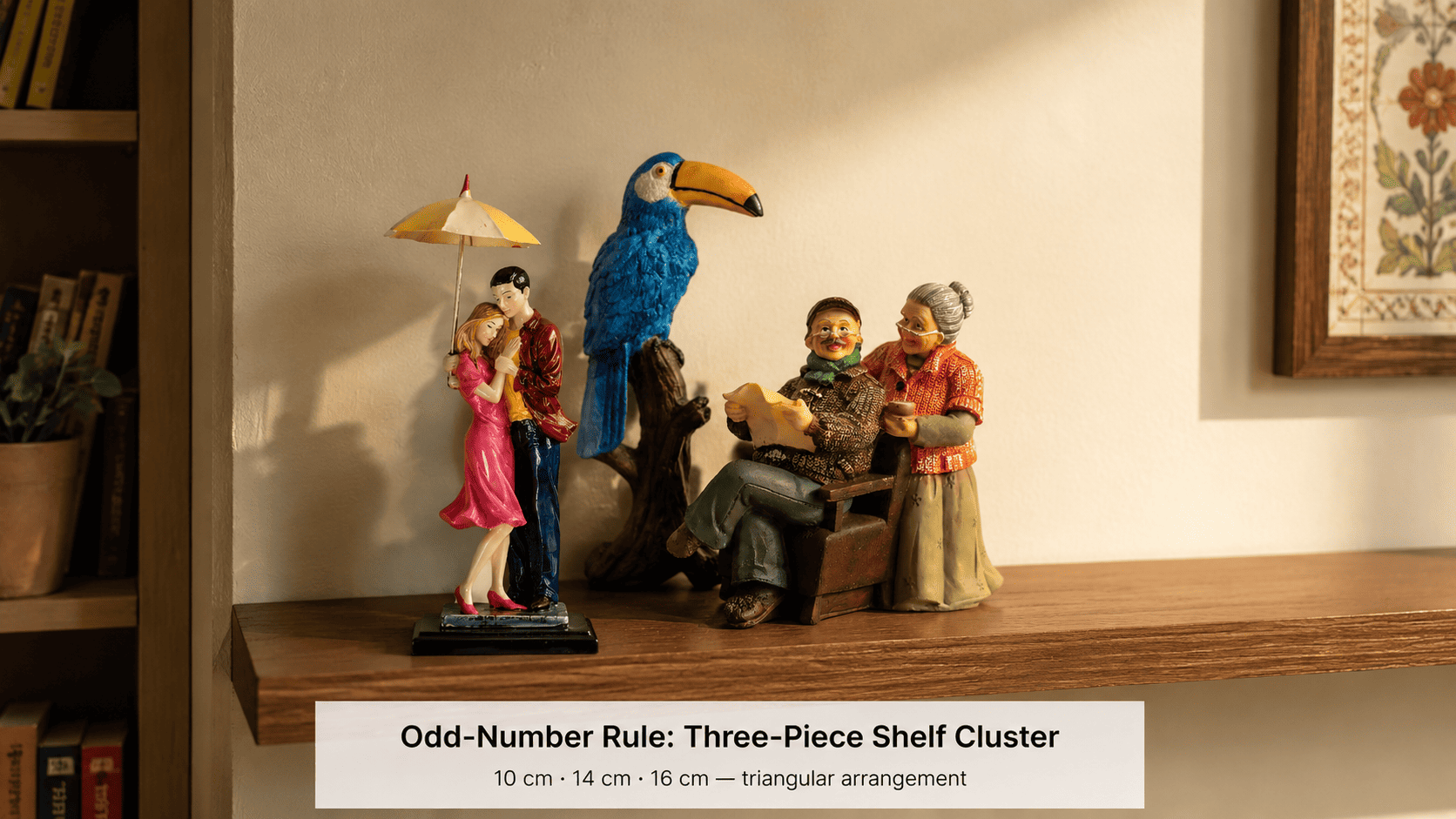
Placing two objects of similar height side by side creates a visual pair that the eye treats as a single larger mass — effectively doubling the perceived footprint of the décor on the surface. Three objects of varied height (low-medium-high progression) arranged in a triangular cluster create three distinct focal points that the eye resolves as a composition rather than a mass, reducing the perceived footprint by approximately 30% compared to a flat side-by-side arrangement of the same pieces.
The height differential between the tallest and shortest piece in a cluster should not exceed 8–10 cm in a compact Indian living room, because larger differentials create vertical movement that draws the eye upward and disrupts the horizontal sightlines that make small spaces feel settled. For a shelf with a 30 cm depth, a cluster of three small décor pieces at 10 cm, 14 cm, and 16 cm — arranged from front to back in ascending height — uses depth to create the perception of layering without increasing the surface footprint beyond the 40% zone.
Ready to bring home a showpiece engineered for Indian humidity and scaled for your exact surface? Shop the full Moolwan living room décor collection now.
Material Choice: When Ceramic Outperforms Resin in an Indian Living Room
Resin showpieces rated to a minimum 94% epoxy purity perform reliably at humidity levels up to 60% RH and temperatures between 15–35°C — conditions that describe climate-controlled Indian living rooms during the non-monsoon months. However, in rooms without consistent air conditioning, or in coastal cities where indoor humidity routinely exceeds 65% RH during June–September, resin surfaces develop surface tackiness and micro-yellowing within 24–30 months because the epoxy matrix absorbs atmospheric moisture at the molecular level.
Ceramic pieces with a 92% high-density clay composition tolerate up to 85% RH without structural or surface degradation, making them the climatically correct choice for any Indian living room that experiences seasonal humidity swings. The trade-off is brittleness: high-fired ceramic fails at point impact, whereas resin deforms rather than shatters. For low-traffic surfaces — floating shelves, console tables, or bookcases where the piece is not regularly moved — ceramic's durability advantage under humidity outweighs the impact risk. For high-touch surfaces like coffee tables in households with children, resin's deformation-over-fracture behaviour makes it the safer long-term choice within its 60% RH operational range.
Palette Selection: Matching the Accent to Indian Living Room Colour Schemes Without Creating Contrast Clutter
Visual clutter is not always a function of the number of objects in a space — it is frequently a function of palette conflict. A single piece in a strongly contrasting colour (a cobalt blue showpiece against warm-beige walls, for instance) creates more perceived visual noise than three pieces in tones drawn from the same warm-neutral family as the surrounding surfaces. The eye must resolve colour contrast as a separate cognitive task from resolving spatial arrangement, and when both tasks are active simultaneously, the room reads as busier than it physically is.
In Indian living rooms where wall colours skew toward warm whites, greiges, and muted ochres — the dominant palette in Indian apartment construction — décor accents in warm earth tones (terracotta, sand, warm taupe, antique brass) integrate into the visual field and read as curated rather than placed. A single accent in a restrained contrast colour — dusty sage, slate blue, muted olive — works as a deliberate punctuation piece, but only when it is the sole colour departure in the room's décor. Introducing two or more contrast-colour pieces activates multiple visual interruptions simultaneously, which is the perceptual mechanism behind the feeling that "the room is too busy."
Frequently Asked Questions
How many décor accents are too many for a small Indian living room?
In a living room under 120 sq ft, one medium showpiece (16–21 cm) functioning as a standalone focal point, or a cluster of two to three small pieces (10–16 cm each) in an odd-number grouping, is the functional ceiling before perceived clutter sets in. The mechanism is cognitive load: each independently scaled and coloured object in the visual field requires a separate resolution step, and beyond three unrelated pieces, the brain registers the surface as disordered rather than styled. Moolwan's size guidance is built around this threshold — keeping the accent count low and the surface breathing room high.
Does the weight of a showpiece matter for a coffee table or shelf?
Weight matters primarily for stability and surface safety, not aesthetics. For floating shelves rated to 5–8 kg load capacity (standard for Indian masonry wall-anchored shelves), a 150–250 g small ceramic piece uses under 5% of load capacity — well within safe range. On coffee tables with glass tops (common in Indian living rooms), pieces above 500 g increase the risk of surface stress concentration at point contact; rubber-footed bases distribute this load and are advisable for pieces above 400 g. Moolwan's small and medium ceramic pieces fall within the 150–400 g range, making them safe for standard Indian floating shelves and glass-topped tables without additional modification.
Can I use a large showpiece (25–34 cm) in a compact Indian living room without it looking overwhelming?
Yes, under two conditions: the piece must be the sole accent on its surface (no coexisting objects), and the surface must be a console or entryway table at least 80 cm wide, not a coffee table or shelf. Large pieces generate a focal-point effect because their height-to-eye-level ratio in a seated position (where Indian living room occupants spend most of their time) creates an upward visual vector that commands attention. This is appropriate for a console along a feature wall but disruptive on a low coffee table where the piece sits within the primary sightline across the room. Place one large piece at the room's perimeter, never at its centre.
Does a décor accent's finish affect how dusty it looks between cleanings in an Indian home?
Yes — significantly. Textured matte surfaces trap fine particulate dust in their micro-surface irregularities, making dust accumulation visible in raking light within 7–10 days without cleaning. Smooth glazed ceramic surfaces hold dust more loosely because the uniformly flat surface offers minimal adhesion points, and a single wipe removes visible accumulation. For high-traffic Indian living rooms where daily dusting is impractical, a smooth-finish glazed ceramic piece on a low surface requires less maintenance than a deeply textured matte piece. For shelf or console placements where raking light is less direct, matte finishes perform acceptably on a weekly cleaning schedule.
A living room décor accent that earns its place over 5+ years in an Indian home is one sized to 35% or less of its surface width, finished in a material rated for Indian humidity, and placed with 60% of the surface left deliberately clear. Buy a climate-rated piece sized to your exact surface from the Moolwan living room décor collection — manufactured in-house, sold direct, and engineered for Indian rooms. If you are furnishing a living room that also needs to make a stronger design statement, consider the curated selection at Moolwan's unique décor items for elegant living rooms for accent pieces with greater visual presence; or, for homes where modern aesthetics coexist with traditional architecture, browse Moolwan's modern-vintage home décor for traditional living rooms for pieces that bridge both registers without creating palette conflict.


