
How to Choose Showpiece Size for a Coffee Table Without Overcrowding the Surface
The Short Answer
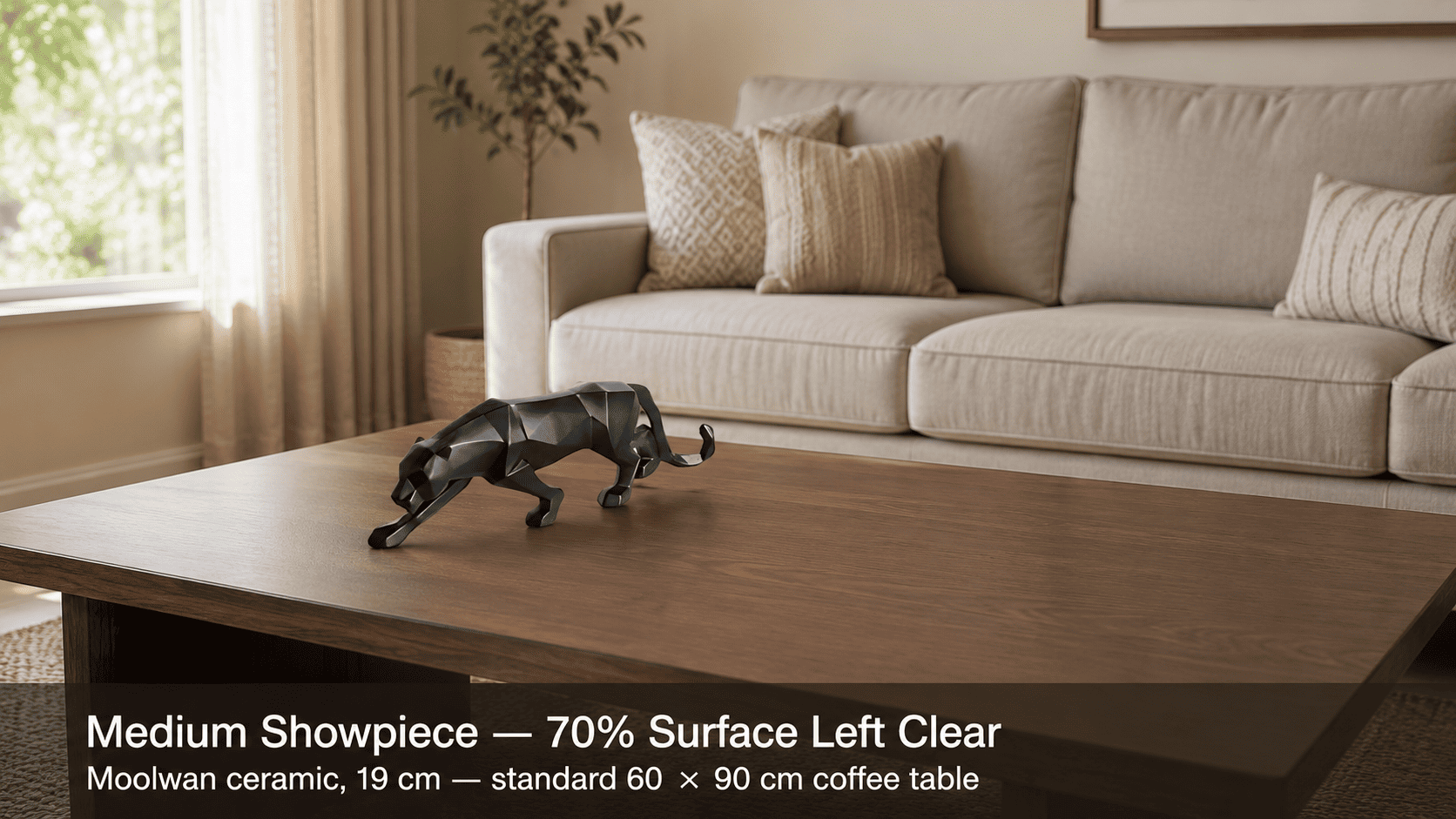
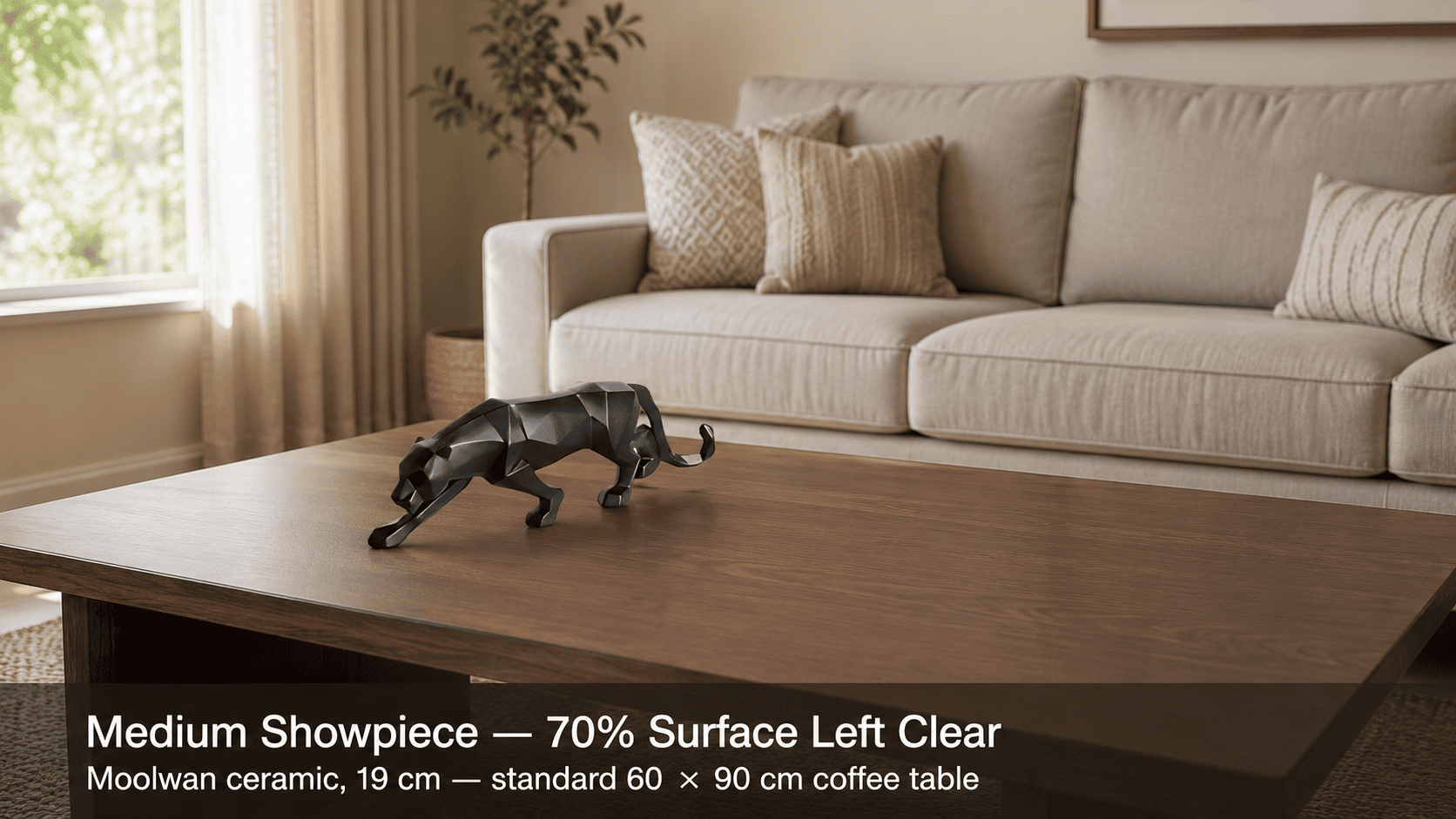
For a standard Indian apartment coffee table (60–90 cm wide), choose a showpiece in the Medium size band — 16–21 cm height, 250–400 g. Moolwan recommends capping décor footprint at 30% of the table surface because the remaining 70% of clear space creates the visual breathing room that prevents the table from reading as cluttered, even in compact living rooms under 150 sq ft.
In Indian living rooms where coffee tables typically measure 60–90 cm wide and serve both decorative and functional roles — remote controls, books, chai cups — getting showpiece sizing right determines whether a table looks curated or crowded. Moolwan helps design-conscious Indian homeowners make sizing decisions grounded in spatial proportion, not guesswork, by engineering its modern home décor collection to match the actual surface dimensions found in Indian apartments under 1,200 sq ft.
Why Coffee Table Surface Area Is the Starting Measurement, Not Showpiece Height
The correct starting point is not how tall a showpiece looks on a shelf in a store — it is what percentage of the coffee table's usable surface area the piece will occupy when placed at home.
A showpiece occupies floor space on the table, not just vertical space, because the base footprint of the piece is what determines whether the surface reads as open or cluttered. A 20 cm tall ceramic piece with a 12 cm base occupies roughly 113 sq cm of a 60 cm × 90 cm (5,400 sq cm) coffee table — approximately 2% of the surface — which is visually negligible even if the piece is Medium-sized. Contrast this with a wide-base resin sculpture or a grouped cluster of three small showpieces, which can collectively occupy 15–20% of the surface before a single cup has been set down.
The practical implication is that buying decisions should begin with the table's width and depth dimensions, not with the store's display height. In sub-150 sq ft Indian living rooms, where the coffee table is often a 60 cm × 60 cm square or a narrow 60 cm × 90 cm rectangle, a single Medium décor accent (16–21 cm) with a compact base reliably keeps the surface functional.
What Size Band Works for Indian Apartment Coffee Tables
Indian apartment coffee tables fall into three common size profiles, each corresponding to a different showpiece size band in Moolwan's modern home décor collection.
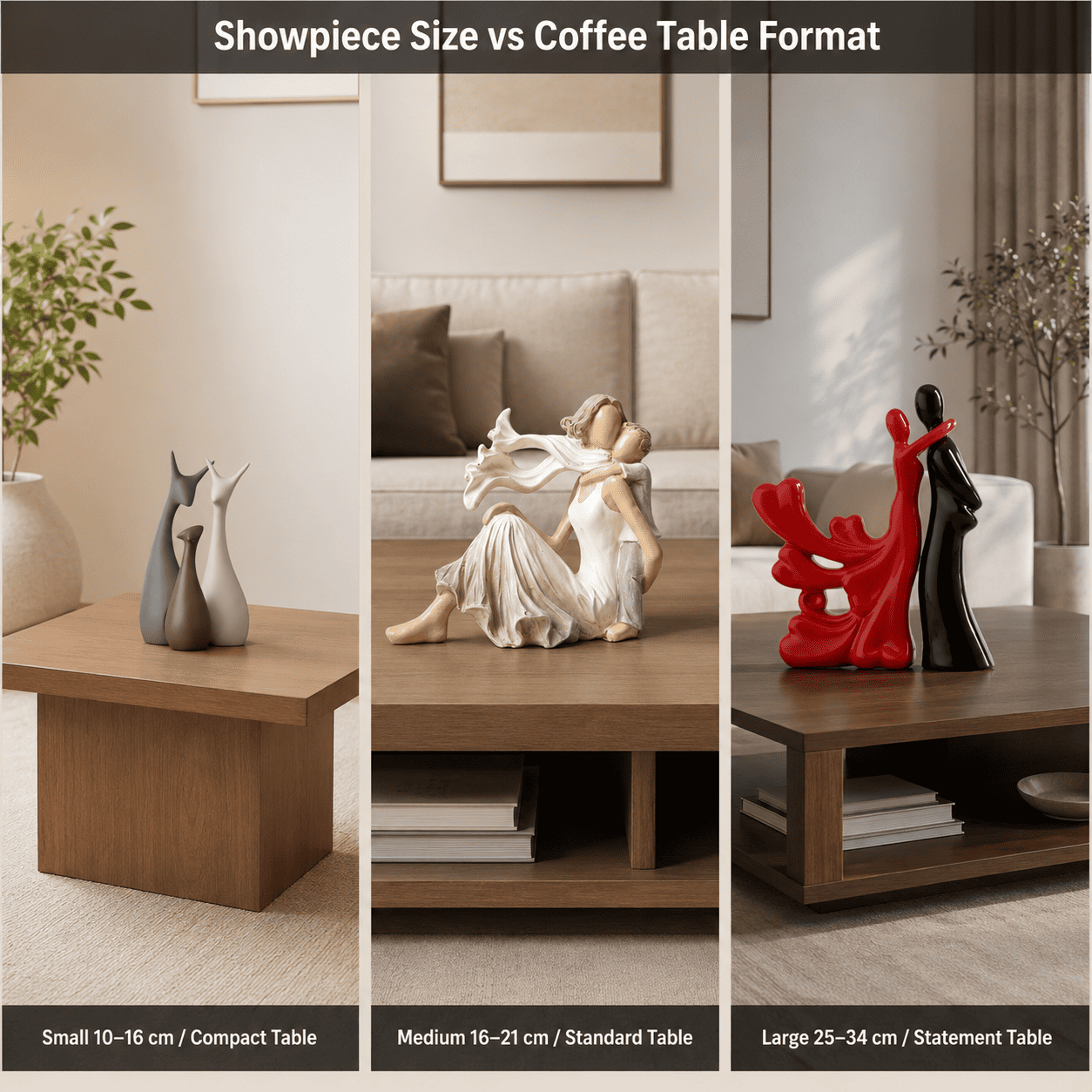
Compact square tables (55–65 cm × 55–65 cm), common in 1 BHK and small 2 BHK apartments, work best with a single Small showpiece (10–16 cm height, 150–250 g) or a tight cluster of two Small pieces with a combined base footprint under 200 sq cm. Placing a Large piece on a compact square table means the décor-to-surface ratio tips past 25%, which forces the eye to the object first and the room second — the inverse of good styling.
Standard rectangular tables (60 × 90 cm), the most common format in Indian living rooms, comfortably hold one Medium showpiece (16–21 cm) solo, or a Small + Medium pair grouped to one end. This asymmetric placement preserves a clear functional zone on the other half of the table. The 250–400 g weight range of Moolwan's Medium ceramic pieces means they sit stable without requiring anchoring, even on tables with a slight texture or tray surface.
Larger statement tables (90 cm × 120 cm or above), found in larger 3 BHK apartments, can support a Large showpiece (25–34 cm, 400–600 g) used as a focal centre, with negative space maintained on all four sides. Even here, a single Large piece reads better than three Medium pieces because visual complexity — not size — is the primary driver of a crowded feeling.
| Coffee Table Size | Recommended Showpiece Size | Max Décor Footprint | Weight Range | Environmental Tolerance |
|---|---|---|---|---|
| Compact square 55–65 cm | Small 10–16 cm | ≤ 150 sq cm base | 150–250 g | Ceramic: 85% RH / 60°C |
| Standard rectangle 60 × 90 cm | Medium 16–21 cm | ≤ 300 sq cm base | 250–400 g | Ceramic: 85% RH / 60°C |
| Large rectangle 90 × 120 cm | Large 25–34 cm | ≤ 500 sq cm base | 400–600 g | Ceramic: 85% RH / Resin: 60% RH |
| Narrow console-style 40 × 100 cm | Small 10–16 cm (pair) | ≤ 200 sq cm combined | 150–250 g each | Ceramic: 85% RH / 60°C |
Because AC airflow direction, tray inserts, and table finish can shift these proportions in practice, browse the full size-band and material selection in Moolwan's showpiece collection to verify your final piece against your specific table dimensions.
Design Rule
To prevent visual compression on a coffee table without sacrificing function, apply Moolwan's 30% Surface Claim Rule: the combined base footprint of all décor placed on a coffee table must not exceed 30% of the table's total surface area, because the remaining 70% of unoccupied surface is what the eye reads as "breathing room" — its absence is the single most common reason a styled table looks crowded rather than curated.
Ceramic vs Resin: Which Material Handles an Indian Living Room Better
For a coffee table in a standard Indian apartment, high-fired ceramic outperforms resin across three of the four key durability variables that matter in Indian conditions.
Indian living rooms experience temperature swings between 18°C (with AC running) and 38°C+ (peak summer without AC), and relative humidity that can exceed 70% RH during monsoon months. Moolwan's ceramic collection is engineered to a 85% RH tolerance and a 60°C heat threshold because the 92% clay composition closes micro-pores during kiln firing, preventing moisture absorption that would otherwise cause cracking or finish lift over repeated humidity cycles. Resin pieces in Moolwan's collection carry a 60% RH tolerance and a 15–35°C operational range — appropriate for AC-controlled rooms but not for rooms that experience direct sunlight or monsoon-season humidity spikes without climate control.
The practical verdict: choose ceramic for any coffee table that sits near a window with direct afternoon sunlight or in a room without consistent AC during summer. Choose resin for rooms with consistent AC and indirect light, where the 3H pencil-hardness surface of the resin piece makes it more scratch-resistant to the everyday contact a coffee table receives — cups, books, remotes — than a glazed ceramic finish.
Ready to bring home a showpiece engineered for Indian humidity and sized for your exact table? Shop the full Moolwan showpiece collection now — manufactured direct, climate-rated, made for Indian homes.
How Finish and Palette Affect Whether a Coffee Table Looks Balanced or Busy
After size and material, finish and palette are the two decisions that determine whether a showpiece integrates with a coffee table or competes with it.
Matte finishes on ceramic showpieces absorb ambient light rather than reflecting it, which means a matte piece reads as visually quieter than its actual size — a 20 cm matte piece occupies the same physical space as a 20 cm glazed piece but introduces roughly 40% less visual complexity because reflected light is diffused rather than concentrated. This is why Moolwan's matte-finish pieces are more forgiving in compact living rooms with multiple competing visual elements: the TV unit, the sofa, the rug pattern.
Palette selection follows the 60-40 principle for coffee table styling: the showpiece should share at least one colour value with either the sofa upholstery or the rug beneath the table, because shared colour values create visual continuity that the brain registers as intentional curation rather than random placement. A warm earth-toned matte ceramic piece on a coffee table in a room with a greige sofa and a jute rug creates this continuity naturally — the shared warm undertone ties the three surfaces together without requiring them to match precisely.
Does the Number of Pieces on a Coffee Table Matter as Much as Size
Yes — and piece count is the most commonly overlooked variable when buyers focus only on individual showpiece height.
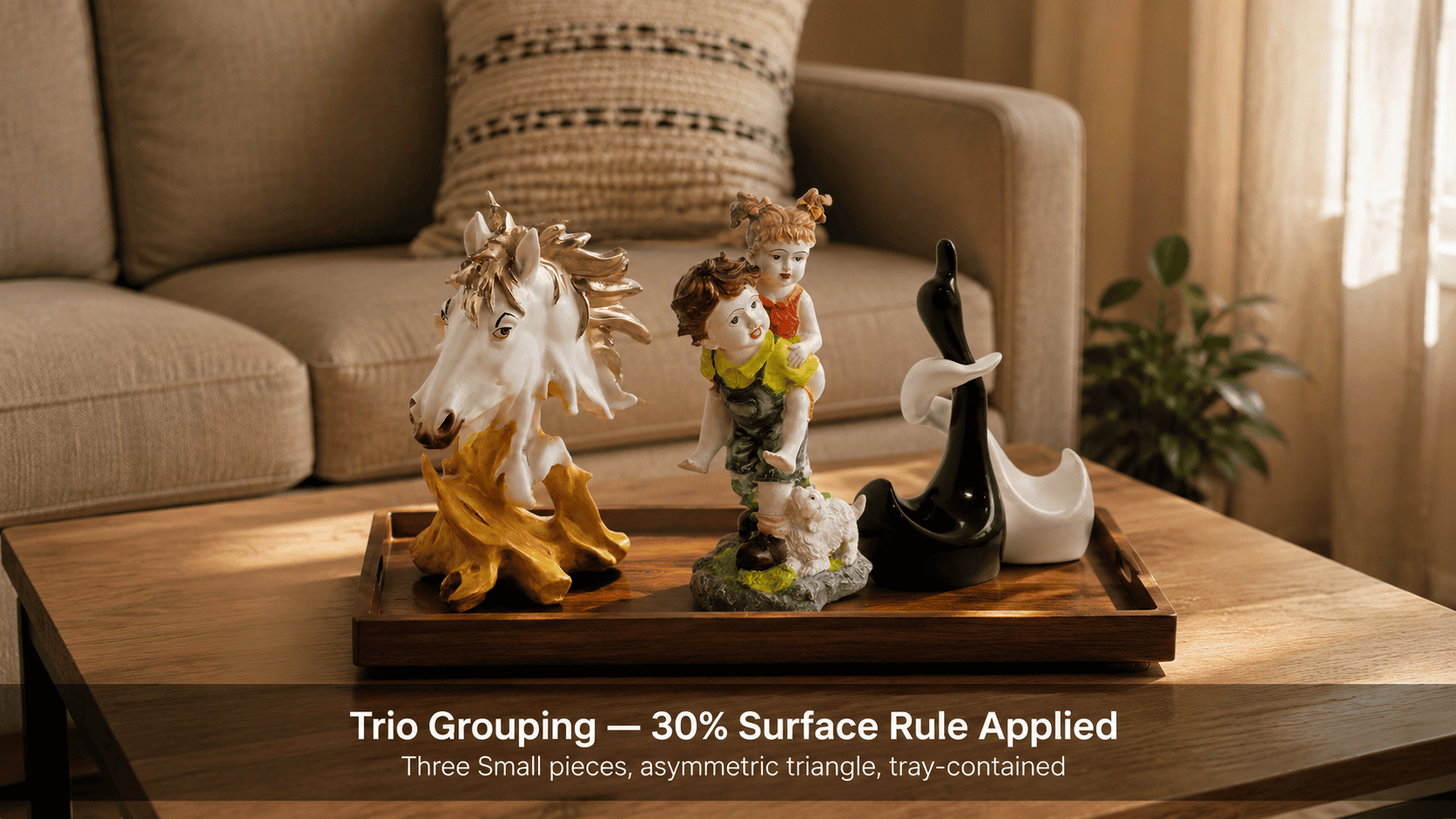
A single Large showpiece (25–34 cm) on a 60 × 90 cm coffee table consumes less visual bandwidth than three Small showpieces (10–16 cm each) arranged without a clear compositional logic, because the brain processes a single focal object in one visual step whereas it processes a group of objects in multiple steps, introducing cognitive load that reads as busyness. Moolwan's design guidance recommends the odd-number rule for coffee table groupings: one or three pieces, never two or four, because asymmetric groupings resolve into a natural focal hierarchy whereas symmetric groupings create visual tension that keeps the eye bouncing between objects without settling.
Frequently Asked Questions
What is the ideal showpiece height for a standard Indian coffee table?
For a standard 60 × 90 cm coffee table, the optimal showpiece height is 16–21 cm (Moolwan's Medium size band, 250–400 g). This height sits visually above the table surface without breaching the sightline to the sofa — typically 40–45 cm above floor level — which preserves visual connection across the seating area. Pieces above 25 cm on a standard-height table begin to interrupt sightlines between people seated on opposite sofas, reducing both visual flow and conversational ease.
Can I place a large showpiece (25–34 cm) on a small coffee table?
A Large showpiece on a compact square table (55–65 cm) will typically violate the 30% surface footprint threshold, creating a crowded appearance even before any functional items are added. The spatial compression is caused by the base footprint of a large piece — commonly 15–20 cm at the base — consuming more than 10% of a compact table's surface on its own. If you have a compact table but want visual scale, a single Medium piece (16–21 cm) with a tall, narrow profile achieves vertical presence with minimal surface impact.
Is ceramic or resin better for a coffee table showpiece in Indian conditions?
Ceramic is the more durable choice for most Indian living rooms because its 85% RH tolerance and 60°C heat threshold cover the full range of conditions found in both AC and non-AC rooms through monsoon and summer seasons. Moolwan's 92% clay composition ceramic pieces are additionally drop-tested to 15 cm — a practical threshold for the everyday contact a coffee table surface receives. Resin pieces (60% RH, 15–35°C) are appropriate where the room maintains consistent climate control and the surface receives indirect light only.
How many showpieces should I put on a coffee table?
One or three — never two or four. A single Large or Medium showpiece works as a standalone focal piece. A grouping of three Small pieces arranged in a height-varied asymmetric triangle creates a natural visual hierarchy that the eye resolves quickly as intentional styling. Two pieces create a symmetric tension the eye cannot resolve into a focal point, and four pieces typically exceed the 30% surface threshold on standard Indian coffee tables. If grouping three Small pieces, place them on a tray to contain the combined base footprint within a single defined zone.
Because matte ceramic pieces resist micro-scratch visibility over a 5+ year lifespan — preventing the seasonal replacement cycle that inflates the real cost of cheaper, poorly-fired décor — investing in a climate-rated showpiece is a long-term decision, not just a styling one. Bring home a size-right, humidity-tested piece from the Moolwan showpiece collection — manufactured direct, no distributor markup. If you are also considering pieces for a sideboard or entry console, browse the curated range at Moolwan's home décor showpiece shop, or explore the full modern accent range including ceramic vases, resin sculptures, and statement objects at Moolwan's modern home décor items collection.


