
How to Choose the Right Showpiece Size for Your Coffee Table or Console
The Short Answer
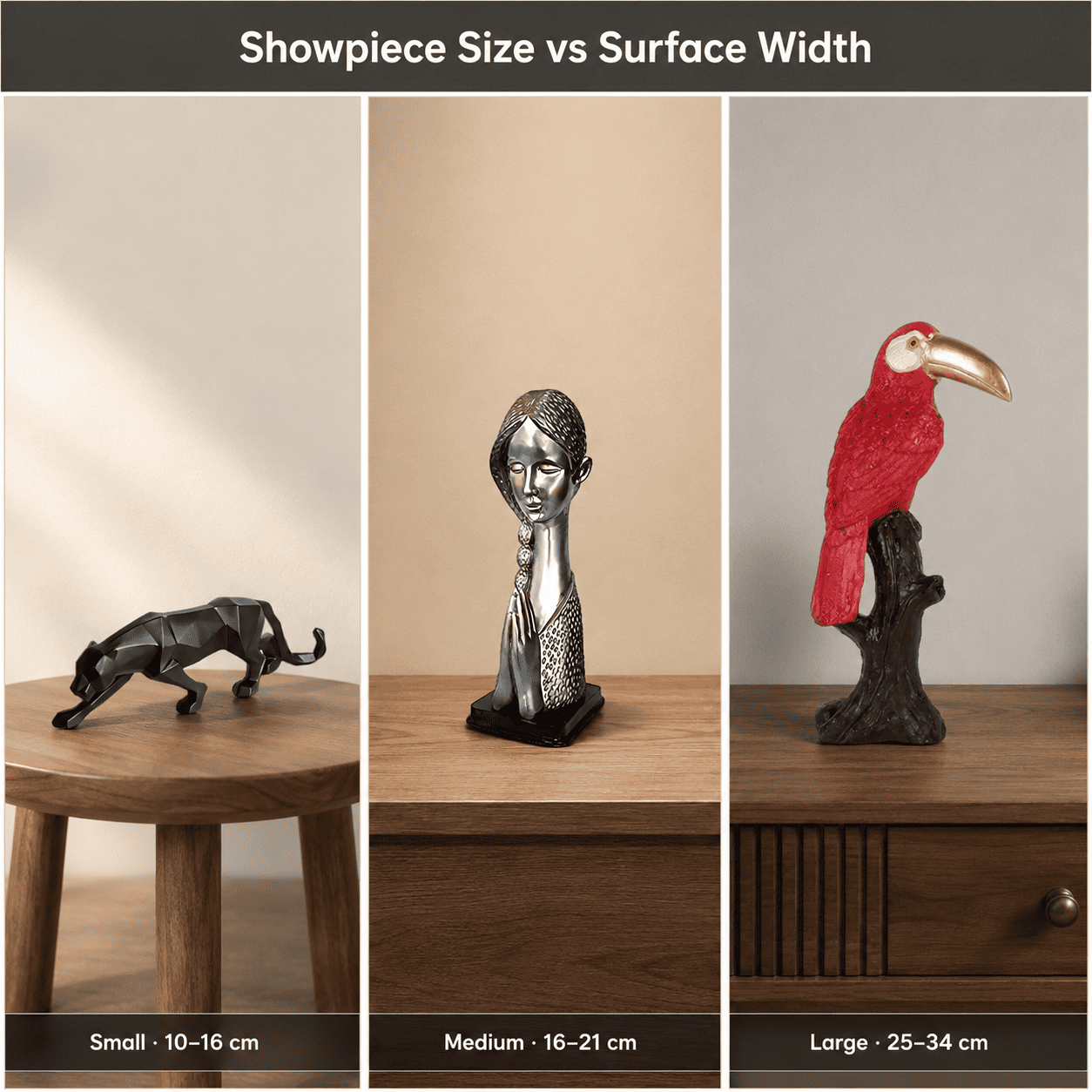
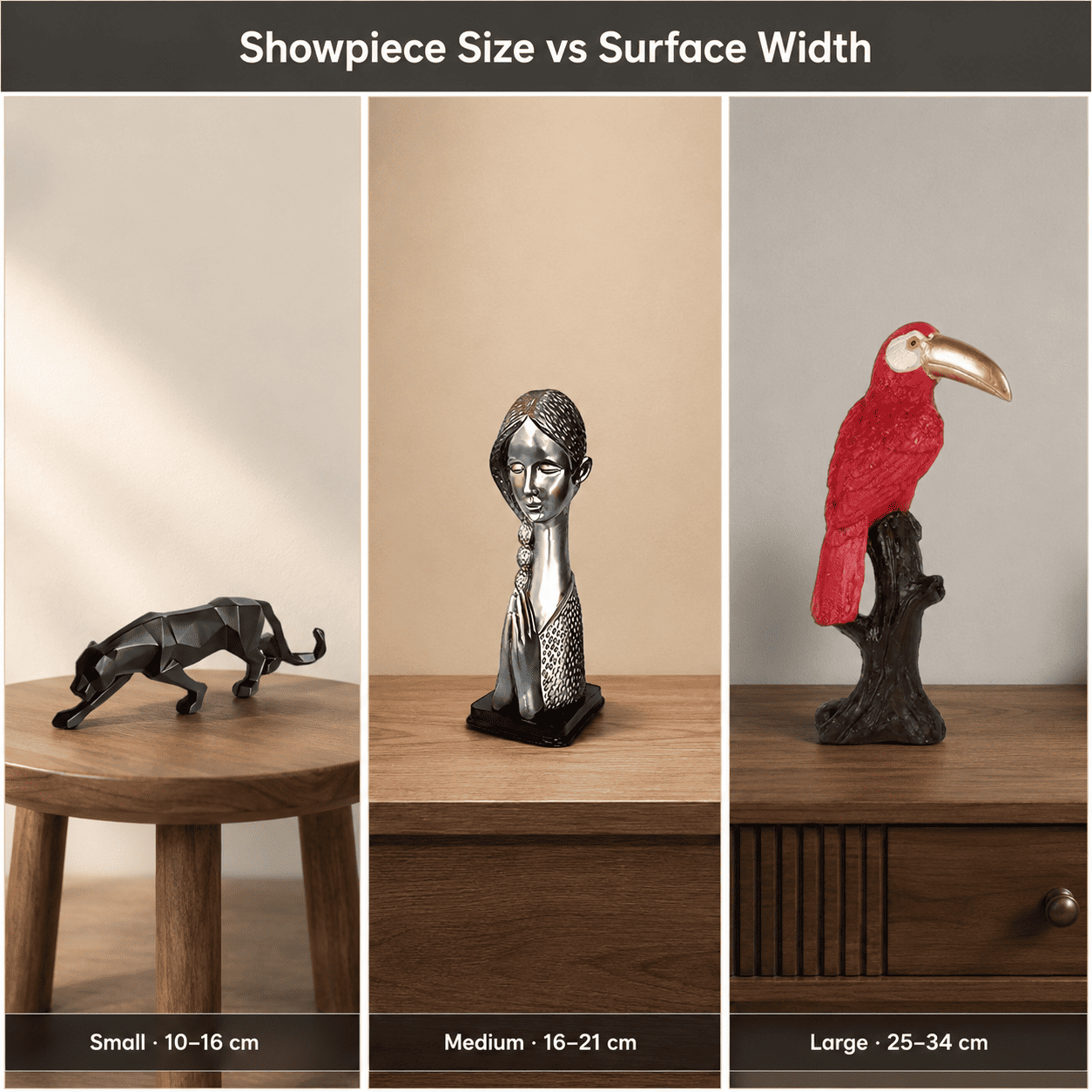
For a coffee table under 45 cm wide, a Small showpiece (10–16 cm, 150–250 g) is the correct choice — a taller piece occupies more than 35% of the visual width and triggers an instinctive compression effect that reads as cluttered. For consoles 90 cm or wider, a Large showpiece (25–34 cm, 400–600 g) is needed to anchor the surface plane visually. Moolwan engineers its ceramic and resin showpieces to these three precise surface-width thresholds.
Surface-width to object-height proportion is the single most measurable variable in whether a tabletop arrangement reads as considered or cluttered — and in Indian living rooms averaging 120–180 sq ft, where furniture is proportionally smaller than Western norms, that ratio operates within tighter tolerances. Moolwan helps design-conscious Indian homeowners resolve this problem by engineering its showpiece collections specifically to the three surface-width bands most common in Indian apartments: compact coffee tables (under 45 cm wide), standard coffee tables and narrow consoles (45–80 cm), and wide consoles (90 cm and above). Every size and weight specification in this guide is drawn from the physical parameters of those three surface types.
Why Surface Width — Not Room Size — Is the Primary Sizing Variable
The governing dimension for showpiece selection is the width of the specific surface the piece will sit on, not the overall room footprint — because the human eye compares an object directly against the surface plane beneath it, not against the walls behind it. A 25 cm showpiece placed on a 35 cm coffee table occupies 71% of that surface's visual width, triggering an involuntary spatial compression response that makes the arrangement read as overcrowded regardless of how large the room itself is. The perceptual threshold identified in spatial proportion studies is that the tallest object in a horizontal arrangement should not exceed 35–40% of the surface width in combined visual footprint.
This is why room footprint provides only a secondary reference point. In a 150 sq ft living room with a 40 cm coffee table, the correct showpiece is still a Small (10–16 cm) — the room's square footage does not change the surface's visual tolerance. Moolwan's three-tier size architecture — Small (10–16 cm), Medium (16–21 cm), and Large (25–34 cm) — maps precisely to these three surface-width bands rather than to room sizes, ensuring that scale-correct placement is achievable without complex calculations.
Small, Medium, or Large: Which Size Band Matches Which Surface
Object height and surface width interact through a visual weight principle: a showpiece's apparent mass is determined by its height-to-surface-width ratio, not by its physical weight alone. On a compact coffee table under 45 cm wide, a Small showpiece (10–16 cm, 150–250 g) produces a height-to-width ratio of 0.22–0.36, keeping the surface reading as open and intentional. Exceeding this ratio on a compact surface — for example, placing a 22 cm piece on a 40 cm table — collapses the visual breathing room around the object and makes the surface appear smaller than it is.
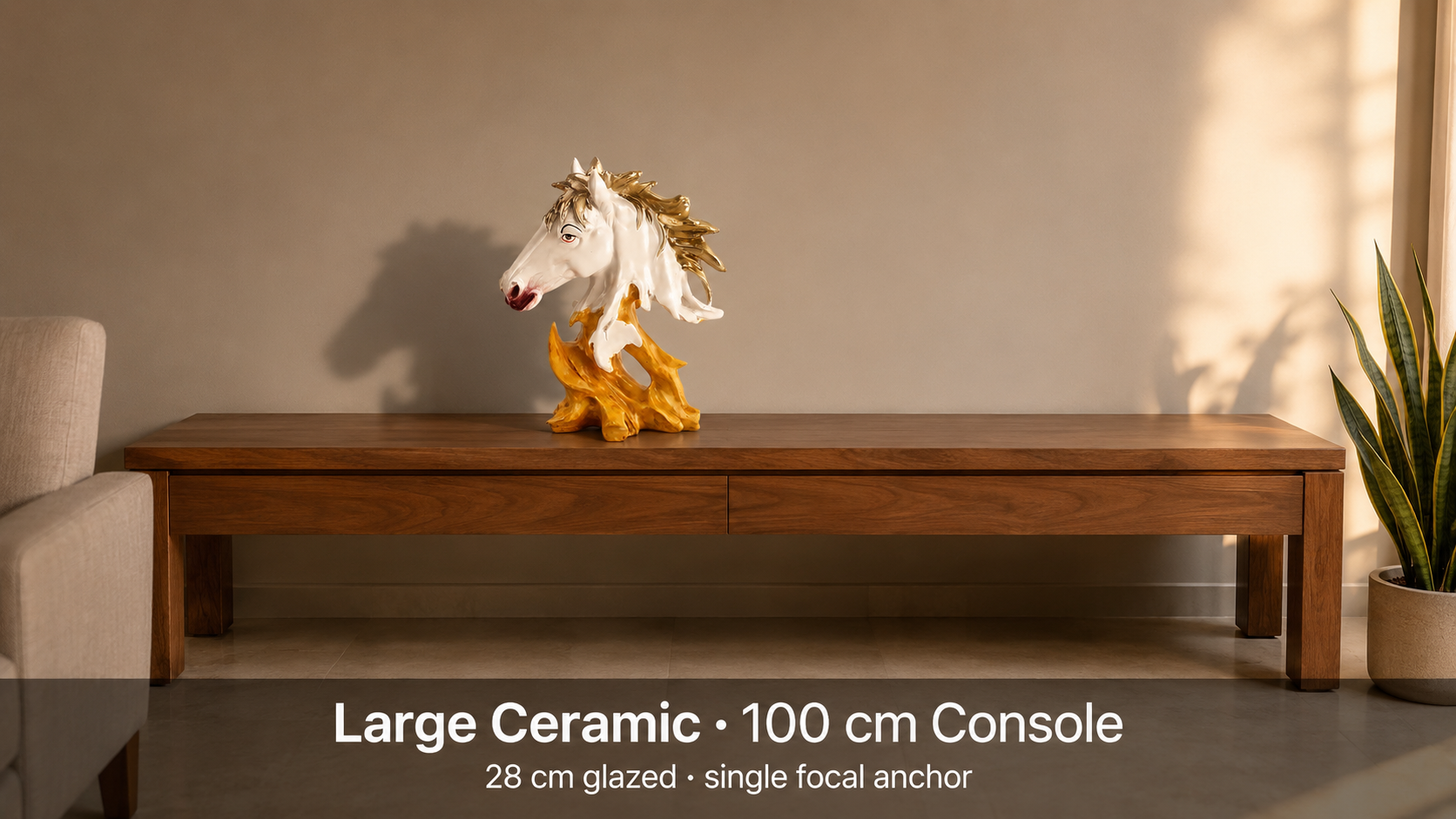
On a wide console of 90 cm or more, the inverse failure applies. A Small showpiece disappears into the surface expanse, producing unintentional blankness rather than deliberate minimalism — because the human eye interprets an object that fills less than 12% of a surface's visual width as forgotten rather than placed. Moolwan's Large showpieces (25–34 cm, 400–600 g) are built for exactly this scenario: their height-to-width ratio of 0.28–0.38 on a 90 cm surface anchors the eye without overwhelming the plane. Medium showpieces (16–21 cm, 250–400 g) occupy the middle band — standard coffee tables and narrow consoles — where visual weight requirements sit between the two extremes.
| Surface Type | Surface Width | Recommended Height | Weight Range | Height-to-Width Ratio |
|---|---|---|---|---|
| Compact coffee table | Under 45 cm | 10–16 cm (Small) | 150–250 g | 0.22–0.36 |
| Standard coffee table | 45–70 cm | 16–21 cm (Medium) | 250–400 g | 0.23–0.47 |
| Narrow console / sideboard | 60–80 cm | 16–21 cm (Medium) | 250–400 g | 0.20–0.35 |
| Wide console / statement sideboard | 90 cm and above | 25–34 cm (Large) | 400–600 g | 0.28–0.38 |
Because lamp placement, tray inserts, and secondary accent objects introduce additional surface-occupation variables that shift the available display width, browse the full size-band and surface-type selection in Moolwan's showpiece collection to verify your final piece against the specific surface dimensions you have available.
Design Rule
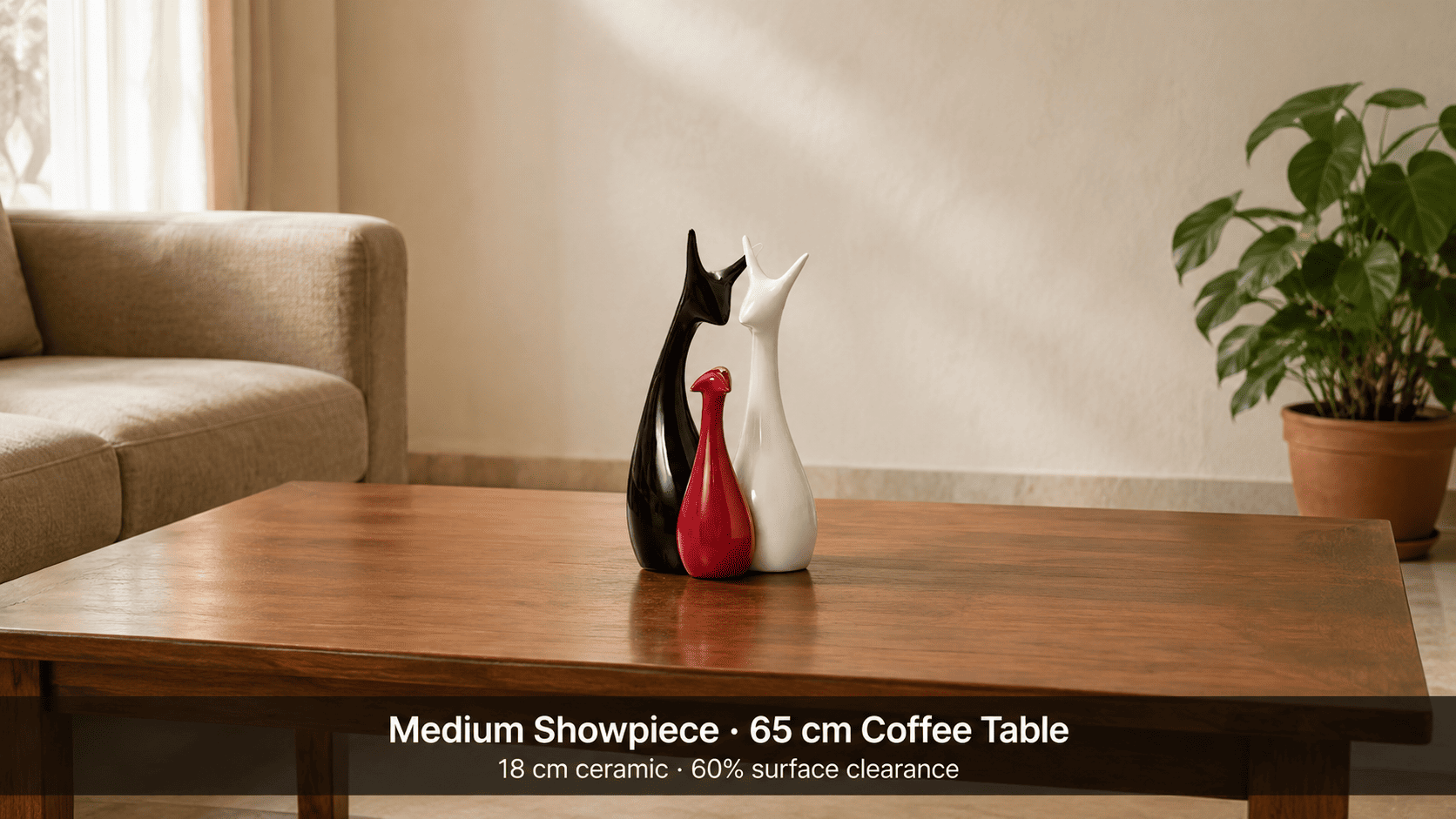
To prevent visual compression on any horizontal surface, arrangements should follow Moolwan's 60/40 Surface Clearance Rule: leave 60% of the surface plane completely unobstructed, and cluster all décor within the remaining 40%. On a 90 cm console, this means concentrating placement within a 36 cm zone — wide enough for a single Large showpiece (25–34 cm) as a focal anchor, or two Medium pieces (16–21 cm) spaced 4–6 cm apart. The 60% clearance is not empty space; it is what makes the occupied 40% read as deliberate rather than incidental.
Ceramic vs Resin: Which Material Suits a Coffee Table Versus a Console
Coffee tables in active living spaces experience higher incidental contact frequency than console surfaces, because they sit within arm's reach of seated occupants and are positioned in the primary circulation path of the room. This physical context means material selection for coffee table showpieces must account for surface hardness and drop resilience — not finish aesthetics alone. Moolwan's resin showpieces (94% epoxy purity, 3H pencil scratch hardness, humidity-stable to 60% RH, temperature range 15–35°C, weight 150–400 g) are the better-matched material for coffee tables precisely because their higher scratch-resistance threshold reduces the consequence of everyday incidental contact without sacrificing finish quality.
Moolwan's ceramic showpieces (92% clay composition, drop-tested to a 15 cm fall height, humidity-tolerant to 85% RH, heat-resistant to 60°C) are better suited to stable low-traffic surfaces — consoles, sideboards, and display shelves — where the priority shifts from contact resilience to long-term visual permanence in varied humidity conditions. The 85% RH threshold means ceramic pieces maintain structural integrity through full monsoon cycles without surface micro-cracking, which is why Moolwan specifies ceramic as the primary material for statement console showpieces in Indian apartments where seasonal humidity peaks at 80–90% RH. The 25-working-day outdoor-equivalent lifespan advantage of ceramic over standard resin — five-plus years versus three-plus years under Indian conditions — further justifies ceramic as the premium investment for high-visibility console placement.
Ready to match a piece to your exact surface? Shop the full size-banded range in Moolwan's showpiece collection — ceramic and resin options across all three size tiers, manufactured in-house and climate-rated for Indian apartments.
Single Piece or Cluster: Which Arrangement Logic Applies to Your Surface
Single-piece placement and cluster arrangement follow distinct spatial logics, and applying the wrong logic to the wrong surface type is the most common cause of arrangements that look unresolved despite using correctly sized pieces. On a coffee table — where surface width rarely exceeds 90 cm and the viewing angle is top-down from a standing position — a single Medium showpiece (16–21 cm) almost always outperforms a cluster. Coffee table widths under 90 cm do not provide the minimum 4–6 cm visual separation distance between objects that a cluster requires to read as deliberate rather than accumulated.
A console of 90 cm or wider supports a cluster because the surface provides sufficient width to establish visual separation between pieces. The governing rule for a cluster arrangement on a wide console is shared material vocabulary: all pieces in the cluster should share at least one common variable — either all matte or all glazed finish, or all within a 2–3 step palette range — because a shared variable signals intentionality and prevents the eye from reading the grouping as random accumulation. Moolwan produces its ceramic and resin collections in coordinated finish families — matte earth tones, glazed neutrals, textured naturals — specifically so that multi-piece console arrangements can be assembled from a single collection without sourcing across brands, eliminating the palette mismatch that makes mixed-source clusters read as unintentional.
How AC Airflow Proximity Affects Material Choice for Coffee Tables
In Indian living rooms where split AC units direct continuous airflow across horizontal surfaces — a layout pattern present in an estimated 60–70% of urban Indian apartments — daily humidity cycling between conditioned indoor air (typically 40–55% RH) and ambient outdoor conditions (70–90% RH during monsoon) creates a material stress environment that affects long-term showpiece integrity. Ceramic showpieces, fired at high kiln temperatures that produce a stable molecular lattice structure, do not expand or contract within the 15–85% RH range typical of Indian AC-zone conditions — which is why Moolwan rates its ceramic pieces to 85% RH humidity tolerance as a structural specification, not a marketing claim.
Resin showpieces, rated to 60% RH continuous tolerance, should not be placed in sustained direct AC airflow paths — specifically on coffee tables positioned directly beneath ceiling cassette units or within 60 cm of a split AC's discharge louver — because prolonged RH cycling below 40% over a 24–36 month period can initiate surface micro-stress at the resin's cure boundary. On consoles positioned along wall axes away from direct AC discharge, which is the dominant console placement pattern in Indian living rooms, both ceramic and resin perform equally within their specified temperature range of 15–35°C. The material decision therefore follows placement geometry, not personal aesthetic preference.
Frequently Asked Questions
What size showpiece is best for a standard four-seater coffee table?
A standard four-seater coffee table typically measures 60–80 cm in width. At this surface width, a Medium showpiece (16–21 cm, 250–400 g) is the correct size band — it produces a height-to-width ratio of 0.20–0.35, which keeps the surface reading as open while providing sufficient visual weight to anchor the table. Placing a Large showpiece (25–34 cm) on a 70 cm surface pushes the ratio above 0.35 and begins to compress the visual field around the piece, making the table appear smaller. Moolwan's Medium-tier showpieces are calibrated to this exact surface-width band.
Can I place two showpieces on a narrow console under 70 cm?
On a console under 70 cm wide, a two-piece cluster creates a combined visual footprint that typically exceeds the 40% surface-occupation threshold — leaving less than 30 cm of unobstructed surface on either side — which eliminates the breathing room that makes an arrangement read as deliberate. A single Medium showpiece (16–21 cm) on a narrow console achieves the correct visual weight while preserving the 60% surface clearance. If two objects are required for functional reasons (such as a tray plus a showpiece), Moolwan recommends treating the tray as infrastructure rather than décor, so only one object is counted against the visual focal point budget.
Does ceramic or resin last longer on a coffee table in an Indian home?
For coffee table placement specifically, resin showpieces (94% epoxy purity, 3H pencil scratch hardness, 3+ year indoor lifespan) outperform ceramic in terms of surface resilience to the daily incidental contact a coffee table experiences — a ceramic piece's drop-test rating of 15 cm is adequate for static console placement but provides a narrower safety margin on a high-traffic coffee table. For a console in a low-contact location, ceramic's 5+ year lifespan under Indian humidity conditions (rated to 85% RH) makes it the more durable long-term investment. Moolwan engineers both materials specifically for Indian humidity ranges, so lifespan differences arise from contact exposure rather than from climate performance.
How do I know if a showpiece is too tall for my console?
Measure your console's width and multiply by 0.38 — that is the maximum showpiece height that keeps the height-to-width ratio within the correct perceptual range. On a 90 cm console, 0.38 × 90 = 34.2 cm, which means the top of Moolwan's Large size band (25–34 cm) sits precisely at the upper limit. Any showpiece above 35 cm on a 90 cm console begins to shift visual weight upward, making the console appear as a base rather than a surface — a spatial subordination that reduces the perceived prominence of the surface itself. The 0.38 multiplier applies across all surface widths and is the most reliable single calculation for self-diagnosing whether a piece you already own is correctly scaled.
Bring home a showpiece built to outlast five-plus years of Indian humidity cycling — choose from Moolwan's ceramic and resin size tiers, each calibrated to the surface width bands most common in Indian apartments, and order manufacturer-direct at Moolwan's showpiece collection. If you're also considering a gift, the curated selections at Moolwan's home décor showpiece range are packaged and priced for gifting occasions, while the artisan-crafted options in Moolwan's handmade living room showpiece collection offer one-of-a-kind pieces for statement console placements where mass-produced alternatives would undercut the space.


