
How to Choose the Right Size Showpiece for a Small Indian Living Room
The Short Answer
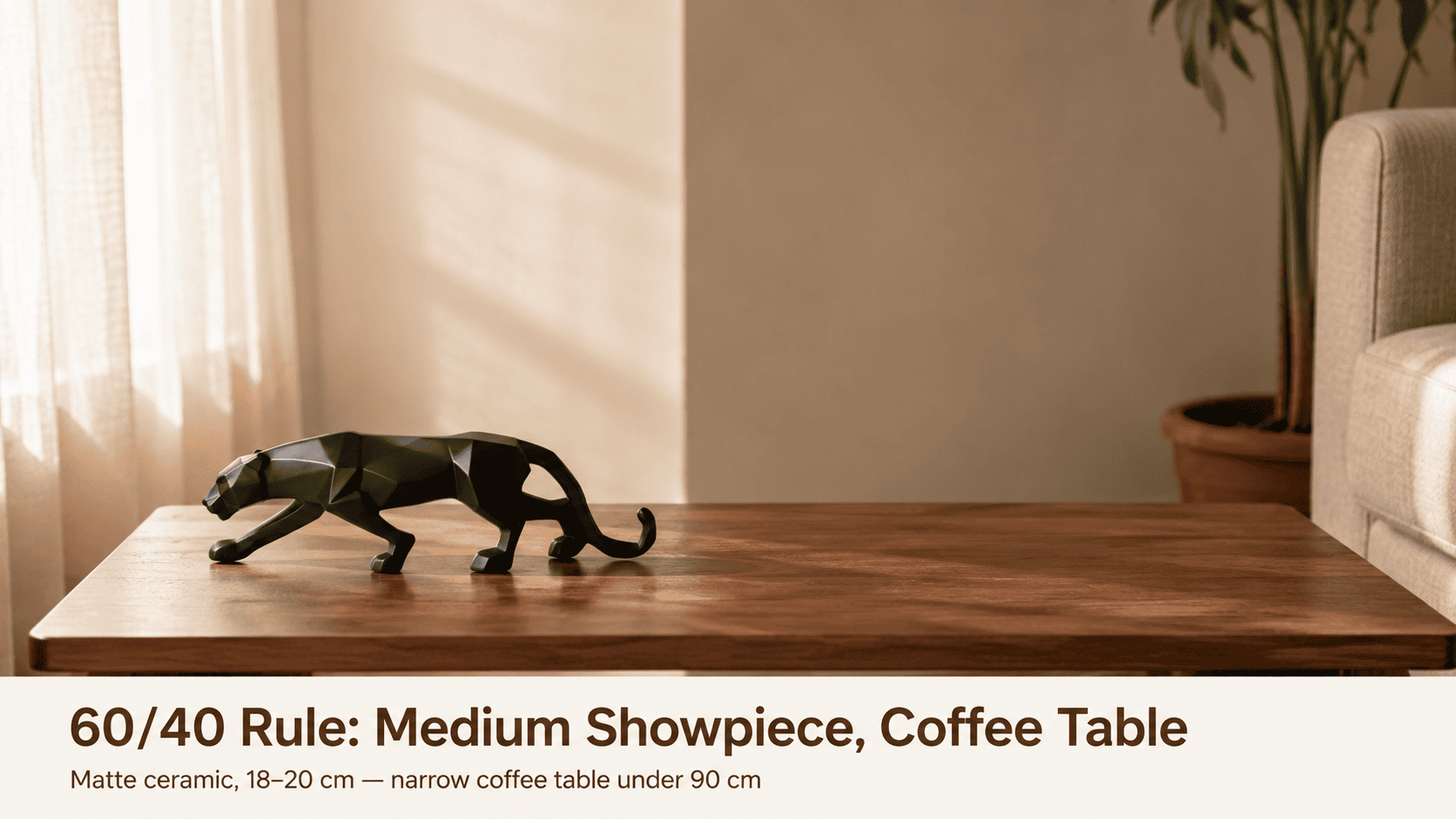
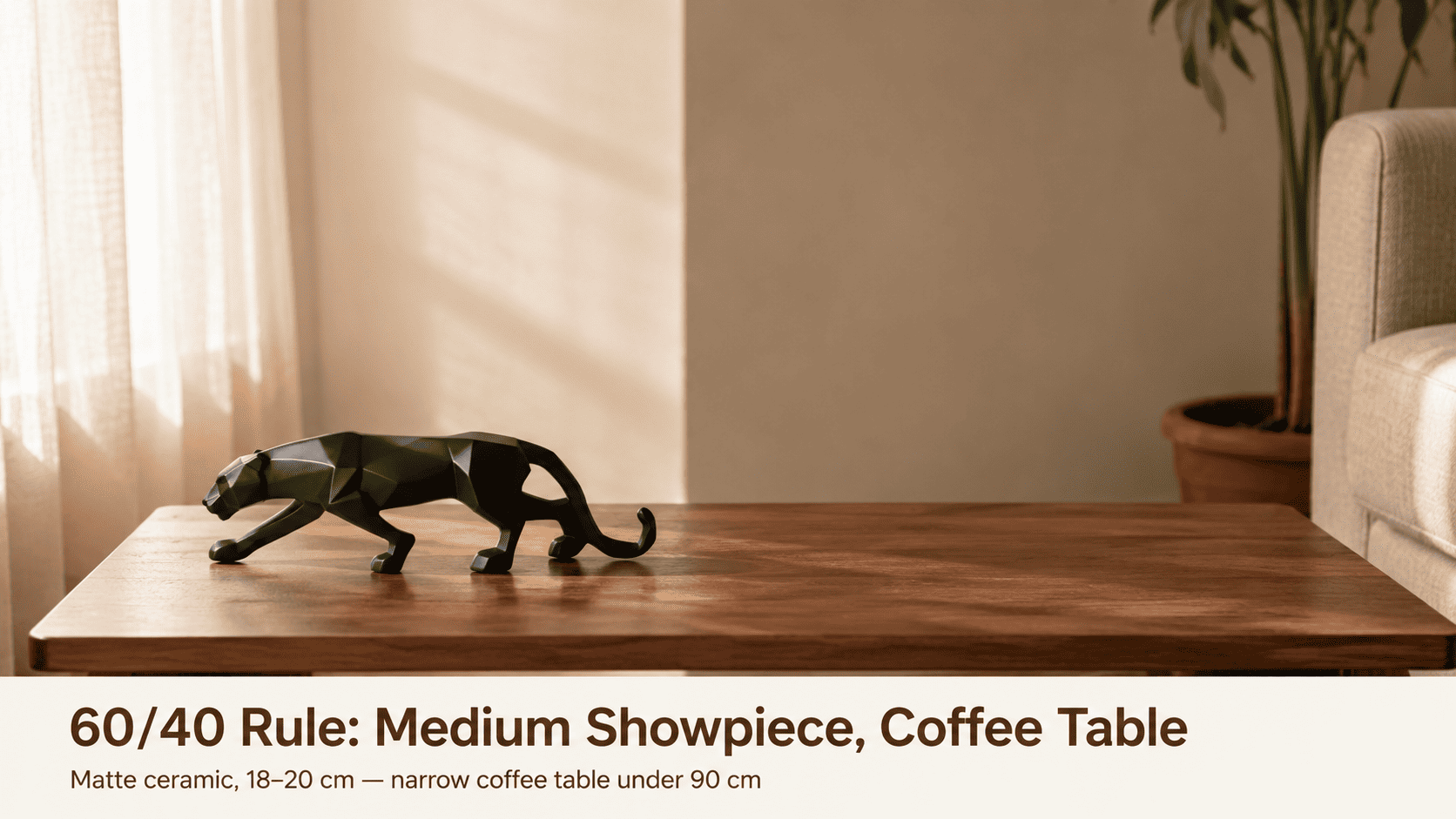
In a living room under 150 sq ft, a showpiece taller than 21 cm visually compresses the space because the eye reads oversized objects as spatial competitors rather than accents. Moolwan's size guide recommends Medium pieces (16–21 cm) for coffee tables and consoles in compact Indian apartments — ceramic at 85% RH tolerance ensures the finish survives year-round without seasonal replacement.
Indian urban apartments average 800–1,200 sq ft across the full unit, with living rooms often occupying just 100–160 sq ft of that footprint — a spatial constraint that makes décor sizing one of the highest-impact decisions a homeowner can make. Moolwan helps design-conscious Indian homeowners choose showpieces that fit the actual geometry of their space, rather than the aspirational proportions of a 2,500 sq ft villa. When a showpiece is correctly sized for its surface and room volume, it reads as a deliberate accent; when it is oversized, it reads as clutter, regardless of its quality or finish.
Why Size Matters More Than Style in a Compact Living Room
In interior spatial perception, the human visual cortex evaluates objects relative to their surroundings — not in isolation. A showpiece that occupies more than 40% of a surface's visible width triggers a cognitive pattern associated with clutter, because the brain cannot resolve the boundary between the object and its negative space. This is measurable: studies in environmental psychology confirm that visual density above a threshold of 40% occupied surface area consistently reduces perceived room size.
In a compact Indian living room, surfaces are already spatially loaded — a 3-seater sofa, a coffee table under 90 cm wide, and a television unit can collectively reduce visual breathing room to a critical minimum. Introducing a showpiece above 21 cm on a sub-90 cm coffee table pushes that visual density past the threshold at which the room begins to feel smaller than it is. Moolwan engineers its Medium tier (16–21 cm, 250–400 g) specifically for the coffee table and console surfaces most common in Indian apartments in this footprint range, because the height-to-surface ratio stays within the perceptually comfortable zone.
The material composition also affects the visual weight of a piece independent of its physical dimensions. High-fired ceramic pieces with a matte finish absorb ambient light rather than reflecting it, which reduces the visual prominence of the object and allows a 20 cm piece to read as understated rather than dominant — a critical property in a room where every surface contributes to the overall visual load.
How to Read Your Surface Before You Choose a Showpiece
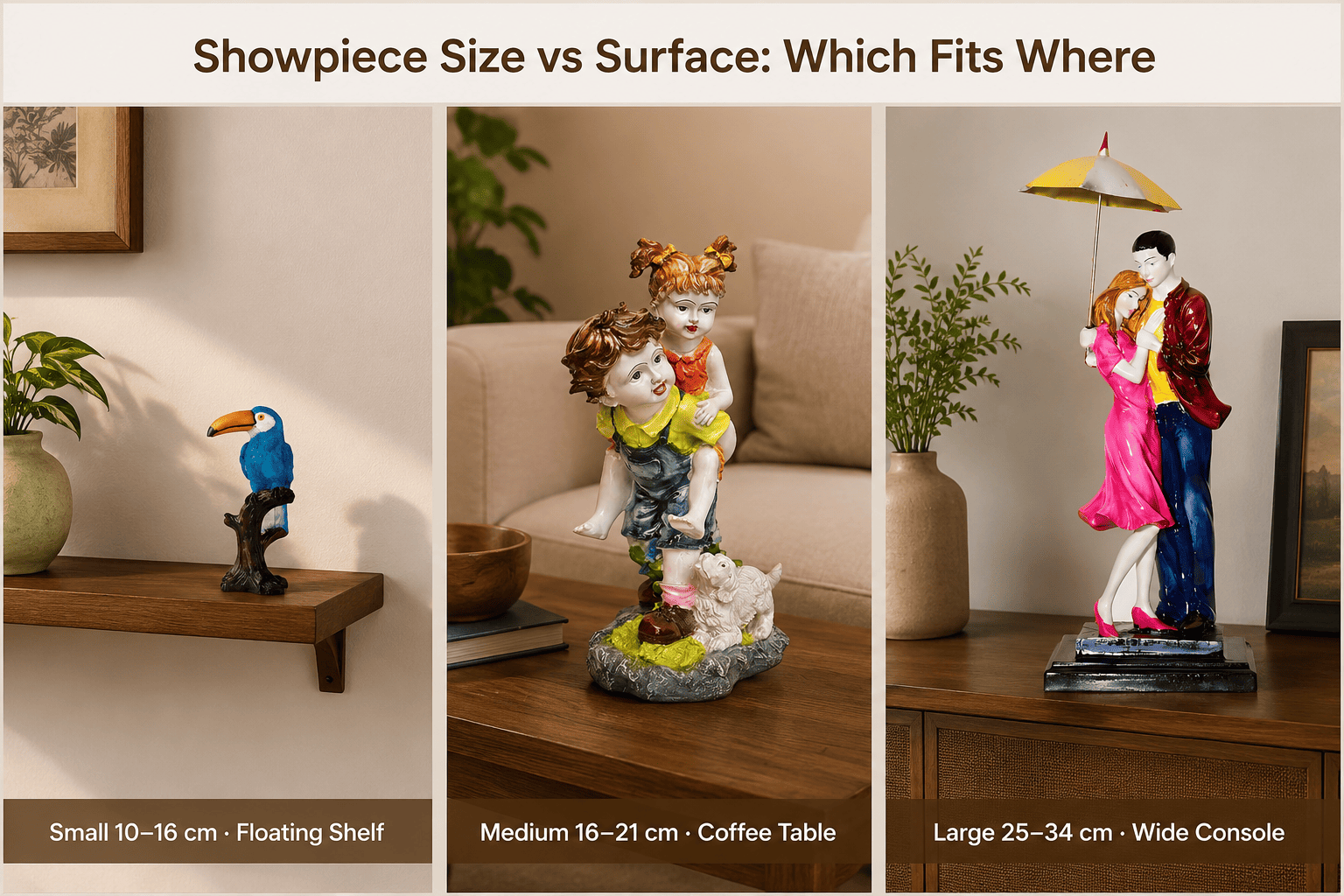
The correct size tier for a showpiece is determined first by surface width, then by room footprint — in that order, because a piece placed on an undersized surface creates instability risk and visual imbalance regardless of how large the room is. A surface under 30 cm wide (typical of a floating shelf or narrow console ledge) can only support a Small-tier piece (10–16 cm, 150–250 g) without the object appearing to hang over the edge, which the eye reads as precarious and therefore visually uncomfortable.
For surfaces between 40–60 cm — the most common Indian living room coffee table width — Medium-tier pieces (16–21 cm) create the correct proportion because the piece height is approximately one-third to one-half of the surface width, a ratio that interior spatial research identifies as the stable visual anchor range. Going above this ratio pushes the piece into focal dominance, which is appropriate only for a dedicated display surface with no competing objects nearby.
Moolwan's ceramic collection addresses an additional Indian-specific constraint: proximity to air conditioning units. In rooms where the AC vent is directed toward a display surface, humidity fluctuations between 40–85% RH occur daily during the monsoon months. The 92% clay composition in Moolwan's ceramic pieces is rated to 85% RH tolerance, which means the finish and structural integrity remain stable across these daily swings — preventing the micro-cracking and glaze separation that accelerates in pieces made from lower-density clay blends exposed to the same conditions.
The Sizing Matrix: Surface, Room Footprint, and Recommended Showpiece Tier
The table below cross-references living room footprint, target surface, surface width, recommended showpiece height, and material humidity tolerance to identify the correct piece for each scenario. The weight range reflects Moolwan's verified specifications for each size tier.
| Living Room Footprint | Target Surface | Surface Width | Recommended Showpiece Height | Weight Range / Humidity Tolerance |
|---|---|---|---|---|
| Under 100 sq ft | Floating shelf / bathroom ledge | Under 30 cm | 10–16 cm (Small tier) | 150–250 g / ceramic: 85% RH, resin: 60% RH |
| 100–130 sq ft | Narrow coffee table / side table | 30–50 cm | 16–18 cm (Lower Medium) | 250–350 g / ceramic: 85% RH, resin: 60% RH |
| 130–160 sq ft | Standard coffee table / console | 50–75 cm | 18–21 cm (Upper Medium) | 350–400 g / ceramic: 85% RH, resin: 60% RH |
| 160–200 sq ft | Wide console / TV unit ledge | 75–100 cm | 21–25 cm (Medium-to-Large transition) | 400–500 g / ceramic: 85% RH, resin: 60% RH |
| 200+ sq ft | Dedicated display surface / sideboard | 100 cm+ | 25–34 cm (Large tier) | 500–600 g / ceramic: 85% RH, resin: 60% RH |
Because individual surfaces vary by furniture manufacturer and actual room layout introduces additional variables — such as wall proximity, sofa arm height, and window light direction — browse the full size-band and material selection in Moolwan's living room showpiece collection to verify the right piece for your specific surface.
Design Rule
To prevent visual compression in small Indian living rooms, Moolwan's 60/40 Surface Clearance Rule specifies that at least 60% of any horizontal display surface must remain entirely unoccupied — with all décor objects clustered within the remaining 40% — because the unoccupied surface area functions as visual negative space, and without it the eye cannot register the placed objects as intentional accents rather than accumulated clutter.
Ceramic vs Resin: Which Material Holds Up in a Small, Poorly Ventilated Indian Living Room
Material choice is a durability decision before it is an aesthetic one, particularly in Indian living rooms where cross-ventilation is limited and humidity can spike to 80–85% RH during monsoon months. Ceramic pieces rated to 85% RH tolerance remain structurally stable across these fluctuations because the high-density 92% clay composition reduces the micro-porosity through which moisture enters the material and causes internal pressure build-up. Resin pieces, by contrast, are rated to 60% RH — a threshold that is regularly exceeded in poorly ventilated Indian interiors during July and August.
This does not mean resin showpieces are unsuitable for Indian living rooms; it means placement matters. Resin pieces (94% purity epoxy, 3H pencil hardness, rated 15–35°C) are well-suited to air-conditioned rooms where the AC maintains humidity below 60% RH year-round, or for living rooms in drier Indian climates such as Delhi-NCR or Rajasthan where ambient monsoon humidity stays below the resin threshold. For rooms in coastal cities — Mumbai, Chennai, Kochi — or rooms without consistent air conditioning, ceramic is the correct material because it tolerates the full humidity range without the finish dulling or the structure developing hairline stress fractures at year two.
Ready to bring home a showpiece sized and climate-rated for your actual living room? Shop the full Moolwan living room showpiece collection — manufacturer-direct, engineered for Indian humidity, delivered with free shipping.
How to Group Multiple Small Showpieces Without Making a Small Room Feel Crowded
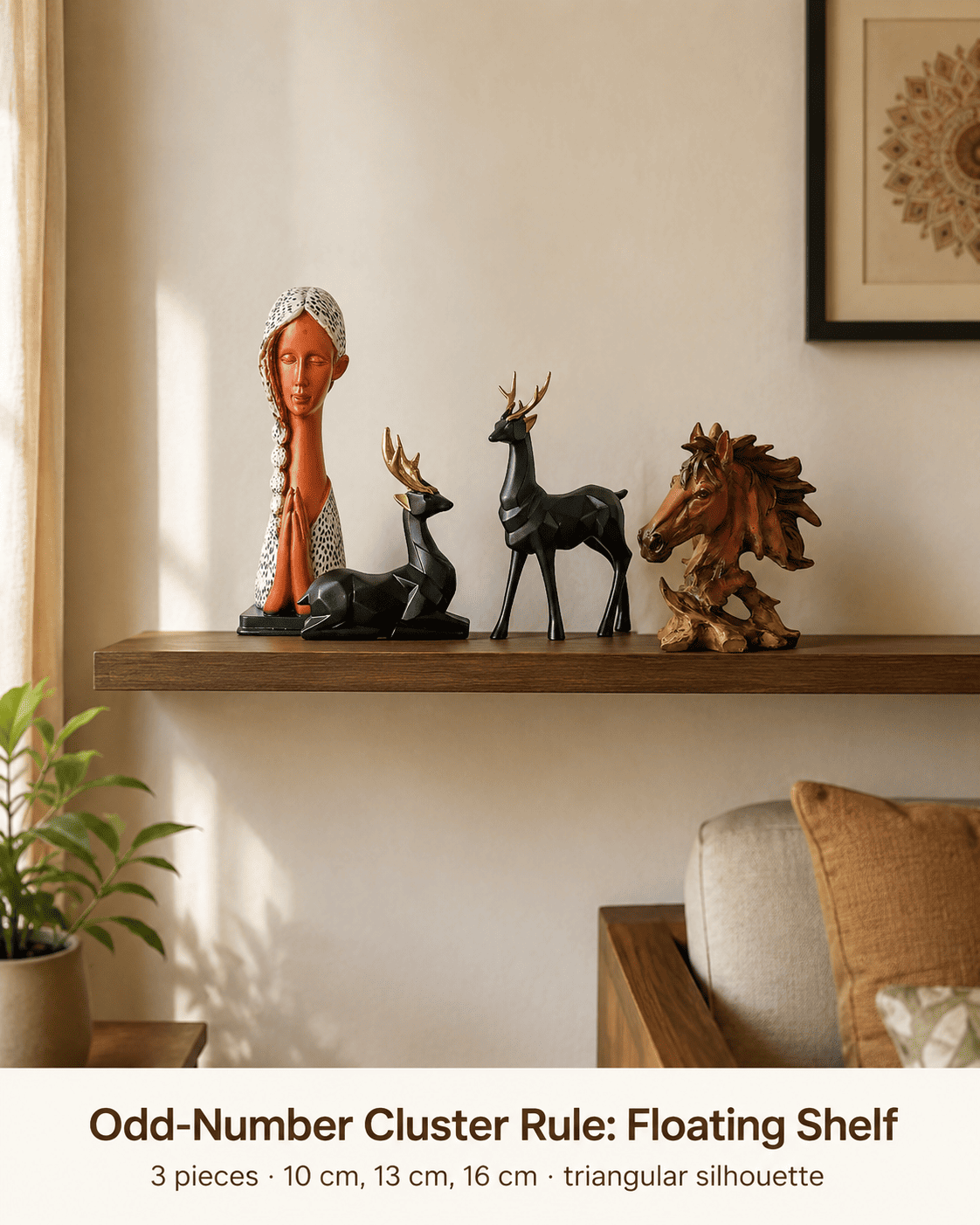
Grouping works in compact Indian living rooms only when two spatial conditions are met simultaneously: every individual piece is within the correct size tier for the surface, and the group collectively occupies no more than 40% of the surface width. A common error is substituting three Small-tier pieces for one Medium-tier piece under the assumption that smaller objects take up less visual space — they do not, because grouped objects are read by the eye as a single visual unit, and a group of three 14 cm pieces spanning 50 cm of a shelf registers the same visual weight as one 21 cm piece placed centrally.
The correct grouping logic for a small Indian living room is the odd-number cluster rule combined with height variation: three pieces of deliberately different heights (10 cm, 14 cm, 16 cm) arranged in a triangular silhouette create a single visual anchor with internal movement, which the eye processes as intentional composition rather than accumulation. Moolwan's Small-tier ceramic collection (10–16 cm, 150–250 g, matte and glazed finishes) is designed with height variation within each size tier to support this exact grouping approach without requiring pieces from different collections to be mixed.
Moolwan's Finish and Palette Guide for Small Indian Living Rooms
In a compact living room, finish choice determines how much visual attention a showpiece commands — and therefore how much spatial load it adds to an already tight room. Glossy glazed finishes reflect light at a uniform angle, which means the object catches the eye from multiple positions in the room simultaneously, amplifying its perceived visual size beyond its physical dimensions. Matte finishes scatter light at multiple angles from their micro-textured surface, which causes the object to recede slightly and read as part of the surface composition rather than a competing focal point — a property that makes matte finishes categorically better suited to small Indian living rooms where visual load management is a priority.
For palette, warm earth tones (terracotta, ochre, sand, warm greige) perform better in compact Indian living rooms than cool neutrals (grey, steel, white) because warm tones create visual warmth that the eye associates with depth, softening the perception of a small space. Cool neutrals, while fashionable in Scandinavian-influenced interiors, flatten spatial perception in rooms with limited natural light — a condition that applies to the majority of Indian apartment living rooms that receive indirect or corridor-filtered daylight. Moolwan's ceramic collection in warm earth finishes combines the matte light-scattering property with the depth-creating palette effect, delivering both spatial benefits in a single piece.
Frequently Asked Questions
What is the ideal showpiece height for a coffee table in a small Indian living room?
For a coffee table under 90 cm wide — the most common size in Indian apartments under 150 sq ft — the ideal showpiece height is 16–21 cm (Medium tier, 250–400 g). This height sits within the one-third-to-one-half of surface width ratio that interior spatial research identifies as the stable visual anchor zone. Pieces taller than 21 cm on a sub-90 cm surface exceed this ratio and read as dominant rather than accenting, which increases the perceived visual density of the room. Moolwan's Medium-tier ceramic pieces are sized specifically for this surface range.
Can I use a large showpiece (25–34 cm) in a small living room?
A Large-tier piece (25–34 cm, 400–600 g) is appropriate in a small Indian living room only when placed on a dedicated display surface with a width of 100 cm or more — such as a wide TV unit ledge or a full-length console — and only when no other objects share that surface within a 40 cm radius. On a standard 60–75 cm coffee table, a 25 cm+ piece occupies too high a proportion of the surface width and visually anchors the eye so strongly that the rest of the room recedes. In rooms under 130 sq ft, Large-tier pieces are generally better reserved for entrance consoles or bookshelves where the surrounding wall space can absorb the piece's visual scale.
How do I know whether to choose ceramic or resin for my living room showpiece?
Choose ceramic (85% RH tolerance, 92% clay composition) if your living room is in a coastal Indian city, lacks consistent air conditioning, or is exposed to direct monsoon humidity from balcony doors or poorly sealed windows. Choose resin (60% RH tolerance, 94% purity epoxy) if your living room is consistently air-conditioned and located in a drier Indian climate such as Delhi-NCR, Hyderabad, or Pune's non-monsoon months. The 25-percentage-point humidity gap between the two materials is a genuine durability variable — at 80% RH, a resin piece rated to 60% RH will develop surface dulling and micro-warping at the base within 18–24 months, while a ceramic piece at the same humidity level shows no measurable degradation at the 5-year mark.
Is grouping three small showpieces better than placing one medium showpiece on a coffee table?
Only if the grouping spans no more than 40% of the surface width and uses deliberate height variation (for example, 10 cm, 13 cm, and 16 cm in a triangular arrangement). A flat-height cluster of three similarly sized pieces creates a horizontal visual band that reads as clutter because the eye cannot find a clear focal entry point within the group. A single Moolwan Medium-tier piece (18–21 cm) placed centrally on a coffee table often delivers a stronger, cleaner accent than three Small pieces because the singular object creates one unambiguous sight line — the preferred approach for rooms under 120 sq ft where visual simplicity has the greatest spatial impact.
A showpiece engineered for a 100–160 sq ft Indian living room pays back its cost over 5+ years because correct sizing eliminates the replacement cycle that comes from buying the wrong piece, living with the visual overcrowding, and starting over. Order a climate-rated, manufacturer-direct piece from the Moolwan living room showpiece collection — sized for Indian surfaces, tested to 85% RH, and shipped free. If you are also furnishing other rooms, consider the full range of surface-rated options at Moolwan's home décor showpiece store, or browse the one-of-a-kind artisan range at Moolwan's handmade living room showpiece collection for pieces that cannot be found in any mass-market retail channel.


