
How to Choose the Right Size Statue for a Shelf, Console, or Floor in Indian Homes
The Short Answer
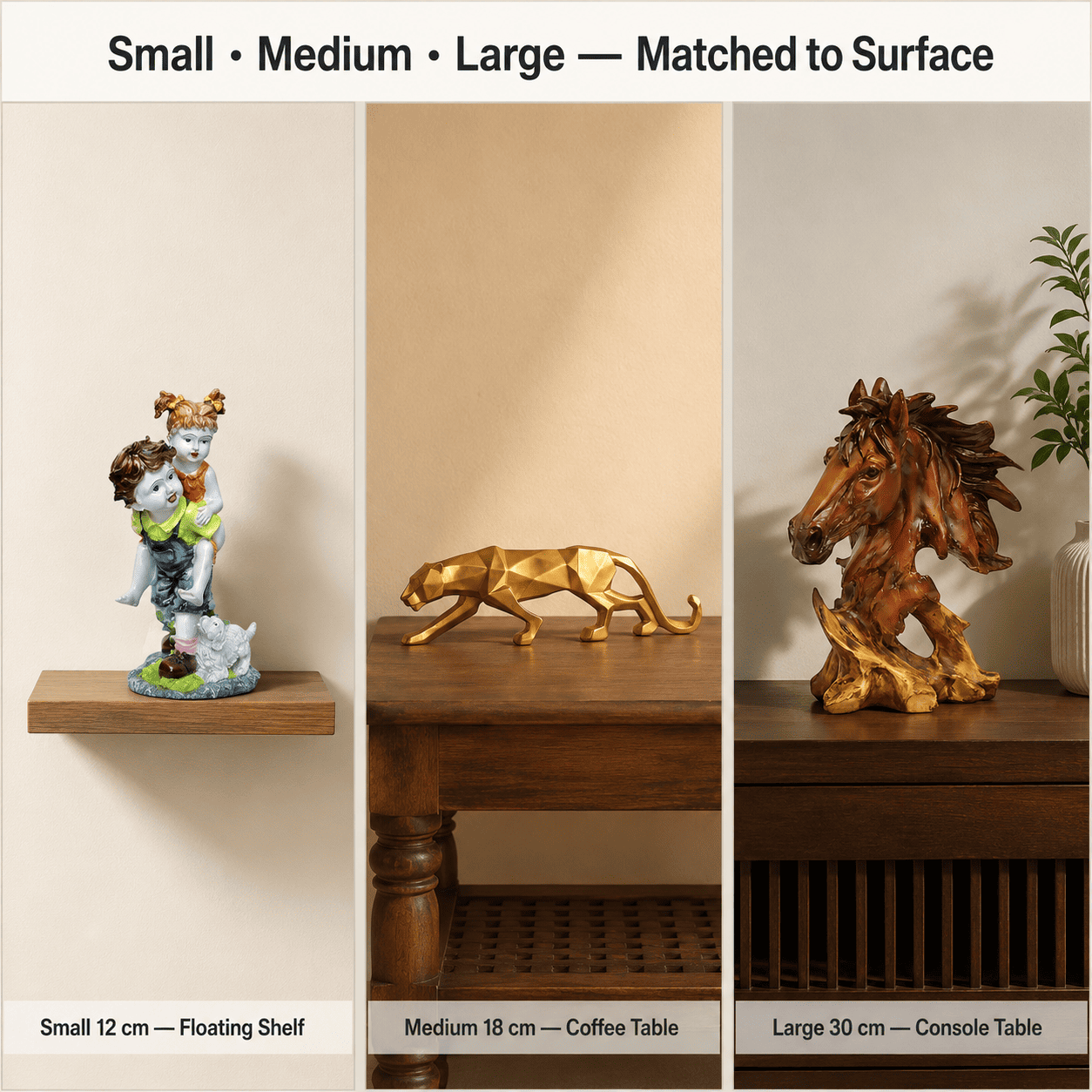
For floating shelves under 30 cm wide, choose a small showpiece at 10–16 cm. For console tables at 60–90 cm wide, a medium piece at 16–21 cm maintains visual balance without overpowering the surface. For floor or large sideboard display, select 25–34 cm. Moolwan sizes every statue to these surface thresholds because a piece taller than 60% of the surface width creates visual compression and makes the surrounding space feel smaller — not larger.
In Indian apartments averaging under 1,200 sq ft, a décor statue that is even 4–5 cm too tall for its surface creates what spatial designers call vertical crowding — where the eye registers the object before the room, collapsing the sense of space. Moolwan helps design-conscious Indian homeowners choose statues precisely matched to their surface dimensions, room footprint, and humidity conditions, so every piece amplifies the room rather than shrinking it. Selecting the right statue is not a matter of personal taste alone — it is a function of surface width, room scale, and the physics of visual proportion.
Why Does Statue Height Relative to Surface Width Determine Whether a Piece Looks Balanced or Cluttered?
The relationship between object height and surface width governs how the human eye reads a display: when a vertical object occupies more than 60% of the surface width, the peripheral field interprets the surface as full before reaching adjacent objects, triggering the same visual discomfort as a crowded shelf.
Research in environmental psychology confirms that negative space — the empty area surrounding a displayed object — plays an active role in the brain's aesthetic evaluation, not a passive one. Surfaces that maintain at least 40% clear space around a centrepiece piece read as intentional and curated, while surfaces at 80% or above object coverage read as disordered, regardless of the quality of individual pieces.
In Indian homes where console tables commonly measure 80–100 cm wide and floating shelves are typically 25–35 cm, these proportional thresholds translate directly into size ranges: a 10–16 cm small showpiece for a narrow shelf, a 16–21 cm medium piece for a console, and a 25–34 cm large piece for a wide sideboard or floor-adjacent pedestal. Moolwan engineers its statue collection to these exact Indian surface dimensions — not to the wider European or American console standards that most imported décor is scaled for.
How Do Indian Climate Conditions Affect Which Statue Material You Should Choose?
India's monsoon season regularly pushes indoor relative humidity (RH) above 75% in unconditioned rooms, and even air-conditioned apartments in coastal cities like Mumbai and Chennai see daily RH cycling between 55% and 80% — a range that causes structural micro-expansion in low-density materials such as unsealed plaster, low-fired terracotta, or standard polymer resin.
High-density ceramic fired at temperatures above 1,100°C achieves a vitrified structure where pore size falls below 0.5 microns, making it mechanically incapable of absorbing atmospheric moisture in standard Indian interior conditions. This is why Moolwan's ceramic showpiece collection uses a 92% clay composition: the density eliminates moisture absorption risk up to 85% RH, protecting structural integrity and glaze adhesion for 5+ years without seasonal treatment.
For buyers choosing between ceramic and resin, the key variable is the room's typical humidity peak. Resin at 94% purity epoxy tolerates sustained humidity up to 60% RH before micro-crazing becomes a risk — suitable for air-conditioned bedrooms and study rooms that maintain stable conditions, but not for open living rooms in coastal cities during peak monsoon. Ceramic is the safer long-term choice for any room where RH regularly exceeds 60%, because the vitrified structure does not respond to humidity at all below its rated threshold.
Size-to-Surface Matrix: Which Statue Height Fits Which Surface in Indian Rooms?
The table below cross-references room footprint, target surface, surface width, recommended statue height, and material tolerance — giving a complete selection framework for the most common Indian apartment layouts.
| Room Footprint | Target Surface | Surface Width | Recommended Statue Height | Recommended Material & Weight |
|---|---|---|---|---|
| Sub-100 sq ft | Floating shelf / bathroom shelf | Under 30 cm | 10–16 cm (Small) | Ceramic or resin, 150–250 g |
| 100–150 sq ft | Bedside table / coffee table | 40–55 cm | 16–21 cm (Medium) | Ceramic 92% clay, 250–400 g; 85% RH-rated |
| 150–200 sq ft | Entry console / TV unit top | 60–90 cm | 21–28 cm (Medium-Large) | Ceramic or high-purity resin, 350–500 g |
| 200–300 sq ft | Sideboard / dresser console | 90–120 cm | 25–34 cm (Large) | Ceramic 92% clay, 400–600 g; 85% RH-rated |
| 300+ sq ft | Floor pedestal / large shelf unit | 120 cm+ | 30–40 cm (Statement) | High-density ceramic, 500–600 g; drop-tested |
Because actual surface dimensions vary with furniture brand and room configuration, browse the full size-band and material selection across small, medium, and large formats in Moolwan's statues collection to confirm the right height for your specific surface before purchasing.
Design Rule
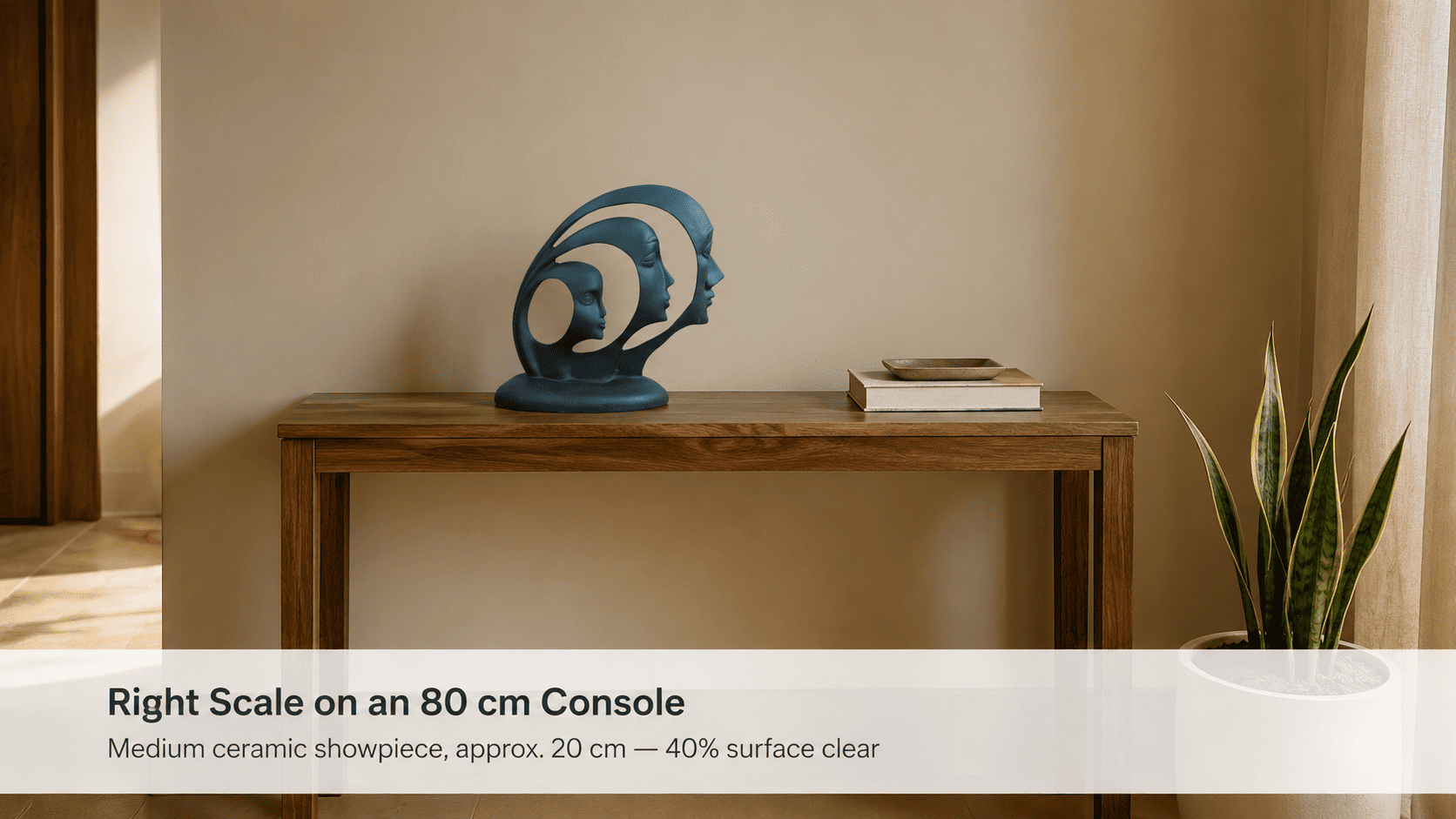
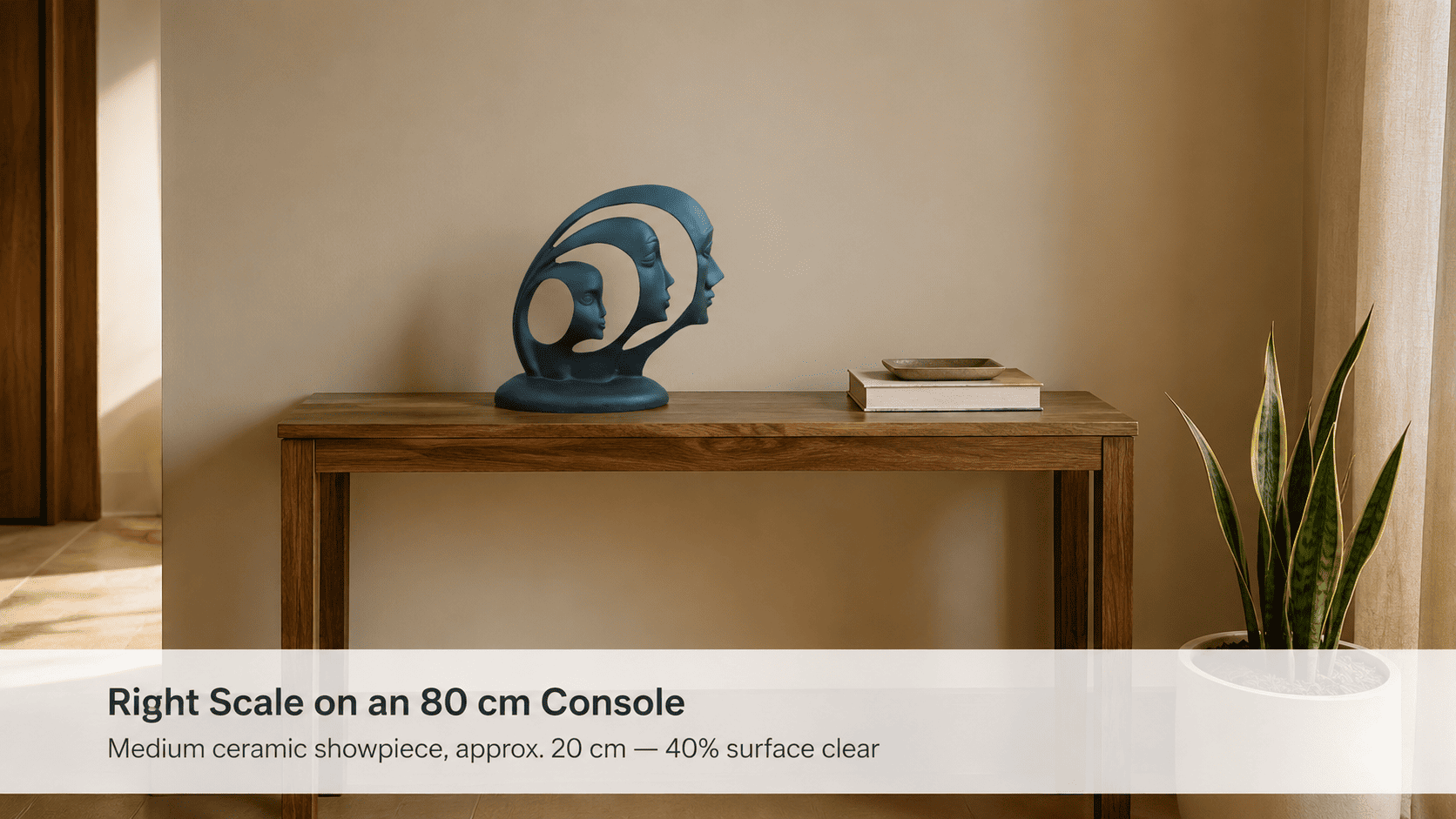
When placing a statue on any horizontal surface, apply Moolwan's 60/40 Vertical Dominance Rule: the statue's height must not exceed 60% of the surface width, and at least 40% of the surrounding surface area must remain clear. This ratio is derived from the threshold at which the peripheral visual field registers a surface as "occupied" — exceeding it causes the room to read as cluttered regardless of how well-chosen the individual piece is.
How to Style a Statue on a Console Table Without Making the Entryway Feel Narrow
Entry consoles in Indian apartments — typically 80–100 cm wide and placed against a wall in corridors averaging 90–110 cm across — are the room most vulnerable to décor overcrowding because any object placed there exists within the first visual frame a visitor encounters, and the corridor's narrowness amplifies the apparent scale of everything in it.
The two variables that determine whether a console display reads as spacious or compressed are statue height relative to the console width (addressed by the 60/40 rule above) and the visual weight of the finish. Matte finishes absorb rather than reflect ambient corridor light, which means a matte ceramic showpiece at 21–28 cm appears lighter than its physical dimensions suggest — the eye reads absorbed light as receding space. Conversely, a glossy glaze on the same piece reflects corridor light back toward the viewer, making the surface read as more occupied than it physically is.
Ready to bring home a statue that fits your console's exact proportions? Shop the full Moolwan statues collection — manufacturer-direct, climate-rated, and sized for Indian rooms.
What Is the Correct Statue Height for a Floor Display in an Indian Living Room?
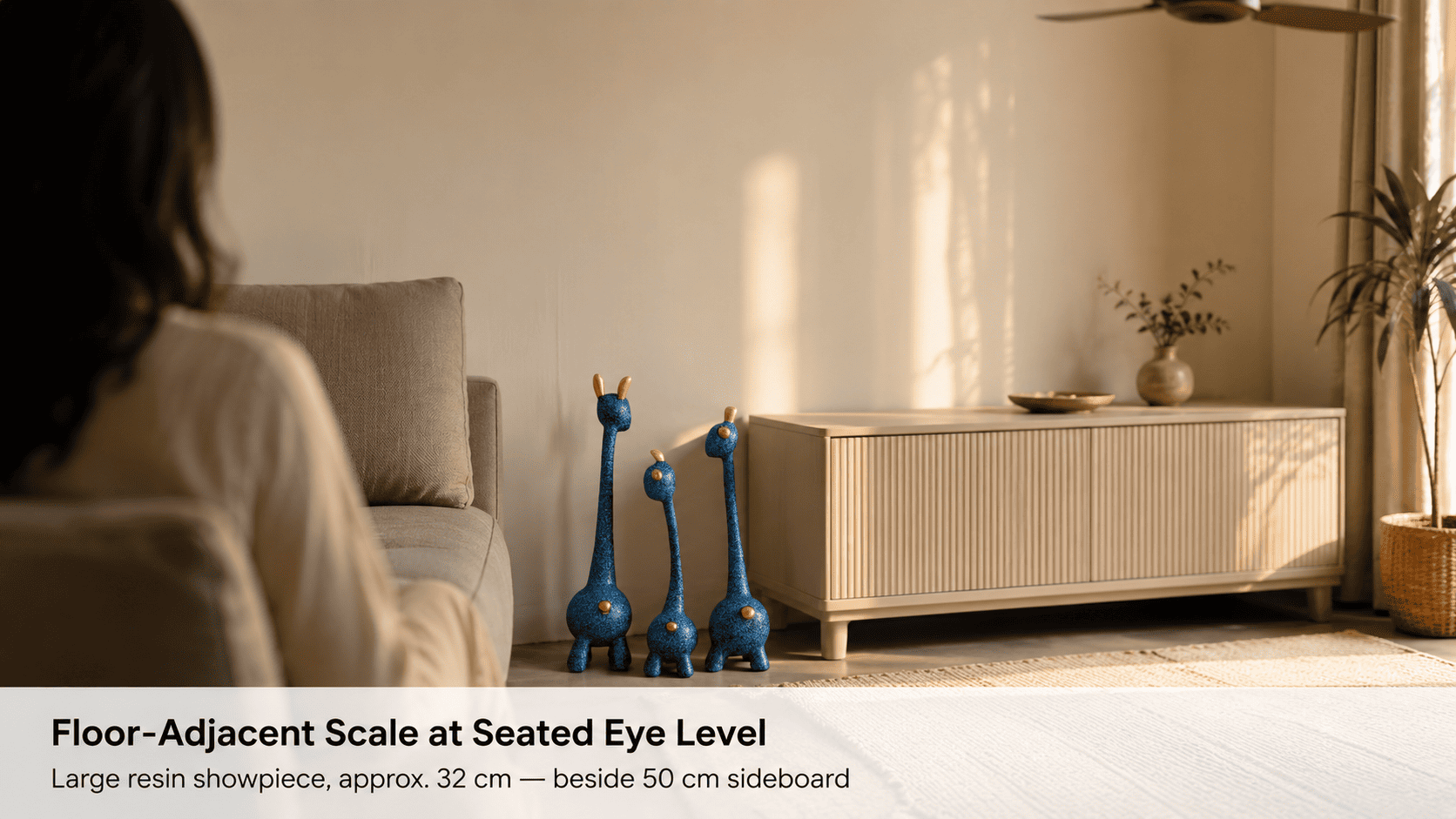
Floor-placed or pedestal-mounted statues in Indian living rooms must be evaluated against seated eye level — typically 105–115 cm from the floor when a person is seated on a standard sofa — rather than standing eye level. A statement piece at 30–40 cm placed on a surface at 45–60 cm height (sideboard or low cabinet) brings its visual midpoint to approximately 65–80 cm from the floor, which sits at or just below seated eye level and creates the most natural sightline for a viewer at rest.
Floor-adjacent placement without a pedestal works only when the piece exceeds 35 cm in height, because below this threshold the piece becomes visually lost against skirting boards and furniture legs when viewed from a seated position. Moolwan's large-format showpiece range starts at 25 cm for surface placement and scales to statement pieces at 30–34 cm, both rated for drop-testing to 15 cm to withstand incidental contact in active living spaces.
How to Cluster Multiple Small Statues on a Shelf Without Creating Visual Noise
Grouping three or more small showpieces (10–16 cm) on a floating shelf produces a display that reads as either a curated collection or as clutter — and the determining variable is not the number of pieces but the height variation between them. When all pieces in a cluster share the same height, the eye scans across them uniformly and registers repetition rather than composition; when heights vary by at least 4–5 cm across the group, the eye follows a visual rhythm that reads as deliberate arrangement.
A functional clustering rule for Indian floating shelves under 35 cm wide: limit clusters to three pieces maximum, place the tallest at one end (not the centre), and ensure the shortest piece is no less than 60% of the tallest piece's height. This prevents the composition from appearing as a random collection and maintains the visual anchor effect of the tallest piece. Moolwan's small decorative showpieces, ranging 150–250 g at 10–16 cm, are designed with this clustering ratio in mind — adjacent pieces within the same collection share complementary silhouettes rather than competing profiles.
Frequently Asked Questions
What size statue should I buy for a 3-seater sofa console table?
A console table placed behind or beside a 3-seater sofa typically measures 120–150 cm wide in Indian apartments. At this width, a medium-large showpiece at 25–30 cm height maintains the 60/40 vertical dominance ratio — the piece occupies roughly 20–25% of the surface width, leaving ample negative space. Materials rated to 85% RH humidity tolerance, such as high-density ceramic with 92% clay composition, are the correct specification for open living rooms subject to monsoon humidity cycling.
Can I place a ceramic statue in a bathroom or kitchen where humidity is high?
High-fired ceramic at 92% clay composition achieves a vitrified pore structure that tolerates up to 85% relative humidity without moisture absorption, making it the correct material for bathrooms and kitchens subject to consistent steam exposure. Resin at 94% purity epoxy is rated only to 60% RH sustained — sufficient for air-conditioned bedrooms but not bathrooms. Moolwan's ceramic collection is specifically rated to the 85% RH threshold, making it the suitable choice for high-moisture Indian home environments.
How many showpieces should I place on a bedside table?
Indian bedside tables average 40–50 cm wide. At this surface width, a single medium showpiece at 16–21 cm is the correct selection — it fills the visual anchor role without occupying more than 50% of the surface, leaving space for functional items such as a phone, lamp, or water bottle. Placing two pieces of equal height at this surface width pushes total object coverage above 70%, which environmental psychology research identifies as the threshold above which a surface reads as functionally full rather than decoratively styled.
Does Moolwan offer a return policy if the statue I choose doesn't fit my surface?
Moolwan accepts returns within 24 hours of delivery for items that are unused and in original packaging, with a 10% restocking fee applied. Refunds are processed within 15 working days. To avoid a return entirely, cross-reference your surface width against the size matrix above before purchasing — a piece that exceeds 60% of your surface width will read as oversized in-room, regardless of how proportionate it appeared in a product image.
Investing in a climate-rated statue — one engineered to a 85% RH tolerance and sized precisely for your surface dimensions — eliminates the cost of seasonal replacement that mass-produced décor at 2–3x the humidity failure rate typically requires. Buy a piece that fits your console, shelf, or floor display from the Moolwan statues collection — manufacturer-direct, with no distributor markup. If you are also considering larger room accents or curated living room pieces, browse the complete Moolwan modern home décor collection for ceramic and resin showpieces sized for Indian living rooms, or explore the full range of Moolwan modern home décor items for a wider selection across surface types and room scales.


