
How to Cluster Showpieces on a Living Room Console Table Without Clutter
The Short Answer
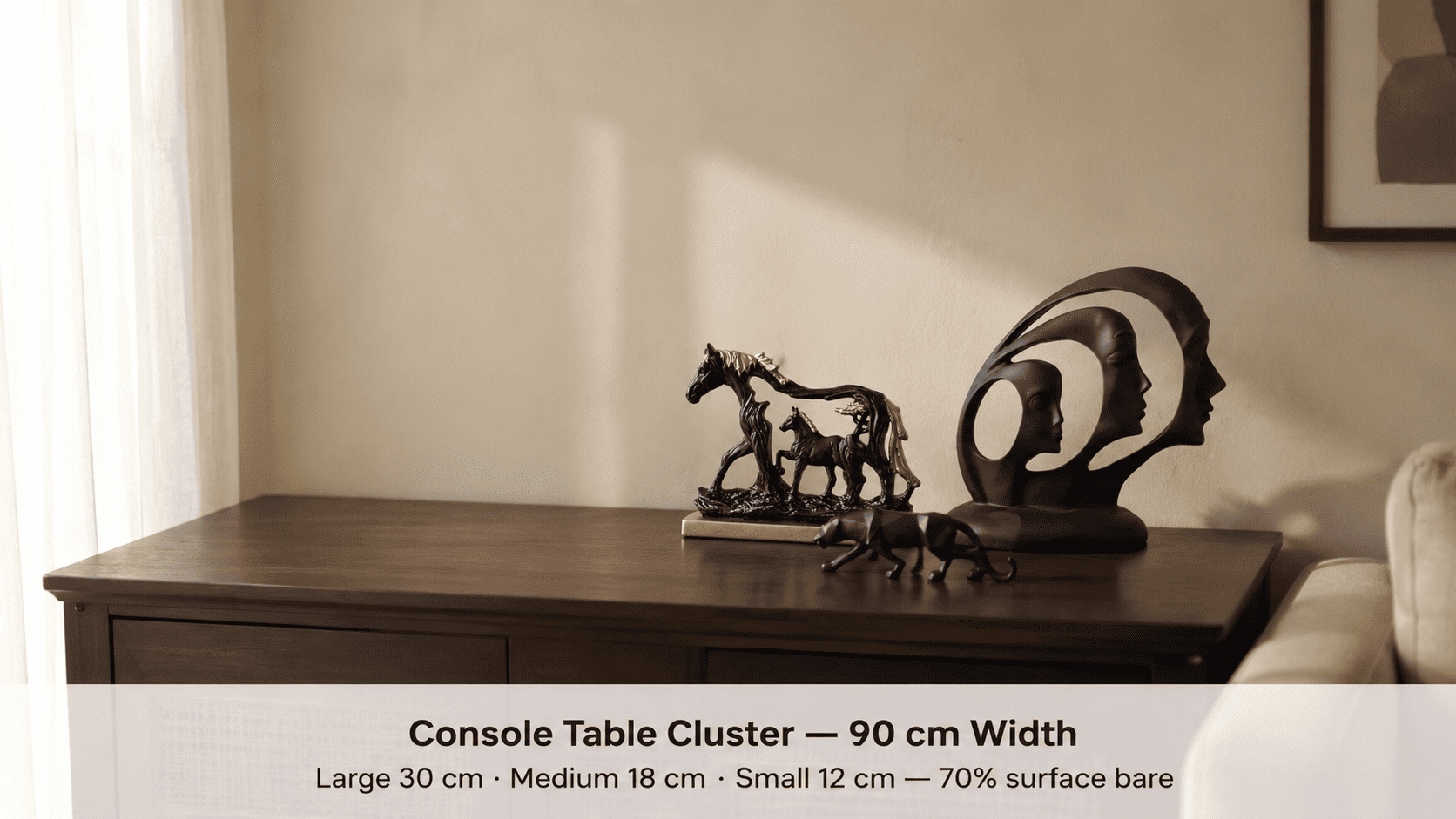
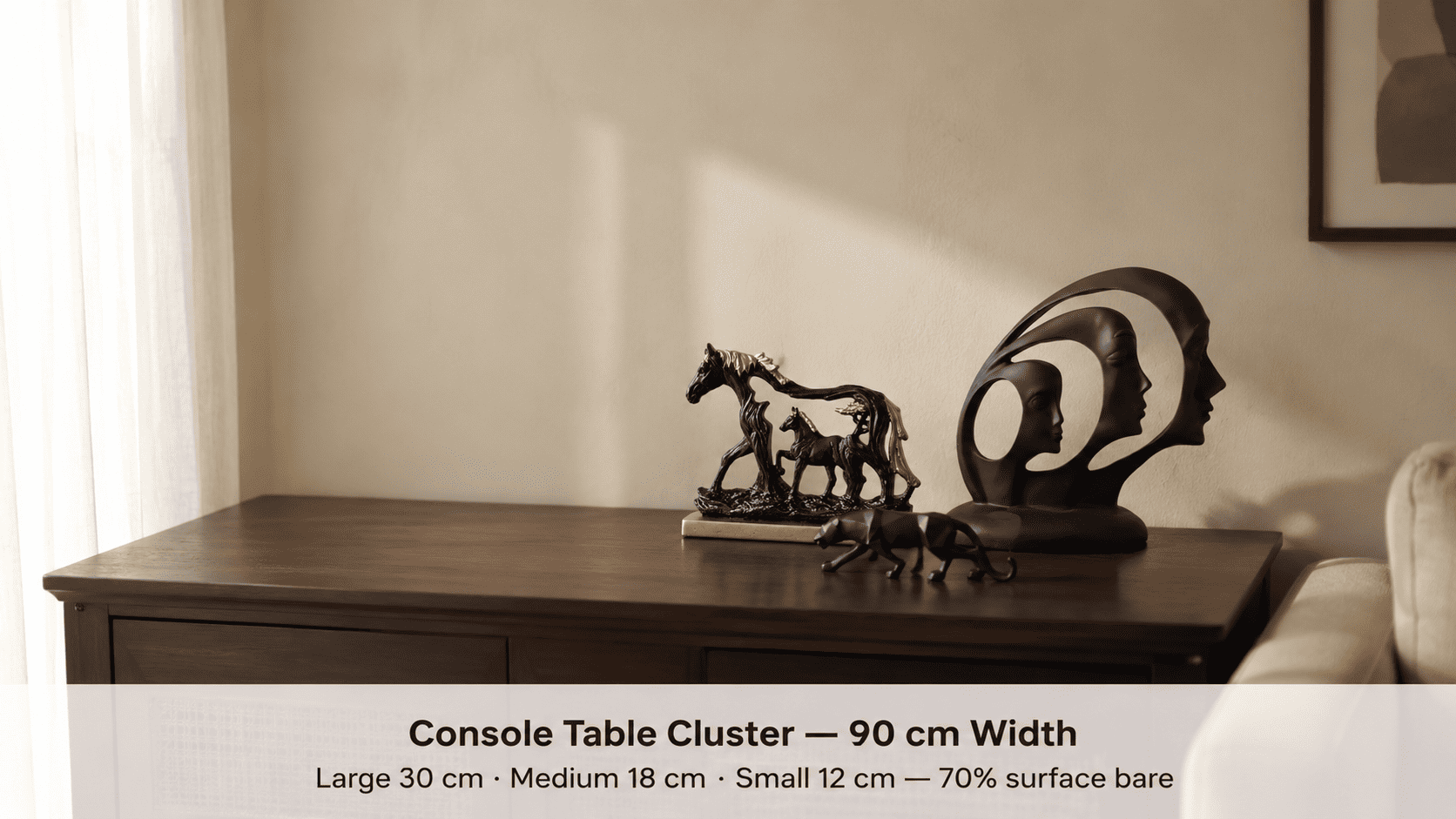
Cluster in odd numbers (3 or 5 pieces), stagger heights by at least 8 cm between pieces, and leave 70% of the console surface completely bare. Moolwan's ceramic and resin showpieces — ranging from 10 cm to 34 cm — are weight-graded at 150 g–600 g so they anchor console surfaces without tipping on uneven Indian flooring. Height variation prevents the eye from flattening the group into a single visual block.
In Indian living rooms, the console table carries a disproportionate share of visual weight: it is the first surface seen when entering the room and the last thing a guest remembers. Moolwan helps design-conscious Indian homeowners turn this narrow surface into a composed focal display — without overfilling it or creating the chaotic shelf-shop effect that plagues most apartments. The structural problem is not owning too many showpieces; it is placing them without a spatial logic that accounts for console width, piece height, and the eye's need for breathing room.
Why Does Grouping in Odd Numbers Actually Work on a Console Table?
The human visual system processes grouped objects by seeking a central anchor and two balancing flanks — a pattern that even numbers cannot produce because they split the group symmetrically and the eye treats them as two separate pairs rather than one unified composition. This is why interior designers worldwide apply the odd-number rule to surface styling, and it holds with particular force on narrow console tables (typically 30–40 cm deep) where depth variation is limited and the eye must work horizontally.
Grouping three showpieces allows one piece to serve as the focal point (tallest, placed slightly off-centre toward one end) and two pieces to create visual weight on either side without mirroring. Five-piece arrangements apply the same logic at scale, appropriate for consoles wider than 110 cm. For Indian apartments — where the average living room spans 120–180 sq ft and console tables rarely exceed 100 cm in width — a three-piece cluster at one end of the console with the opposite end left completely bare is both spatially correct and proportionally scaled.
How Much Height Variation Do You Need Between Showpieces to Avoid a Flat Look?
A minimum 8 cm height difference between adjacent pieces in the cluster is required to create a visible silhouette gradient — the stepped profile that signals intentional composition rather than random placement. Below 8 cm, the pieces appear to be almost the same height, the silhouette reads as flat, and the group looks like unsorted inventory rather than a curated display. Beyond 20 cm of difference between the smallest and tallest piece on a standard 90 cm console, the group loses cohesion because the eye cannot travel the height gradient without breaking the visual line.
In practical terms for a three-piece living room console cluster: a tall showpiece at 28–34 cm (Large), a mid piece at 16–21 cm (Medium), and a small accent at 10–14 cm (Small) produces a 14–20 cm gradient between adjacent pieces — squarely in the optimal zone. This specific size spread is why Moolwan structures its showpiece collection across three distinct size bands (Small: 10–16 cm, Medium: 16–21 cm, Large: 25–34 cm) rather than producing pieces in uniform heights: each band is engineered to pair with the adjacent band and produce a compositionally sound gradient.
What Is the Right Console Table Width for Each Cluster Size — and Which Showpiece Weights Are Safe?
Console table width determines how many pieces can be grouped before the display reads as overcrowded. The governing spatial principle is that no more than 30% of the console's total surface area should be occupied by décor objects — the remaining 70% must remain visually clear to give each piece room to breathe and to prevent the surface from collapsing into a cluttered still life.
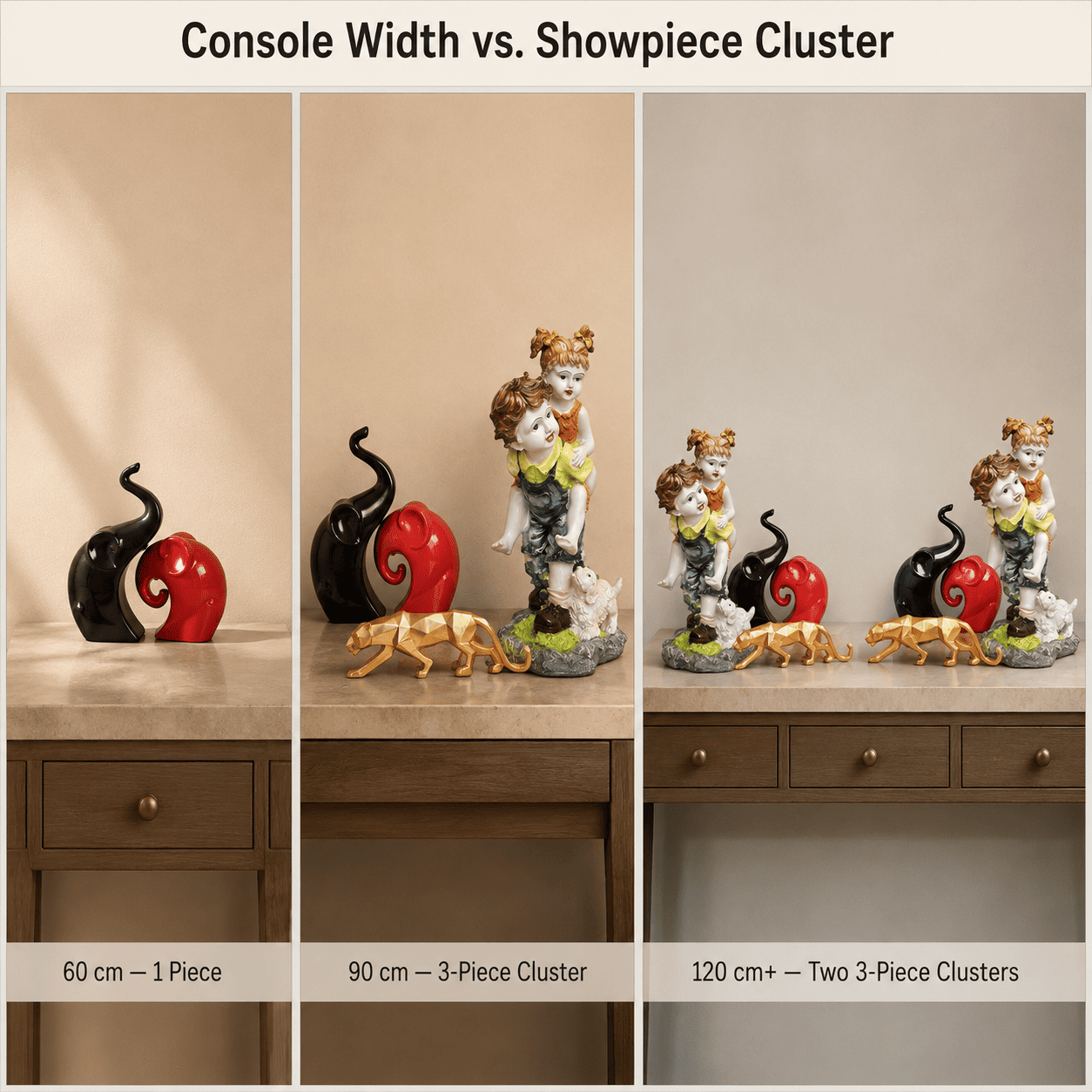
| Console Width | Recommended Cluster Size | Showpiece Height Range | Total Weight Limit | Environmental Tolerance |
|---|---|---|---|---|
| Under 60 cm | 1 focal piece only | 16–21 cm (Medium) | Up to 400 g | Ceramic: 85% RH / Resin: 60% RH |
| 60–80 cm | 2 pieces (avoid even-number flat look — add a tray to anchor) | 10–21 cm (Small + Medium) | Up to 650 g combined | Ceramic: 85% RH / Resin: 60% RH |
| 80–100 cm | 3 pieces (standard odd-number cluster) | 10–34 cm (Small + Medium + Large) | Up to 1,200 g combined | Ceramic: 85% RH / Resin: 60% RH |
| 100–120 cm | 3 pieces + 1 low-profile tray or book | 10–34 cm + tray anchor | Up to 1,600 g combined | Ceramic: 85% RH / Resin: 60% RH |
| 120 cm+ | Two separate 3-piece clusters at opposing ends | 10–34 cm per cluster | Up to 2,400 g combined | Ceramic: 85% RH / Resin: 60% RH |
Because console table depths, wall colour, and natural light direction introduce additional pairing variables beyond the width-to-cluster ratios above, browse the full size-band and material selection in Moolwan's showpiece for living room collection to verify your final piece combination before purchasing.
Design Rule
To prevent visual compression on Indian living room console tables — which average 30–40 cm in depth and create limited foreground-to-background layering — Moolwan's 3-Cluster Anchor Rule specifies: place the tallest piece (Large, 25–34 cm) at one-third from the left or right edge of the console, position the Medium piece (16–21 cm) within 10 cm of the Large piece, and place the Small piece (10–16 cm) in front of and between them to create a triangular footprint — leaving the remaining two-thirds of the console surface entirely bare.
Does Finish — Matte Versus Glazed — Change How a Console Cluster Reads in Indian Living Room Lighting?
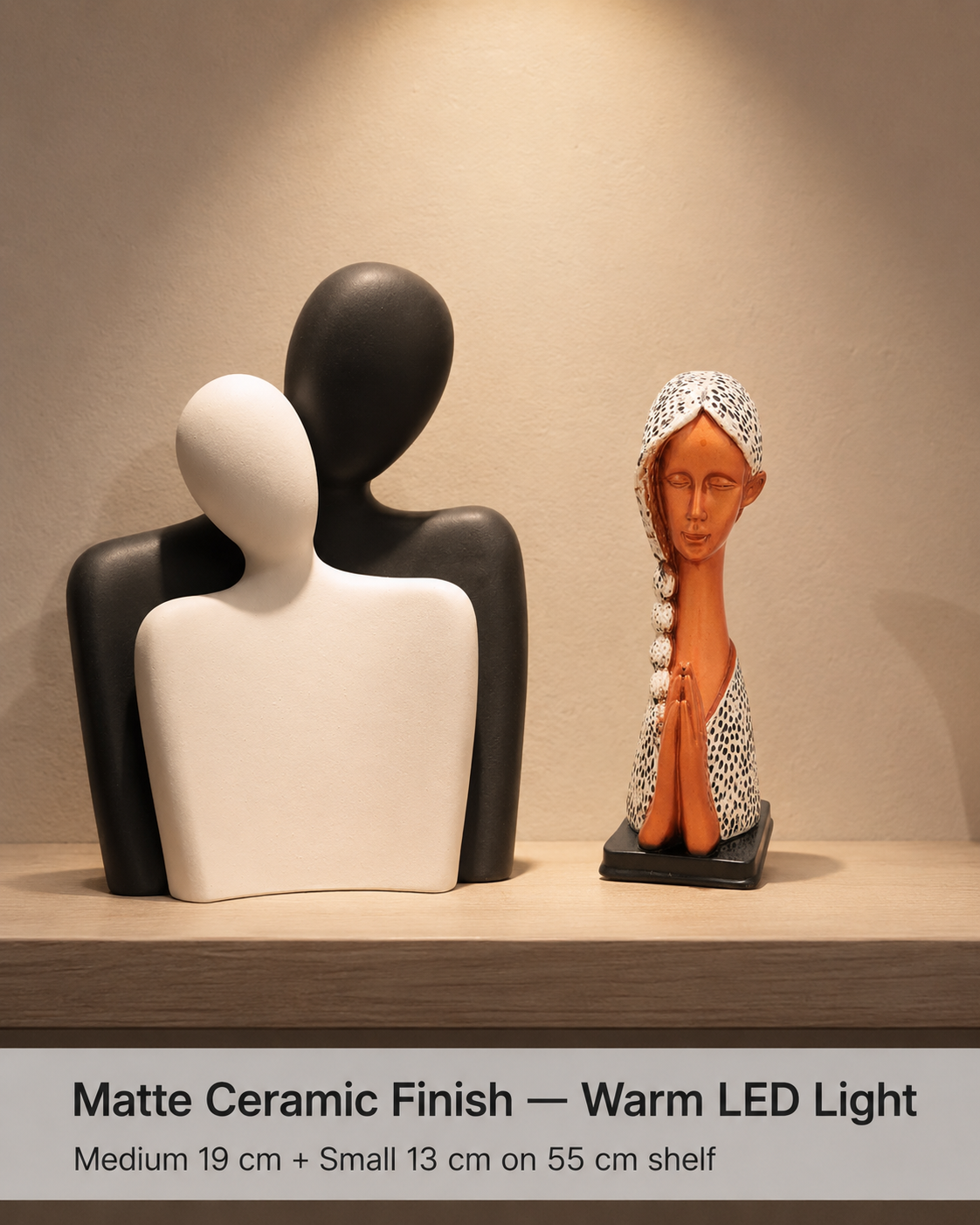
Finish determines how a piece interacts with the dominant light source in the room — and in most Indian living rooms, that source is a combination of warm-white overhead LEDs (2,700–3,000 K) and diffuse natural light from south- or west-facing windows in the afternoon. Matte finishes absorb and scatter incident light at multiple micro-surface angles, producing a consistent warm tone regardless of where a viewer stands — this is why matte pieces age better over a 5+ year lifespan in Indian homes, where the same overhead LEDs and the same viewing angles repeat daily and would otherwise create predictable hot-spot glare on a glossy surface.
Glazed finishes, by contrast, reflect light directionally: a single overhead LED produces a visible specular highlight that shifts as the viewer moves. In a console cluster, mixing one glazed piece (typically the Medium focal piece) with two matte pieces allows the glazed piece to act as a visual anchor that catches light without the entire group appearing reflective. Moolwan's ceramic collection uses a 92% high-density clay body, which holds matte glazes and high-fire gloss finishes with equal dimensional stability — meaning the chosen finish does not compromise the piece's structural resistance to India's humidity cycles (tolerance tested to 85% RH).
Ready to build a console cluster that's engineered for Indian humidity and scaled to your console width? Shop the full Moolwan showpiece for living room collection now.
How Do You Prevent a Console Cluster From Looking Different Every Monsoon Season?
The primary cause of seasonal display drift in Indian homes is material instability: resin pieces with below-94% purity epoxy absorb ambient moisture during high-humidity months (June–September), which causes micro-warping, colour shift, and surface clouding — so the same cluster that looked polished in February appears faded and slightly misshapen by August. The structural fix is material specification, not seasonal rearranging.
Ceramic pieces rated to 85% relative humidity maintain dimensional stability through the full Indian monsoon cycle without warping or surface degradation because a high-density 92% clay composition is non-porous at a molecular level, preventing the moisture ingress that causes lower-density ceramics to bloat and crack at humidity spikes. Moolwan's resin pieces, specified at 94% purity epoxy, hold a 3H pencil-hardness surface rating and tolerate humidity up to 60% RH — appropriate for air-conditioned living rooms where the AC system actively dehumidifies the environment. For consoles positioned near open windows or balcony doors where humidity regularly exceeds 60% RH during monsoon, ceramic is the more durable material choice by a significant margin.
How to Use Palette to Unify a Console Cluster Across Different Piece Materials
A console cluster containing two or more different materials — for example, one ceramic and one resin piece — reads as intentionally composed rather than mismatched when all pieces share a single palette constraint: either the same dominant hue (e.g. warm earth tones across all pieces), or the same finish temperature (all pieces matte, or all pieces sharing a cool-neutral palette). The palette acts as a visual contract that tells the viewer the pieces belong together despite material differences.
The most reliable palette constraint for Indian living rooms with warm-white LED lighting is a warm-neutral range: terracotta, sand, warm greige, and muted ochre. These tones absorb the warm yellow bias of 2,700–3,000 K LEDs without shifting toward orange, because the pigments in this range already sit within the warm-yellow colour temperature band and do not produce the colour-clash that cooler greys or cool-whites develop under the same LED type.
Frequently Asked Questions
How many showpieces should I put on a living room console table?
For consoles between 80 cm and 100 cm wide — the most common range in Indian urban apartments — three showpieces is the correct number. Three pieces allow one Large focal anchor (25–34 cm), one Medium supporting piece (16–21 cm), and one Small accent (10–16 cm), producing the height gradient and triangular footprint that the eye reads as composed. Below 80 cm, one or two pieces is the correct maximum, because three pieces on a narrow console consumes more than 30% of the surface area and the display reads as crowded.
Should all showpieces on a console table be the same material?
No — but mixing materials requires a shared palette constraint. Ceramic and resin pieces can coexist in the same cluster when all pieces share either the same dominant hue or the same finish temperature (all matte, or all warm-neutral). The material difference becomes invisible when palette unity is maintained because the eye groups objects by colour before it registers material variation. Moolwan's ceramic pieces (92% clay, 85% RH tolerance) and resin pieces (94% purity epoxy, 60% RH tolerance) are designed in overlapping warm-neutral palettes specifically to allow cross-material clustering without visual conflict.
Can I put showpieces directly on a console table without a tray?
Yes — but a tray improves compositional legibility in one scenario: when using a two-piece cluster on a console wider than 70 cm. Two pieces without a tray leave an asymmetric void that the eye reads as incomplete rather than airy. A low-profile tray (under 3 cm tall) placed beneath the two pieces acts as a visual base that closes the composition without adding height, turning the pair into a single unified object in the viewer's perception. For three-piece clusters on standard 80–100 cm consoles, the triangular footprint is self-anchoring and no tray is needed.
What is the best finish for a living room console showpiece near a window?
Matte ceramic is the most durable finish for console tables near windows in Indian homes because direct sunlight at UV Index 6–8 (the annual average across Indian metros) degrades resin surfaces and bleaches glossy-glazed finishes over 18–24 months. A matte high-fire ceramic finish maintains its colour and surface integrity under direct sunlight exposure because the fired clay substrate is chemically inert to UV radiation and the matte surface has no reflective coating to break down. Moolwan's ceramic showpiece collection is fired to a density that achieves this UV stability alongside the 85% RH humidity tolerance required for year-round Indian conditions.
Investing in climate-rated ceramic showpieces prevents the seasonal replacement cycle that erodes the long-term cost advantage of buying cheap resin pieces — a piece that lasts 5+ years at 85% RH tolerance costs less per year than a cheaper piece replaced every 18 months. Bring home a curated cluster from the Moolwan showpiece for living room collection — manufacturer-direct, humidity-tested, and sized specifically for Indian console tables. If you are working with a compact living room under 120 sq ft, the Moolwan luxury décor collection for small living rooms offers pieces scaled for tighter surface constraints. For a distinctive centrepiece that no other console on your street will carry, explore the Moolwan unique handmade showpiece collection — each piece a one-of-a-kind decorative accent for the living room.


