
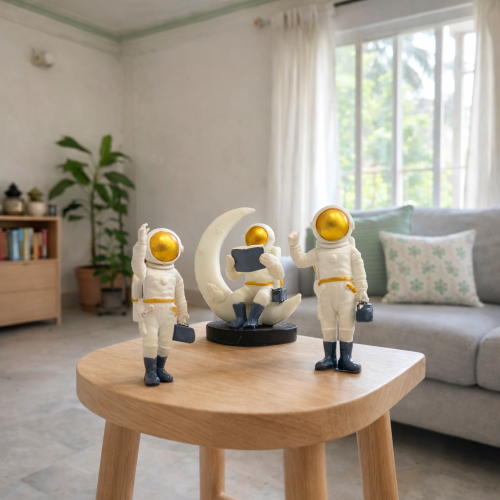
An everyday dining table is decor that stays exactly where it is through three meals a day, monsoon humidity, and a toddler's elbow. We help design-conscious Indian homeowners style dining tables that work every single day, not just for the one dinner party a year. That means choosing pieces by height, weight, and material resistance first — aesthetics second.
The One Rule: Keep Everything Under 15cm
Anything taller than 15cm blocks eye contact across a standard 75–90cm-wide dining table, which is why it gets moved after the first meal and never comes back. Moolwan engineers its small-format showpieces specifically in the 10–16cm range for surfaces people use daily — desks, shelves, and dining tables — while reserving the 25–34cm "large" sizing for consoles and sideboards where height doesn't interrupt sightlines.
This is also the size range that survives daily wiping and resetting without looking fussy. Browse Moolwan's modern home decor collection filtered to small and medium pieces built for exactly this job — tables people actually eat at, not just photograph.
What Actually Survives Daily Use on an Indian Dining Table
Fresh flowers wilt in 3–4 days and need replacing weekly — a real cost and a real chore for a table used three times a day. Ceramic and resin showpieces, by contrast, are built to sit through Indian humidity and kitchen heat without maintenance. The table below is the comparison worth checking before you buy anything for daily use.
| Material | Composition | Heat / Humidity Tolerance | Lifespan | Daily Maintenance |
|---|---|---|---|---|
| Ceramic showpieces | 92% clay composition | Heat-resistant to 60°C · humidity-tolerant up to 85% RH | 5+ years | Wipe down only; 15cm drop-resistant |
| Resin accents | 94% purity epoxy resin | 15–35°C range · humidity up to 60% RH | 3+ years indoors | Scratch-resistant to 3H pencil hardness |
| Fresh flowers | — | Wilts above 30°C or in AC dryness | 3–7 days | Daily water change, weekly replacement |
For kitchens and dining areas that run warm — near a stove, or in a non-AC dining space — ceramic's 60°C heat tolerance is the safer pick. For AC-cooled dining rooms with lower humidity swings, resin's scratch resistance handles daily resetting better. Either way, matte finishes hide daily fingerprints and water rings far better than glazed ones on a surface touched three times a day.
Everyday Table vs. Festive Table: What Actually Changes
This is the real tension for Indian homes: the table that hosts a quiet Tuesday dinner also has to become the table for Diwali, a birthday, or unexpected guests within the hour. The fix isn't two separate tables — it's a base layer that stays and an accent layer that swaps.
What Stays (the everyday base)
- A neutral-toned runner or placemats in a fixed position
- One centred showpiece, 10–16cm, matte finish
- Two smaller accents flanking it, symmetrical, non-fragile
What Swaps (the festive layer)
- A brass or ceramic statue as a temporary centrepiece for festivals or puja-adjacent occasions
- Seasonal colour accents — marigold, deep red, gold — added around the fixed base, not replacing it
- Taller pieces (25cm+) only when the table is being used for display, not for eating
For the swap layer, Moolwan's statues collection is built for exactly this in-and-out use — pieces sized and weighted to move from a shelf to a table centre and back without chipping, which is where imported stone statues tend to fail after a few festivals.
Building your everyday base layer first makes every festive swap faster — start with pieces designed to stay put.
Shop everyday table decorThe 5-Step Formula to Style Your Dining Table Today
This is the exact sequence to follow, in order. Each step takes under two minutes and doesn't require rearranging anything once the meal is on the table.
-
Clear and measure first
Wipe the table and note its width. A 75–90cm table has room for one centre piece and two flanking accents; anything narrower fits a single centred piece only.
-
Anchor with a runner, not a full cloth
A runner defines a decor zone without covering the whole eating surface, so it never needs removing before meals.
-
Place one centre accent, 10–16cm tall
Keep it under sightline height. This is the single piece that carries the table's personality — a ceramic form, a small sculptural bowl, or a matte vase without fresh stems.
-
Balance with two smaller pieces
Flank the centre piece symmetrically. Explore Moolwan's home decor items for smaller matte pieces sized specifically for this flanking role.
-
Cut anything that needs daily upkeep
If a piece needs watering, dusting more than weekly, or careful handling around cutlery, it belongs on a console — not the table you eat at.
| Size | Dimensions | Best For | Weight |
|---|---|---|---|
| Small | 10–16cm | Everyday dining table, shelf, desk | 150g–300g |
| Medium | 16–21cm | Showcase, coffee table, occasional table centre | 300g–450g |
| Large | 25–34cm | Console, sideboard, focal point (not daily-use tables) | 450g–600g |
What Moolwan Stands For
Moolwan is India's direct-to-consumer home decor brand, manufacturing canvas wall art, ceramic and resin showpieces, and curated gifts in-house rather than importing through middlemen. That direct model is what makes climate-specific engineering — 85% RH-tolerant ceramics, 60°C heat resistance — commercially possible at everyday prices, not just showroom prices.
Every piece ships with a straightforward return window: unused items in original packaging can be returned within 24 hours of delivery, with a 10% restocking fee and refund processed within 15 working days. That's the same standard applied whether you're buying one accent piece or restyling a full table.


