
How to Decorate a Home According to Vastu Shastra?
By Ruchi Malhotra, Founder & CEO, Moolwan (Euphorica Ventures Pvt Ltd), Bangalore
At Moolwan, we help design-conscious Indian homeowners decorate their spaces with décor that is simultaneously Vastu-aligned, climate-engineered, and genuinely beautiful — without inflated retail markups or generic mass-market aesthetics. Every piece in our Vastu range is manufactured in-house and selected against both energy principles and real Indian living conditions.
Why Vastu Décor Is Not Just Superstition — It Is Design Logic
Vastu Shastra is a 5,000-year-old Indian architectural science that maps spatial energy (prana) to compass directions, materials, and forms. When you place a heavy metal sculpture in the north-east or hang a sunset painting in the north, you are not just following ritual — you are making intentional design decisions about visual weight, light direction, and spatial mood. Modern interior designers increasingly cross-reference Vastu with environmental psychology because the two disciplines frequently agree on what makes a space feel balanced.
The challenge for most Indian homeowners is not belief — it is execution. Finding décor that satisfies a Vastu consultant, fits an 8–10 ft ceiling apartment, survives monsoon humidity, and still looks curated and modern is genuinely difficult. That is the exact problem Moolwan was built to solve.
Room-by-Room Vastu Decoration Guide
Entrance and Main Door (North or East Facing)
The main entrance is the primary point of energy entry into your home. Vastu recommends placing auspicious symbols, lightweight sculptures, or nature-themed art near the entrance. Avoid broken décor, dark imagery, or heavy metal objects directly at the door. A small Buddha sculpture in glazed ceramic or a floral motif canvas sets the welcoming tone Vastu prescribes. Our modern home decor items include several entrance-ready pieces sized 15–21 cm — compact enough for urban foyers, meaningful enough to anchor the space.
Living Room (North, East, or North-East Corners)
The living room is where Vastu's visual rules are most visible and most often violated. Heavy art on the south wall, dark colour schemes, or cluttered shelves create energetic stagnation according to Vastu — and, notably, also according to standard interior design principles. Vastu recommends: light colours for the north and east walls, nature scenes or spiritual art as the focal point, and showpieces placed in the north-east or south-west corners based on their material (light ceramic in the north-east, heavier resin or stone in the south-west).
For living room canvas wall art, faces and human figures should be serene — not aggressive or sorrowful. Abstract geometric art, nature landscapes, and spiritual motifs (lotus, tree of life, peacock) all meet Vastu guidelines. Browse Moolwan's showpieces for the living room — our collection starts at ₹150 and is trusted by 3,000+ customers across India.
Puja Room and Spiritual Corner
The puja corner or room should ideally face north-east. Décor here must be made of natural, non-synthetic materials where possible. Ceramic idols and brass-finish resin sculptures are both Vastu-compatible. Moolwan's ceramic showpieces use a 92% clay composition and are heat-resistant to 60°C — suitable for spaces where lamps and diyas are used daily. Avoid plastic décor, cracked idols, or photos of deceased individuals in the puja space.
Bedroom (South-West, Ideally)
The bedroom should feel restful and grounded. Vastu discourages placing mirrors facing the bed, hanging art depicting water scenes directly opposite the headboard, or keeping sharp angular objects on the bedside shelf. Soft nature scenes, abstract art in muted tones, and paired decorative objects (symbolising partnership) are all recommended. Keep bedside showpieces lightweight — our ceramic and resin pieces weigh between 150g and 600g, well within the range for standard Indian floating shelves.
Vastu-Recommended Materials vs. Materials to Avoid
One of the most confusing aspects of Vastu décor is material selection. The table below maps common décor materials to their Vastu standing, ideal placement zones, and Moolwan's product specifications — so you can shop with clarity, not guesswork.
| Material | Vastu Standing | Best Zone / Direction | Moolwan Spec | Avoid In |
|---|---|---|---|---|
| Ceramic / Clay | Highly auspicious (earth element) | North-East, Centre | 92% clay composition, heat-resistant to 60°C, humidity-tolerant up to 85% RH | South-West (too light) |
| Resin / Epoxy | Neutral to positive (use natural motifs) | South-West, West | Epoxy resin 94% purity, scratch-resistant (3H pencil hardness), 3+ year indoor lifespan | North-East (heavy energy) |
| Canvas Wall Art | Positive (content-dependent) | North, East, South walls | 340 GSM cotton canvas, UV-resistant eco-solvent inks, moisture-resistant coating | Directly above bed head |
| Metal (brass-finish) | Positive (north and west) | North, West | Resin-cast with metallic finish; weight 150–400g | South-East (fire zone) |
| Glass / Crystal | Conditional (water element) | North-East, North | Not recommended for high-humidity zones without sealed finish | South-West, bedroom |
| Plastic (solid colour) | Not recommended in Vastu | — | Moolwan does not manufacture plastic décor items | Everywhere, especially puja |
Vastu Colour Directions: What to Hang or Display Where
Vastu assigns elemental energy to each compass direction — and each element has compatible colours and motifs. This is not arbitrary. North (water element) benefits from blue and green tones because they psychologically reinforce calm and flow. South (fire element) accepts reds and oranges because they reinforce energy and ambition. Using these as a guide when selecting canvas wall art or showpiece colours removes the guesswork from Vastu-aligned decorating.
- North: Water element — blue, green, black tones; flowing water scenes, fish motifs, nature landscapes
- North-East: Space/spiritual element — white, light yellow; spiritual art, lotus, deities
- East: Air element — white, light green; sunrise imagery, birds, trees
- South-East: Fire element — orange, red, pink; abstract energetic art, warm floral prints
- South: Fire element — red, coral; bold art, strong forms, warrior imagery
- South-West: Earth element — brown, yellow, beige; heavy sculptures, paired objects, grounding art
- West: Metal element — white, grey, metallic; geometric art, circular forms, metallic showpieces
- North-West: Air element — white, grey; movement-themed art, cloud and wind motifs
Explore Moolwan's full range of Vastu decorative items for home — each product page includes size, material, finish, and placement guidance to help you shop by direction, not just by appearance.
Size Matters: Getting Proportions Right for Indian Apartments
One of the most common Vastu decoration mistakes in urban Indian homes is using under-sized showpieces on large shelves or over-scaled wall art in compact rooms. Vastu recommends proportionality — décor that fits the space it occupies, not décor that dominates or disappears. Moolwan sizes every piece against Indian apartment realities: 8–10 ft ceilings, standard 3-seater sofa walls, and open-plan living-dining configurations.
- Small (10–16 cm): Shelf corners, bathroom ledges, study desks — accent energy, not focal points
- Medium (16–21 cm): Coffee tables, display cabinets, TV unit sidebars — strong enough to anchor a zone
- Large (25–34 cm): Living room showcases, entrance consoles, puja shelves — Vastu focal points
For canvas wall art, a standard 3-seater sofa wall in an Indian living room accommodates a 24×36 inch or 18×24 inch canvas comfortably without overwhelming the space. Our frames are made from 1.5-inch kiln-dried pine — lightweight enough for Indian drywall and rental-friendly mounting with D-ring hangers.
What to Absolutely Avoid in a Vastu-Compliant Home
Vastu has fewer rules about what to add than what to remove. If your décor ticks none of the following boxes, you are already ahead of most Indian homes in energy alignment.
- Broken, chipped, or cracked décor: Even a hairline crack in a ceramic idol or vase is considered energetically negative in Vastu. Moolwan's ceramic items are tested to 15cm drop resistance to prevent in-transit damage.
- Cactus or thorny plants indoors: Vastu considers sharp indoor plants hostile. Replace with smooth-leaf plants or floral ceramic sculptures.
- Sad, aggressive, or violent artwork: Wall art featuring grief, battle, or predators is strongly discouraged — particularly in the bedroom and living room.
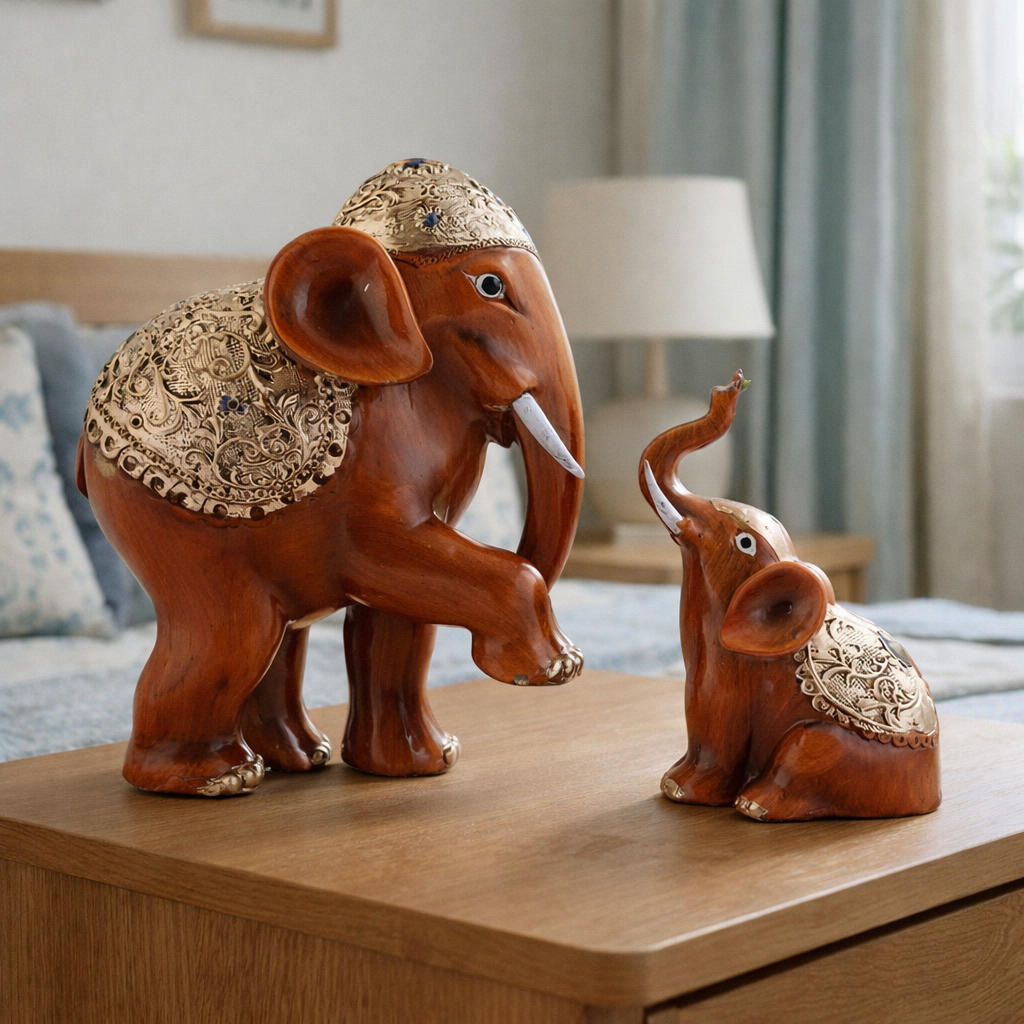
- Single bird or lone figure art: Symbolises loneliness in Vastu. Always opt for pairs or groups in romantic and family spaces.
- Clutter above eye level: Vastu considers overhead visual weight as suppressive. Keep high shelves clean and minimal.
- South-West entrance décor that is too light: South-west needs heavy, grounded objects — not featherweight knick-knacks.
Frequently Asked Questions
Which showpiece is best for the living room as per Vastu?
For the north-east corner, a ceramic lotus, Buddha, or Ganesha showpiece in white or light yellow is ideal — ceramic is an earth element material that reinforces the spiritual energy of this zone. For the south-west corner, opt for a heavier resin sculpture in earthy brown or gold tones. Moolwan's medium-sized pieces (16–21 cm) are the most popular for Indian living rooms because they hold presence on a shelf without overwhelming a compact space.
Can I use canvas wall art in a Vastu-compliant home?
Yes — canvas wall art is fully compatible with Vastu when the subject matter aligns with the directional element of the wall. Nature scenes, spiritual motifs, sunrise imagery, and floral art are universally recommended. Moolwan's canvases use 340 GSM cotton canvas with UV-resistant inks and moisture-resistant coating — durable enough for Indian monsoon humidity. Avoid abstract art depicting chaos, war, or isolation regardless of wall direction.
What colours should I use for home décor as per Vastu?
Each compass direction maps to a Vastu element with compatible colours: north uses blue and green (water), north-east uses white and light yellow (space), south-east uses orange and red (fire), south-west uses brown and beige (earth), and west uses white and grey (metal). Use these as the guide for accent colour in wall art and showpieces placed in each zone. You do not need to repaint walls — even a small ceramic piece in the right tone for its corner satisfies the energy intention.
Is a fish or water motif showpiece good for home as per Vastu?
Yes — fish and water motifs are auspicious in Vastu and represent abundance, flow, and prosperity. They are best placed in the north zone of your living room or entrance. An aquarium-style showpiece or a blue ceramic fish sculpture on a north-facing console table or shelf is a common and effective Vastu recommendation. Avoid placing water-themed décor in the south or south-east (fire zone), as it is considered energetically conflicting.
Where should I place Ganesha in my home as per Vastu?
Ganesha should face either north or east — never face south (considered inauspicious for deity placement). The main entrance facing inward (welcoming position) is the most common and Vastu-approved placement. Avoid placing Ganesha in the bedroom or bathroom. For a puja corner, north-east facing placement is ideal. Moolwan's ceramic Ganesha showpieces are available in small (10–16 cm) and medium (16–21 cm) sizes — small for desks or entrance shelves, medium for puja corners and showcase units.
Transform Your Home with Vastu-Aligned Décor from Moolwan
Every piece in Moolwan's Vastu décor range is manufactured in-house, priced direct, and engineered for Indian apartments — no middlemen, no guesswork, no generic mass-market pieces.
Shop Vastu Decorative Items Living Room Showpieces from ₹150 Browse All Modern Home DecorFree shipping · COD available · Trusted by 3,000+ Indian homes · Returns within 24 hours of delivery


