
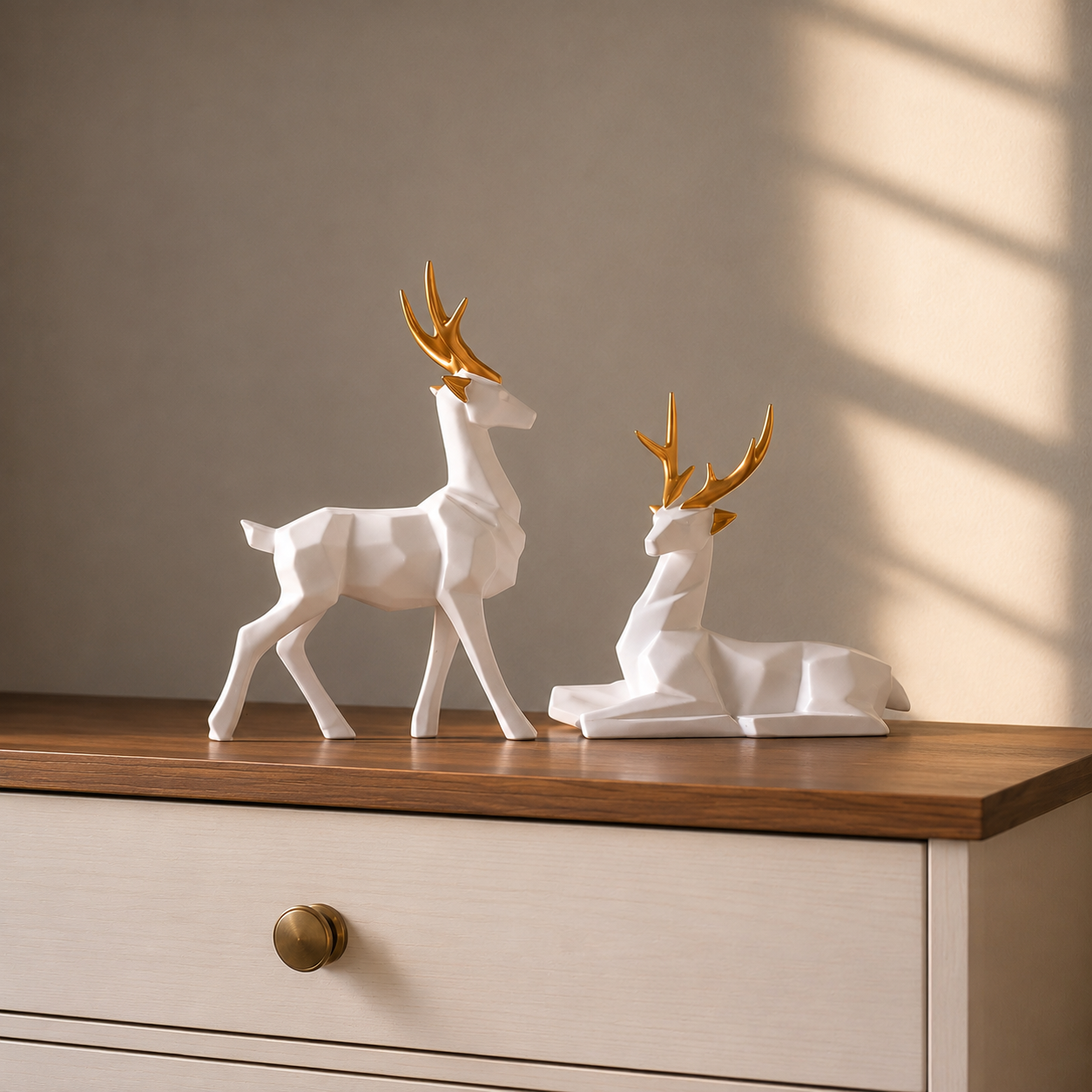
Why plants and showpieces need to be planned together, not bought separately
Most Indian living rooms fail visually not because the pieces are ugly, but because they were bought at different times, for different corners, with no shared logic. A living room with plants and showpieces works when both categories are treated as one system: greenery supplies texture and movement, showpieces supply form and focal weight, and both sit inside a consistent height rhythm across the room.
The rule that separates a styled console from a cluttered one is the rule of three heights: one tall element (a plant or floor vase, 60cm+), one mid element (a showpiece or planter, 16–34cm), and one low element (a small object or trailing plant). Repeat this triangle on every surface — TV unit, console, coffee table, bookshelf — and the room reads as intentional even with different pieces on each surface.
The odd-number principle
Group objects in threes or fives, never pairs. A pair looks symmetrical and static; an odd-numbered cluster creates a visual triangle the eye naturally follows. On a coffee table, that means one tray, one small showpiece, and one low plant — not two matching vases flanking a candle.
Explore Moolwan's modern home decor collection to find pieces sized specifically for Indian console tables and TV units, where space is tighter than in Western room layouts and every object has to earn its place.
Choosing showpieces: ceramic vs resin for Indian living rooms
The material of a showpiece decides how long it survives Indian summers, monsoon humidity, and daily handling — not just how it looks in a photo. Ceramic and resin behave differently under heat, humidity, and impact, and picking the wrong one for a given spot is the most common reason décor looks tired within a year.
| Property | Ceramic Showpieces | Resin Showpieces |
|---|---|---|
| Core composition | 92% clay composition | 94% purity epoxy resin |
| Heat tolerance | Heat-resistant up to 60°C | Stable between 15–35°C |
| Humidity tolerance | Up to 85% RH — suited to coastal and monsoon-heavy cities | Up to 60% RH — better for drier, AC-controlled rooms |
| Drop resistance | Withstands drops from 15cm | Scratch-resistant, 3H pencil hardness |
| Expected lifespan | 5+ years indoors | 3+ years indoors |
| Finish options | Matte or glazed | Matte or glazed |
| Weight range | 150g–600g | 150g–600g |
For living rooms near windows, balconies, or in humid coastal cities like Mumbai, Chennai, or Kochi, ceramic's 85% RH tolerance makes it the safer pick for open shelves. For air-conditioned apartments in drier climates, resin's scratch resistance suits low coffee tables and high-traffic consoles where objects get moved and handled often.
Browse Moolwan's full range to buy showpieces for home decor filtered by material, size, and finish — every listing states the composition so you're not guessing which piece survives your room's conditions.
Sizing showpieces and plants to your surface
A showpiece that looks proportionate on a showroom shelf can dwarf or disappear on your actual console. Size decisions should follow the surface, not the object's individual appeal.
| Size Band | Dimension | Best Surface | Pair With |
|---|---|---|---|
| Small | 10–16cm | Shelf, desk, bathroom counter | Trailing plant (pothos, string of pearls) |
| Medium | 16–21cm | Showcase, coffee table | Mid-height plant (snake plant, ZZ plant) |
| Large | 25–34cm | Console, TV unit, entryway — focal point | Floor plant (fiddle leaf, areca palm) |
Weight matters as much as height. Moolwan's showpieces are engineered between 150g and 600g, deliberately light enough for gypsum walls and standard Indian shelving, which often can't bear the load of heavier imported stoneware or metal pieces without additional wall anchors.
For statement corners — an entryway console, the space beside a sofa — pair one large showpiece with one floor-standing plant and nothing else. Restraint at this scale reads as luxury; crowding a focal point with multiple large objects reads as clutter regardless of how expensive each piece is.
Shop sized-to-fit decor for your living room →A five-step styling formula for plants and showpieces together
Follow this sequence in order. Skipping the mapping step is the single biggest reason living rooms end up over-decorated — buyers pick pieces they like individually instead of pieces the room actually needs.
- Map your surfaces first. List every flat surface in the room — console, coffee table, TV unit, bookshelf, corner floor space. Each gets one styling "moment," not several competing ones.
- Assign one focal surface. Pick the surface guests see first (usually the console facing the entryway) and give it your largest plant and showpiece. Every other surface should feel quieter than this one.
- Build each moment in odd-numbered clusters. One tall, one mid, one low — repeated per surface, varied in material and texture so surfaces don't look identical.
- Match material to microclimate. Shelves near windows or in humid regions get ceramic; drier, AC-cooled surfaces can take resin. Refer to the specification table above before buying.
- Edit, don't add. Once every surface has its triangle, stop. If a room still feels empty after this, add one more plant — not another showpiece. Green space reads as calm; object density reads as noise.
This is the same framework Moolwan's design team uses when styling show-flats for Indian developers, adapted for real homes where surfaces are smaller and light is more directional than in staged photography.
What Moolwan stands for — and why it matters for this decision
Moolwan is a direct-to-consumer, manufacturer-first home décor brand built for Indian homes specifically — not a reseller of generic imported stock. The brand's position: most Indian décor is mass-produced for climates it was never tested against, or priced up by layers of middlemen before it reaches a shelf. Moolwan manufactures canvas wall art, ceramic and resin showpieces, and curated gifting pieces in-house, prices them direct, and engineers every material spec — heat tolerance, humidity rating, drop resistance — around Indian conditions rather than borrowing specs from a Western catalogue.
That manufacturer-direct model is also why the brand can commit to specifics most decor retailers won't publish — exact GSM, exact clay percentage, exact humidity rating — because the products are made to that spec, not sourced and relabelled. If a piece doesn't work once it arrives, Moolwan's return policy allows returns within 24 hours of delivery on unused items in original packaging, with a 10% restocking fee and refunds processed within 15 working days.
For living rooms that need to hold both a modern silhouette and a distinctly Indian sensibility — brass tones, earthenware textures, motifs that don't feel imported — Moolwan's unique decor items for an elegant living room collection is built specifically around that tension, pairing contemporary shapes with materials and finishes suited to Indian light and heat.
Frequently asked questions
How many plants should I put in a living room with showpieces?
Three is the working number for most Indian living rooms — one floor plant near the focal surface, one mid-height plant on a console or shelf, and one small trailing plant. Beyond four or five, plants start competing with showpieces for visual attention rather than supporting them.
Should showpieces match my plant pots?
No — matching finishes look staged. Instead, match tone: a matte ceramic showpiece pairs naturally with a matte terracotta pot, while a glazed resin piece suits a glazed or metallic planter. Vary the shape so the eye reads texture, not repetition.
What showpiece size works for a small Indian apartment living room?
Stick to Moolwan's small (10–16cm) and medium (16–21cm) size bands for apartments under 250 sq ft of living space. Reserve the large 25–34cm pieces for a single focal console; using more than one large piece in a compact room crowds sightlines and makes the space feel smaller.
Is ceramic or resin better for a humid coastal city like Mumbai or Chennai?
Ceramic, in most cases. Moolwan's ceramic showpieces are humidity-tolerant up to 85% RH versus resin's 60% RH ceiling, which makes ceramic the safer choice for shelves near windows, balconies, or un-airconditioned rooms in coastal climates.
What if the showpiece I ordered doesn't suit my living room once it arrives?
Moolwan accepts returns within 24 hours of delivery, provided the item is unused and in its original packaging. A 10% restocking fee applies, and refunds are processed within 15 working days of the returned item being received.


