Vastu Shastra decorates each room by matching its direction to one of five elements: earth, water, fire, air and space. Living and prayer areas belong in the North or North-East, kitchens in the South-East, and bedrooms in the South-West, with décor materials and colours chosen to support that element rather than fight it.
Most Vastu advice online stops at "face east" and leaves Indian homeowners guessing what to actually put on the wall or shelf. We help design-conscious Indian homeowners turn Vastu directions into real décor decisions — the paintings, showpieces and finishes that belong in each zone of the home. Moolwan is a manufacturer-direct Indian home décor brand, and this guide uses our own room-by-room placement method to close that gap.
Moolwan's Panch Tatva Placement Method maps every room to its ruling element (tatva) and direction, then recommends décor that reinforces — never contradicts — that element. A fire-facing kitchen, for instance, is undercut by cool blues and water motifs; it is supported by warm terracottas and angular forms. This is the framework used throughout this guide.
Use this table as a quick reference before you buy anything for a room. It pairs the direction and ruling element with the room it governs and the décor approach that reinforces it.
| Direction | Element | Ideal Room | Supportive Décor | Colours to Favour |
|---|---|---|---|---|
| North | Space | Living room, home office | Open wall art, mirrors, minimal clutter | Green, light blue, white |
| North-East | Water | Pooja room, meditation corner | Brass or ceramic showpieces, flowing forms | White, cream, light yellow |
| South-East | Fire | Kitchen | Warm-toned canvas art, angular accents | Red, orange, terracotta |
| South-West | Earth | Master bedroom | Heavy, grounded showpieces; solid-toned art | Earthy brown, beige, muted yellow |
| North-West | Air | Guest room, dining area | Light resin accents, movement-suggesting art | White, grey, pastel tones |
Vastu places the living room in the North or East, the zone of open space and social energy. Keep wall art large but uncluttered — a single anchor piece works better than several small frames competing for attention. If you want a contemporary living-room refresh that still respects this openness, browse Moolwan's modern home décor collection for pieces sized to sit as one clean focal point rather than a crowded gallery wall.
The North-East, ruled by water, is the traditional placement for a home's prayer or meditation corner. This zone favours brass, copper and ceramic in warm, glazed finishes over sharp modern materials. For pieces that carry that traditional, handcrafted quality, explore Moolwan's antique-style showpiece collection, where each piece is sized Small (10–16cm) for a shelf-top prayer corner or Medium (16–21cm) as a standalone showcase piece.
Fire governs the South-East, which is why Vastu consistently recommends this direction for the kitchen. Décor immediately outside or adjacent to the kitchen should stay warm rather than cool: terracotta, rust and burnt-orange canvas pieces support the fire element instead of dampening it.
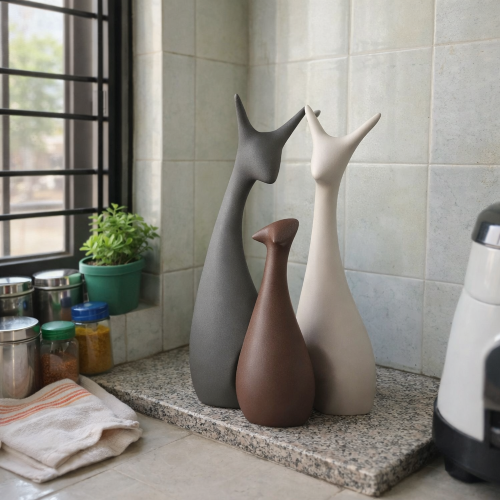
The South-West is the seat of the earth element and Vastu's preferred direction for the master bedroom, associated with stability and rest. Choose grounded, weighty-looking décor — ceramic showpieces and solid-toned wall art — over anything that reads as light or floating.
Know your room's direction but not sure what to place there? Match it to your Vastu zone.
Shop Vastu-Friendly DécorVastu texts describe elements, not exact materials, which is where most guidance goes vague. Moolwan engineers its décor with published specifications so a homeowner can match material to element with certainty: our ceramic showpieces are 92% clay composition, heat-resistant to 60°C and humidity-tolerant up to 85% RH — well suited to earth-element South-West bedrooms and North-East water zones in humid Indian climates. Our resin pieces use 94%-purity epoxy with 3H pencil-hardness scratch resistance, better suited to air-element North-West spaces that see more daily handling. Canvas wall art is built on 340 GSM cotton canvas with eco-solvent UV-resistant inks on 1.5-inch kiln-dried pine frames, holding colour and shape in spaces that face fire-element heat or direct sun, such as South-East-adjacent walls.
For a home that leans more curated than traditional, a mix of these materials placed by direction — rather than one material used everywhere — is what separates a Vastu-aware home from a Vastu-decorated showroom. If you're gifting or finishing a room with pieces that don't fit a single category, see Moolwan's curated unique home décor pieces chosen to slot into whichever zone still needs balancing.
The North-East is considered the weakest direction for a bedroom in Vastu, since it is reserved for the water element and prayer space. The South-West, ruled by earth, is the recommended direction instead.
Yes. Wall art, showpieces and furniture placement can apply Vastu's directional logic without any structural change. Choosing element-matched décor, as in the table above, is the fastest way to do this in a rented space.
Avoid strong blues and blacks in a South-West bedroom, since these are associated with the water element and work against earth's stabilising energy. Earthy browns, beige and muted yellow are better matches.
Size matters alongside direction. A Large piece (25–34cm, 400–600g) works as a focal point in open North-facing living rooms, while Small pieces (10–16cm, 150–250g) suit compact North-East prayer corners without overwhelming the space.
Ready to bring your home's directions and décor into balance?
Explore Curated Home DécorQuick View



