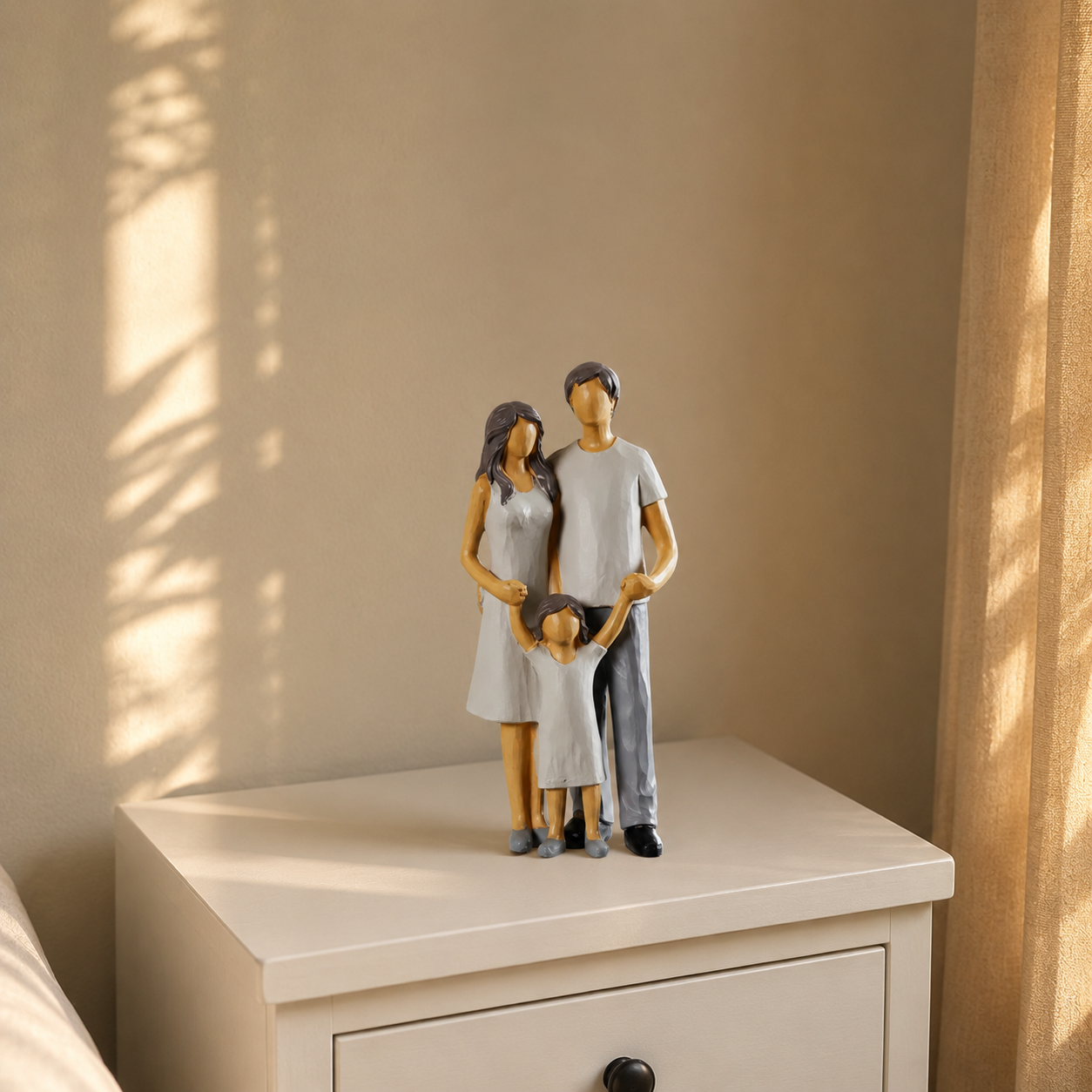
A closed living room has four walls doing the organising for you. An open-plan living room — the kind now standard in most new Indian apartments, where the living, dining, and sometimes kitchen counter share one uninterrupted floor — has no walls to lean on. Furniture alone cannot define where one "room" ends and the next begins; decor has to do that work.
Most open-plan living rooms in Indian homes fail the same way: decor gets scattered evenly across the space, one showpiece near the TV console, one near the dining table, one on a random shelf, with no relationship between them. The result reads as clutter, not curation, because nothing tells the eye where to look first or how the zones connect. The fix is not more decor. It is decor placed with a system.
Moolwan's design team calls this system the Anchor–Accent–Air Rule: one anchor piece that carries visual weight, secondary accent pieces that echo it in scaled-down form, and enough negative space (air) between them that the room can breathe. Applied to an open floor plan, this rule turns three or four functional zones into one legible room.
Every open-plan living room needs exactly one anchor, and it belongs on the largest uninterrupted wall behind your primary seating — usually the sofa. A large-format canvas wall art panel works best here because it reads clearly from every angle of an open floor plan, including from the dining table or kitchen counter fifteen feet away. Moolwan's canvas pieces use 340 GSM cotton canvas with eco-solvent, UV-resistant inks on 1.5-inch kiln-dried pine frames, finished with a moisture-resistant coating — specifications chosen specifically so the piece holds its colour and shape through an Indian summer and monsoon without warping.
Size the anchor to roughly two-thirds the width of your sofa, not the width of the wall. An anchor that is too small gets swallowed by an open floor plan; one that is correctly scaled becomes the single fixed point the rest of the room can be read against. Once that anchor is set, resist the urge to add a second large piece on the same sightline — the room only needs one visual full stop.
The hardest part of an open floor plan is the transition — the console table, half-wall, or shelf ledge where "living room" quietly becomes "dining area." Left empty, this spot makes the whole layout feel unfinished. Filled with the wrong object, it competes with the anchor instead of supporting it. The right move is a medium showpiece, 16–21cm, placed at console or shelf height, in a material and finish that echoes the anchor's palette without repeating its motif.
Ceramic showpieces are the most reliable material for this role in Indian homes: they are engineered at 92% clay composition, heat-resistant to 60°C, humidity-tolerant up to 85% relative humidity, and rated for a 5-plus-year lifespan even with the occasional accidental knock, since they hold up to a 15cm drop. For a transition point that sees more daily traffic — a console near a walkway, say — resin pieces are a strong alternative: 94% purity epoxy resin, scratch-resistant to a 3H pencil hardness, with a 3-plus-year indoor lifespan.
This is also where you can safely introduce texture that the anchor doesn't have. If your canvas art is smooth and matte, let the transition piece carry a glazed finish, or vice versa. That contrast — not repetition — is what makes a two-piece pairing look designed rather than default. You can browse Moolwan's showpieces for living rooms filtered by size and finish to find one that pairs correctly with whatever anchor you've already chosen.
Counterintuitively, the bigger the open floor plan, the less decor it needs per square foot. A closed room forces the eye to stop at a wall; an open floor plan lets the eye travel, which means every additional object is competing for attention across a longer sightline. Leave visible breathing room on both sides of the anchor and above the transition piece — at minimum, a margin equal to the height of the object itself.
A useful test: stand at the entrance to the space and count how many decor objects are visible in a single glance without turning your head. If the answer is more than three, the room is over-decorated for its scale, regardless of how good any individual piece is.
Open-plan living rooms in Indian homes are exposed to more airflow, more sunlight through larger window runs, and often kitchen-adjacent humidity — all of which stress decor materials faster than a closed room would. Matching the material to the zone's exposure is what keeps the room looking coordinated a year later instead of mismatched once one piece fades or warps.
| Material | Best zone | Humidity tolerance | Lifespan | Key trait |
|---|---|---|---|---|
| Canvas wall art | Anchor wall, low direct humidity | Moisture-resistant coating | Multi-year with UV-resistant ink | 340 GSM cotton, 1.5″ kiln-dried pine frame |
| Ceramic showpieces | Console, shelf, transition points | Up to 85% RH | 5+ years | 92% clay, heat-resistant to 60°C, 15cm drop-resistant |
| Resin showpieces | High-traffic consoles, coffee tables | Up to 60% RH | 3+ years indoor | 94% epoxy purity, 3H scratch-resistant, 15–35°C range |
As a rule, keep resin pieces away from direct window heat above 35°C, and give ceramic pieces the console or shelf spots nearest a kitchen or balcony where humidity spikes are more likely. Matching material to micro-climate within one open room is a small decision that prevents a mismatched, half-faded look within the first year.
Scale mistakes are the single most common failure in open-plan decorating. A showpiece that looks proportionate on a showroom shelf often disappears entirely on a real console in a room with 10-foot sightlines. Size against the surface and the sightline, not against the object in isolation.
Shelf, desk, or bathroom scale. In an open living room, reserve small pieces for close-range surfaces like a side table next to the sofa arm — never a console visible from across the room, where it will read as empty space.
The default for showcase units and coffee tables. This is the correct scale for most transition-zone accent pieces in a standard Indian apartment living room.
Focal-point scale, reserved for anchor positions or a console that sits directly opposite the main entry, where it needs to register at a distance immediately.
Weight matters too. Moolwan's showpieces range 150g–600g specifically so they stay stable and lightweight on Indian wall-mounted shelves and floating consoles, which are rarely rated for heavy static load. Before buying, check both the shelf's stated load capacity and the piece's weight — a beautiful showpiece that stresses a floating shelf is a returns problem waiting to happen.
Open floor plans complicate traditional Vastu guidance because zones that were once separate rooms with their own directional rules now share one continuous space. The practical adaptation most Indian homeowners use: treat each functional zone by its own Vastu logic even without walls between them. Seating clusters generally favour the south or west wall as the anchor position; the northeast corner is traditionally kept lighter and less cluttered, which conveniently also matches good open-plan practice of leaving one corner visually open.
This is also where the tension between modern minimalism and traditional Indian aesthetics shows up most in open-plan homes — a fully open floor plan can feel stripped of the cultural warmth a household wants, while an overly traditional approach can clutter a layout that depends on openness to function. Antique-style showpieces are the effective middle ground: a single well-chosen antique-finish piece at the transition point brings cultural texture without requiring the ornament-everywhere approach that open floor plans can't support. You can explore Moolwan's antique showpieces for home decoration to find one piece that carries that weight rather than several that compete for it.
Take a standard 14x18ft open-plan Indian living-dining space as an example. The anchor: a large canvas wall art piece, roughly 30 inches wide, on the wall behind the sofa. The accent: a medium ceramic showpiece, 18cm, on the console table that separates the seating cluster from the dining table, in a glazed finish that plays against the canvas's matte texture. The second accent: a small resin piece, 12cm, on a side table within the seating cluster itself, echoing the ceramic piece's colour family so the two accents read as a pair even though they sit in different zones.
What ties the three pieces together is not matching them exactly but keeping one shared thread — colour family, finish contrast, or material logic — visible across all of them. That shared thread is what makes an open floor plan with three functional zones still read as one decorated room when someone walks in.
Two to three well-placed pieces — one anchor and one or two accents — outperform five or six scattered ones. The goal is a legible zone system, not maximum coverage.
Not matching, but related. Repeat one element — a finish, a colour family, or a material — across zones instead of duplicating the same showpiece, so the space feels connected without looking mass-produced.
Favour glazed finishes over matte ones at the accent points, since glazed ceramic and resin surfaces catch and bounce ambient light. Reserve matte finishes for the anchor wall, which usually gets more direct light exposure.
Yes. Moolwan accepts returns within 24 hours of delivery for unused items in original packaging, with a 10% restocking fee and refund processed within 15 working days.
Moolwan's canvas pieces are built for this exact condition — 340 GSM cotton canvas with eco-solvent, UV-resistant inks and a moisture-resistant coating on kiln-dried pine frames, engineered to hold colour and shape through Indian humidity and sun exposure.
Shop anchor-ready wall art, console-scale showpieces, and antique accents engineered for Indian homes — trusted by 3000+ customers, 100% authentic, free shipping and COD available.
Quick View



