
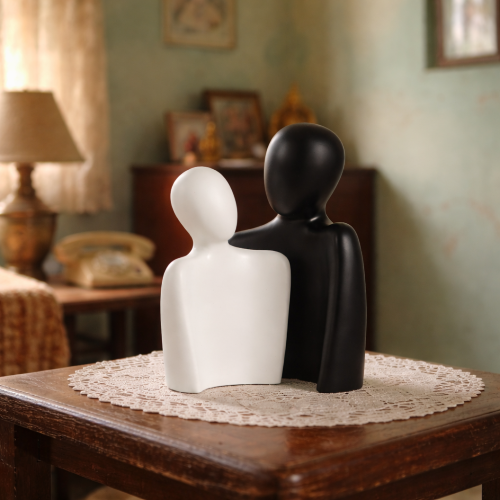
A living room reads as luxury when every object earns its place — not when it holds the most objects. Indian living rooms are often mid-sized, between 140 and 220 square feet, which means the difference between "expensive" and "cluttered" comes down to editing, material quality, and how much air is left around each piece. We help design-conscious Indian homeowners achieve a designer-grade living room without hiring a designer, using a repeatable framework instead of guesswork.
01 — The FrameworkThe Anchor-Accent-Air Rule
Every luxury living room needs exactly three layers, applied in this order: one Anchor (a single large-format piece that sets the room's tone — a canvas wall art panel or a floor-standing showpiece), two to three Accents (smaller showpieces or vases that echo the anchor's palette without competing with it), and generous Air (the empty space between and around objects, which is what actually signals restraint to the eye).
Most Indian living rooms fail the "Air" test first. A shelf with six showpieces touching each other reads as a display cabinet, not a curated room. Leave at least 15–20cm of visible surface around every showpiece, and treat your wall art as the single loudest statement in the room — everything else should whisper.
Ready to anchor your room? See sized-for-Indian-homes pieces.
Shop Modern Home Decor Items02 — MaterialsWhat Separates Luxury Materials From Mass-Market Ones
Luxury is a material claim before it is a visual one. Mass-market décor in India is frequently manufactured for cost, not for Indian climate — humidity, heat, and monsoon moisture degrade cheap resin and untreated canvas within a year. Moolwan manufactures in-house specifically to engineer around this, which is the proprietary detail that separates a piece that ages well from one that doesn't.
| Material | Best For | Lifespan | Climate Tolerance |
|---|---|---|---|
| 340 GSM Canvas | Wall anchor, above sofa or console | 5+ years indoors | Moisture-resistant coating |
| 92% Clay Ceramic | Coffee table or console accent | 5+ years | Up to 85% RH, 60°C |
| 94% Purity Resin | Shelf or desk accent, gifting | 3+ years indoors | Up to 60% RH, 15–35°C |
03 — Color & TextureLayering Modern With Traditional Indian Tones
The luxury look Indian homeowners are chasing right now is not a full Western minimalist reset — it's modern structure carrying traditional warmth. Keep walls and large furniture in neutral, low-saturation tones (warm white, greige, deep charcoal), then let your accent layer — wall art, showpieces, textiles — carry the color and cultural texture: terracotta, ochre, deep emerald, brass gold.
A simple rule for color count
Cap the room at three dominant colors: one neutral base, one deep accent, and one metallic (gold or brass) for highlight. Anything beyond three starts to look decorated rather than designed. For inspiration on pairing contemporary pieces with these tones, browse Moolwan's modern luxury decor items for contemporary living rooms, which are pre-styled around this exact three-color logic.
04 — SizingScaling Pieces to an Indian-Apartment Living Room
Wrong scale is the single biggest reason a living room looks cheap even when the individual pieces are expensive. Moolwan sizes every showpiece into three fixed bands so buyers don't have to eyeball it:
- Small (10–16cm): shelf, desk, or bathroom counter — never a coffee table centerpiece on its own.
- Medium (16–21cm): showcase units or a coffee table, paired with one small accent.
- Large (25–34cm): the room's focal point — console table, TV unit shelf, or floor placement near the anchor wall art.
Weight also matters for Indian walls: Moolwan pieces run 150g–600g, light enough for standard drywall or brick-and-plaster anchors without structural reinforcement. Match your largest showpiece to your largest wall art piece in visual weight — a heavy, dark canvas next to a tiny 10cm showpiece looks unbalanced, not curated.
05 — Common MistakesWhat Makes a "Luxury" Living Room Look Cheap Instead
Three mistakes account for most Indian living rooms that spend real money but still don't read as luxury:
- Too many small showpieces, no anchor. A shelf full of 8–10cm trinkets with nothing large-format in the room has no focal point for the eye to land on.
- Mismatched finishes in the same sightline. Mixing high-gloss glazed ceramic with matte resin in the same visual cluster reads as accidental, not intentional — pick one finish family per cluster.
- Ignoring climate durability. Cheap resin or untreated canvas warps, yellows, or cracks within a year in Indian humidity, which is the fastest way for a "luxury" room to look worn out fast. For a broader set of styling frameworks beyond this one, see Moolwan's room decoration ideas hub.
Frequently Asked Questions
How many showpieces should a luxury living room have?
Three to five total, arranged as one anchor and two to four accents, is the ceiling for a mid-sized Indian living room. Beyond that, the room starts to look like storage rather than styling.
What size wall art works best above a sofa?
As a rule, your wall art should span 60–75% of the sofa's width. For a standard 6-foot Indian sofa, that's roughly a 90–105cm wide canvas panel, using Moolwan's 340 GSM cotton canvas with a 1.5-inch kiln-dried pine frame.
Is ceramic or resin better for humid Indian climates?
Ceramic tolerates higher humidity — up to 85% RH versus resin's 60% RH — making it the safer choice for coastal cities or rooms without regular air conditioning. Resin is better suited to drier, climate-controlled interiors.
How do I mix modern and traditional Indian décor without it looking mismatched?
Keep the furniture and wall color modern and neutral, then introduce tradition only through the accent layer — terracotta tones, brass finishes, or motif-driven wall art — capped at three dominant colors total.
What is Moolwan's return policy if a piece doesn't suit the room?
Returns are accepted within 24 hours of delivery for unused items in original packaging, with a 10% restocking fee and refund processed within 15 working days.
Build Your Room on the Anchor-Accent-Air Rule
Moolwan manufactures in-house and prices direct, so you get climate-engineered, correctly-sized pieces without the middleman markup that inflates most Indian décor.
Start With an Anchor Piece


