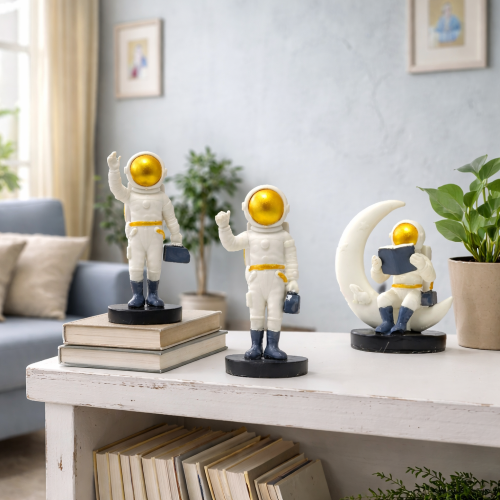
How to display statues at home?
Quick Answer: Display statues at eye level or slightly below, in odd-numbered groupings, on surfaces that contrast with the statue's colour and finish. Match statue material to your room's humidity and temperature — ceramic for bathrooms and kitchens, resin for air-conditioned bedrooms, any material for dry living rooms. Placement, proportion, and light are the three non-negotiables.
At Moolwan, we help design-conscious Indian homeowners style their spaces with decorative statues that work with Indian room proportions, monsoon humidity, and the visual tension between modern and traditional aesthetics — not against them. The advice below is based on the materials and sizing standards we manufacture to, and the placement patterns that consistently look intentional rather than cluttered.
A well-chosen statue placed carelessly looks like an afterthought. The same piece placed with intention becomes the focal point of a room. Most Indian homes — flats, row houses, or independent bungalows — share a specific spatial challenge: limited floor space, high walls, and rooms that double as living and entertaining zones. This means your statue display must do two things simultaneously: hold attention and stay uncluttered.
The three variables that determine how good a statue display looks are: height (where the eye lands), backdrop (what the statue is set against), and light (whether natural or artificial). Get all three right and even an affordable piece will look like a deliberate design decision.
Not every room is equally suited to statue display. The table below maps common Indian home zones to ideal statue types, sizes, and materials — based on Moolwan's product specifications and the specific climate conditions of Indian interiors.
| Room / Zone | Recommended Size | Best Material | Placement Spot | What to Avoid |
|---|---|---|---|---|
| Entrance / Foyer | Large (25–34 cm) | Ceramic (92% clay, humidity-tolerant to 85% RH) | Console table or floor pedestal at 110–130 cm | Tiny pieces that get lost in transition |
| Living Room — Coffee Table | Medium (16–21 cm) | Ceramic or Resin (epoxy 94% purity) | Centre or off-centre grouped with a tray | Tall statues that block sightlines across the table |
| Living Room — Display Shelf | Small to Medium (10–21 cm) | Ceramic or Resin | Eye level, grouped in threes | More than 5 pieces on one shelf without breathing room |
| Bedroom — Bedside Table | Small (10–16 cm) | Resin (stable 15–35°C, scratch-resistant 3H hardness) | One side only — symmetry reads as hotel, not home | Ceramic in non-AC humid bedrooms (above 60% RH) |
| Bedroom — Dresser / Shelf | Small to Medium | Resin or Ceramic (matte finish for dust resistance) | Grouped with a plant or framed photo | Heavy pieces on floating shelves with low load ratings |
| Pooja Room / Sacred Corner | Medium to Large | Ceramic (heat-resistant to 60°C) | Raised platform or dedicated shelf, always at eye level | Resin near diyas or incense (heat-sensitive above 35°C) |
| Bathroom / Balcony | Small (10–16 cm) | Ceramic only (tolerates up to 85% RH) | Dry counter shelf, away from direct water splash | Resin or canvas — moisture degrades both |
Browse Moolwan's decorative statue collection — each piece is tagged with its ideal room zone and climate compatibility so you are not left guessing at the time of purchase.
Ready to find the right statue for your space? Moolwan ships across India with free delivery and COD available.
Shop Decorative Statues Explore All Modern DécorThe single biggest mistake in statue display is grouping even numbers of similar-sized pieces in a straight line. It reads as inventory, not interior design. The rule that consistently works in Indian home settings — whether a compact Mumbai flat or a spacious Bengaluru independent house — is odd numbers, varying heights, single visual anchor.
Group statues in sets of three: one tall (focal piece), one medium, one small — arranged in a loose triangle, not a row. This creates visual movement. Add one non-statue element — a small plant, a stack of books, a single candle — to break the mono-material look and make the grouping feel curated rather than collected.
Leave at least 5–8 cm between each piece in a grouping. Negative space is what makes each statue legible. On a 90 cm shelf, three well-spaced statues look better than six pieces crowded from end to end. This applies especially to decorative items for the bedroom, where the room's intimate scale demands restraint.
A circular or rectangular tray underneath a group of statues does two things: it defines the display zone visually, and it makes cleaning far easier — lift the tray, wipe the surface, replace. Brass trays, woven cane trays, and matte ceramic platters all work well with Moolwan's statue finishes (matte and glazed both available).
India's climate diversity is real, and it matters for décor. A resin statue that looks pristine in a Bangalore drawing room may show stress in a coastal Mumbai home with persistent humidity above 60% RH. Getting the material right is not over-engineering — it is the difference between a statue that lasts two years and one that lasts a decade.
Moolwan manufactures statues in two primary materials, each engineered to specific climate tolerance standards:
Both finishes — matte and glazed — are easy to maintain. A soft dry cloth is sufficient for routine cleaning. Avoid abrasive cleaners on either finish.
When styling your living room or hallway with multiple décor pieces, pairing a statue with canvas wall art creates a layered look that feels collected over time. Explore Moolwan's modern home decor items — including canvas art, showpieces, and curated room-specific collections — to see coordinated styling options.
Statues displayed above 170 cm — on top of wardrobes or high wall brackets — become invisible in daily living. They collect dust and lose their design impact. Bring them down to where the eye naturally rests when you are standing or seated.
A 10 cm small statue on a large dining sideboard looks lost. A 30 cm large statue on a narrow bedside table looks precarious. Moolwan's size guidance: Small (10–16 cm) for desks, shelves, bathrooms; Medium (16–21 cm) for coffee tables and showcases; Large (25–34 cm) for console tables, floor displays, or as focal-point anchors.
Moolwan's ceramic and resin statues range from 150 g to 600 g — lightweight enough for standard Indian wall-mounted shelves. However, always verify your shelf's load rating before grouping more than three pieces. A combined weight of 1.2–1.5 kg is a reasonable ceiling for most market-standard floating shelves.
Moolwan statues are manufactured in-house, priced direct, and built to Indian climate standards. Free shipping. COD available. Returns accepted within 24 hours of delivery.
Browse Statues — Shop Now Shop Bedroom DécorIn traditional Vastu practice, the northeast corner (Ishaan) is considered ideal for spiritual or deity statues, while the east-facing entrance is auspicious for welcoming pieces. For non-religious decorative statues, placement is governed by proportion and sightlines rather than direction. Whatever the tradition, the practical rule holds: statues must be at eye level, well-lit, and on stable surfaces — clutter and wrong height undermine both aesthetics and intent.
There is no universal number, but a reliable ceiling for most Indian living rooms is 5–7 decorative statues total — split across two or three display zones rather than concentrated in one spot. The test: if removing one piece makes the display feel complete, you have one too many. Each piece should earn its place with visual purpose, not presence alone.
No. Resin (epoxy-based) statues are rated for humidity up to 60% RH and temperatures between 15–35°C. Indian bathrooms and exposed balconies regularly exceed both thresholds. Use ceramic statues in these zones — Moolwan's ceramic pieces are humidity-tolerant up to 85% RH and heat-resistant to 60°C, making them the only safe choice for wet or semi-outdoor spaces.
For both ceramic and resin statues, a soft dry microfibre cloth is the safest cleaning tool. For stubborn dust in crevices, use a soft-bristle paintbrush or a dry toothbrush. Avoid wet cloths on resin surfaces in humid rooms — moisture trapped in crevices can cause micro-damage over time. Never use abrasive cleaners, bleach, or alcohol-based sprays on glazed or matte finishes.
Small (10–16 cm) and medium (16–21 cm) statues are ideal for compact Indian apartments — they deliver visual weight without consuming surface area. In rooms under 120 sq ft, stick to one medium statue as a focal piece paired with one or two small pieces, rather than multiple large statues competing for attention. Moolwan's entire range is lightweight (150 g–600 g), which also means no stress on apartment shelves or rental fixtures.
Quick View



