
Dining walls get skipped because they're the hardest to size
We help design-conscious Indian homeowners fill exactly this wall — the one behind the dining table that's too big for a small print and too central to guess on. Most dining rooms fail here for one of three reasons: the art is undersized against the table, it's hung too high for a seated sightline, or the material can't survive kitchen-adjacent heat and humidity. All three are fixable with numbers, not taste.
Moolwan is a manufacturer-direct home décor brand — we produce our own canvas art, ceramic showpieces, and resin décor in-house, which is why we can quote exact specifications instead of vague styling advice. That's also what Moolwan stands for: décor engineered for Indian homes, priced at factory rate, sold directly to you without a retail markup layered on top.
The three proven ways to fill a dining room wall
Each formula below solves the sizing problem differently. Pick by wall width and table length, not by browsing for "something nice."
One oversized canvas
A single large-format piece, 60–75% of the table's width, hung as the sole focal point above the table or sideboard. Best when the wall is a single uninterrupted stretch.
Best for: walls under 7ft, minimal styling effortSymmetrical gallery wall
3–5 pieces of matching or complementary size, arranged in a grid with 5–7cm gaps, sized together to equal 60–75% of the table's width.
Best for: walls 8ft+, eclectic or layered roomsShelf + showpiece combo
A floating shelf above the sideboard holding 2–3 ceramic or resin showpieces, paired with one mid-size canvas beside it for height contrast.
Best for: dining-cum-living zones, gifting-forward homesFormula 01 is the fastest fix for a bare wall this week.
Browse oversized wall artSizing: what actually fits your wall
Use your dining table's width as the anchor measurement — not the wall's full width. Art that spans the full wall reads as oversized once chairs are pulled out.
| Table width | Recommended art width | Best format |
|---|---|---|
| 36–42 in (3–3.5 ft) | 22–31 in | Single medium canvas |
| 48–60 in (4–5 ft) | 29–45 in | Single large canvas or 3-piece gallery |
| 66–72 in (5.5–6 ft) | 40–54 in | Oversized canvas or 4–5 piece gallery |
| 78 in+ (6.5 ft+) | 47 in+ | Gallery wall + shelf combo |
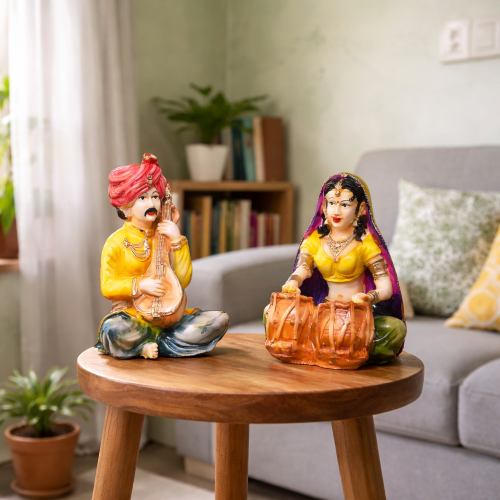
If you're mixing in showpieces rather than only wall art, Moolwan's size bands apply the same logic to a shelf or sideboard: small pieces (10–16cm) suit a desk-width shelf edge, medium (16–21cm) suit a coffee-table-width surface, and large (25–34cm) work as a standalone focal piece — each weighing 150g–600g, light enough for standard Indian wall fixings and shelf brackets.
Why material matters more in a dining room than anywhere else
A dining wall sits closer to cooking heat, serving steam, and higher ambient humidity than a living room wall. Material specs that are fine elsewhere in the house can fail here within a year.
Canvas pieces are stretched on 1.5-inch kiln-dried pine frames with a moisture-resistant coating, which matters directly beside a kitchen pass-through. Resin décor is built from 94%-purity epoxy resin, scratch-resistant to 3H pencil hardness, rated for indoor humidity up to 60% RH and temperatures of 15–35°C — comfortably inside the range of most Indian dining rooms, including non-AC spaces. Ceramic pieces are 92% clay composition and drop-resistant from 15cm, which matters on a sideboard that gets bumped during serving.
Want the shelf-plus-showpiece formula instead of only wall art?
Shop showpieces built for thisHanging height and placement rules for a seated room
Dining rooms are viewed seated, not standing — the standard "eye-level" hanging rule (145–152cm centre) still applies, but the reference point shifts.
-
Measure your table's width, not the wall's.
Use the table as the anchor for art width — 60–75% of table width, per the sizing table above.
-
Set the centre at 145–152cm from the floor.
This keeps the piece at eye level for a person standing near the table, and comfortably above sightline while seated.
-
Above a sideboard, leave 15–20cm of clearance.
Anything tighter reads as cluttered; anything looser breaks the visual connection between furniture and art.
-
For gallery walls, keep gaps to 5–7cm.
Consistent spacing reads as intentional; uneven gaps read as unfinished, especially at dining-height sightlines.
-
Choose matte finish near open kitchens.
Matte resists glare from overhead dining lights and steam fogging better than glazed finishes in high-humidity zones.
For a dining room that leans traditional-meets-modern — common across Indian homes balancing both — a curated mix from Moolwan's unique home décor collection lets you combine a contemporary canvas with a culturally rooted showpiece on the same wall, without either element competing for attention.
Frequently asked
What size art should go above a 6-seater dining table?
For a standard 6-seater table (roughly 60 inches wide), aim for art between 36 and 45 inches wide — 60–75% of the table's width. A single large canvas or a 3-piece gallery cluster both work at this size.
Is canvas or ceramic better for a dining room wall?
Canvas suits the main wall art position; ceramic and resin suit a shelf or sideboard accent. Moolwan's canvas uses a moisture-resistant coating for kitchen-adjacent humidity, while ceramic pieces tolerate up to 85% RH — both are built for Indian dining conditions, not imported climate assumptions.
How high should I hang art above a dining table?
Keep the centre of the piece 145–152cm from the floor, or 15–20cm above the top of a sideboard if one sits below it. This holds regardless of table size.
Can I mix wall art and showpieces on the same dining wall?
Yes — a floating shelf with 2–3 showpieces beside one mid-size canvas is one of the three standard formulas for this wall, and works well when the room also serves as a gifting or display space.
What if I order the wrong size?
Moolwan accepts returns within 24 hours of delivery on unused pieces in original packaging, with a 10% restocking fee and refund processed within 15 working days.


