
How to Find One-of-a-Kind Décor Pieces for an Indian Living Room
The Short Answer
A décor piece reads as one-of-a-kind when its finish, height, or material breaks from the symmetrical, identical-unit output of mass factory molds. Moolwan's modern home décor collection achieves this with hand-variable ceramic glazing (92% clay composition) and asymmetric three-piece clustering, sized from 10cm to 34cm for shelves through console-level focal points.
Mass-manufactured décor runs on a small set of repeated factory molds, which is why the same vase or figurine often turns up in dozens of homes across the same neighbourhood. Moolwan helps design-conscious Indian homeowners break that pattern by curating modern home décor in small-batch finishes and asymmetric forms that rarely repeat identically within a single production run.
What Actually Makes a Décor Piece Feel One-of-a-Kind?
A piece feels one-of-a-kind when its form, finish, or proportion breaks from the nearest mass-market equivalent. Symmetry signals mass production because injection-mold and cast-resin manufacturing is cheapest when every unit comes out identical, so undecorated symmetry is the default output of high-volume factories. Moolwan's modern home décor collection works against that default with irregular silhouettes, hand-finished glaze variation, and asymmetric clustering — the visual cues a trained eye reads as "not from a catalogue."
Material choice carries the same signal. Ceramic fired at high temperature with a 92% clay composition develops micro-variations in glaze pooling that no two pieces replicate exactly, because the glaze chemistry reacts differently to subtle position shifts inside the kiln. This is why hand-glazed ceramic showpieces tend to read as more distinctive than uniformly coated resin alternatives, even when the underlying shape is similar.
Why Size and Surface Matching Determines Whether a Piece Looks Curated or Random
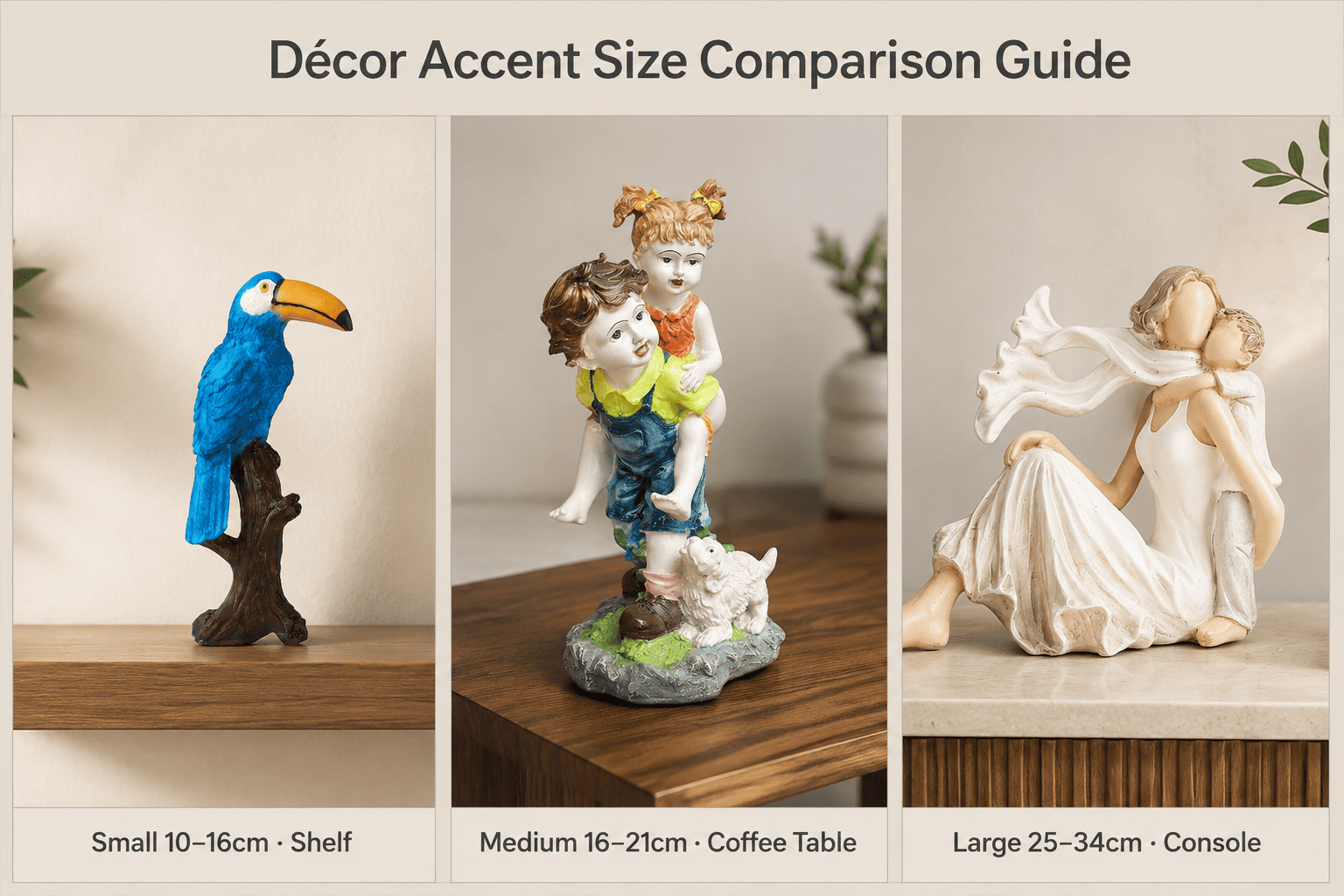
A décor piece looks curated when its height-to-surface ratio falls within a specific proportional band, not by chance pairing. Interior proportion studies generally place that band at 20–35% of the surface's depth, because anything smaller disappears visually and anything larger overwhelms the surface's negative space. Moolwan's size-graded showpiece range — Small (10–16cm), Medium (16–21cm), Large (25–34cm) — is built directly around this ratio so each size has a defined surface match rather than a guess.
Buying the correctly sized piece the first time also avoids the sunk cost of replacing an oversized or undersized showpiece within a year — a price-justification Moolwan's size-graded approach is designed to prevent.
| Target Surface | Surface Width | Recommended Décor Size | Weight Range |
|---|---|---|---|
| Floating shelf / bookshelf | Under 30cm | 10–16cm (Small) | 150–250g |
| Entryway console | 30–50cm | 12–18cm (Small–Medium) | 150–350g |
| Coffee table | 50–70cm | 16–21cm (Medium) | 250–400g |
| Dining table centrepiece | 70–100cm | 18–28cm (Medium–Large) | 300–500g |
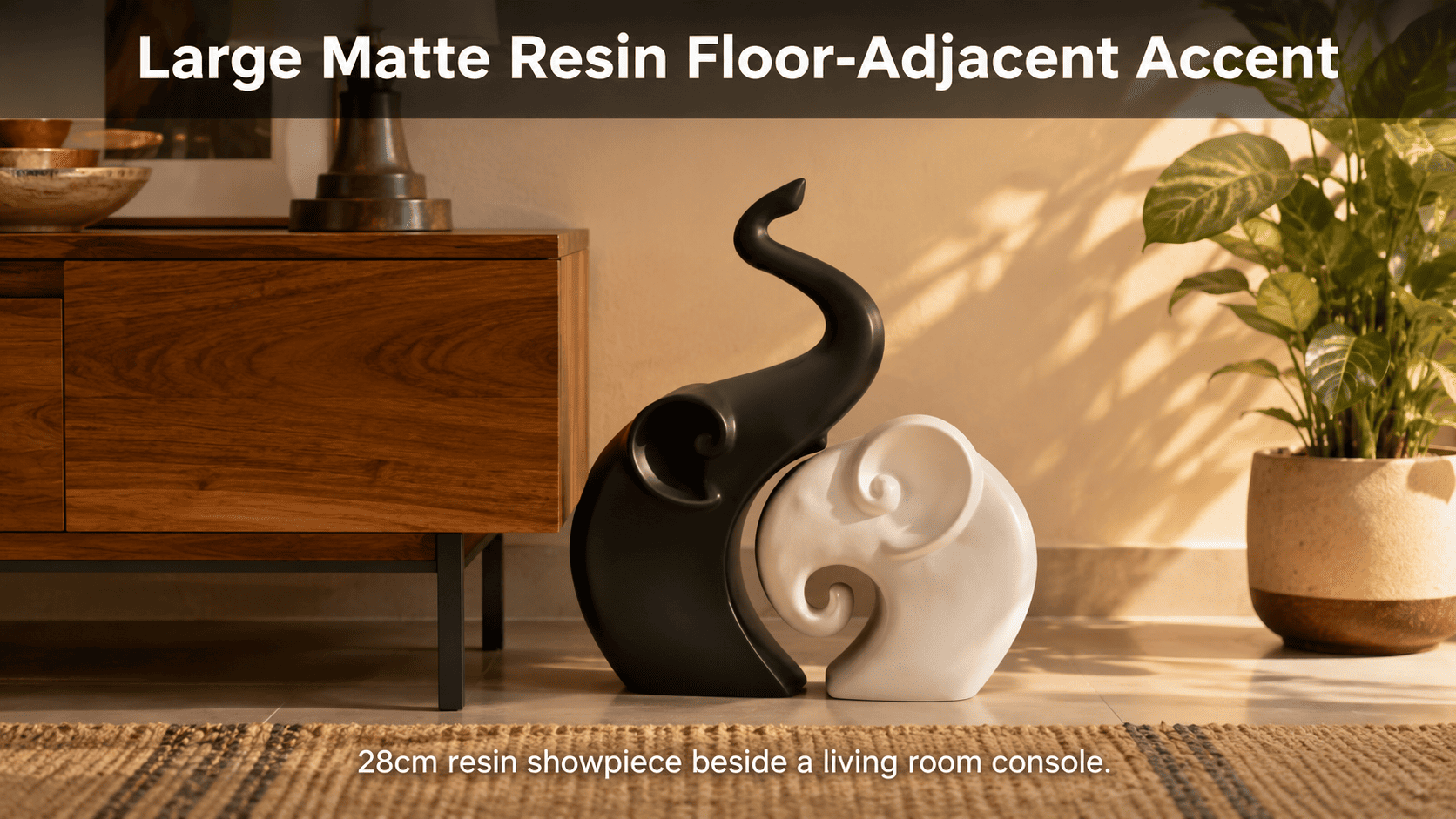
| Large console / floor-adjacent focal point | 100cm+ | 25–34cm (Large) | 400–600g |
Because finish, material, and clustering style add further variables beyond surface width alone, browse the full size-band and finish selection in Moolwan's living room décor collection to match your exact surface.
Design Rule
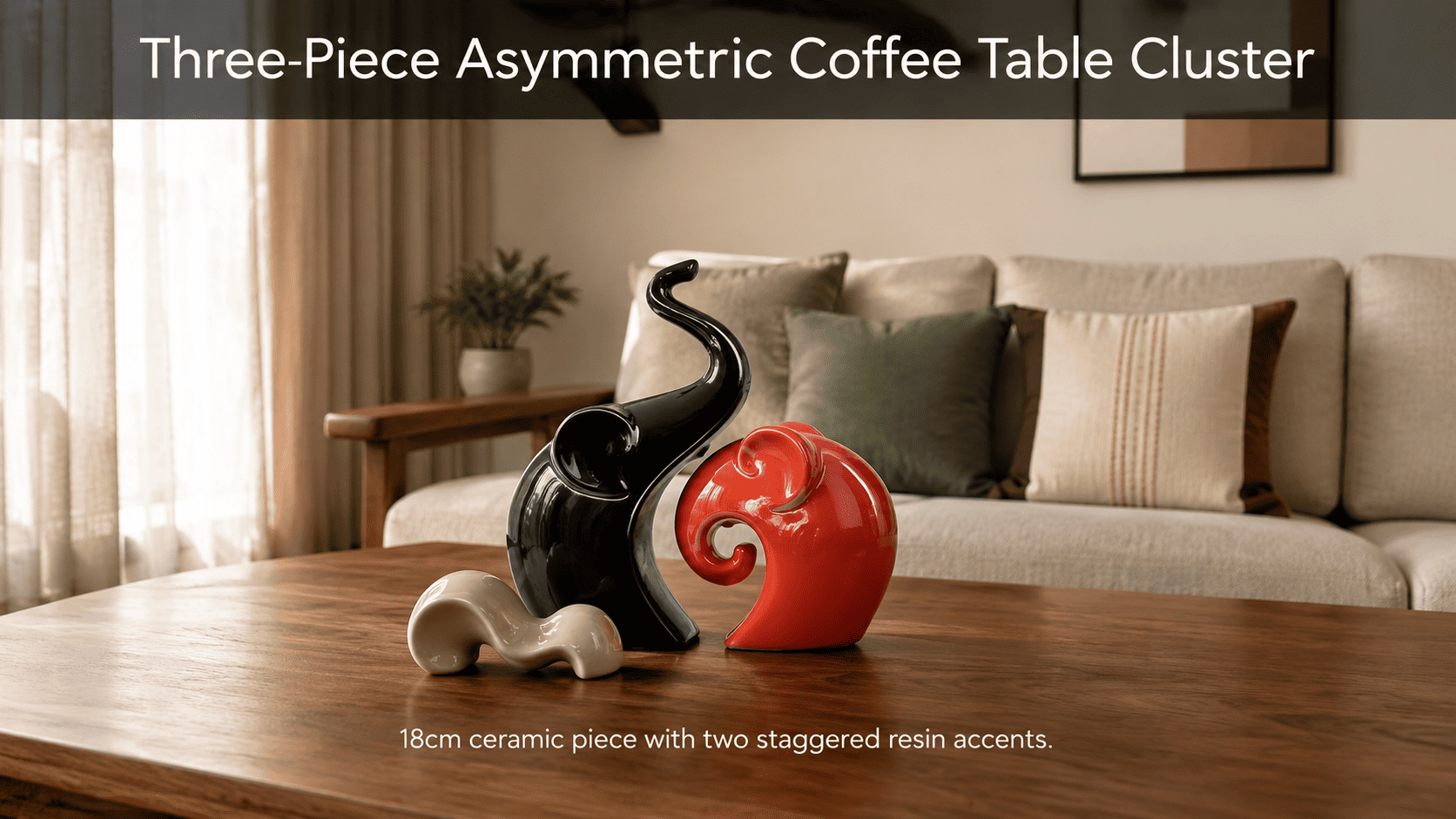
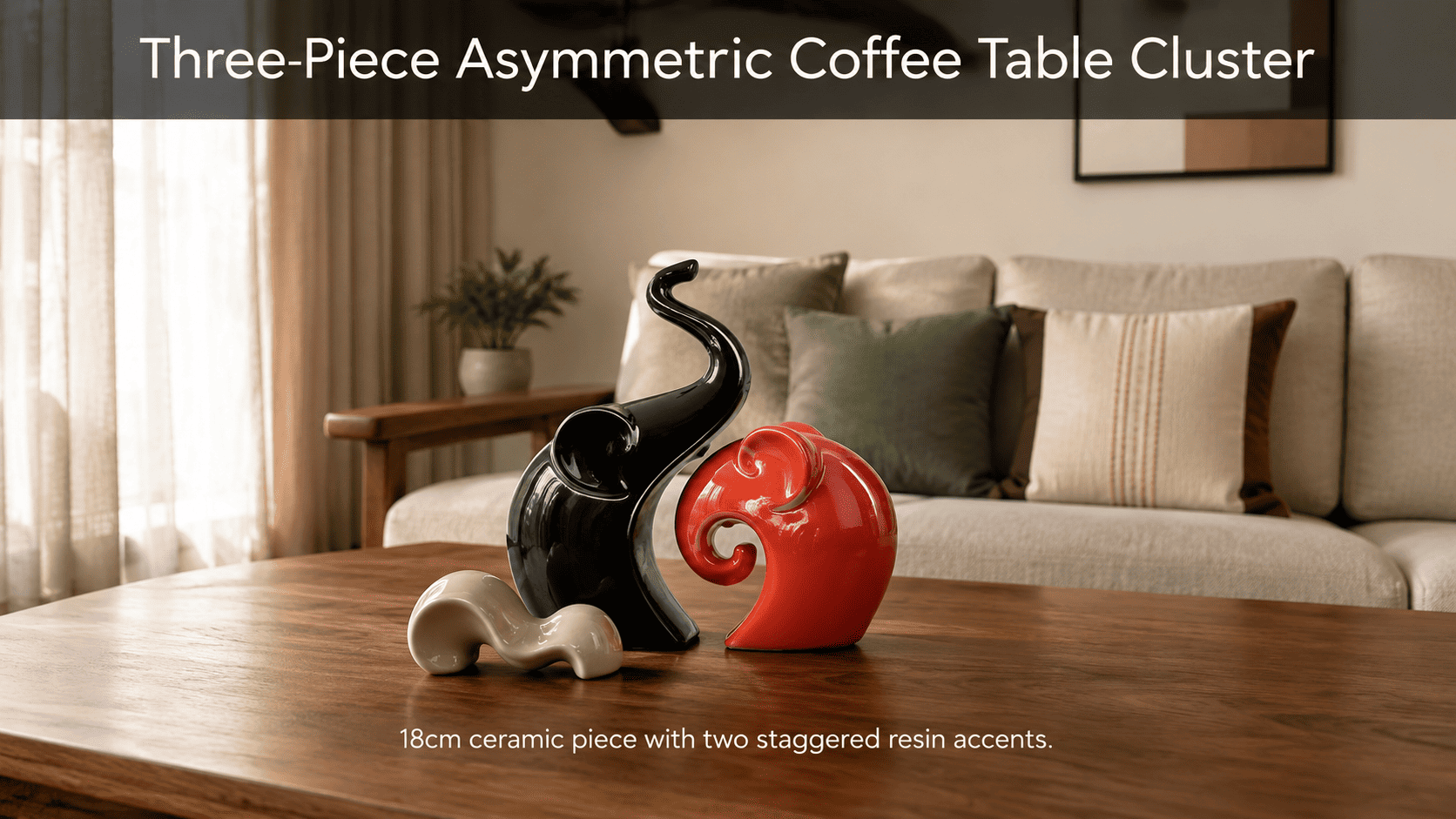
Décor accents arranged in clusters of three — at staggered heights and mixed materials — register as deliberately curated, because the human eye parses evenly spaced, same-height groupings as a matched factory set, while uneven spacing and height variation breaks that pattern recognition. Moolwan designs its modern home décor collection specifically for this three-piece, mixed-height clustering, known as Moolwan's Odd-Number Asymmetry Rule.
Should You Mix Ceramic and Resin Pieces in the Same Display?
Yes — mixing ceramic and resin pieces in one display creates a contrast a single-material set cannot achieve. Ceramic surfaces scatter light unevenly because of micro-texture in the glaze, while resin surfaces reflect light uniformly due to their smooth epoxy finish, so pairing the two materials in one cluster creates a visible difference in how each piece catches ambient light. Moolwan's modern home décor collection pairs 92%-clay-composition ceramic (humidity-tolerant to 85% RH) with 94%-purity resin (humidity tolerance 60% RH, 3+ year indoor lifespan) specifically so the two materials can sit side by side without either degrading on a different schedule.
This also means a mixed-material cluster won't need piecemeal replacement at different times, since both materials are rated for multi-year indoor use under typical Indian living-room humidity conditions.
Want to build a coffee-table cluster that doesn't look like everyone else's? Shop the full Moolwan living room décor collection now.
How Do You Avoid a Cluttered, Showroom Look?
A display avoids looking cluttered when at least 60% of the surface around the cluster stays visibly empty. Visual clutter is a function of negative space, not item count — a coffee table with three pieces and no breathing room looks busier than one with five pieces arranged with deliberate gaps, because the eye needs uninterrupted surface to rest between focal points. Moolwan's décor accents are kept in a 150g–600g weight range specifically so a small cluster doesn't need a large surface footprint to register as a complete display.
Frequently Asked Questions
What makes a décor piece look one-of-a-kind instead of mass-produced?
A piece reads as one-of-a-kind when its finish or form shows visible hand variation, because uniform symmetry is the cheapest and most common output of high-volume factory molds. Moolwan's ceramic showpieces use a 92% clay composition with kiln-variable glaze pooling, so no two pieces in a batch finish identically.
What size décor accent works best for a coffee table?
A medium accent in the 16–21cm range works best for most coffee tables, because it occupies roughly 20–35% of a typical 50–70cm coffee table's depth without overwhelming the surface. Pieces under 16cm tend to visually disappear on a coffee table of that width.
Can ceramic and resin pieces be displayed together?
Yes — ceramic and resin can be displayed together because both materials are rated for comparable indoor lifespans, 5+ years for ceramic and 3+ years for resin, so neither degrades faster and breaks the pairing over time.
How many pieces should be in one décor cluster?
Three pieces at staggered heights is the most reliable cluster size, because odd numbers and uneven heights are harder for the eye to read as a matched, mass-produced set than even numbers at equal height.
Ready to put together a living room corner that doesn't look like a showroom display? Bring home a curated piece from Moolwan's living room décor collection — manufacturer-direct, climate-rated, and finished for Indian humidity. If you're still narrowing down a style, browse the wider unique home décor pieces range or the focused living room item selection to compare finishes side by side before you commit.


