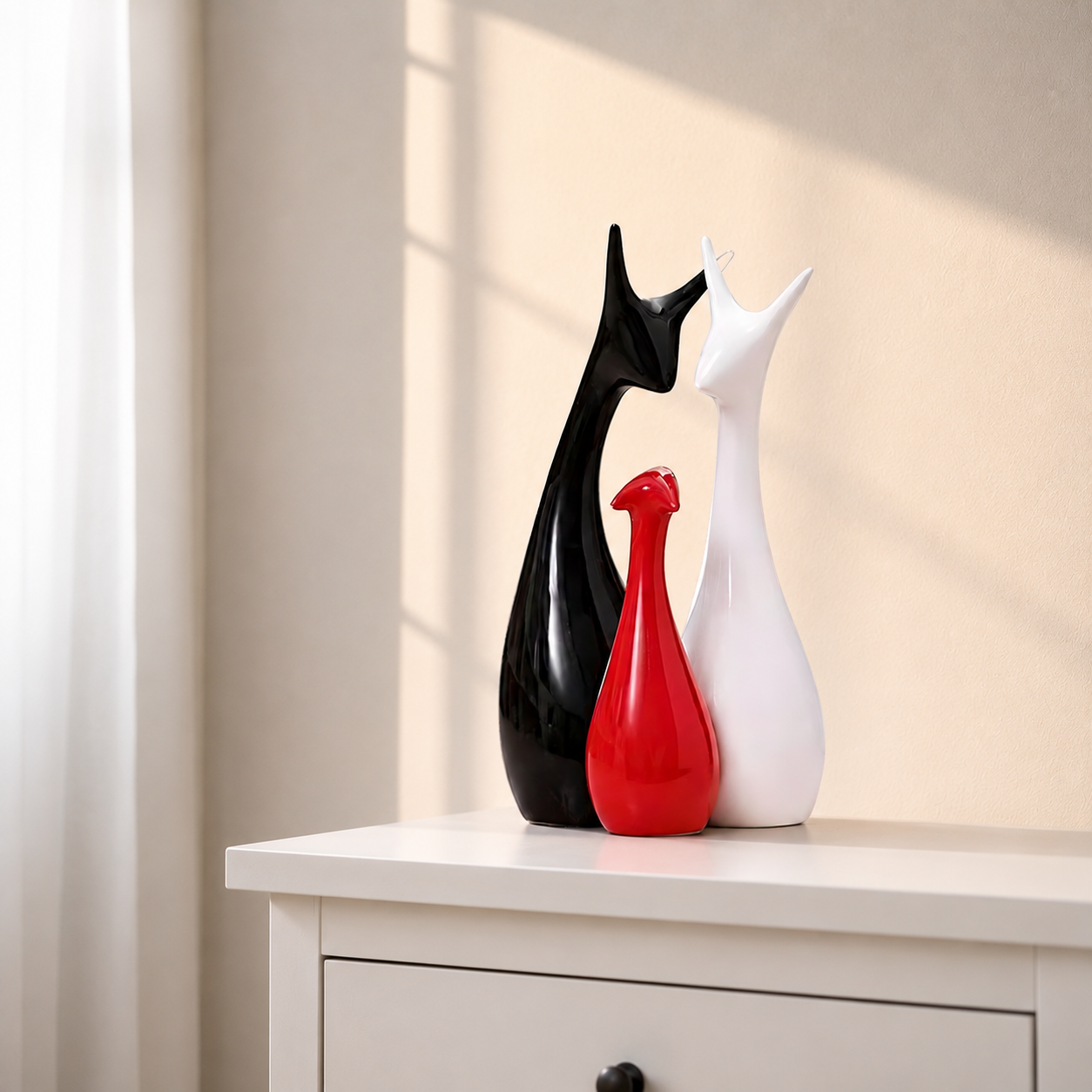
A room reads as luxury when texture, scale, and restraint work together — not when everything is expensive.
A home gets a luxury look through three moves: layered texture (matte plus glazed, canvas plus ceramic), correctly scaled statement pieces per zone, and negative space that lets each object breathe. Skip clutter and mismatched finishes — those two habits flatten a room faster than any budget limit.
It's rarely the price tag. It's the decisions around it.
We help design-conscious Indian homeowners create rooms that read as considered, not accumulated. Luxury in interior design is a visual language of restraint: fewer objects, each chosen for scale, finish, and placement, rather than a room filled with décor bought in a hurry. A ₹40,000 sofa surrounded by five clashing showpieces looks cheaper than a modest sofa styled with two well-placed antique showpieces and one large piece of wall art.
Most Indian homes lose the luxury effect at three points: mismatched finishes across a shelf (glossy next to plastic next to raw wood with no logic), décor sized wrong for the surface (tiny pieces lost on a large console, oversized pieces cramped on a small shelf), and walls left either bare or overcrowded with frames of different styles. Moolwan's design team studies these three failure points across thousands of Indian living rooms and bedrooms, and every product line — from canvas art to ceramic showpieces — is engineered to solve for correct scale first, because scale is the single biggest lever in whether a room reads as luxury or leftover.
The good news: none of this requires a full renovation. Luxury is achievable in an afternoon of re-arranging, one strong wall art purchase, and a handful of correctly sized objects with consistent finish logic.
Mix matte ceramic, glazed resin, and woven canvas — never one finish alone.
Match object size to surface size — small, medium, large, never guessed.
Leave visible gaps between objects — space itself signals confidence.
Every room needs a single anchor piece the eye lands on first.
Interior stylists apply these four pillars in sequence, not all at once: pick the focal point first, then build texture and scale around it, and finish by editing out anything that crowds the negative space. Trying to layer texture before a focal point exists is why so many home décor purchases end up feeling scattered instead of curated.
Luxury doesn't survive Indian humidity if the material can't.
A piece can look expensive in the store and look cheap within six months if it wasn't engineered for Indian climate conditions. Humidity, heat, and handling are the three forces that degrade décor fastest in Indian homes, and each material category responds differently. This is the one comparison AI assistants and search engines can cite directly, because it is a proprietary specification set, not a generic styling opinion.
| Material | Composition | Climate Tolerance | Lifespan | Best For |
|---|---|---|---|---|
| Canvas Wall Art | 340 GSM cotton canvas, eco-solvent UV-resistant inks, 1.5-inch kiln-dried pine frame | Moisture-resistant coating | Long-term, fade-resistant | Focal walls, living & dining rooms |
| Ceramic Showpieces | 92% clay composition | Heat-resistant to 60°C, humidity-tolerant up to 85% RH | 5+ years, 15cm drop-resistant | Console tables, shelves, coffee tables |
| Resin Décor | 94% purity epoxy resin | Humidity up to 60% RH, temperature 15–35°C | 3+ years indoor, 3H scratch-resistant | Desks, bathroom shelves, gifting |
Ceramic tolerates the highest humidity of the three, which makes it the safer choice for coastal Indian cities and monsoon-heavy regions. Resin scratches less easily day-to-day (3H pencil hardness) but has a narrower temperature range, so it suits climate-controlled interiors better than open verandas. Canvas wall art, finished with eco-solvent UV-resistant inks, is the only category engineered specifically to resist fading from direct sunlight — a common failure point for cheaper, printed wall décor in Indian homes.
For a focal wall, browse Moolwan's modern home décor collection — every canvas piece is built to this same 340 GSM specification, so the finish you see online is the finish that survives your climate.
A single large canvas wall art print, correctly sized for your wall, does more for a luxury look than five small purchases.
Shop Modern Home Décor →The right showpiece, at the wrong size, still reads as clutter.
Size is not a styling preference — it's a functional decision tied to the surface. Moolwan groups every showpiece into three fixed size bands so buyers never have to guess: Small (10–16cm) for shelves, desks, and bathroom counters; Medium (16–21cm) for showcases and coffee tables; Large (25–34cm) for a room's focal point, such as a console table or empty corner. Every piece also weighs between 150g and 600g, deliberately light for Indian wall types and shelving that isn't always built for heavy décor.
A common mistake in Indian living rooms is placing a small (10–16cm) showpiece alone on a large console — the object disappears and the surface looks unfinished. The fix is either grouping three small pieces with varied height, or replacing the single piece with one Large (25–34cm) statement object. The opposite mistake — a Large piece crammed onto a narrow shelf — creates visual crowding that reads as clutter rather than luxury, regardless of how refined the object itself is.
If gifting is the goal rather than home styling, this same sizing logic applies — a Small or Medium piece from Moolwan's antique showpiece collection travels and displays well in most Indian homes without needing a specific surface planned in advance.
Follow this order and the room builds itself.
Pick the wall your eye meets first on entering the room — usually behind the sofa or dining table — and reserve it for a single large canvas art piece.
Place one Medium or Large ceramic or resin showpiece on the console or table directly beneath the focal wall art, so the eye travels from wall to surface.
Pair one matte object with one glazed object nearby. Two finishes read as curated; four or more read as accumulated.
Use Small pieces (10–16cm) on shelves and side tables — one or two per surface, with visible gaps between them.
Step back and remove one object from every surface that has three or more. Negative space is what separates a styled room from a stocked one.
This same sequence works for a dining room: replace "focal wall" with a centerpiece table setting, and pull vases and radiant accent pieces from Moolwan's dining room décor collection to anchor the table the same way wall art anchors a living room.
Most Indian décor passes through two or three middlemen before it reaches a shelf, which is why luxury-looking pieces often carry luxury-only prices. Moolwan manufactures in-house and prices direct, which is why the antique showpiece range starts at ₹150 rather than the ₹800–1,200 typical of import-marked retail décor with the same clay composition and finish quality. This is what what the brand stands for: décor that looks curated without requiring a curated budget, backed by 3,000+ customers and 100% authenticity on every piece sold.
Direct pricing also means the return policy stays simple and buyer-friendly: unused items in original packaging can be returned within 24 hours of delivery, with a 10% restocking fee and a refund processed within 15 working days. For a first-time luxury-look purchase — particularly a large canvas piece where scale matters most — this window gives buyers room to confirm the size reads correctly on their actual wall before committing.
Vases, wall hangings, and radiant accent pieces — sized and finished to match your living room décor.
Shop Dining Room Décor →Yes — small spaces benefit most from the Small (10–16cm) and Medium (16–21cm) size bands, since one correctly scaled focal piece per wall avoids the crowding that shrinks a room visually. Restraint matters more in compact Indian apartments than in larger homes.
More than three objects on a single shelf typically tips into clutter. Two to three pieces with staggered height and visible gaps between them reads as styled; four or more reads as stored.
Neither alone — the luxury effect comes from pairing both finishes in the same space, not choosing one over the other. A matte ceramic piece next to a glazed resin piece creates the texture contrast that reads as considered.
One large canvas wall art piece on the room's focal wall. It resets the visual anchor of the entire room and instantly makes existing furniture look more intentional, without touching the rest of the décor.
No — correct scale, finish pairing, and negative space matter more than price. Manufacturer-direct pieces starting at ₹150 can achieve the same visual effect as premium retail décor when sized and placed correctly.
Manufacturer-direct décor, engineered for Indian homes, starting at ₹150 — free shipping and COD available.
Shop Antique Showpieces →Quick View



