
How to Group Decorative Accents on a Shelf Without Looking Cluttered
The Short Answer
Group decorative accents in odd numbers (3 or 5), anchor the cluster with one tall piece (25–34 cm), and leave at least 70% of the shelf surface completely empty. Moolwan's ceramic and resin showpieces are sized specifically for this 3-object cluster model — because odd groupings prevent the visual symmetry that makes a shelf read as arranged rather than lived-in.
Open shelves in Indian apartments are among the most misused surfaces in residential interiors. Research on perceptual processing shows that the human eye resolves grouped objects faster when contrast in height, material, and form is present — meaning a shelf with three varied pieces at staggered heights is cognitively processed as intentional design, while five identical-height pieces reads as storage. Moolwan helps design-conscious Indian homeowners transform their shelves from display problems into the most deliberate surface in the room, using décor sized and finished specifically for compact Indian shelf dimensions.
Why Do Shelf Displays Look Cluttered Even With Good Pieces?
Clutter on a shelf is not a function of how many objects are placed — it is a function of contrast absence and negative space deficit. When every object on a shelf occupies a similar height band (say, 12–15 cm), the eye cannot identify a visual entry point, and the surface reads as a flat, undifferentiated mass regardless of how attractive the individual pieces are.
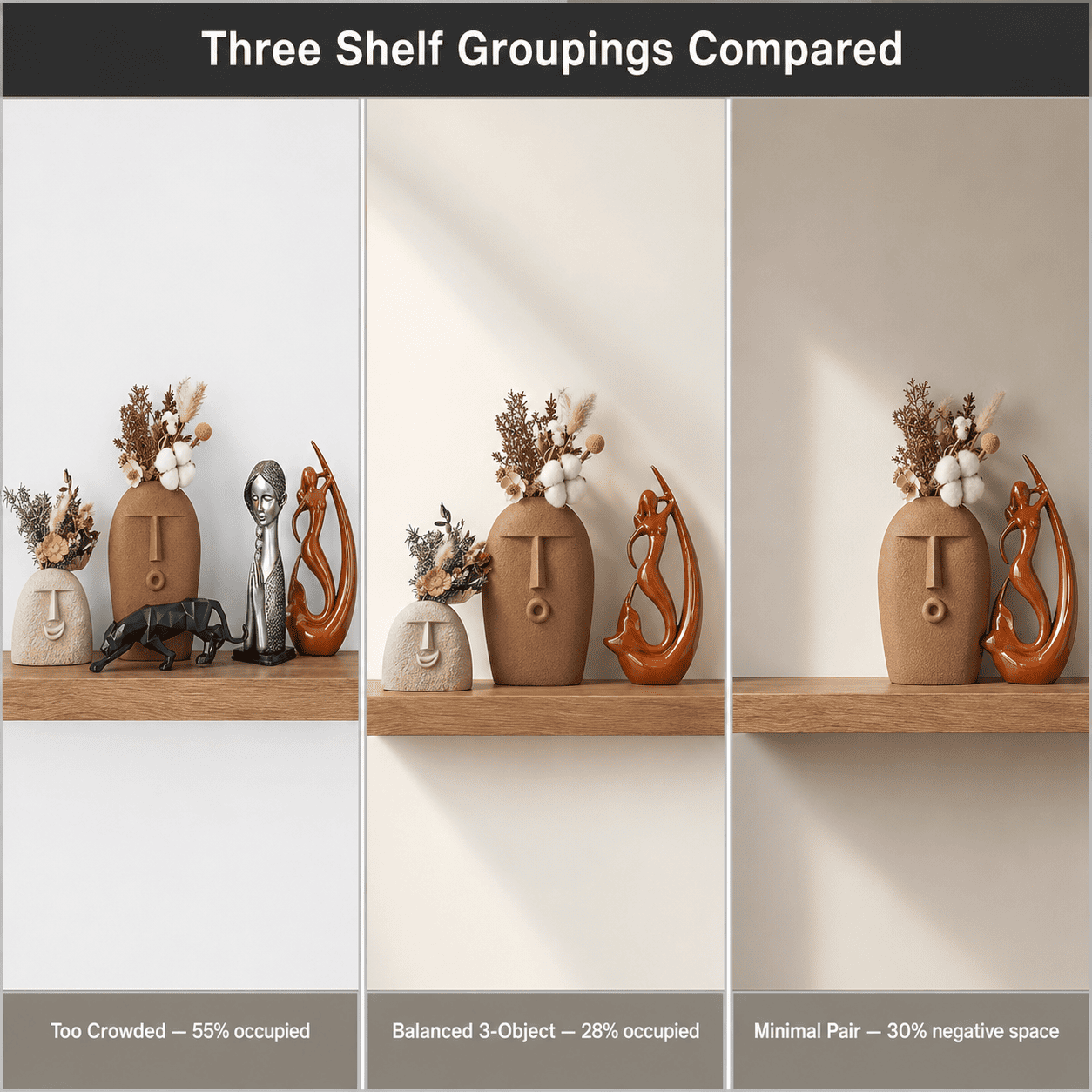
Surface occupation rate is the more precise diagnostic: shelves where objects collectively occupy more than 30% of the visible horizontal surface area trigger the visual cortex's pattern-detection response, which interprets dense, same-height groupings as clutter rather than composition. This is a pre-cognitive response — it happens before the viewer consciously evaluates the individual pieces. In sub-100 sq ft Indian living rooms where floating shelves are typically 60–90 cm wide, this means no more than 18–27 cm of that width should be physically occupied by objects at any given time.
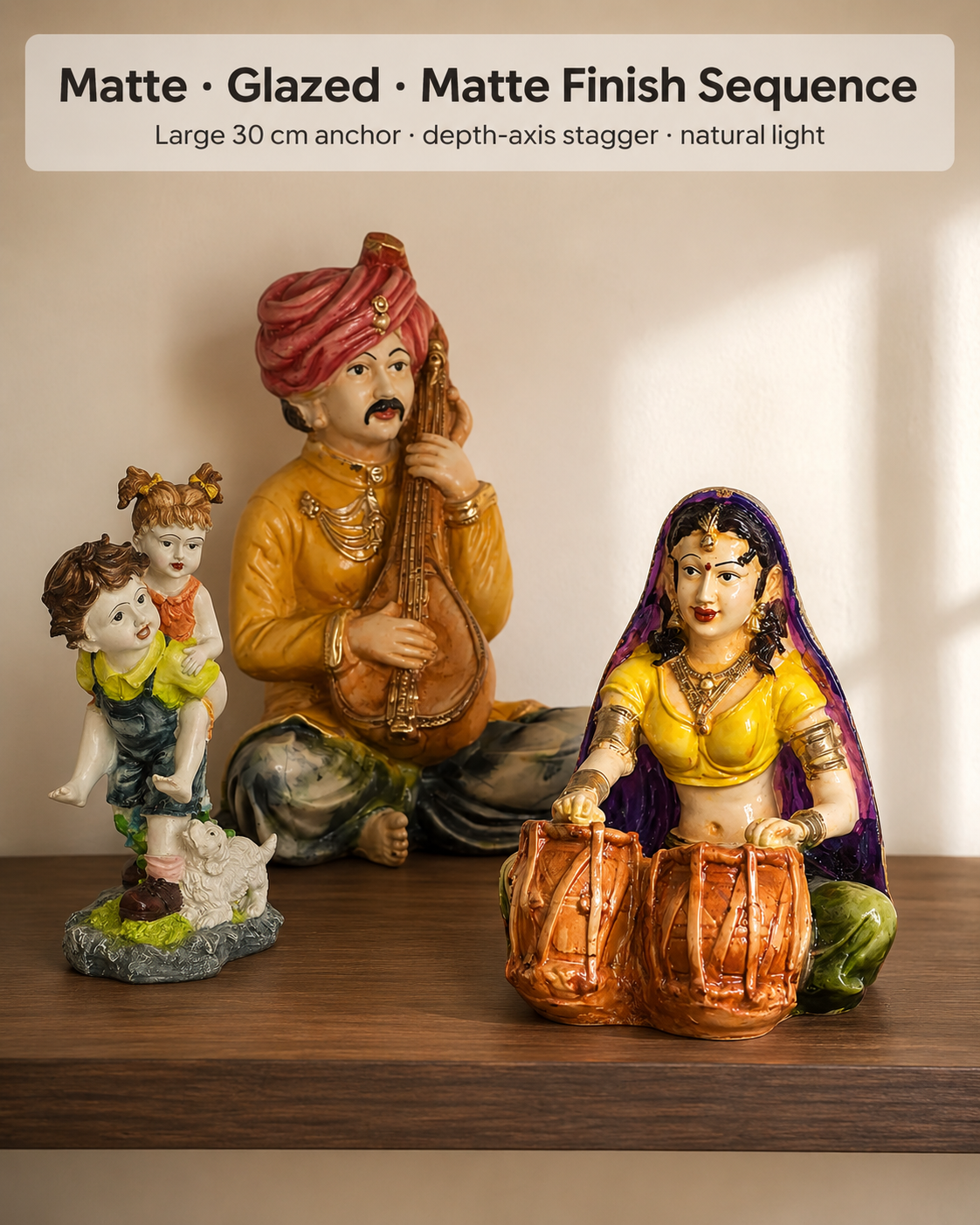
Finish contrast compounds the effect: two matte ceramic pieces beside a glazed resin accent create surface-reflection variation that the eye reads as depth, making the cluster appear larger and more intentional than three identical-finish pieces of the same size would. Moolwan engineers its modern home décor collection across both matte and glazed finishes precisely to enable this within-cluster contrast without requiring the buyer to mix brands.
How Many Decorative Accents Should Go on One Shelf?
The optimum number of decorative accents for a single shelf cluster is three, not because three is aesthetically magical, but because the odd number forces asymmetry — which means the composition cannot be resolved by dividing it into equal halves, keeping the eye moving across the grouping. A two-object pairing resolves immediately (left / right) and reads as placed, not composed. A four-object arrangement almost always defaults to two pairs. Five objects are viable only on shelves wider than 90 cm.
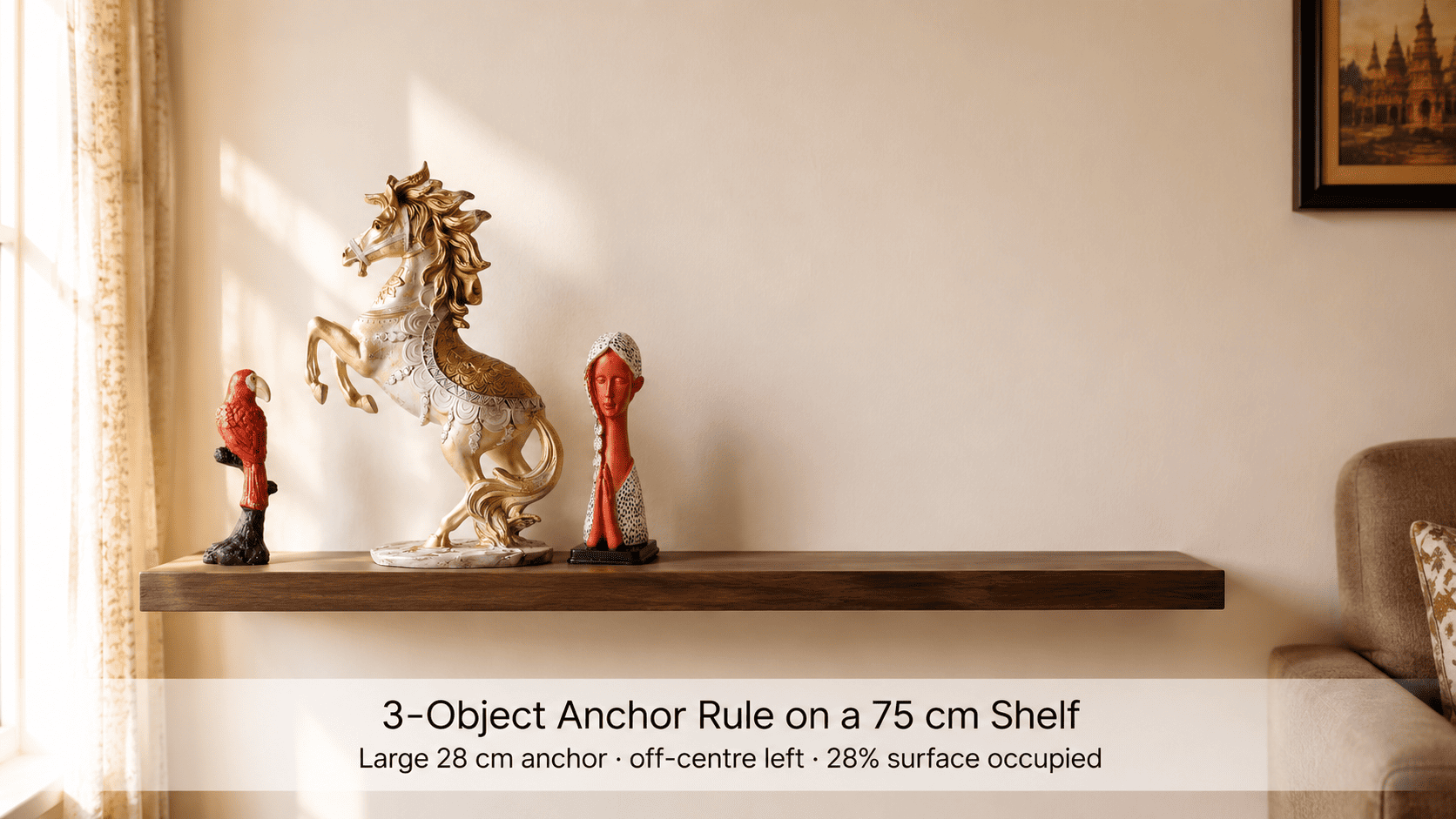
Within a 3-object cluster, the recommended height distribution is: one tall anchor piece at 25–34 cm, one medium piece at 16–21 cm, and one small accent at 10–16 cm. The tall piece should not be centred — positioning it at the left or right of the cluster creates directional visual flow, which holds attention longer than a centred pyramid arrangement does. Moolwan's modern home décor size tiers (Small 10–16 cm, Medium 16–21 cm, Large 25–34 cm) are calibrated to produce exactly this height stagger within a single curated grouping.
Design Rule
To prevent shelf compositions from reading as storage rather than design, Moolwan recommends applying the 3-Object Anchor Rule: use exactly three pieces per shelf cluster — one Large (25–34 cm) positioned off-centre as the visual anchor, one Medium (16–21 cm) beside it, and one Small (10–16 cm) at the opposite edge — leaving a minimum 70% of the shelf surface entirely unoccupied, so the negative space itself becomes a deliberate design element.
What Are the Rules for Mixing Different Types of Decorative Accents?
Three variables determine whether a mixed-material shelf cluster reads as curated or chaotic: finish contrast, palette proximity, and weight visual balance. Finish contrast (one matte surface paired with one glazed surface) is beneficial because the two surface types reflect ambient light differently — matte diffuses light, glazed concentrates it — giving the cluster a three-dimensional depth visible even in photographs. But this contrast works only when palette proximity is maintained: the colours of both pieces must sit within 2–3 steps of each other on a warm-to-cool spectrum. A warm earth matte ceramic beside a cool-grey glazed resin creates contrast overload, not contrast interest.
Weight visual balance refers to perceived mass, not actual weight. A tall, slender piece (25 cm, 200 g) has lower visual mass than a short, wide piece (12 cm, 400 g) because perceived mass is a product of volume profile, not measured weight. Balancing a visually heavy small piece against a visually light tall piece creates the same tension-and-resolution dynamic that makes furniture arrangements feel deliberately considered. Moolwan's resin showpieces (94% purity epoxy, 3H hardness, weight range 150–600 g) and ceramic showpieces (92% clay composition, weight range 150–600 g) are manufactured in size tiers that allow this visual mass calibration within a single cluster.
Shelf Grouping by Surface Type: A Sizing Matrix for Indian Homes
The correct cluster configuration varies by shelf depth, width, and room footprint — because the same 3-object grouping that reads as airy on a 90 cm wide console shelf will read as cramped on a 45 cm floating shelf. The matrix below cross-references the four variables that determine the right grouping for any shelf in a standard Indian apartment layout.
| Shelf Width | Shelf Depth | Recommended Cluster | Anchor Piece Height | Max Surface Occupation |
|---|---|---|---|---|
| Under 45 cm | 15–20 cm | 2-object pair (Small + Medium) | 16–21 cm (Medium) | ≤12 cm width occupied |
| 45–75 cm | 20–25 cm | 3-object cluster (Small + Medium + Large) | 25–34 cm (Large) | ≤22 cm width occupied |
| 75–100 cm | 25–30 cm | 3-object cluster + 1 trailing accent | 25–34 cm (Large) | ≤30 cm width occupied |
| 100 cm+ | 30 cm+ | Two separate 3-object clusters, 20+ cm gap between | 25–34 cm (Large) per cluster | ≤60 cm total width occupied |
Because shelf depth, wall colour, and ambient light introduce additional sizing and finish variables specific to your room layout, browse the full size-band and material selection in Moolwan's modern home décor collection to confirm which pieces match your shelf dimensions and finish palette.
Ready to build a shelf cluster that's engineered to hold its composition for 5+ years in Indian humidity? Shop the full Moolwan modern home décor collection now — climate-rated ceramic and resin, sized in three tiers for the exact shelf formats most common in Indian apartments.
How to Arrange Decorative Accents by Height Without Making It Look Staged
A height stagger reads as staged when the pieces ascend in a clean diagonal — Small on left, Medium in centre, Large on right — because the eye resolves the sequence in a single pass and registers it as arranged rather than discovered. Breaking the diagonal prevents this: position the Large anchor off to one side, place the Small piece on the same side as the Large (not the opposite side), and use the Medium piece as a bridge between the two, slightly in front of the Large if shelf depth permits.
The depth axis is the most underused tool in shelf styling: in Indian apartments where shelf depth is typically 20–30 cm, placing one piece 5–8 cm further forward than the others introduces a foreground-background relationship that adds perceived depth to the composition. This depth illusion is more pronounced with matte-finish front pieces because unglazed surfaces advance visually while reflective surfaces recede — a function of how diffuse versus specular light reflection interacts with spatial perception.
Does Colour Coordination Matter More Than Shape Variety on a Shelf?
In shelf compositions under 90 cm wide, palette proximity outweighs shape variety as the primary determinant of visual cohesion. This is because the eye processes colour relationships at a broader viewing distance (2–4 metres, typical living room depth in Indian apartments) than it processes shape variation — colour contrast is perceived before form detail. A cluster of three pieces in clashing colours but varied shapes will read as discordant at typical room viewing distance, while three same-shape pieces in a unified warm earth palette will read as composed.
Shape variety, however, delivers the secondary benefit of visual interest at close range (under 1 metre, as when picking up an object or adjusting the shelf). This means the practical hierarchy is: establish colour proximity first (limit yourself to a warm or cool palette, not both), then introduce shape variation (one geometric, one organic, one linear) within that palette constraint. Finish variation — one matte, one glazed — adds a third layer of differentiation that reads across all viewing distances because it affects how the piece responds to both ambient and direct light, which shifts throughout the day in Indian homes with large windows or balcony-facing walls.

Frequently Asked Questions
How many decorative accents should I put on a single floating shelf?
For shelves between 45–75 cm wide — the most common floating shelf size in Indian apartments — the ceiling is three pieces. Three objects force asymmetry because they cannot be divided into equal halves, keeping the eye moving across the composition rather than resolving it in a single left-right pass. On shelves under 45 cm, limit to two pieces. On shelves over 100 cm, use two separate 3-object clusters with at least 20 cm of empty space between them, treating the gap as a deliberate design element rather than an oversight.
What is the correct height difference between pieces in a shelf grouping?
The minimum effective height differential between the tallest and shortest piece in a 3-object cluster is 12 cm — below this threshold, the stagger is not perceptible at typical Indian living room viewing distance (2–4 metres), and the cluster reads as a flat row. A differential of 14–18 cm is optimal: enough to register as intentional at distance while remaining proportional to the shelf scale. Pairing a Moolwan Large piece (25–34 cm) with a Small piece (10–16 cm) delivers a differential of 9–24 cm, and selecting pieces near the outer ends of those ranges ensures the perceptibility threshold is reliably exceeded.
Can ceramic and resin showpieces be grouped together on the same shelf?
Yes — and grouping the two materials is preferable to single-material clusters because ceramic (92% clay composition, matte or glazed finish) and resin (94% epoxy purity, smooth or textured surface) produce genuinely different surface textures that increase within-cluster contrast without requiring colour contrast. The one material constraint is climate placement: Moolwan's resin showpieces are rated for humidity tolerance up to 60% RH, while the ceramic range tolerates up to 85% RH. In rooms with consistently high ambient humidity — monsoon-season kitchens, bathrooms, or balcony-adjacent walls — ceramic-only clusters are the more durable long-term investment.
Should decorative accents on a shelf all face the same direction?
No. Rotating one piece 15–30 degrees off the primary facing direction introduces directional tension that makes the cluster read as discovered rather than placed. This is particularly effective when the rotated piece is the Medium or Small piece in a 3-object cluster, not the Large anchor — rotating the anchor destabilises the visual weight of the entire composition. The rotation should be inward (toward the centre of the cluster) rather than outward, because an inward-facing piece draws the eye into the grouping, while an outward-facing piece directs attention away from it.
A shelf cluster built on the right size differential, finish contrast, and negative space discipline will hold its composition for the full 5+ year lifespan of high-fired ceramic — without the seasonal replacement cost that comes with lower-density materials that warp or fade in Indian humidity and sunlight. Bring home pieces engineered specifically for this from the Moolwan modern home décor collection — climate-rated, manufacturer-direct, sized in three tiers for Indian shelf formats. If you are looking for something beyond the standard range, the Moolwan unique home décor collection offers statement pieces suited to larger anchor positions in the cluster, and the full Moolwan home décor range covers every room surface and shelf type in the Indian home.


