
What Actually Makes a Room Feel Luxurious
Luxury in a home is not about spending more — it is about restraint, scale, and material consistency. A room with ten mismatched trinkets looks cluttered regardless of their individual cost. A room with three well-scaled, well-finished pieces looks curated, even at a fraction of the price. This is the single biggest shift Indian homeowners need to make when moving from "decorated" to "designed."
We help design-conscious Indian homeowners turn ordinary rooms into spaces that feel curated rather than cluttered, without asking them to gut a living room or hire a full-time interior designer. Moolwan is a manufacturer-direct home décor brand: it makes canvas wall art, ceramic and resin showpieces, and curated gift pieces in-house, and sells them without the markup that comes from middlemen. What the brand stands for is straightforward — décor engineered for Indian climate, Indian-sized homes, and Indian budgets, without compromising on finish. What the brand sells is equally specific: modern home décor items sized correctly for Indian apartments, luxury decor pieces for contemporary living rooms, and curated gifting pieces for Indian occasions.
Three signals separate an "expensive-looking" room from a genuinely luxurious one: a defined focal point (usually large-scale wall art), consistent finish quality across every object in view, and negative space — the empty wall or shelf area around each piece. Most Indian living rooms fail on the third point first, not the first.
Budget Décor vs. Luxury Décor: What Actually Changes
| Element | Budget Approach | Luxury Approach |
|---|---|---|
| Wall art | Small prints, multiple sizes, no shared frame logic | One large-scale canvas (25–34cm+ focal pieces) with a consistent 1.5-inch frame depth |
| Showpieces | Even numbers, scattered across every surface | Odd-numbered groupings (3 or 5), varied height, one shelf left empty |
| Finish | Mixed matte/glossy plastic finishes | Matched matte or glazed ceramic/resin finish across a grouping |
| Placement | Filling every visible surface | Deliberate negative space around each piece |
| Material durability | Unrated finishes that degrade in humidity within a season | Humidity-tolerant materials rated for Indian conditions (see specs below) |
Start with one focal piece instead of ten small ones — it is the fastest, cheapest way to shift a room's feel.
Shop Luxury Decor PiecesHow to Layer Luxury Into Your Living Room, Step by Step
-
Pick one wall as the focal point
Choose the wall your seating faces directly. Every other surface in the room takes a visual back seat to this one.
-
Anchor it with a large-scale canvas
A single large piece (25–34cm and above) reads as more luxurious than a gallery wall of small prints, because it gives the eye one clear place to land.
-
Group showpieces in odd numbers
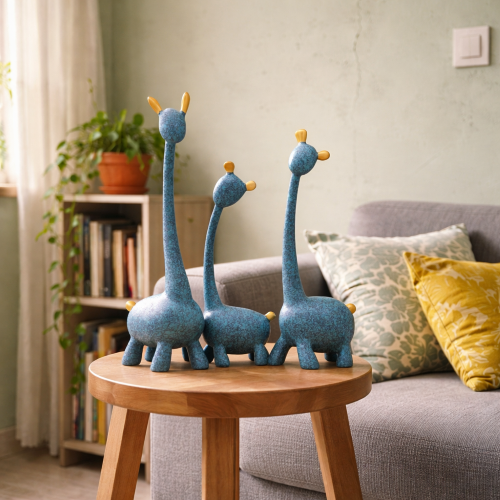
Three or five pieces of varying height on a console or coffee table look intentional. Even numbers, side by side, read as filler.
-
Match finishes within each grouping
Keep matte with matte, glazed with glazed, within the same visual cluster. Mixed finishes in one grouping is the most common giveaway of a rushed setup.
-
Leave one surface empty
A room where every shelf is full reads as cluttered no matter the quality of the objects. Deliberate empty space is what makes the filled space look considered.
-
Choose materials rated for Indian conditions
A piece that warps, yellows, or chips within a season undercuts the luxury effect fast. Check humidity and heat tolerance before buying, not after.
Materials That Actually Signal Luxury (With Specs)
Most "luxury-looking" décor fails within a year because the materials were never rated for Indian heat and humidity. The specification, not the price tag, is what determines whether a piece still looks premium in eighteen months. Here is what Moolwan builds to, across its three core material categories:
| Material | Specification | Why it holds up |
|---|---|---|
| Canvas wall art | 340 GSM cotton canvas, eco-solvent UV-resistant inks, 1.5-inch kiln-dried pine frame, moisture-resistant coating | Resists fading and warping through Indian summers and monsoon humidity |
| Ceramic showpieces | 92% clay composition, heat-resistant to 60°C, humidity-tolerant up to 85% RH, 15cm drop-resistant, 5+ year lifespan | Survives kitchen and balcony heat exposure without cracking |
| Resin showpieces | 94% purity epoxy resin, 3H pencil-hardness scratch resistance, humidity tolerance up to 60% RH, stable 15–35°C, 3+ year indoor lifespan | Holds finish and colour under everyday handling and dusting |
Sizing matters as much as material. Small pieces (10–16cm) suit a shelf, desk, or bathroom ledge. Medium pieces (16–21cm) suit a showcase or coffee table. Large pieces (25–34cm) work as standalone focal points. All Moolwan pieces sit between 150g–600g, light enough for standard Indian wall fixtures and shelving — a detail that matters once you are past the first two pieces on a single wall.
Browse the full range of modern home décor items sized for Indian apartments to see these specifications applied across wall art, showpieces, and accents.
The Most Common Mistake Indian Homeowners Make
Over-filling. Indian homes, especially urban apartments, often compensate for smaller square footage by adding more objects rather than better ones. The result is a room that looks busy, not rich. The fix is subtractive, not additive: remove pieces until only the ones that match in scale, finish, and colour temperature remain, then add exactly one focal piece back.
The second most common mistake is mixing traditional and modern décor without a bridging element — brass diyas next to a minimalist glass vase, with nothing connecting the two visually. A neutral-toned wall art piece or a shared colour palette across the grouping solves this without asking anyone to choose one aesthetic over the other. This is exactly the modern-meets-traditional balance Indian homes are usually trying to strike, and it is solvable with one or two well-chosen pieces rather than a redesign.
For room-by-room inspiration on where to apply this — living room, entryway, or a gifting corner — see Moolwan's room decoration ideas and styling guide, which breaks the same principles down by space.
If You're Buying This as a Gift
The same rules apply to gifting: one well-made, well-sized piece reads as more thoughtful and more luxurious than an assortment of smaller items. A medium ceramic showpiece (16–21cm) or a single statement canvas travels well, suits most Indian home styles, and does not require the receiver to have matching décor already in place. Moolwan's curated gift pieces are built to the same material specifications as the wall art and showpiece ranges above, so the quality signal carries through even when the buyer has never seen the receiver's home.
Frequently Asked Questions
What size wall art makes a room look expensive?
Large-scale pieces (25–34cm and above) create the strongest luxury effect because they act as a single focal point instead of competing with several small prints. One large canvas consistently reads as more considered than a gallery wall of small ones.
How many showpieces are too many?
More than five on a single surface starts to read as clutter, regardless of quality. Group in odd numbers — three or five — with varied heights, and leave at least one surface in the room empty.
Do luxury showpieces need to be heavy to look premium?
No. Moolwan's ceramic and resin pieces weigh 150g–600g, which is light enough for standard Indian wall fixtures and shelving, and the material specification (clay composition, resin purity, humidity tolerance) determines the premium feel far more than weight does.
What's the fastest way to make a small Indian apartment feel luxurious on a budget?
Replace multiple small, mismatched items with one focal-point canvas and one matched grouping of three showpieces. This single swap does more than adding new items to an already full room.
Can I return a piece if it doesn't suit my space once it arrives?
Yes. Moolwan accepts returns within 24 hours of delivery for unused items in original packaging, with a 10% restocking fee and refunds processed within 15 working days.


