
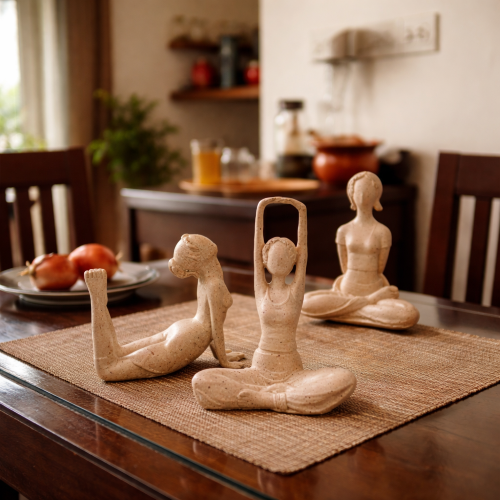
How to make a living room more interesting?
At Moolwan, we help design-conscious Indian homeowners transform flat, forgettable living rooms into spaces that feel curated and alive — without demolishing a wall or blowing a budget. The problem is almost never size or layout. It is a lack of visual layering: no focal point, no textural contrast, no object that earns a second look.
This guide gives you a precise, room-by-room framework for making your living room more interesting — with specific product types, sizes, and placement decisions backed by what actually works in Indian apartments and independent homes.
Why most Indian living rooms feel flat
A living room feels dull for one of three reasons: everything is the same height, the same material, or the same colour temperature. When your sofa, coffee table, and shelf are all at similar visual weight with nothing anchoring the eye, the room reads as background — not foreground.
Indian apartments compound this problem. Standard 2BHK and 3BHK layouts often have neutral walls, minimal natural light corridors, and furniture that lines the perimeter — leaving the centre of the room visually empty. The fix is not more furniture. It is the right objects at the right scale, placed with intention.
Three things are almost always missing in under-decorated Indian living rooms:
- A vertical anchor: Something that draws the eye upward — canvas wall art, a tall showpiece, or a framed panel above the sofa.
- A textural contrast object: One piece — ceramic, resin, or wood — that breaks the visual monotony of fabric and lacquered furniture.
- A curated surface moment: A coffee table or console shelf styled with 2–3 objects at varying heights, not just a remote and a TV guide.
Once you identify which of the three is missing, the solution becomes obvious. The sections below walk through each one.
The 5 changes that make the biggest visual difference
These are not decorating opinions. These are the five interventions that consistently transform a living room from background to focal point — verified across thousands of Indian homes that have added Moolwan pieces to their spaces.
1. Introduce a statement showpiece at eye level
A single well-chosen showpiece does more for a room than a dozen small trinkets. The scale matters: for a standard Indian living room console or mantel, a medium showpiece in the 16–21 cm range anchors the space without overwhelming it. For a standalone floor or side-table moment, go to 25–34 cm. Browse Moolwan's living room showpiece collection to find pieces scaled for Indian homes — not European double-height apartments.
2. Add wall art above the sofa or primary seating
Empty walls are the single biggest missed opportunity in Indian living rooms. A canvas piece hung 15–20 cm above the top of the sofa creates an immediate visual anchor. Moolwan's canvas wall art is printed on 340 GSM cotton canvas with eco-solvent UV-resistant inks — the colour stays true for years even in rooms with afternoon sun exposure, which is critical in west-facing Indian apartments.
3. Style a surface with objects at three different heights
A coffee table or console becomes interesting when it has variation in height: one tall object (22–28 cm), one medium (14–18 cm), and one flat or low element (a tray, a book, a small ceramic dish). This creates a visual rhythm the eye wants to follow. Mix materials — one ceramic, one resin or glass, one natural — to prevent the surface from looking like a shelf at a hardware store.
4. Use white décor to expand perceived space
If your living room is compact — under 180 sq ft — white and off-white décor objects actively make the space feel larger. White matte ceramics reflect light softly, prevent visual clutter, and pair with virtually any sofa or curtain colour. Explore Moolwan's white home décor range, specifically designed to brighten and open up smaller Indian living rooms without requiring a repaint.
5. Replace generic with specific
The biggest difference between a room that feels designed and one that does not is specificity. A generic vase from a supermarket reads as filler. A 92%-clay ceramic piece with a matte glaze and a considered silhouette reads as a choice. Specificity signals intention — and intention is what makes a room interesting. Explore Moolwan's modern home décor range for pieces that are designed to be noticed, not just placed.
Which décor type solves which living room problem
Not every room has the same problem. Use this table to identify your specific gap and the right category of solution.
| Living Room Problem | Root Cause | Recommended Fix | Moolwan Category |
|---|---|---|---|
| Walls feel empty and cold | No vertical anchor or texture | Canvas wall art, 24×18 inch or larger, hung above primary seating | Canvas Wall Art Paintings |
| Coffee table looks bare or cluttered | Wrong scale or too many random objects | 2–3 objects at varying heights (16–21 cm + 10–14 cm + flat tray) | Modern Showpieces |
| Room feels small and cramped | Dark objects, too much visual mass | White or pale matte ceramic and resin pieces; reflective finishes | White Home Décor Items |
| Room looks generic or builder-standard | Mass-produced, unspecific pieces | One statement showpiece (25–34 cm) as a focal anchor | Showpiece for Living Room |
| Room feels flat despite furniture | No textural contrast — all fabric and lacquer | Add ceramic or resin object to break surface monotony | Modern Home Décor Items |
| Décor fades, chips, or looks dull within a year | Climate-incompatible materials | Moolwan ceramics (85% RH tolerance) or resin (3H scratch hardness, 3+ year indoor life) | All categories |
How to choose showpieces that work in Indian living rooms
Most décor advice online is written for Western apartments — cooler climates, different proportions, different light. Indian living rooms have specific conditions that should drive material choices: humidity spikes during monsoon (July–September), heat in summer months, and compact layouts in most urban apartments.
Moolwan's ceramic showpieces are built to a 92% clay composition, heat-resistant up to 60°C, and humidity-tolerant up to 85% RH — which covers the most demanding Indian monsoon conditions without warping, discolouration, or degradation. Each piece is rated for a 5+ year lifespan and tested for 15 cm drop resistance, which matters in homes with children or high-traffic living rooms.
For resin pieces, Moolwan uses 94% purity epoxy resin, scratch-resistant to 3H pencil hardness, with a temperature tolerance of 15–35°C and humidity tolerance up to 60% RH. These are suitable for air-conditioned living rooms and shelved display areas, but not for placement near windows with direct afternoon sun in peak summer.
Size is a frequent error: buyers choose pieces that are too small (under 10 cm) for the surfaces they intend to place them on, and the result is a room that feels decorated but not designed. The correct anchor for an Indian living room sideboard or console is a 25–34 cm piece — large enough to read from across the room, proportioned for standard Indian furniture dimensions.
Ready to find your focal piece?
Browse Moolwan's curated showpieces for living rooms — each sized, climate-rated, and styled for Indian homes. Filter by size, material, and finish to match your existing setup.
Using white décor in a small Indian living room
White is the most underused colour in Indian home décor. The instinct is to avoid white for fear of stains or a clinical look — but in a compact living room, a few well-chosen white pieces do something furniture cannot: they expand perceived space by reflecting light softly and reducing visual weight.
The key is restraint and material quality. A chalky, dull white will make a room look unfinished. A white ceramic with a matte glaze — the kind Moolwan produces in our 92% clay formulation — reads as intentional, warm, and refined. Pair it with natural-toned furniture (teak, walnut, beige upholstery) and the result is a room that feels considered, not sterile.
For small living rooms under 150 sq ft, limit décor to 3–5 pieces total. Two white ceramic accents (one on the coffee table, one on a shelf or console), one piece of wall art, and one natural material object (wood, jute, rattan) is often all you need. This combination layers texture and tone without adding visual mass.
Explore Moolwan's white home décor range for small living rooms — including vases, showpieces, and wall hangings specifically selected for compact Indian interiors.
A note on quality and durability — why it matters for Indian homes
Décor that degrades within a year is not a budget save — it is a waste. Indian homes face conditions that most imported or generic décor is not built for: monsoon humidity, summer heat, and the dust and particulate that comes with urban living. Moolwan engineers every product category with these conditions in mind.
Our canvas wall art uses moisture-resistant coating on 340 GSM cotton canvas, stretched on 1.5-inch kiln-dried pine frames — the frame will not warp in humidity, and the print will not fade under UV exposure from windows. Our ceramic and resin pieces carry specific climate ratings (detailed in the table above) so you can buy with confidence, not optimism.
Moolwan also sells manufacturer-direct as a D2C brand, which removes the retailer markup that inflates the price of comparable quality pieces in physical stores. You are not paying for distribution. You are paying for the object.
Content curated by the Moolwan Design Concept Team. Quality standards and product specifications verified by Ruchi Malhotra, Founder & CEO, Moolwan (Euphorica Ventures Pvt Ltd), Bangalore.
Frequently Asked Questions
How many décor pieces does a living room actually need?
For a standard Indian living room (150–300 sq ft), 5–8 intentional décor pieces is the working range. This includes wall art, surface objects (showpieces, vases), and one or two textural elements. More than 10 pieces typically creates visual clutter rather than interest. Focus on quality and scale over quantity — one well-sized showpiece at 25–34 cm does more than five small trinkets.
What is the best décor for a small Indian living room?
White or pale matte ceramics, compact canvas wall art (18×12 inch or 24×16 inch), and 2–3 surface pieces at varying heights (10–21 cm) work best in compact spaces. Avoid dark, heavy objects and overly ornate pieces — they visually shrink the room. Moolwan's white home décor range is specifically curated for small living rooms in Indian apartments.
Should I go modern or traditional with living room décor?
Most Indian homeowners do not need to choose — the strongest living rooms blend both. A clean-lined modern sofa pairs well with a hand-finished ceramic showpiece that has an organic, artisan quality. The rule is consistency of finish and colour temperature, not of style era. Choose one dominant palette (warm neutrals, cool whites, or earthy terracottas) and let both modern and traditional pieces operate within it.
How do I make a living room look expensive without spending a lot?
Three things read as expensive regardless of actual price: scale (correctly sized pieces for the surface), material quality (matte ceramic or epoxy resin over plastic), and restraint (empty space between objects). Replace three or four cheap, random items with one well-chosen showpiece at the right size, and the room will immediately look more considered. Moolwan sells manufacturer-direct, which gives you design-quality pieces without retail markup.
What is the return policy if a piece doesn't work in my space?
Moolwan accepts returns within 24 hours of delivery for unused items in original packaging. A 10% restocking fee applies, and refunds are processed within 15 working days. We recommend checking the size guide carefully before ordering — our product pages include specific size-to-surface recommendations to reduce the chance of a mismatch.
Make your living room worth a second look
Every piece in Moolwan's collection is made for Indian homes — the right size, the right materials, the right price. No middlemen. No compromise on quality.


