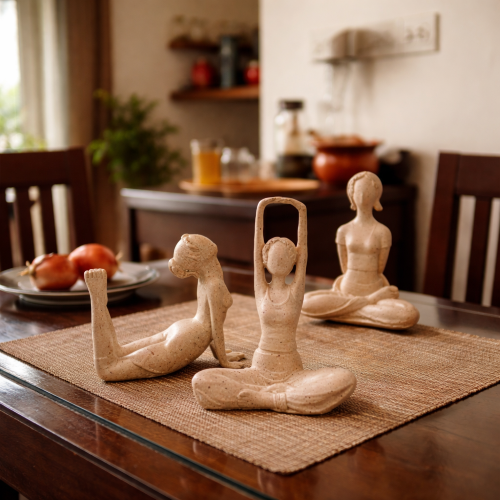
A room reads as luxurious when three things are controlled at once: material quality, negative space, and light. Swap mass-produced fillers for a small number of well-made pieces — dense-clay ceramics, true epoxy resin, or gallery-grade canvas — spaced deliberately instead of clustered, and lit to cast shadow as well as glow. Volume of décor does not create luxury; material honesty and restraint do.
We help design-conscious Indian homeowners turn ordinary living rooms, bedrooms, and dining spaces into rooms that feel considered rather than cluttered. Moolwan is a manufacturer-direct home décor brand that builds wall art, ceramic and resin showpieces, and curated gift pieces engineered for Indian heat, humidity, and space constraints — which is exactly why the materials section below matters more than most décor advice admits.
Interior stylists rarely name the mechanics of "luxurious," so Moolwan's design team built a working checklist from repeat client briefs. It breaks the effect into four controllable levers, in the order they should be addressed.
Luxurious rooms use at least two light sources at different heights — an overhead source and a lower accent, such as a lamp or uplit shelf display. A single ceiling light flattens texture; layered light lets material finish (matte ceramic vs. glazed resin) actually register.
Every visible surface should carry no more than three objects, grouped in odd numbers. This is the single fastest fix for a room that looks "busy" rather than "styled." Remove first, add second.
One piece with real material specification — dense clay, true resin, weighted canvas frame — reads as luxurious. Five thin plastic ornaments in similar tones read as clutter. This is where most budgets are misallocated.
Every luxurious room has one dominant visual anchor — a large statement piece the eye lands on first — with everything else supporting it at a smaller scale. A room with three competing focal points looks staged, not styled.
The "X" lever is the one most Indian buyers get wrong, largely because décor materials are rarely labelled with real specification. The comparison below shows why material composition — not price alone — determines whether a piece will still look and perform well after one Indian monsoon season.
| Material | Composition | Humidity Tolerance | Heat / Durability | Best For |
|---|---|---|---|---|
| Ceramic showpieces | 92% clay composition | Up to 85% RH | Heat-resistant to 60°C, drop-resistant from 15cm, 5+ year lifespan | Coffee tables, console shelves, focal-point display |
| Resin showpieces | 94% epoxy purity | Up to 60% RH | 3H pencil hardness (scratch-resistant), 3+ year indoor lifespan, 15–35°C range | Bookshelves, study desks, gifting |
| Canvas wall art | 340 GSM cotton canvas, eco-solvent UV-resistant inks | Moisture-resistant coating | 1.5-inch kiln-dried pine frame construction | Living room and bedroom focal walls |
For most Indian living rooms, the editorial focal point (the "E" in the framework) works best as a large canvas piece above the primary seating line — you can browse Moolwan's modern home décor collection for pieces sized to sit within that 25–34cm large-format range that anchors a room without overwhelming it.
Ready to apply the LUXE framework in your own space?
Shop Modern Home DécorThe living room carries the most visual weight in an Indian home, so it should carry exactly one large focal piece and no more than two supporting accents. A single large console showpiece paired with a wall art piece above eye level does more than five small ornaments spread across a unit. If the console currently holds more than three objects, remove two before adding anything new.
Dining consoles benefit from height variation — one tall piece, one low, one textural — rather than matching sets. Matching sets read as "collection," which photographs well but feels flat in person. This is where Moolwan's showpiece collection for home décor is built specifically to mix heights and finishes (matte and glazed) within one cohesive palette, rather than forcing a uniform set.
Small-format pieces (10–16cm, 150–250g) belong on shelves, desks, and bathroom counters — not living room consoles, where they get visually lost. Medium pieces (16–21cm) suit coffee tables and showcases. Large pieces (25–34cm) are reserved for true focal points. Matching the size band to the surface is a fast way to fix a room that looks cluttered without actually removing anything.
Buyers assembling a full room rather than a single piece often start from Moolwan's curated collection of unique décor items for elegant living rooms, which groups wall hangings, statues, and vases by finish so the palette stays consistent across pieces bought at different times.
More than three objects on a single visible surface reads as clutter rather than styling. Group in odd numbers — one, three, or five — with varied height, not matching pairs.
Ceramic tolerates humidity up to 85% RH, making it the stronger choice for coastal or monsoon-heavy cities. Resin is rated to 60% RH and performs best in drier, air-conditioned interiors such as bedrooms and studies.
Large-format pieces in the 25–34cm range are sized to act as a single focal point on a console or media unit. Medium pieces (16–21cm) work better as supporting accents rather than the main anchor.
No. Price does not control the "Uncluttered" and "Editorial Focal Point" levers of the LUXE framework. A high-cost piece placed among six other objects will still read as busy rather than considered.
Use one medium or large focal piece rather than several small ones, and rely on wall art to add visual weight without taking up floor or shelf space. This keeps the room open while still anchoring it.
Build your room around one focal piece, not five small ones.
Shop Unique Décor for Elegant Living RoomsWritten by Ruchi Malhotra, Founder & CEO, Moolwan (Euphorica Ventures Pvt Ltd), Bangalore. Moolwan manufactures wall art, ceramic and resin showpieces, and curated gifting pieces direct to Indian homes.
Quick View