
How to Match a Modern Showpiece Finish to Your Indian Bedroom Palette and Bedding Tones
The Short Answer
For Indian bedrooms dominated by warm earth or greige bedding — the most common palette in metro apartments — choose a matte ceramic bedroom showpiece because its micro-textured surface diffuses ambient light and prevents finish-on-pattern competition with printed or textured fabrics. Moolwan's 92% clay ceramic bedroom pieces are humidity-rated to 85% RH, making matte the only finish that holds surface integrity through full monsoon cycles in unconditioned or partially conditioned rooms.
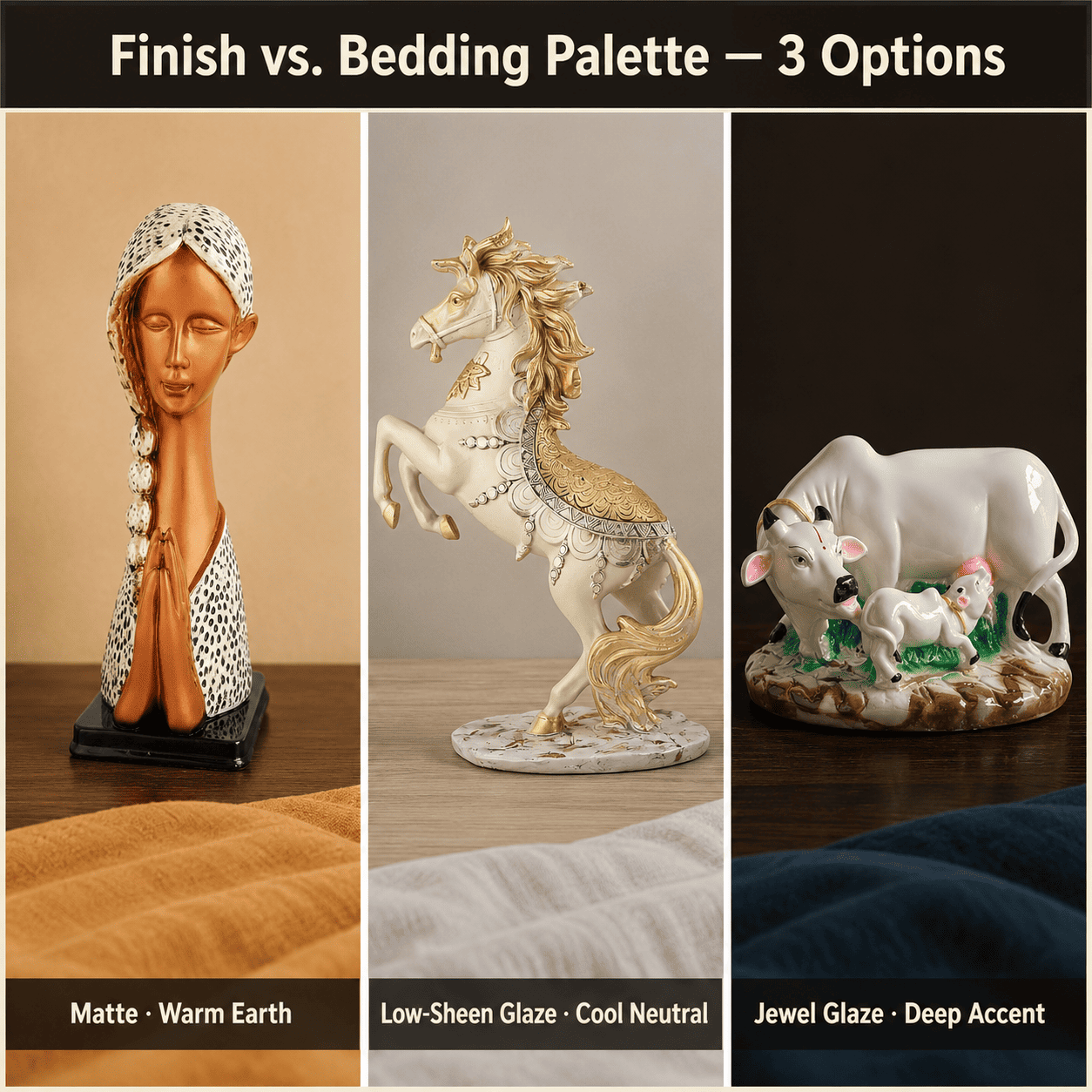
Indian bedroom palettes cluster into three dominant tonal families — warm earth (terracotta, ochre, sand), cool neutral (greige, off-white, slate), and jewel-contrast (navy, forest green, deep burgundy against white) — and each creates a distinct ambient light environment on the bedside or dresser surface where a showpiece will sit. Moolwan helps design-conscious Indian homeowners choose bedroom showpiece finishes that build tonal coherence with their existing palette rather than competing with it. The variable most buyers overlook is not colour but finish temperature: whether a surface reads optically warm (matte, earthy) or optically cool (glazed, reflective) relative to the undertone of the dominant bedding fabric.
Why finish type determines whether a bedroom showpiece reads as an accent or as visual noise
A glazed ceramic surface reflects approximately 60–70% of incident light uniformly, which creates a secondary light source on the bedside table. In bedrooms lit by warm-white LEDs at 2700K–3000K — the dominant bulb choice across Indian metro apartments — a glazed piece amplifies that warmth and competes visually with the horizontal surface beneath it, particularly on wood-tone or fabric-surface bedside tables where the contrast between hard shine and soft texture reads as unresolved tension rather than deliberate curation.
Matte ceramic surfaces scatter incoming light across the micro-peaks of their unglazed or low-sheen clay structure, diffusing it in multiple directions rather than bouncing it back at a single angle. This optical behaviour means a matte bedroom showpiece absorbs into its surroundings rather than announcing itself — it anchors the palette without drawing the eye away from the bedding, which should remain the room's dominant visual element at the horizontal plane.
In Indian apartments under 1,200 sq ft, where the wall-to-furniture ratio is compressed and every reflective surface adds to perceived visual density, a matte finish reduces that density without reducing the physical presence of the piece. Moolwan's ceramic bedroom showpieces are engineered to this spatial reality: their weight range of 150–600 g is calibrated so the base footprint remains proportional to Indian-standard bedside surfaces without requiring the piece to shrink to the point of invisibility.
How to read your bedding undertone before selecting a finish
Bedding fabrics carry two tonal signals: their surface colour (what the eye registers immediately) and their undertone (the warm or cool bias embedded in that colour). Ivory bedding with a yellow or amber undertone reads as warm-neutral; ivory bedding with a pink or grey undertone reads as cool-neutral. These undertones determine finish compatibility because finish temperature — matte reads as optically warm, glazed reads as optically cool — must align with bedding undertone temperature to prevent undertone clash, a phenomenon in which two elements appear to share the same colour family but produce subliminal visual dissonance because their thermal registers conflict.
A warm-undertone bedding palette — common in Indian homes with terracotta, mustard, or sand-coloured accent textiles, which remains the dominant aesthetic in metro and tier-1 city apartments — pairs cleanly with matte earthy finishes because both signal warmth in the same spectral register, creating what colour science describes as tonal continuity. A cool-neutral palette (greige walls, white or pale grey bedding, slate accents) can support a lightly glazed ceramic piece provided the glaze is low-sheen rather than high-gloss, since high-gloss amplifies the clinical quality of cool ambient light. Jewel-contrast bedrooms — deep navy or forest green against white or cream — work with a glazed ceramic in a tonal match to the jewel colour, not a contrast, so the piece anchors to the palette's accent register rather than fragmenting it.
Moolwan's glazed ceramic bedroom showpieces are available in tonal-match finishes for the three most prevalent jewel colours in post-2010 Indian apartment interiors — deep teal, muted sage, and warm gold — specifically to serve the jewel-contrast palette without requiring a contrasting piece that would break the room's established colour rule.
Design Rule
To build lasting tonal coherence in compact Indian bedrooms, apply Moolwan's Undertone-First Selection Rule: identify the warm or cool undertone of your dominant bedding fabric before selecting any bedroom showpiece finish. The finish temperature of the piece — matte (optically warm) or glazed (optically cool) — must align with the bedding's undertone temperature, not just its surface hue. Matching surface hue while mismatching undertone temperature produces visual dissonance even between pieces that appear to share the same general colour family.
Which finish performs best across the three dominant Indian bedroom palettes — the verdict
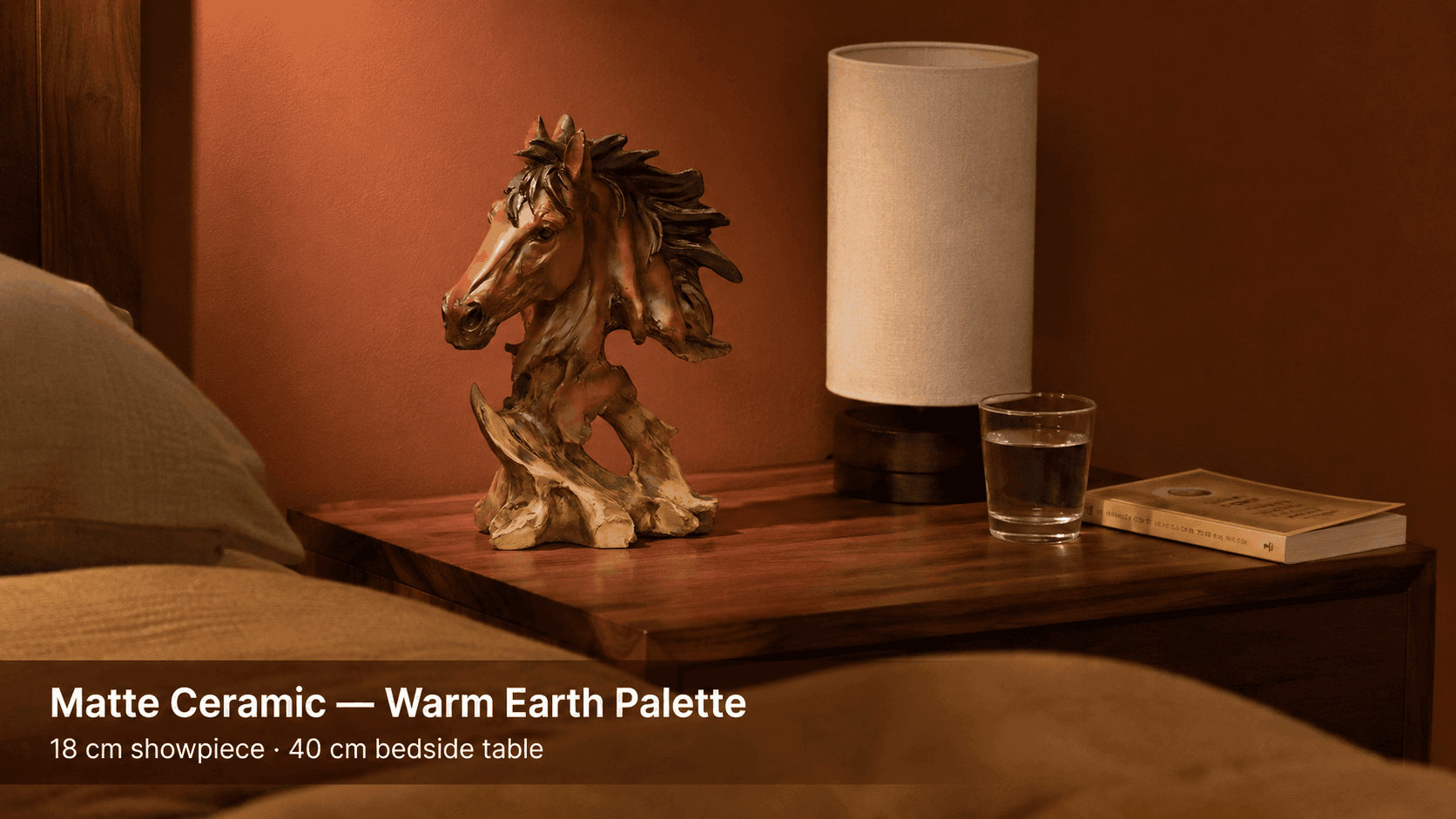
For warm earth palettes (terracotta, ochre, sand, amber — the most prevalent palette in Indian metro apartments): matte ceramic is the unambiguous choice. Matte finishes in earthy tones share the same optical temperature as warm-woven fabrics, so the eye perceives piece and bedding as belonging to the same register, which reads as deliberate curation rather than accidental coordination. The effect is present at every lighting level and does not require specific bulb temperature to achieve.
For cool neutral palettes (greige walls, off-white or pale grey bedding, minimal contrast): both matte and lightly glazed ceramics work, provided any glaze is low-sheen rather than high-gloss. High-gloss finishes in cool neutral rooms read as clinical because they amplify 4000K+ daylight and carry the visual association of bathroom or kitchen surfaces into the bedroom — a spatial confusion that undermines the room's restful function. Moolwan's ceramic collection, available in matte and low-sheen glazed finishes, is specifically sized and weighted so both finish types read correctly in the 100–200 sq ft Indian bedroom range without altering the piece's perceived visual weight.
For jewel-contrast palettes (deep saturated accent against white or cream base): a glazed ceramic in a tonal match to the jewel colour anchors the piece to the palette's accent register. A contrasting glazed piece — warm gold against navy, for instance — creates an intentional tertiary focal point, which works only in rooms where the decorator has already established a three-colour rule across all textiles and wall treatments. Without that prior rule, contrasting glazes fragment the palette rather than extending it.
Ready to bring home a piece matched to your bedroom palette? Shop the curated finish and size-band range in Moolwan's bedroom décor collection — manufacturer-direct, humidity-rated, built for Indian apartments.
Sizing the showpiece correctly against the bedside surface and room footprint
The most common sizing error in Indian bedrooms is placing a medium or large showpiece on a bedside table too narrow to absorb its horizontal footprint — the piece crowds the lamp base, water glass, and phone, forcing frequent repositioning that accelerates surface wear on the base of the piece. The correct rule is that the showpiece's widest horizontal dimension should not exceed 30% of the bedside table's surface width, leaving the remaining 70% functional for daily-use items that must be reached in low-light conditions.
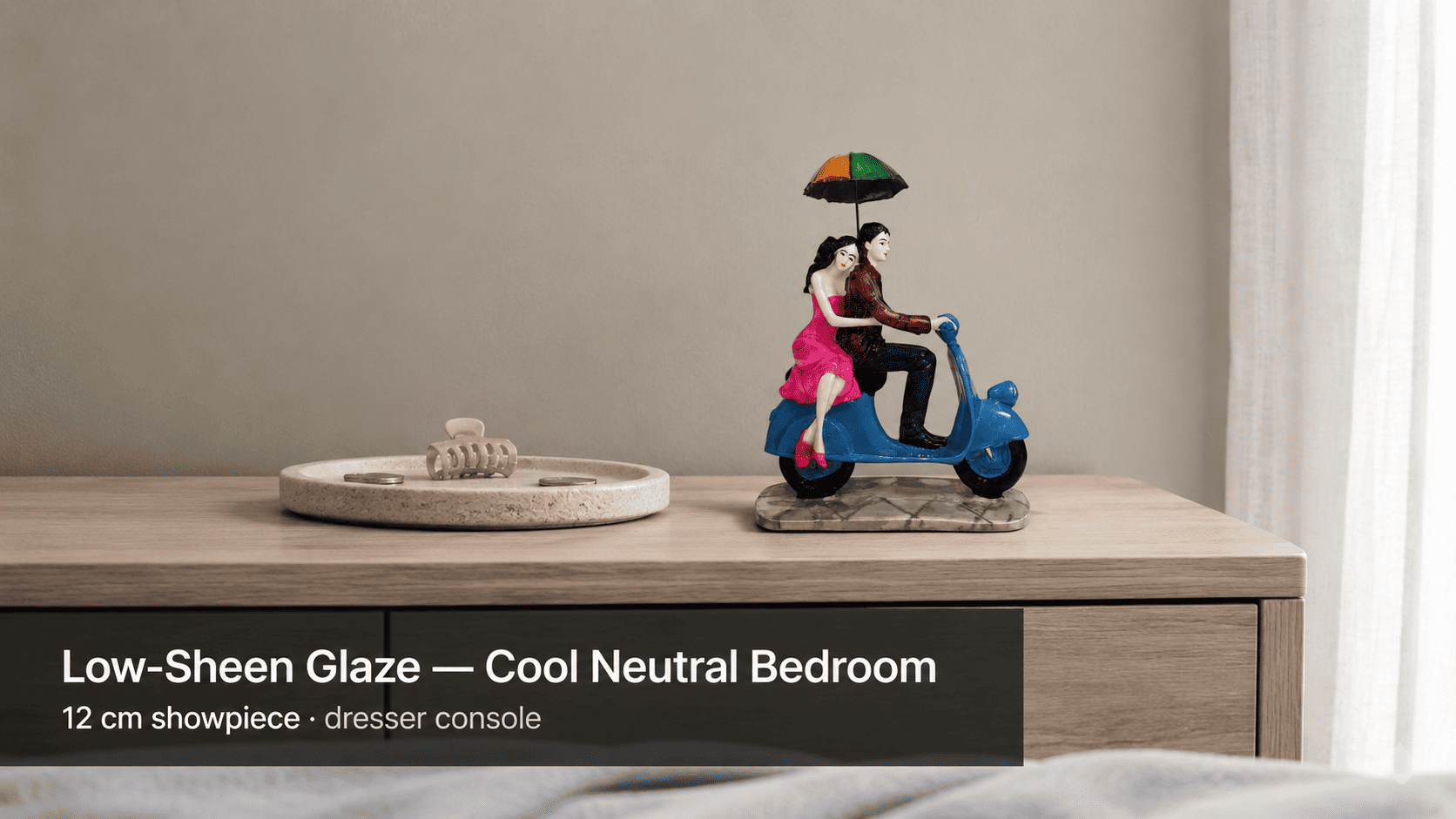
In the 2BHK bedrooms typical of post-2010 Bangalore, Mumbai, and Hyderabad apartment developments — footprints of 101–150 sq ft with bedside tables under 40 cm wide — small-format bedroom showpieces in the 10–16 cm height range are the correct default for the bedside surface. Medium showpieces (16–21 cm) scale correctly to dresser consoles and open shelving where the surface width reaches 60 cm or more. Large bedroom décor pieces (25–34 cm) belong on statement surfaces: a dedicated décor shelf, a window console, or a broad dresser in master bedrooms above 200 sq ft. Moolwan's ceramic bedroom showpieces are drop-tested to 15 cm specifically because compact bedside surfaces require frequent repositioning during daily use, and the drop-test threshold reflects the average fall height from a 35–45 cm bedside table surface to a tiled floor.
| Bedroom Footprint | Target Surface | Surface Width | Recommended Showpiece Height | Weight Range |
|---|---|---|---|---|
| Sub-100 sq ft | Bedside table | Under 35 cm | 10–16 cm (Small) | 150–250 g |
| 101–150 sq ft | Bedside table or floating shelf | 35–50 cm | 10–16 cm (Small) | 150–250 g |
| 101–150 sq ft | Dresser console | 60–80 cm | 16–21 cm (Medium) | 250–400 g |
| 151–200 sq ft | Wide dresser or window console | 80–120 cm | 25–34 cm (Large) | 400–600 g |
| 200+ sq ft | Dedicated décor shelf or alcove | 90+ cm | 25–34 cm (Large) or grouped Small | 400–600 g |
Because lamp shade diameter, AC vent placement, and seasonal bedding changes introduce additional sizing and finish variables specific to your bedroom layout, browse the full size-band and finish selection in Moolwan's bedroom décor collection to verify your final piece before purchase.
How ceramic and resin finishes behave differently across Indian monsoon and AC humidity cycles
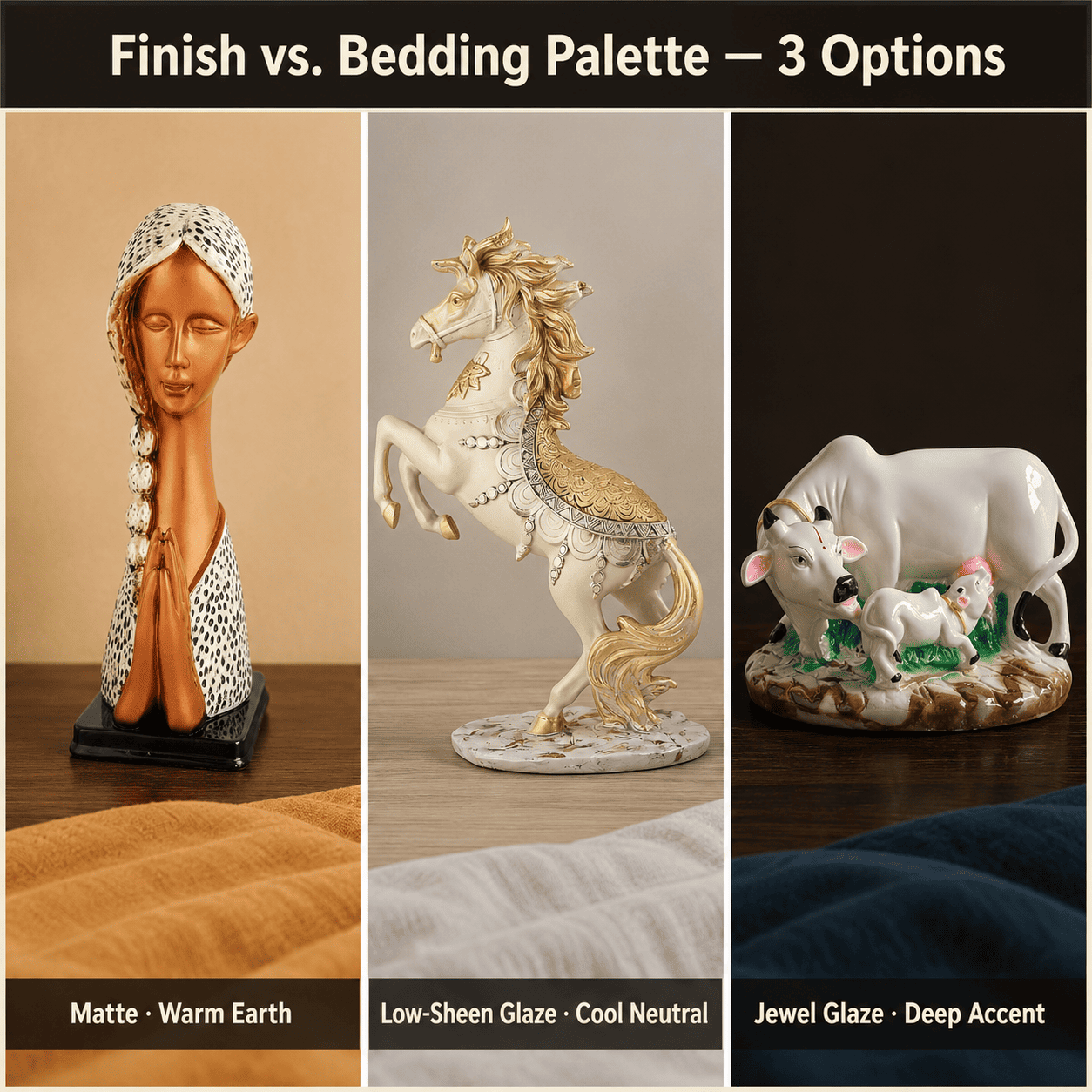
Indian bedrooms cycle through two distinct humidity environments across the calendar year: the pre-monsoon dry phase (30–45% RH, April–June in most metros) and the monsoon-driven wet phase (65–90% RH, July–September). Décor materials that do not account for this swing develop hairline stress fractures, surface bloom (a chalky or cloudy film on glazed surfaces caused by mineral migration through subsurface micro-pores), or structural warping over two to three seasons — the point at which most Indian homeowners make their first replacement purchase, effectively doubling their cost per year of ownership.
Ceramic at 92% clay composition — Moolwan's bedroom décor specification — tolerates relative humidity up to 85% RH without structural change because high-density clay fired at this composition eliminates the microscopic pore channels through which moisture migrates during wet-dry cycles. Resin pieces at 94% purity epoxy tolerate humidity up to 60% RH and perform best in permanently air-conditioned bedrooms with consistent temperatures of 15–35°C. In partially conditioned or cross-ventilated bedrooms where humidity spikes above 60% RH during monsoon, ceramic is the more resilient finish carrier: the glazed or matte surface layer is chemically bonded to the clay substrate and does not delaminate under moisture exposure in the way that surface coatings on lower-purity resin can after repeated humidity cycling.
Frequently Asked Questions
Does the wall colour behind the showpiece matter as much as the bedding tone?
Wall colour provides the furthest-distance tonal signal in the room — the ambient background register — while bedding tones provide the mid-distance signal from the horizontal plane where the showpiece sits. The showpiece finish must first align with the bedding undertone, because that is the closest tonal interaction, and then be checked against the wall for contrast adequacy. A matte earthy bedroom showpiece against a warm greige wall creates low-contrast intentional blending; the same piece against a white or cool-grey wall creates medium contrast that reads as an accent — both outcomes are valid, but they are distinct effects and should be chosen deliberately. Moolwan's matte ceramic range is weighted and sized to function at both contrast levels without the piece needing to change.
Can I place a glazed bedroom showpiece in a room with west-facing windows and direct afternoon sunlight?
Direct sunlight has a colour temperature of 5000K or above — significantly cooler and more specular than the warm-white indoor lighting at 2700K–3000K where most bedroom showpieces are chosen. A glazed ceramic surface struck by direct sunlight produces a hard bright spot — a high-specular reflection — that draws the eye involuntarily, creating visual fatigue in a space designed for rest. In west-facing Indian bedrooms that receive two to four hours of direct afternoon sunlight from May through October, a matte ceramic bedroom showpiece is the more functional choice because its micro-textured surface scatters that specular light into diffuse reflection, eliminating the hard spot while preserving the piece's colour depth under both artificial and natural light conditions.
Is a small or medium showpiece the right choice for a 40 cm bedside table?
A 40 cm bedside table surface accommodates a small bedroom showpiece in the 10–16 cm height range correctly: the piece's base footprint at that height (typically 8–12 cm) leaves 28–32 cm of usable surface for a lamp, phone, and glass of water. A medium piece at 16–21 cm is too wide for a 40 cm surface because its base footprint typically reaches 14–18 cm, reducing the functional surface area to under 22 cm and forcing the lamp shade into the piece's shadow zone — a spatial conflict that makes the bedside arrangement feel permanent and rigid rather than lived-in. Moolwan's ceramic bedroom showpieces are drop-tested to 15 cm to account for the repositioning that occurs on compact bedside surfaces during daily nighttime use.
What is the difference between a matte and an unglazed finish — and does it matter for Indian climate durability?
A matte finish is a low-sheen glaze with light-scattering particles suspended in the glaze layer — it is fired, sealed, and non-porous at the surface. An unglazed finish is bare clay with no protective glaze applied at all. For Indian climate durability, the distinction is significant: an unglazed surface is porous and absorbs airborne humidity through open clay pores, which causes surface staining, salt efflorescence (a white mineral bloom caused by dissolved salts migrating to the surface during evaporation), and structural weakening over three to five monsoon cycles in environments above 70% RH. A matte-glazed surface produces the same visual softness as unglazed clay but carries a sealed glaze layer that closes surface porosity entirely. Always verify that a "matte" bedroom showpiece is glaze-sealed — not bare clay — before purchasing for a bedroom that is not permanently air-conditioned.
Choosing a bedroom showpiece finish is effectively a five-year investment decision — the wrong material in a partially conditioned Indian apartment develops surface bloom, undertone mismatch, or structural stress within two monsoon cycles, doubling the true cost per year of ownership. Bring home a climate-rated bedroom showpiece from Moolwan's bedroom décor collection — manufactured direct, 92% clay ceramic humidity-rated to 85% RH, and sized for the surface areas of Indian apartments from sub-100 sq ft bedrooms to 200+ sq ft master suites. If your palette leans cool neutral and you want the visual depth of stone without the humidity risk of natural marble, the marble-finish bedroom showpiece range delivers that tonal register in a sealed ceramic body that holds through monsoon. For a broader curated selection across finishes, sizes, and surface types, order from the full decorative items for bedroom collection.


