
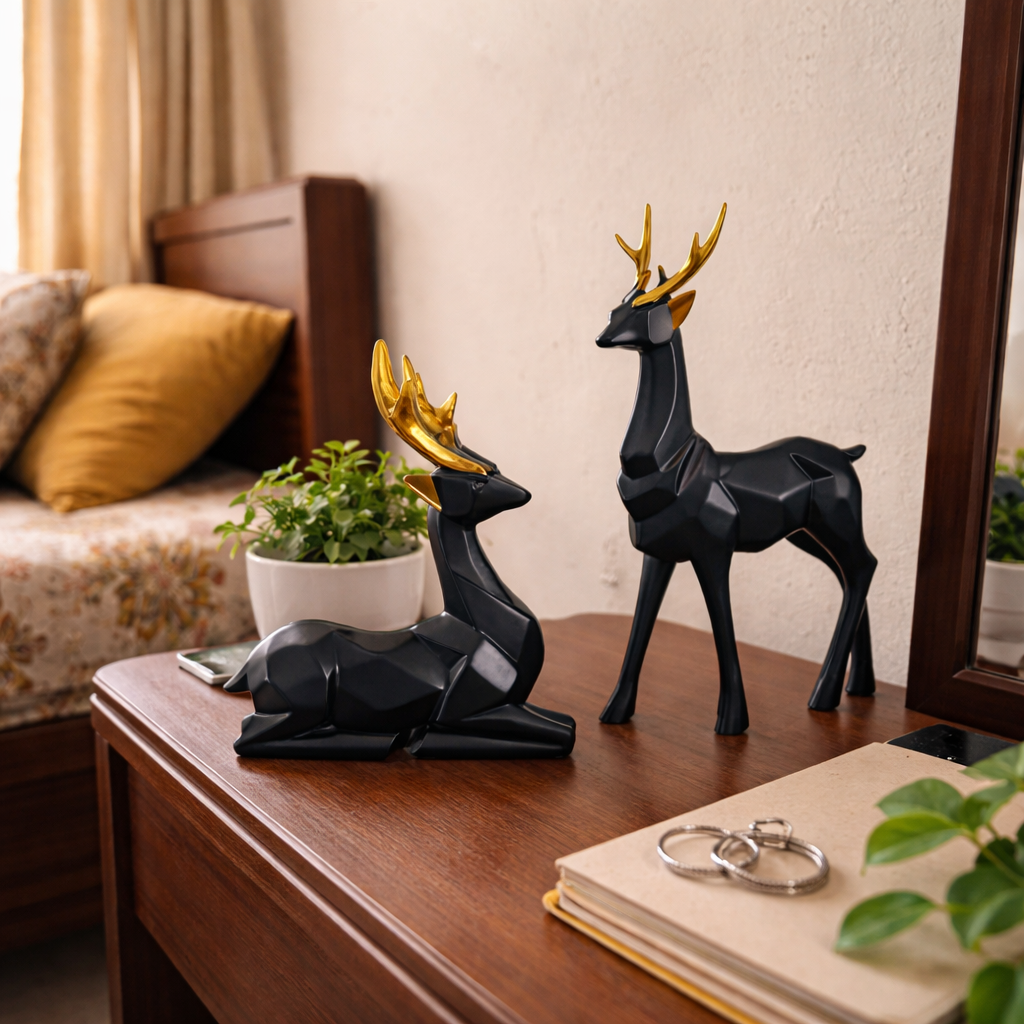
How do I mix different styles without making the room look messy?
At Moolwan, we help design-conscious Indian homeowners build rooms that feel layered and intentional — not like a showroom that forgot what it was selling. The challenge isn't mixing styles. The challenge is mixing them with a system. Below is that system, built for Indian apartments, Indian light, and the Indian instinct to balance the contemporary with the inherited.
---
The 60-30-10 Rule: The Only Formula You Need
The 60-30-10 rule is an interior design proportion rule that prevents visual overload. It works whether you're mixing Scandinavian minimalism with Indian handcraft, or modern geometric with vintage Rajasthani. The numbers refer to visual weight — not the count of objects.
- 60% dominant style: Your base — furniture, walls, large textiles. This is the style that defines the room at a glance.
- 30% secondary style: Supporting pieces — a side table, a rug, shelving. This layer creates interest without competing.
- 10% accent style: Showpieces, cushions, a single wall art piece. This is where personality lives.
If you keep all three numbers in check, your room reads as cohesive even when three different design traditions are present. The moment two styles fight for the 60% slot, the room starts to feel unresolved. Most rooms labelled "messy" are simply 50-50 splits without a clear dominant voice.
You can apply this rule to your living room, your bedroom, or even a study corner — the scale doesn't matter. The proportion does.
---How to Find Your Anchor: The One Element That Ties Everything Together
Every successfully mixed room has an anchor — a shared material, a repeating colour, or a consistent finish that connects otherwise mismatched pieces. Without this anchor, even well-proportioned rooms look accidental.
The most reliable anchors for Indian homes are:
- Colour echo: Pull one colour from your dominant style and repeat it in at least two pieces from your secondary and accent styles. A terracotta ceramic showpiece echoing the terracotta undertones in your sofa fabric is a visual anchor.
- Material consistency: Pair woods with woods, or ceramics with naturals. Mixing a teak shelf with ceramic accents and cotton canvas art creates warmth without noise — these materials all sit in the same sensory register.
- Finish harmony: Matte finishes read as calm and unified. Mixing matte and glossy across every surface creates visual chatter. Pick a dominant finish for 60% of your accents — matte or glazed — and reserve the other for deliberate contrast.
At Moolwan, our modern home décor items are specifically designed so that pieces across different styles — geometric resin, hand-finished ceramic, and canvas wall art — share either a matte finish or a warm neutral palette. This means you can mix freely within our range without losing cohesion.
---Style Mixing: What Works, What Doesn't, and Why
| Style Combination | Anchor to Use | Risk to Watch | Works Best In |
|---|---|---|---|
| Modern + Traditional Indian | Warm neutrals (ivory, terracotta, sand) | Pattern overload | Living room, puja corner area |
| Minimalist + Bohemian | Natural textures (jute, cotton, wood) | Too many focal points | Bedroom, reading nook |
| Scandinavian + Eclectic | Matte finishes throughout | Scale mismatch (too many small pieces) | Living room, home office |
| Industrial + Warm Artisanal | Metal + ceramic pairing | Cold feeling without soft textiles | Kitchen counter, study |
| Contemporary + Vintage | One repeating brass or gold tone | Clutter from inherited pieces | Entryway, display shelf |
Use this table as a decision filter before you buy. If you cannot name the anchor for your intended combination, pause — and find the anchor first.
---The Bedroom Rule: One Style Leads, One Style Rests
The bedroom is the room where mixed styling most easily tips into visual fatigue. Because it is a space for rest, the dominant style should feel calming, not stimulating. A good bedroom mix keeps the dominant style (bedding, wall colour, headboard) as calm as possible, and lets the secondary style appear only in accents — cushions, a bedside showpiece, or a single canvas print.
For Indian bedrooms specifically, the challenge is balancing the warmth of inherited textiles (grandparent's silk, block-print runners) with clean modern furniture. The solution is almost always colour. If your inherited textile is warm-toned, carry that warmth into your modern pieces through one or two accent showpieces in a complementary ceramic or resin finish.
If you are currently updating your bedroom, explore Moolwan's bedroom décor range — designed specifically for Indian apartment proportions, with showpieces in the Small (10–16 cm) and Medium (16–21 cm) size range that fit nightstands and shelves without crowding them.
Browse Moolwan's modern home décor collection — every piece is designed to pair across styles. Manufacturer-direct pricing. Free shipping. COD available.
Scale and Negative Space: The Two Most Overlooked Rules
Mixed-style rooms collapse most often not because of a bad style choice, but because of a scale imbalance or a refusal to leave empty space. Both are correctable once you see them.
Scale: Match Visual Weight, Not Physical Size
A large resin sculpture and a small delicate ceramic figurine placed side by side create visual imbalance — not because of their style difference, but because their visual weight is mismatched. When mixing styles, match the visual weight of your anchor pieces. A bold geometric wall painting needs an equally grounded showpiece beneath it. A subtle watercolour needs a quieter companion.
Moolwan's size system — Small (10–16 cm), Medium (16–21 cm), Large (25–34 cm) — is designed around exactly this. Use Large pieces as focal statements, Medium pieces as supporting companions, and Small pieces as shelf details. Never group three large pieces together from three different styles — the room will feel crowded and conflicted.
Negative Space: The Style That Holds Everything Together
Empty space is not wasted space. In a mixed-style room, negative space is what lets the eye rest between style transitions. A deliberately bare section of wall between a vintage print and a modern shelf tells the viewer: "this contrast is intentional." Without that breath, contrasting styles read as clutter.
A rule of thumb: for every three décor objects you place, leave one equivalent surface area empty. This applies to shelves, walls, and table tops equally.
---Choosing Showpieces That Work Across Styles
Not every showpiece is style-agnostic. Some pieces are strongly coded — an ornate brass Ganesha reads unmistakably as traditional. A stark white geometric resin orb reads unmistakably as modern. But pieces with material warmth and restrained form — matte ceramics in organic shapes, resin with subtle texture, canvas art in earthy palettes — cross style lines naturally.
Moolwan's ceramic showpieces are built to 92% clay composition with a humidity tolerance of up to 85% RH — which means they perform through Indian monsoons without cracking, bloating, or losing finish. Their weight (150g–600g) keeps them stable on shelves without requiring wall anchoring. These are the kind of anchor pieces that hold a mixed-style shelf together without demanding all the attention.
For accent pieces that work across modern, traditional, and eclectic combinations, browse Moolwan's full home décor items range — filtered by size, finish, and room type.
---Frequently Asked Questions
How many styles can I mix in one room without it looking busy?
Two to three styles is the practical ceiling for most Indian apartments. Beyond three, the room loses a dominant voice and starts to feel unsettled. Pick one primary style, one secondary, and limit any third to accent-only use — small showpieces, cushion covers, or a single wall art piece.
Can I mix modern and traditional Indian décor without it looking confused?
Yes — and it is one of the most successful combinations in Indian homes. The key is colour harmony. Pull one warm tone (terracotta, brass, ivory, deep teal) from your traditional piece and echo it in your modern accents. When the colour connects, the style difference reads as contrast, not confusion.
What type of showpiece works best in a mixed-style room?
Matte-finish showpieces in organic or restrained geometric shapes are the most style-neutral. Moolwan's ceramic pieces in matte glazed finishes are designed for exactly this reason — they do not compete with surrounding décor. Medium sizes (16–21 cm) are the most versatile for mixed-style shelves and coffee tables.
Should my wall art and showpieces match in style?
They should connect, not match. A canvas art piece and a ceramic showpiece do not need to be the same style — but they should share at least one visual thread: a colour, a tone, or a finish. Exact matching across styles looks forced; loose connection looks considered.
Is mixing styles suitable for small Indian apartments?
Mixed styling works well in small apartments if you are disciplined about scale and negative space. Use Small (10–16 cm) and Medium (16–21 cm) pieces. Limit large-scale items to one per room. Keep walls intentionally spare between focal points. Smaller spaces benefit from fewer, more deliberate style contrasts — not more.
Build Your Mixed-Style Room With Moolwan
Moolwan is a D2C manufacturer-direct home décor brand based in Bangalore. We sell canvas wall art, ceramic showpieces, and resin accents built for Indian homes — engineered for Indian humidity, sized for Indian apartments, and priced without middlemen.
Every piece ships with free delivery. COD available. Returns accepted within 24 hours of delivery in original packaging.


