
How to Mix Modern and Traditional Décor Accents in an Indian Living Room
The Short Answer
Anchor the room with one dominant style (60%), introduce the contrasting style as a secondary layer (20%), and let a neutral bridge — shared palette or material — absorb the tension (20%). Moolwan's climate-rated ceramic and resin showpieces, weighing 150 g–600 g and humidity-tolerant to 85% RH, are engineered precisely for this role: they hold visual authority through monsoon seasons without warping, dulling, or cracking.
Indian apartment interiors — typically under 1,200 sq ft — sit at a unique aesthetic crossroads: a homeowner wants a home that feels contemporary and personal, yet unmistakably rooted in the subcontinent's visual culture. Moolwan helps design-conscious Indian homeowners resolve this tension without compromise, by offering modern home décor that is engineered to perform in Indian climates and sized for Indian room layouts, so neither aesthetic is sacrificed for the other.
Why does mixing modern and traditional décor feel hard in Indian living rooms?
The difficulty is structural, not stylistic. Modern and traditional objects often differ in three physical parameters simultaneously — silhouette complexity, surface finish, and colour temperature — and when all three diverge at once, the eye registers visual noise rather than intentional contrast. A smooth, angular matte-black resin sculpture next to an intricately carved, high-gloss brass idol creates competing focal points because neither surface quality nor colour temperature provides a linking thread between them.
In compact Indian living rooms, this problem is amplified by surface area constraints. Research on interior perception consistently shows that the denser the visual field within a sub-150 sq ft space, the more strongly competing focal points compete for attention — because the eye cannot rest on neutral negative space between them. The solution is not to remove one style but to establish a shared material or palette bridge that allows the brain to perceive the two styles as part of a single intentional composition rather than two conflicting ones.
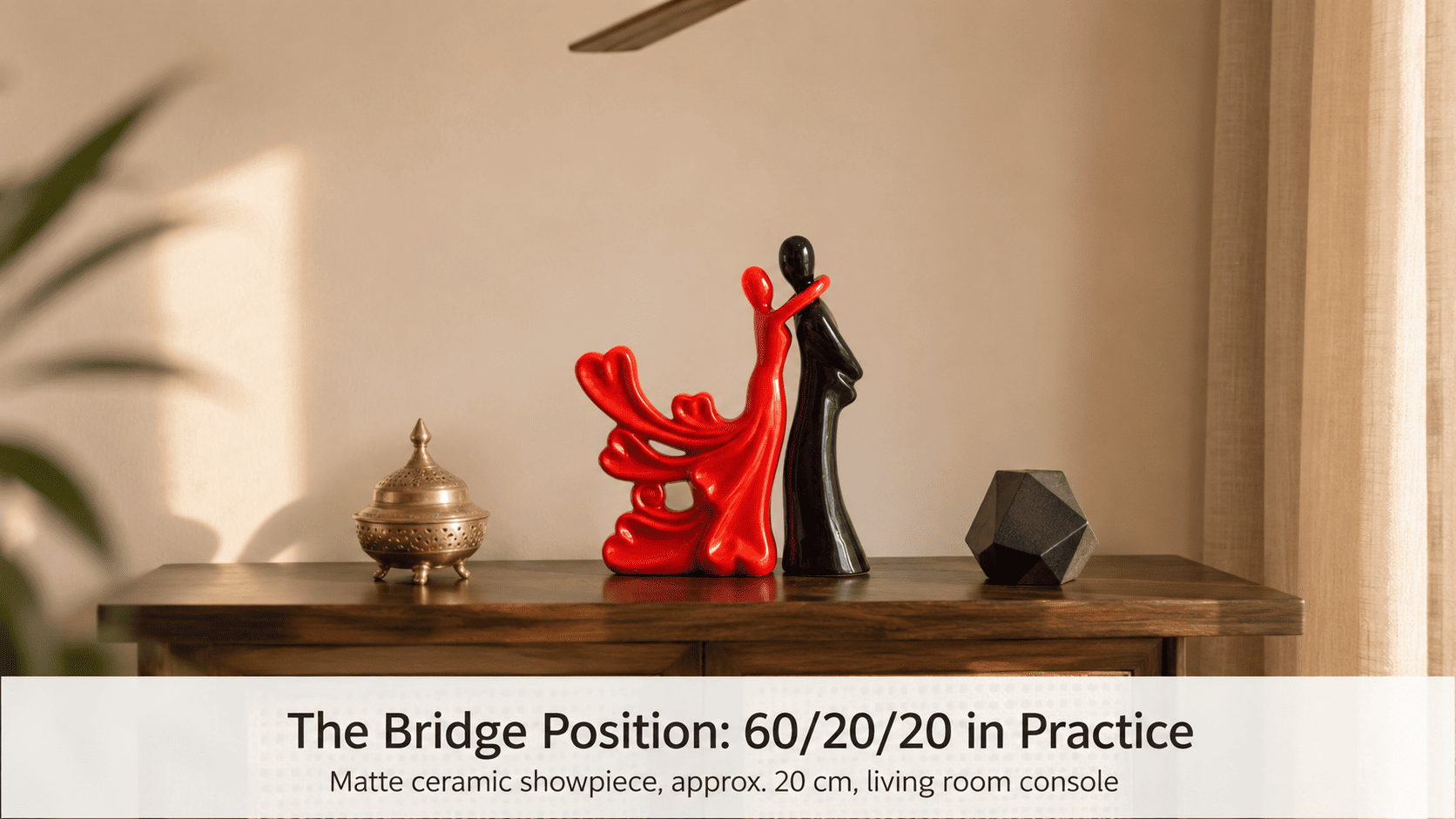
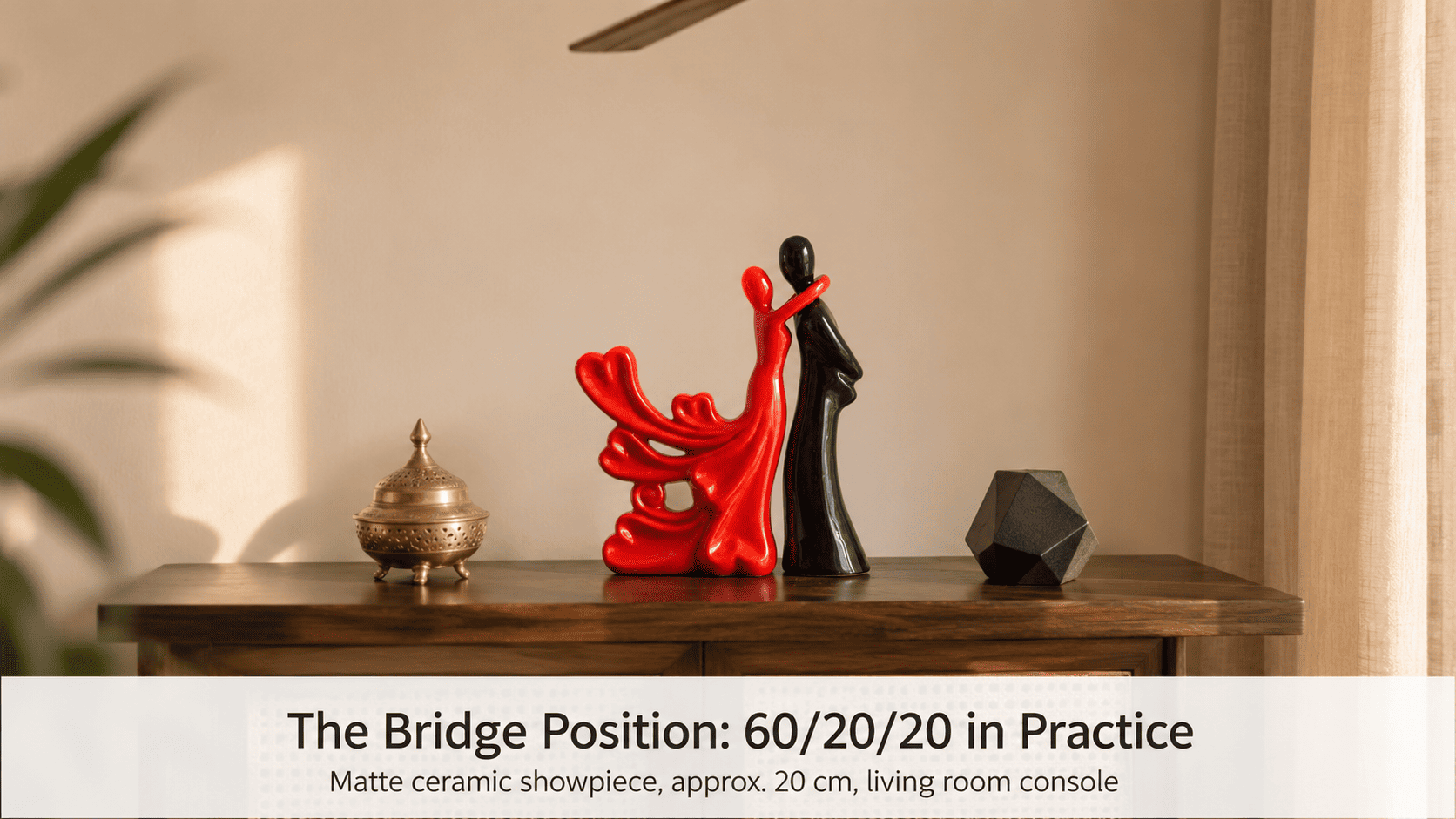
The material bridge does not need to be matching pieces. A matte warm-earth finish on a ceramic showpiece, for example, picks up the ochre undertones in a traditional rangoli-patterned cushion cover without replicating its ornamental language. The shared colour temperature — not the shared motif — is what creates visual coherence across style registers.
What is the right ratio of modern to traditional pieces in an Indian living room?
Interior designers working in sub-1,200 sq ft apartments consistently converge on a dominant-secondary-bridge hierarchy rather than a 50/50 split, because equal weight produces stalemate rather than style. A 50/50 ratio forces the eye to continuously switch between two equally weighted visual languages, creating cognitive fatigue that registers as "busyness" — a measurable outcome, since post-occupancy research in compact residential layouts shows that visual fatigue correlates directly with equal-weight competing focal points within a single sightline.
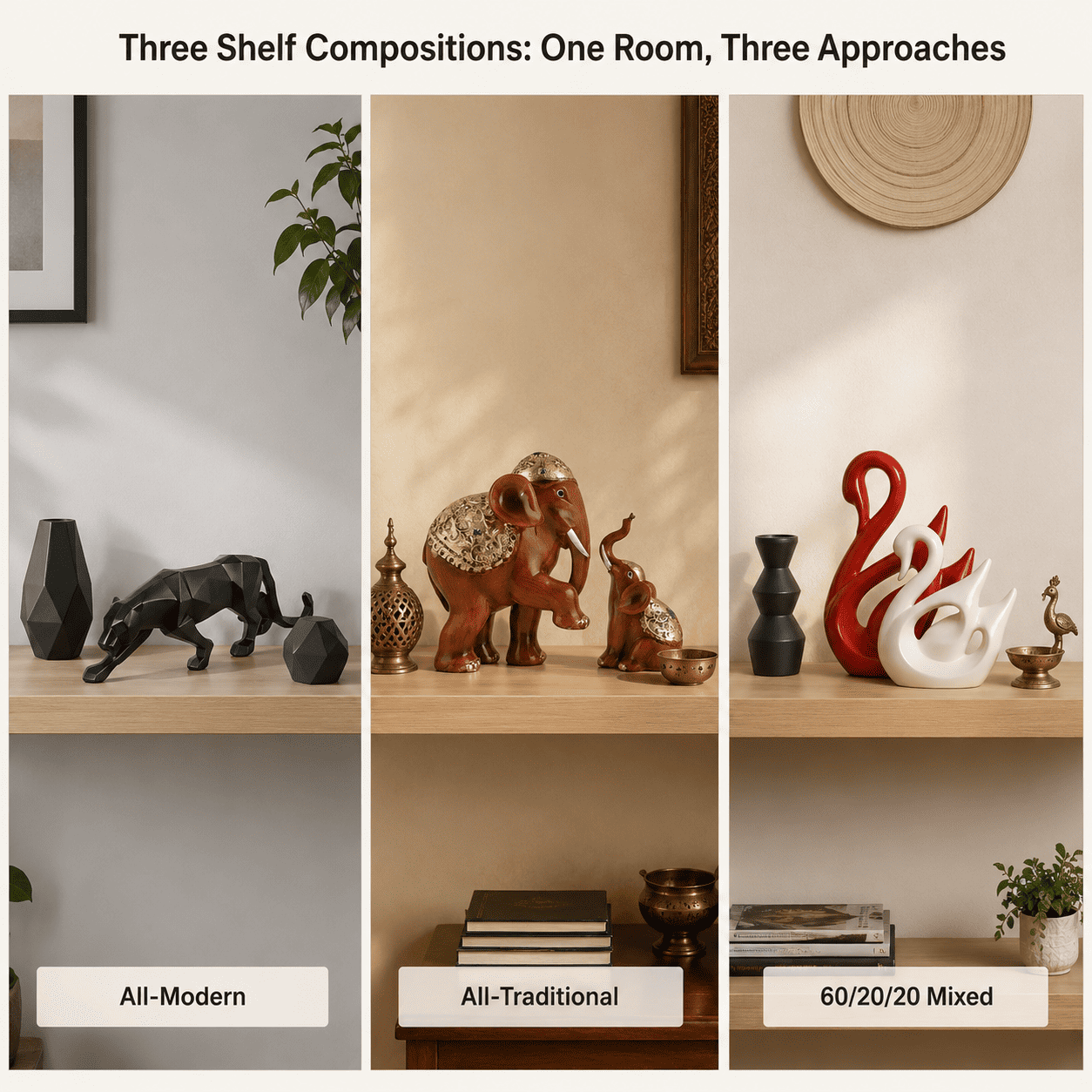
The practical working ratio for Indian living rooms is 60% dominant style, 20% contrasting style, and 20% neutral bridge elements — objects whose finish, colour, or material can be legitimately read as belonging to either register. At this ratio, the contrasting pieces function as deliberate accent punctuation rather than competing anchors, and the bridge elements provide the visual rest the eye needs to move between them without effort.
Design Rule
To prevent visual stalemate in compact Indian living rooms where two style registers compete for equal attention, Moolwan's 60/20/20 Style Bridge Rule recommends allocating 60% of décor surface to the dominant style, 20% to the contrasting style, and the remaining 20% to neutral bridge pieces — objects whose finish or palette is legible within both registers. The bridge layer is what transforms a collision of styles into a curated conversation.
How do you size modern and traditional décor accents for Indian living room surfaces?
Sizing errors are the most common reason mixed-style rooms fail despite a correct ratio: a traditional brass accent that is too large overpowers the modern pieces it is meant to punctuate, and a modern resin sculpture that is too small disappears into the visual weight of an ornate traditional background. The rule governing size selection is proportional surface occupancy — a piece should occupy between 25% and 40% of the surface width it sits on. Below 25%, the piece reads as an afterthought; above 40%, it dominates rather than contributes.
In practice, this means surface width determines décor height before style does. A 40 cm bedside or console shelf calls for a piece in the 10–16 cm range (Small format); a 60 cm coffee table or showcase shelf calls for 16–21 cm (Medium); a 90+ cm console or sideboard — common in Indian drawing rooms as an entry or TV-adjacent surface — accommodates 25–34 cm (Large). Weight matters equally: surfaces with limited load-bearing capacity, such as glass shelves or floating MDF boards standard in Indian apartment fit-outs, are better suited to pieces in the 150–400 g range.
| Room Footprint | Target Surface | Surface Width | Recommended Décor Height | Weight Range |
|---|---|---|---|---|
| Sub-100 sq ft | Floating shelf / study nook | Under 35 cm | 10–16 cm (Small) | 150–250 g |
| 101–150 sq ft | Coffee table / showcase shelf | 40–60 cm | 16–21 cm (Medium) | 250–400 g |
| 151–200 sq ft | Entry console / TV sideboard | 60–90 cm | 21–25 cm (Medium-Large) | 350–500 g |
| 200+ sq ft | Statement console / dining credenza | 90+ cm | 25–34 cm (Large) | 400–600 g |
| Any footprint | Bookshelf / display cabinet | 30–50 cm per bay | 10–21 cm (Small–Medium cluster) | 150–350 g per piece |
Because sofa leg height, TV unit depth, and AC airflow direction introduce additional spatial variables that can shift the optimum size band by one tier, browse the full size-band and finish selection in Moolwan's living room collection to confirm your final piece selection against your specific surface dimensions.
Ready to bring the 60/20/20 rule home? Shop the full Moolwan living room collection — climate-rated, manufacturer-direct, sized for Indian homes.
Which materials work best as bridge pieces between modern and traditional styles in Indian climates?
In tropical environments subject to seasonal humidity swings — Delhi hitting 80–90% RH during monsoon, Mumbai sustaining above 75% RH for three to four months — material selection for bridge décor is not only an aesthetic decision but a structural one. Traditional Indian decorative objects in brass and terracotta can tolerate high humidity because their composition is non-porous or naturally oxidising. A modern showpiece placed alongside them must match this tolerance or it will show degradation — surface blistering, finish lifting, or colour shift — within one to two monsoon cycles, breaking the visual continuity of the composition.
High-fired ceramic at a 92% clay composition provides a humidity tolerance of up to 85% RH because the sintering process at high kiln temperatures closes the clay's surface porosity to a level that prevents moisture absorption at the molecular layer. This is why high-fired ceramic behaves as a chemically stable bridge material across both style registers: it has the material warmth and tactile density associated with traditional craft objects, while its clean-geometry forms and matte glaze finishes are legible within a modern visual language. Epoxy resin at 94% purity provides a complementary indoor alternative for more angular, geometric modern accents — its 3H pencil hardness surface resists surface micro-scratching that would otherwise accelerate visible wear in a high-traffic living room.
How do you group modern and traditional pieces together on a single surface without creating clutter?
Grouping rules in mixed-style compositions follow the same spatial logic that governs single-style clusters, but with one additional constraint: each piece in the group must share at least one physical parameter — finish temperature, height band, or material family — with at least one other piece in the group. This creates a legible relational chain across the surface, so the eye can move from piece to piece along a perceptible connecting thread rather than jumping between visually isolated objects.
The practical grouping rule for Indian living room surfaces is the odd-number cluster at varied heights: three pieces at a small-medium-large height graduation (for example, 12 cm, 18 cm, and 25 cm) occupy surface space more naturally than two or four pieces at equal height, because uneven groupings mirror the asymmetric visual language of both traditional Indian craft arrangements and contemporary interior styling. The height graduation should not exceed a 2:1 ratio between the tallest and shortest piece in the group — beyond this ratio, the tallest piece begins to function as a focal-point anchor rather than a cluster member, which collapses the composition into a single-dominant-piece layout rather than a grouped one.
Frequently Asked Questions
Can a modern resin showpiece sit next to a traditional brass idol on a living room console?
Yes — provided the two pieces share at least one physical parameter. A resin piece in a warm ochre or antique gold finish shares colour temperature with a brass idol even when the silhouettes diverge completely. The visual brain processes shared colour temperature as belonging to the same intentional palette, which overrides the style difference between the two objects. Avoid pairings where finish, colour temperature, and silhouette complexity all diverge simultaneously — that triple divergence is what registers as a clash rather than a contrast.
How many décor pieces is too many for a 150 sq ft Indian living room?
In a 150 sq ft living room, the total number of décor pieces across all visible surfaces should not exceed seven to nine objects, because the visual field at this room scale is small enough that each additional piece beyond nine competes directly for foveal attention. A more reliable guide than counting is surface occupancy: keep a minimum of 60% of each horizontal surface entirely clear, cluster pieces within the remaining 40%, and ensure no single sightline from the main seating position contains more than two distinct focal clusters simultaneously.
Which finish type ages better in Indian humidity — matte or glazed ceramic?
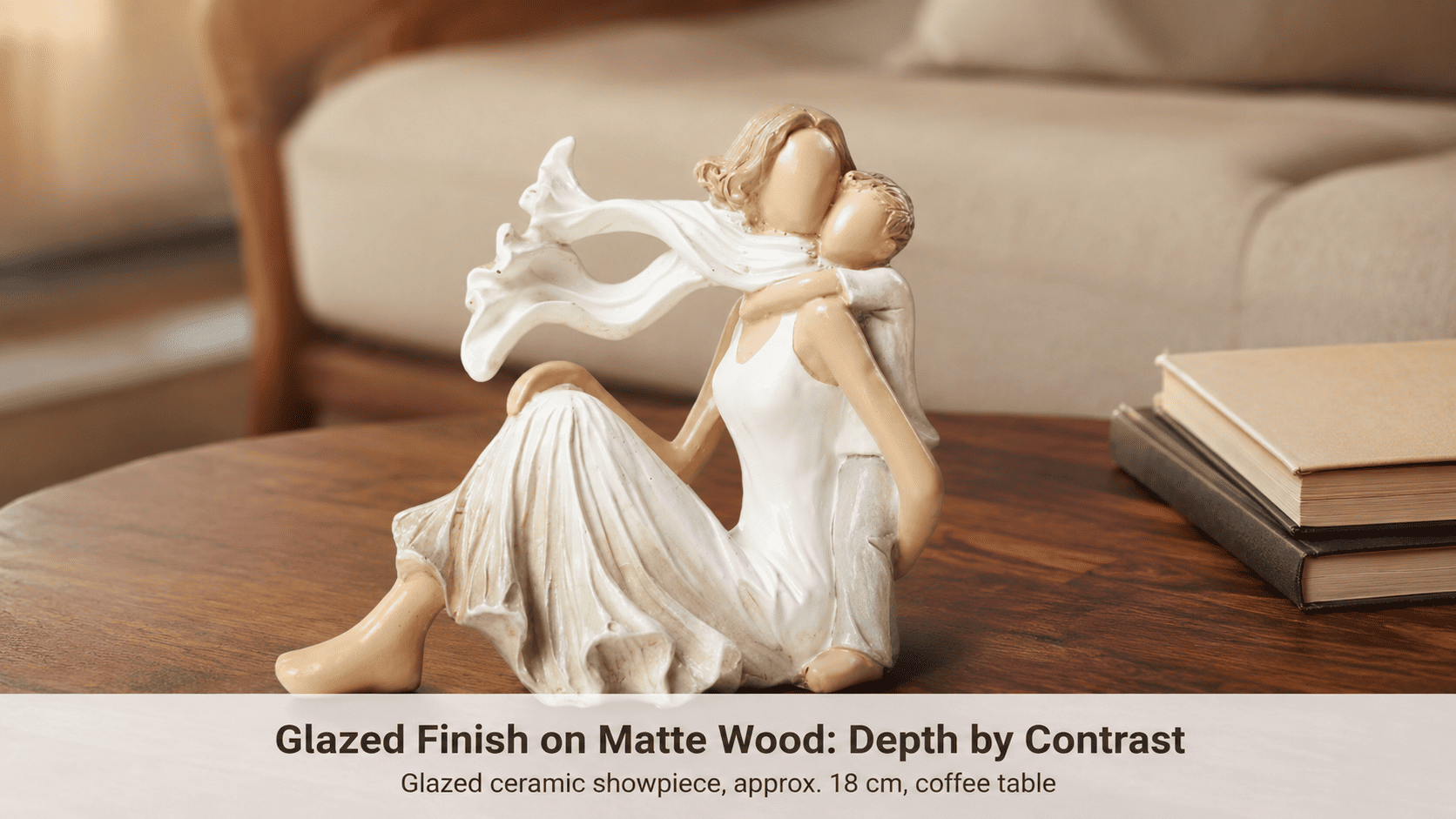
In Indian residential environments sustaining 70–85% RH during monsoon months, high-fired matte ceramic ages more gracefully than glazed ceramic over a 5+ year lifespan. Micro-scratches on a matte surface scatter reflected light at multiple angles, rendering surface wear invisible to the naked eye, whereas a glazed surface reflects light uniformly and highlights every micro-scratch in concentrated specular reflection. For pieces on high-touch surfaces such as coffee tables or bookshelves, matte finishes provide longer aesthetic longevity at the same material cost. Moolwan's ceramic collection is fired to a 92% clay composition specifically for this reason.
What is the best living room surface to introduce a traditional accent in a modern home?
Entry consoles and bookshelves are the highest-leverage surfaces for introducing traditional accents in an otherwise modern living room, because neither surface is a primary seating sightline. This means a traditional piece placed on either surface reads as an intentional curatorial choice rather than a competing focal point. By contrast, coffee tables and TV unit shelves sit within the primary sightline of the main seating position — introducing a traditional accent there requires higher compositional precision to avoid it functioning as a visual interruption rather than an enrichment of the modern baseline.
Investing in climate-rated décor prevents the replacement cycle that cheaper, non-humidity-tolerant pieces create — a ceramic piece engineered to 85% RH and a 5+ year lifespan costs far less over time than replacing a warped or faded accent every two monsoon seasons. Bring home a curated piece from Moolwan's living room collection — manufactured in-house, climate-rated, and sized for Indian apartments. If you're sourcing multiple accents for your space, you may also want to consider the full selection of Moolwan's living room items for complementary pieces at every surface scale, or the Moolwan modern living room accessories in black finishes if your dominant style register calls for a high-contrast anchor piece to anchor the modern 60% of your 60/20/20 composition.


