We help design-conscious Indian homeowners and business owners bring calm, working spaces into their offices without gutting the floor plan. Most office Vastu dosh is not a structural flaw — it is a placement problem, and placement problems respond to placement solutions: a mirror moved six feet, a canvas hung on the right wall, a showpiece placed in the correct corner.
Moolwan is a manufacturer-direct home décor brand built for exactly this kind of precision fix. Every product ships with the specifications that matter for placement decisions — weight, size, humidity tolerance — so a remedy chosen for a specific Vastu zone actually holds up in that zone, month after month, monsoon after monsoon.
Office Vastu dosh usually traces back to one of four causes: a desk facing south or west, a support beam or sharp corner directly above or opposite the seat, a cluttered or empty northeast corner, or an entrance that cuts diagonally across the room's energy path. Rented commercial floors in Indian cities rarely allow structural changes, which is why décor-based correction has become the default approach for most business owners.
The northeast corner (Ishan) governs clarity and decision-making, and it is the zone most often left as storage or completely bare in Indian offices — both are considered dosh-forming. The southeast corner (Agni) governs energy and finances, and traditionally calls for something warm: fire-toned art, a brass or copper accent, or a showpiece in warm tones rather than cool ones.
The person who leads the business should sit facing east or north, with a solid wall behind the chair, never a window, doorway, or walking path. If the desk cannot be physically repositioned, a large piece of grounding wall art placed directly behind the chair is the accepted décor-based substitute — it visually "solidifies" the wall and absorbs the open-space dosh a glass partition or window creates.
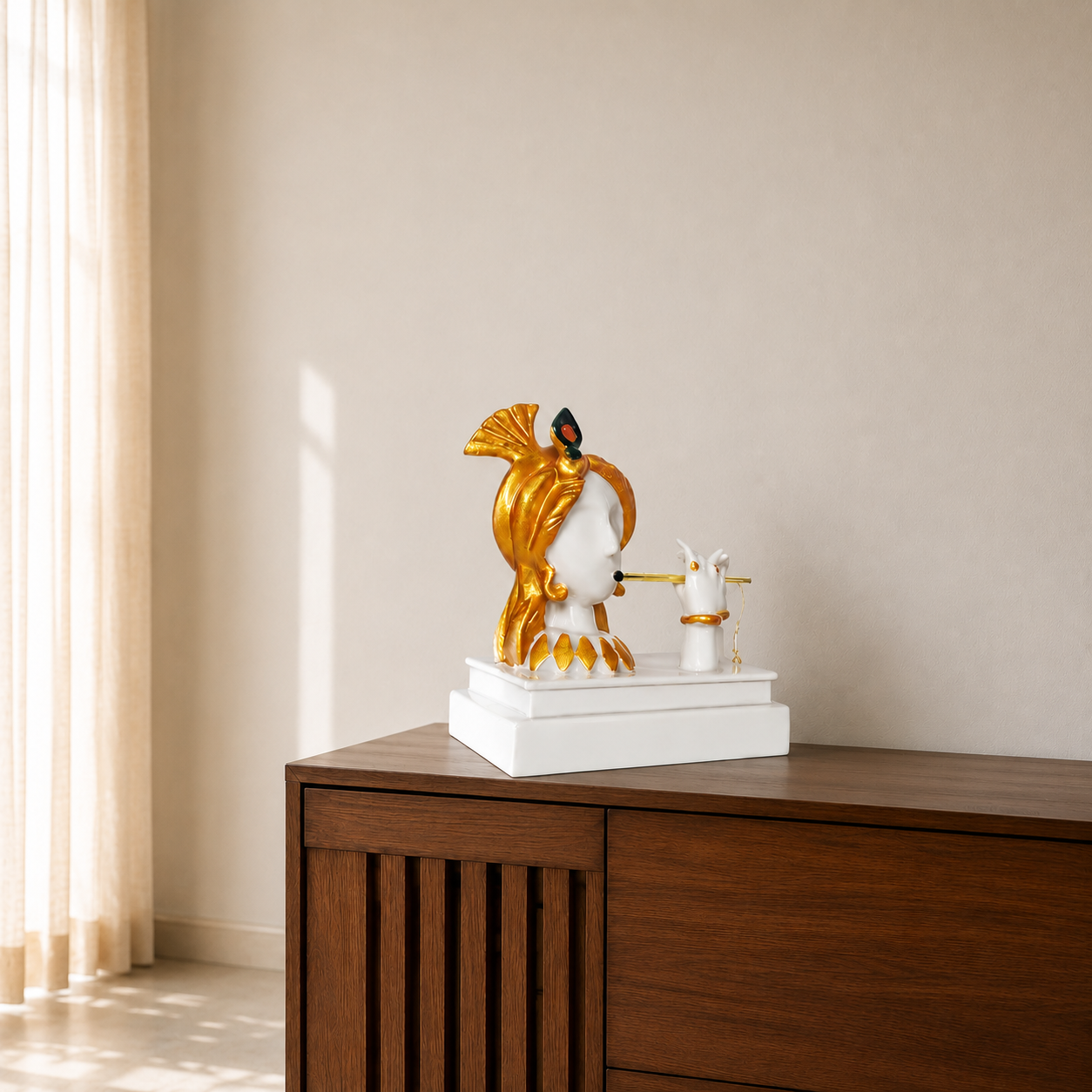
Keep this zone visually light. A small showpiece in white, cream, or pale ceramic tones works better here than a dark or heavy object. Browse Moolwan's showpiece collection for home decor for pieces sized specifically for a desk corner or reception shelf — the small format (10–16cm) is built for exactly this kind of tight, high-visibility placement.
This is the zone to add warmth. A canvas wall art piece in terracotta, ochre, or warm red tones, or a hanging décor piece with a brass or copper finish, is the traditional correction. This is also where Moolwan's canvas range does its heaviest lifting — 340 GSM cotton canvas with UV-resistant, eco-solvent inks holds warm pigment saturation without fading under tube lighting or window glare, which matters in a space this piece will sit in for years.
A support pillar or the sharp edge of a partition wall pointing directly at a workstation is considered one of the more disruptive doshas because it sits at eye level, constantly. The correction is to break the line of the edge — a hanging décor piece suspended in front of the corner, or a floor-to-ceiling piece of art on the facing wall, is enough to visually soften a vedha without any construction. Explore Moolwan's home decor hanging items for pieces designed to be suspended at eye level in exactly this kind of correction.
Fixing a northeast or southeast dosh zone starts with the right piece in the right size.
Shop Modern Home Decor Items| Office Zone | Vastu Element | Common Dosh | Décor-Based Fix |
|---|---|---|---|
| Northeast (Ishan) | Water / Space | Clutter or heavy storage | Small pale-toned showpiece, keep the corner light |
| Southeast (Agni) | Fire | Empty or cool-toned | Warm-toned canvas art or brass hanging accent |
| Behind the seat | Earth / Grounding | Window or open wall | Large grounding wall art panel |
| Facing a pillar edge | Vedha (sharp corner) | Edge pointed at desk | Suspended hanging décor to break the line |
| Southwest | Earth | Light or empty corner | A heavier showpiece to anchor stability |
A Vastu fix that fades, cracks, or discolours within a year is not really a fix — it just delays the problem. This matters more in a working office than a home, because office décor sits under tube lighting, AC-driven humidity swings, and daily foot traffic near the piece.
For ceramic showpieces used in the northeast or southwest corner, look for a minimum 90%+ clay composition and humidity tolerance rated above 80% RH — Indian office air conditioning cycles between dry and humid constantly, and lower-grade ceramic pieces develop hairline cracks within a monsoon season or two. Moolwan's ceramic showpieces are built to a 92% clay composition, heat-resistant to 60°C, with a 5+ year lifespan and humidity tolerance up to 85% RH — specifications chosen specifically for Indian climate swings rather than imported standards that assume a controlled environment.
For wall art used as a grounding piece behind a desk, canvas weight matters more than most buyers realise. Anything under 300 GSM will show frame warping within two to three years in a humid office. Moolwan's canvas pieces use 340 GSM cotton canvas on 1.5-inch kiln-dried pine frames with a moisture-resistant coating — heavy enough to hold flat, light enough (150g–600g depending on size) to hang safely on a standard drywall office partition without needing structural anchors.
A common mistake is choosing a showpiece or canvas that is too small for the zone it is meant to correct — a small piece in a large, high-traffic corner does not carry enough visual and energetic weight to offset a dosh. Match the size to the role: a small (10–16cm) piece works for a desk corner or shelf; a medium (16–21cm) piece suits a reception counter or coffee table in a client-facing area; a large (25–34cm) piece or full canvas panel is what's needed as a focal-point fix behind a desk or on an open wall.
Wall art corrects specific doshas — an open wall behind the seat, a bare southeast corner, or a vedha from a sharp edge — but it works best combined with correct seating direction. Art is the fastest fix when the layout itself cannot be changed.
East or north-facing seating is preferred, with a solid wall behind the chair. If the desk cannot be moved, a large piece of grounding wall art placed directly behind the seat is the accepted substitute for a solid wall.
Warm terracotta, ochre, and red tones suit the southeast (Agni) corner. Pale cream, white, and soft neutral tones suit the northeast (Ishan) corner. Cool blues and greens work well near water-associated zones but are avoided in the southeast.
A showpiece suits a small, contained corner like a desk edge or shelf. A canvas or hanging piece suits a larger open wall or a corner that needs to visually anchor an entire seating area. Match the piece's size to the visual weight the corner actually needs.
Check placement whenever the office layout changes — a new partition, a moved desk, or a new entrance point can shift which corners need correction. Materially, ceramic and canvas pieces built for Indian humidity typically hold their finish for 3–5+ years without needing replacement.
Ready to correct your office's dosh zones with pieces sized and built for Indian offices?
Buy Showpieces for Home DecorWritten by Ruchi Malhotra, Founder & CEO, Moolwan (Euphorica Ventures Pvt Ltd), Bangalore. Moolwan is India's manufacturer-direct source for modern home décor, wall art, and curated gifts — designed and priced without middlemen, and engineered for Indian climate and space.
Quick View



