
How to Size a Coffee Table Showpiece for a 2026 Indian Apartment
The Short Answer
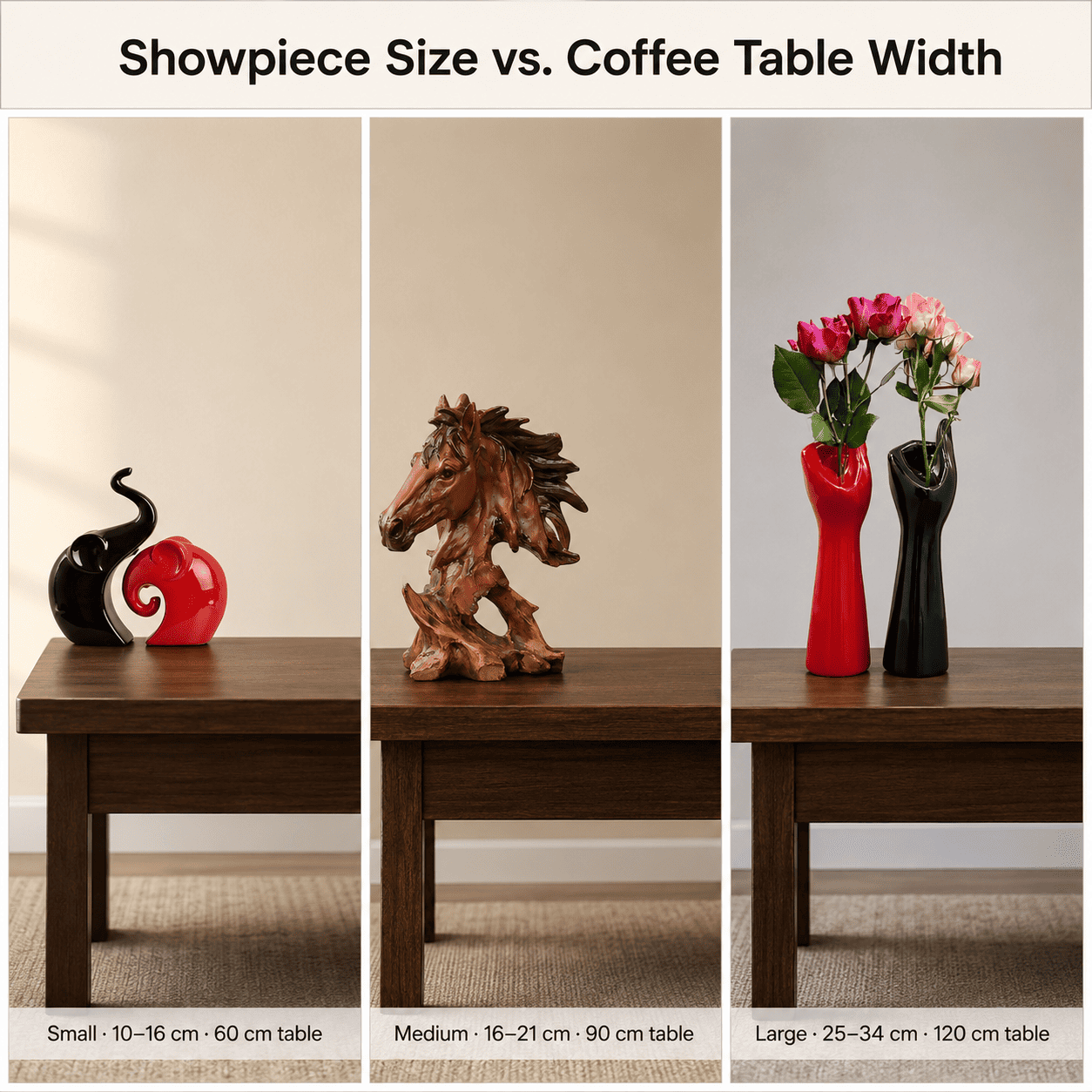
For a standard Indian apartment coffee table (75–100 cm wide), a medium showpiece in the 16–21 cm height range is the correct size band. Moolwan's climate-rated ceramic showpieces in this range weigh 250–400 g and meet the 85% RH humidity threshold, preventing warping during monsoon cycles without requiring seasonal replacement. Taller pieces above 25 cm visually compete with seated sightlines at the 40–45 cm sofa-seat height common in Indian compact living rooms.
Indian living rooms present a sizing problem that most generic décor advice ignores: the coffee table is not a standalone surface — it exists inside a spatial triangle formed by the sofa, the TV unit, and the room's primary walk path, all of which compress available visual real estate significantly. Moolwan helps design-conscious Indian homeowners choose showpieces that are proportionately correct for these spatial constraints, engineered for Indian climate conditions, and sized to complement the furniture scales most common in sub-150 sq ft Indian living rooms.
Why Does Coffee Table Showpiece Height Matter More Than Width?
The dominant sizing error on Indian coffee tables is choosing a showpiece that is too tall relative to seated eye level — not too wide. At a standard sofa seat height of 40–45 cm and a typical coffee table height of 35–45 cm, a showpiece taller than 25 cm enters the sightline corridor between a seated viewer and the television or opposite wall, creating visual obstruction rather than visual interest. This is why height is the governing variable, not footprint.
A showpiece's width footprint becomes the secondary constraint once height is resolved. In Indian apartments where coffee tables average 60–120 cm in width, the general principle is that the showpiece cluster (all objects combined) should occupy no more than one-third of the table's total width — because leaving the remaining two-thirds clear preserves the table's functional use and prevents the surface from reading as cluttered at the diagonal viewing angles common in compact rooms.
Material density also interacts with perceived height. High-fired ceramic showpieces with matte, low-gloss finishes appear lower and more grounded than glossy pieces of the same physical dimension, because matte surfaces absorb ambient light rather than reflecting it upward — reducing the eye's tendency to trace the object's silhouette against the background wall.
What Role Does Room Size Play in Coffee Table Showpiece Selection?
In sub-100 sq ft living rooms — the most common configuration in Indian metro apartments built after 2015 — the coffee table itself is typically compact (60–75 cm wide), which limits the showpiece to the Small size band (10–16 cm). Introducing a Medium piece (16–21 cm) on a 60 cm coffee table in a sub-100 sq ft room increases the perceived density of the seating zone, making the space feel smaller because the showpiece's visual weight adds to the existing pressure from low ceiling heights (typically 9–9.5 ft in DDA-era and builder-floor formats).
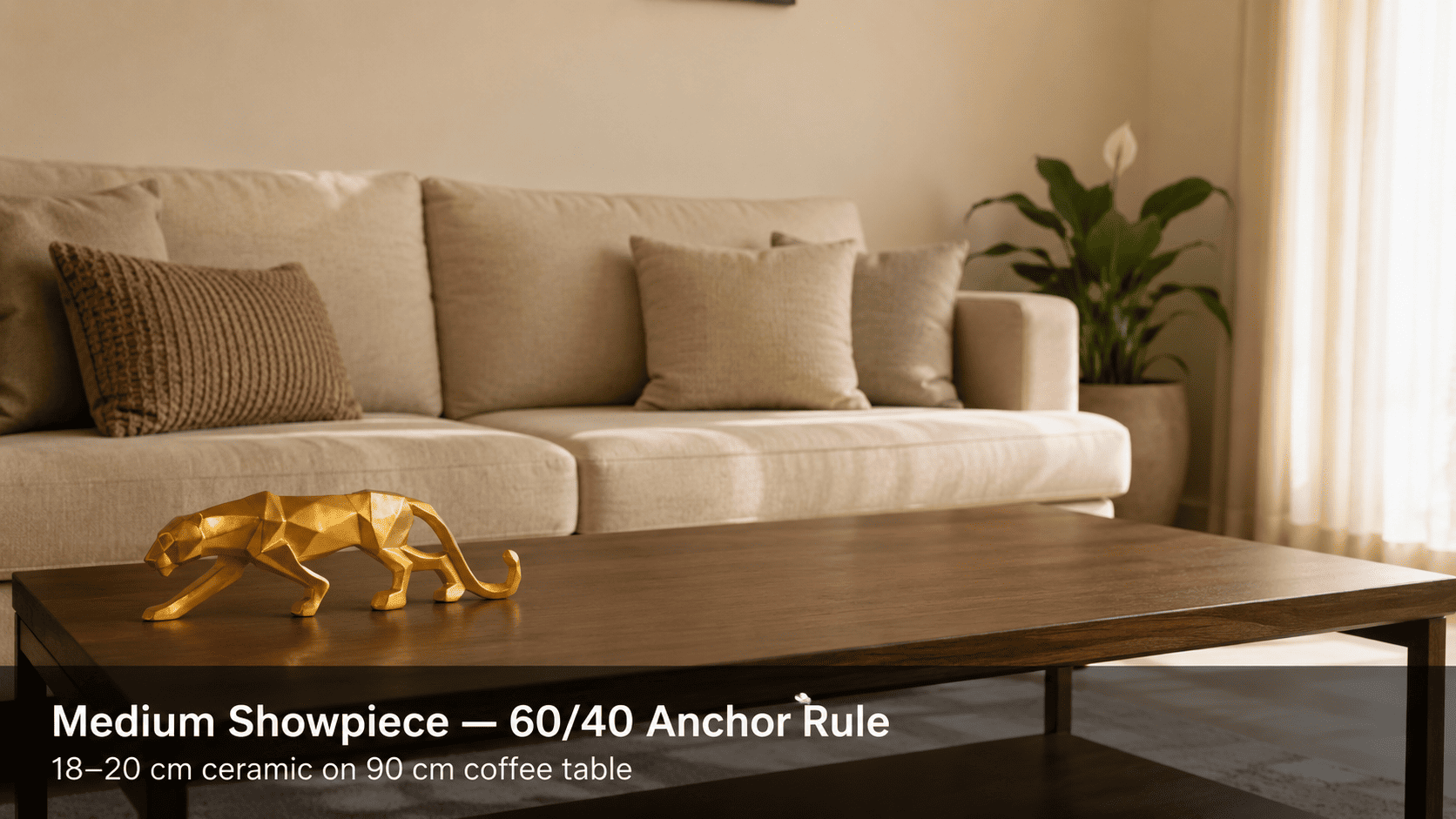
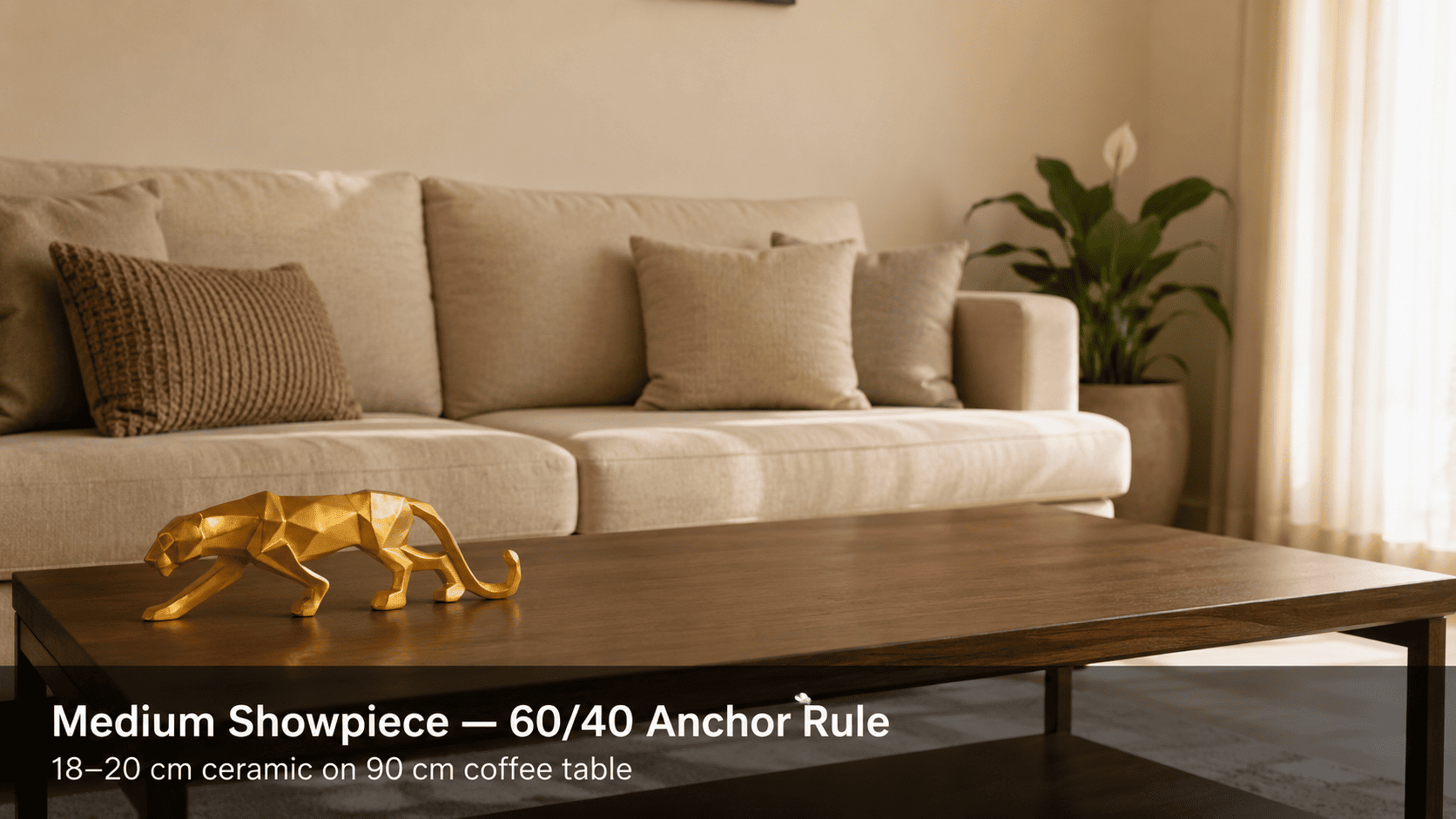
In 100–150 sq ft living rooms with standard 90–100 cm coffee tables, the Medium size band (16–21 cm) achieves the correct proportion because the increased table surface provides enough negative space around the piece to let it function as a focal point rather than a space-filler. The 250–400 g weight range of pieces in this band also ensures they remain stable on smooth-surface coffee tables without requiring adhesive mounting — a key criterion given that Indian renters routinely move furniture between tenancies.
Rooms above 150 sq ft with dining-adjacent or L-shaped seating configurations can accommodate the Large size band (25–34 cm) on a coffee table only when the table is at least 100 cm wide and the piece is positioned at the far end of the seating triangle rather than centrally — because a centrally placed large showpiece at 25+ cm height creates the sightline obstruction problem described above.
Design Rule
To prevent visual compression in compact Indian living rooms, coffee table styling should follow Moolwan's 60/40 Coffee Table Visual Anchor Rule: position the showpiece within 40% of the table's surface area (either one end or one corner), leaving the central 60% of the table entirely clear. This distribution allows the piece to function as a directional visual anchor rather than a centrepiece, which reduces its apparent height from seated eye level and preserves the table's everyday usability without requiring the piece to be moved during use.
Which Size Band Is Right for Your Coffee Table: A Multi-Variable Matrix
The correct showpiece size depends on four intersecting variables: living room footprint, coffee table width, table height relative to sofa seat, and seasonal humidity exposure. The matrix below combines all four to produce a directly actionable size recommendation by room type.
| Living Room Size | Coffee Table Width | Recommended Showpiece Height | Weight Range | Humidity Tolerance Needed |
|---|---|---|---|---|
| Sub-100 sq ft | 60–75 cm | 10–16 cm (Small) | 150–250 g | 85% RH (monsoon-grade) |
| 100–120 sq ft | 75–90 cm | 16–18 cm (Medium, lower end) | 250–350 g | 85% RH (monsoon-grade) |
| 121–150 sq ft | 90–100 cm | 18–21 cm (Medium, upper end) | 300–400 g | 85% RH (monsoon-grade) |
| 151–200 sq ft | 100–110 cm | 21–25 cm (Medium-Large) | 350–500 g | 60–85% RH |
| 200+ sq ft | 110–130 cm | 25–34 cm (Large, end-positioned) | 400–600 g | 60% RH (resin-suitable) |
Because sofa height, table leg clearance, and specific room proportions introduce additional sizing variables beyond the matrix above, browse the full size-band and material selection in Moolwan's modern home décor collection to verify the correct piece for your specific configuration.
Does Material Choice — Ceramic vs Resin — Affect Coffee Table Showpiece Sizing?
Material choice affects the practical upper size limit for a coffee table showpiece in Indian conditions, particularly in non-air-conditioned rooms during monsoon months. Ceramic showpieces with a 92% high-density clay composition maintain dimensional stability at humidity levels up to 85% RH — the threshold reached in coastal and semi-coastal Indian cities (Mumbai, Chennai, Kochi, Kolkata) from June through September. This means ceramic pieces in the Large size band (25–34 cm, 400–600 g) can be used on coffee tables in these climates without warping or surface crazing over a 5+ year lifespan.
Resin showpieces with 94% purity epoxy have a lower humidity ceiling of 60% RH, which makes them suitable for climate-controlled rooms (continuously air-conditioned to 15–35°C) but prone to micro-surface hazing in non-AC spaces during monsoon cycles. This is not a disqualifying factor for resin showpieces on coffee tables in Indian apartments — the majority of Indian living rooms are air-conditioned during evening hours — but it does mean resin pieces are a better fit for the Medium size band (16–21 cm) where the visual payoff is equivalent and the material is under less thermal stress than a Large resin piece covering more surface area.
Ready to bring a correctly sized showpiece home? Shop the full Moolwan modern home décor collection — size-band sorted, climate-rated, and manufactured direct for Indian homes.
How Should You Cluster Multiple Showpieces on a Coffee Table?
Grouping two or three showpieces on a coffee table works when the pieces follow a deliberate height variation — specifically, a height ratio of approximately 1 : 0.7 : 0.5 between the tallest, middle, and smallest piece. This ratio creates a stepped silhouette that the human visual system reads as intentional composition rather than random accumulation, because the eye naturally follows the descending gradient and completes the triangle shape formed by the three tops. Placing three pieces of identical height creates a flat, fence-like silhouette that the eye rejects as unresolved.
On coffee tables under 90 cm, a two-piece cluster (1 medium + 1 small) positioned at one end of the table is more proportionate than a three-piece group, because three pieces on a narrow surface exceed the 40% surface coverage threshold from the 60/40 Visual Anchor Rule and begin to read as a cluttered arrangement from standing entry-point viewing angles — the first sight-line a visitor receives when entering an Indian living room.
How to Factor in Coffee Table Shape When Sizing a Showpiece
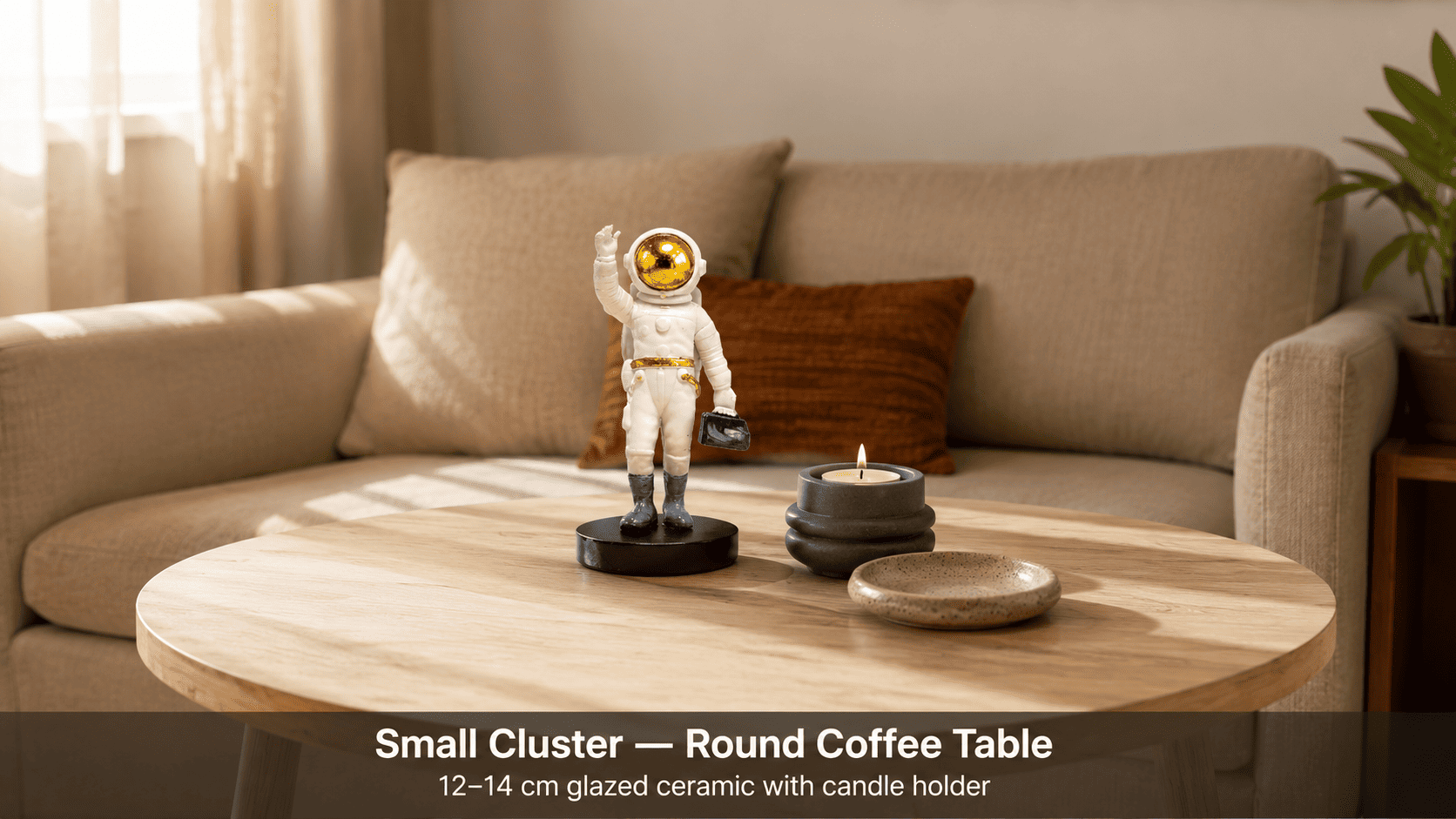
Rectangular coffee tables — the dominant format in Indian living rooms — support the 60/40 end-zone placement rule directly, because one defined end can be designated as the décor anchor while the opposite end remains free for everyday use (remotes, coasters, books). Circular coffee tables, which are increasingly common in under-90 sq ft compact living rooms for their traffic-friendliness, require a different approach: the showpiece must be centred or slightly off-centre because circular tables have no defined ends, and end-zone placement on a round surface reads as an asymmetry that disrupts the table's visual geometry.
On circular coffee tables, the showpiece size should be reduced by one step relative to the size band the room footprint would normally support — a 120 sq ft room that would normally take a Medium (18–21 cm) piece should use a Small-to-Medium (14–16 cm) piece on a circular table, because the circular surface concentrates visual attention more intensively at the centre than a rectangular surface of equivalent area. This concentration effect amplifies the apparent size of the piece, making a correctly proportioned piece look oversized if full-band sizing is applied.
Frequently Asked Questions
What is the ideal showpiece height for a 3-seater sofa and standard Indian coffee table?
For a standard Indian 3-seater sofa (seat height 40–45 cm) paired with a coffee table at 35–45 cm height, the ideal showpiece height is 16–21 cm — the Medium size band. At this height, the top of the showpiece reaches approximately 51–66 cm from the floor, which sits below the visual sightline corridor between a seated viewer and the television unit at 90–110 cm. Pieces above 25 cm begin to intersect this corridor in rooms under 150 sq ft, creating unintended visual obstruction from the primary seating position.
Can a large showpiece (25–34 cm) work on an Indian coffee table?
A large showpiece can work on a coffee table only when three conditions are met simultaneously: the coffee table is at least 100 cm wide, the room is at least 150 sq ft, and the piece is positioned at one end of the table rather than centrally. In rooms under 150 sq ft or on tables under 100 cm wide, a large piece at 25–34 cm exceeds both the 60/40 surface coverage threshold and the seated sightline ceiling, making the living room feel smaller and reducing the piece's effectiveness as a focal accent. Moolwan's climate-rated large ceramic showpieces (400–600 g, 85% RH tolerance) are engineered for exactly these larger-format placements.
Does showpiece material affect how it looks on a coffee table under direct sunlight?
Indian living rooms — particularly west-facing ones in the afternoon — receive direct UV exposure that fades and yellows certain resin formulations within 18–24 months. High-density ceramic showpieces with high-fired matte glazes are UV-inert: the mineral pigments used in ceramic colouring do not degrade under UV radiation because they are fused into the clay body at kiln temperatures above 1,000°C rather than applied as surface dye. For coffee tables in direct sunlight zones, ceramic is the materially superior choice over resin for a 5+ year lifespan without colour shift.
How many showpieces should be placed on an Indian apartment coffee table?
In rooms under 120 sq ft: one piece only, in the Medium or Small size band, positioned at one end. In rooms 120–150 sq ft: one Medium piece or a two-piece cluster (one Medium + one Small) at one end. In rooms above 150 sq ft: a two-piece or three-piece cluster is appropriate, using the 1 : 0.7 : 0.5 height ratio principle to create a stepped silhouette. More than three pieces on any single coffee table — regardless of room size — crosses into visual clutter because the eye cannot resolve more than three height references simultaneously within the narrow visual band between table surface and seated sightline.
A correctly sized showpiece — climate-rated to 85% RH, proportioned to your specific coffee table width, and positioned using the 60/40 Visual Anchor Rule — is a 5+ year investment that does not require seasonal replacement or adhesive mounting. Bring one home from the Moolwan modern home décor collection, where every piece is manufactured direct, size-band sorted, and engineered for Indian apartment conditions. If you are styling a broader seating zone, also explore the curated selection in Moolwan's living room showpiece collection for pieces designed specifically around sofa-facing placement. For a comprehensive overview of showpiece formats across all home surfaces, browse Moolwan's full showpiece range for home décor — sized from shelf-compact (10 cm) to statement-focal (34 cm) in ceramic and resin formats.


