
How to Style a Bedside Table to Look Expensive in a Small Indian Bedroom
The Short Answer
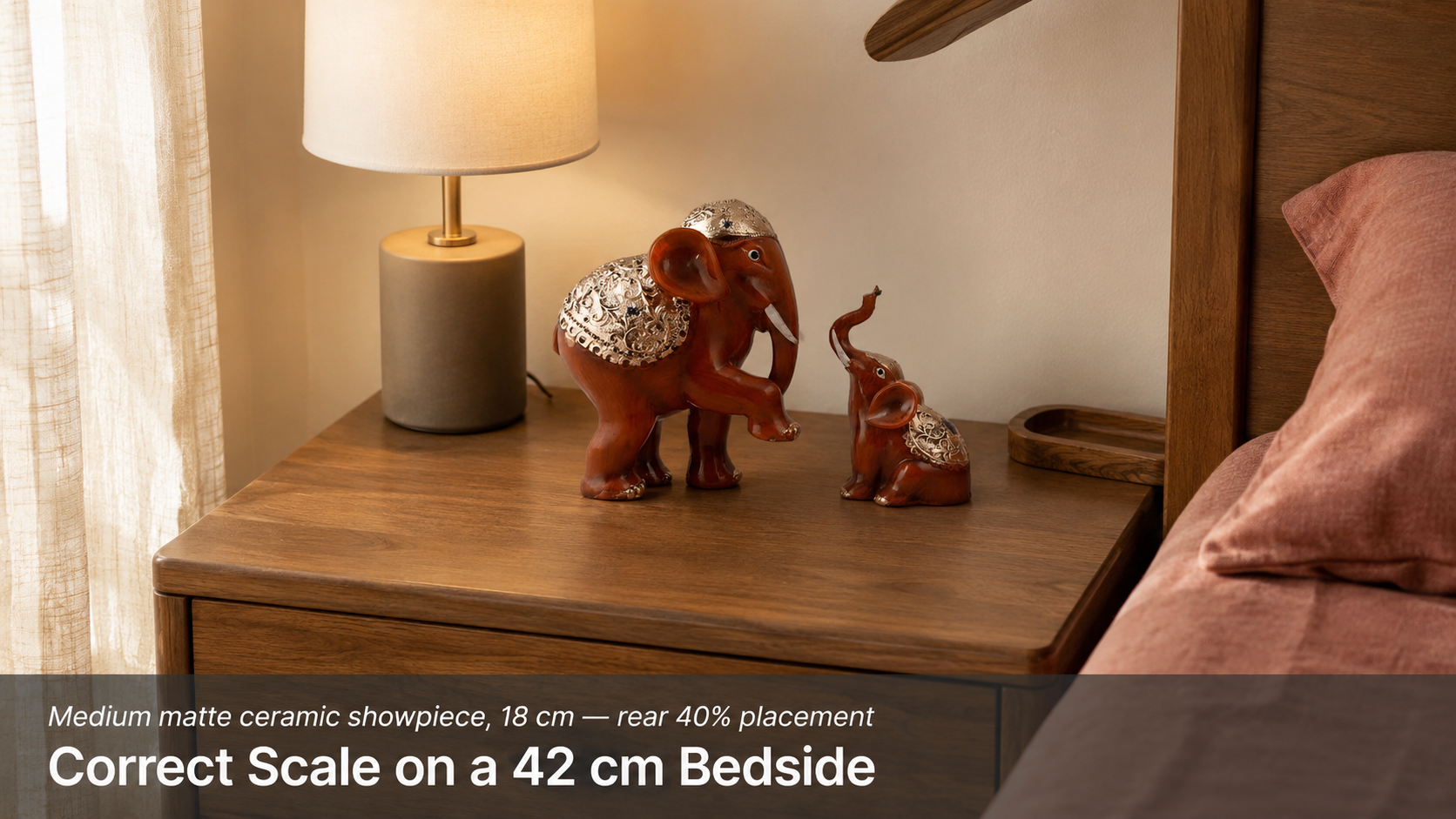
On a standard Indian bedside table (40–50 cm wide), a single matte bedroom showpiece in the 16–21 cm height band — placed on a tray within the rear 40% of the surface — creates a high-cost visual because the tray defines a visual boundary that isolates negative space and prevents surface scatter. Moolwan's ceramic collection is humidity-rated to 85% RH, which means finish and colour stay consistent year-round even through monsoon cycles.
In Indian apartments where bedrooms rarely exceed 120 sq ft, every horizontal surface carries disproportionate visual weight — and no surface is more scrutinised than the bedside table. Moolwan helps design-conscious Indian homeowners turn a 40 cm bedside surface into a composed, elevated vignette without requiring extra space, extra budget, or seasonal replacements. The principles below are grounded in spatial proportion, material physics, and Indian climate realities — not generic styling advice written for a 200 sq ft Western master bedroom.
Why Does a Bedside Table Look Cluttered Even With Nice Pieces?
Visual clutter on a bedside table is almost never caused by having too many objects — it is caused by objects of unequal height placed at random lateral positions, which fractures the eye's natural left-to-right scanning path and registers as disorder. The brain interprets unanchored variation in surface arrangement as entropy, not decoration.
The corrective is height staggering combined with lateral anchoring: one tall anchor element (lamp or taller showpiece at 20–25 cm) to the rear, one mid-height bedroom showpiece (16–21 cm) in the middle zone, and one low-profile flat element (tray, book, or coaster) in the front zone. This creates a descending foreground-to-background height gradient that the eye reads as intentional composition. The same principle governs how retail window displays are staged — the effect is borrowed from commercial visual merchandising, not interior design intuition.
The secondary failure mode is finish mismatch: combining a glossy lamp base with a high-gloss showpiece on a polished bedside surface creates specular reflection competition — each surface bounces light in the same direction and the grouping looks busy rather than cohesive. Introducing one matte-finish bedroom showpiece absorbs rather than redirects ambient light, giving the grouping optical depth without additional objects.
What Size Bedside Showpiece Looks Right in a Small Indian Bedroom?
In unconditioned and semi-conditioned Indian bedrooms — which cycle through 60–85% relative humidity across seasons — surface stability and finish permanence are as important as initial visual proportion. Ceramic bedroom décor at a minimum 92% clay composition resists humidity-driven micro-expansion that causes paint and resin surfaces to craze or cloud at year one. Moolwan engineers its ceramic bedroom showpiece collection to the exact 85% RH threshold tested against Indian monsoon conditions, with a projected 5+ year finish lifespan that eliminates the cost of seasonal replacement.
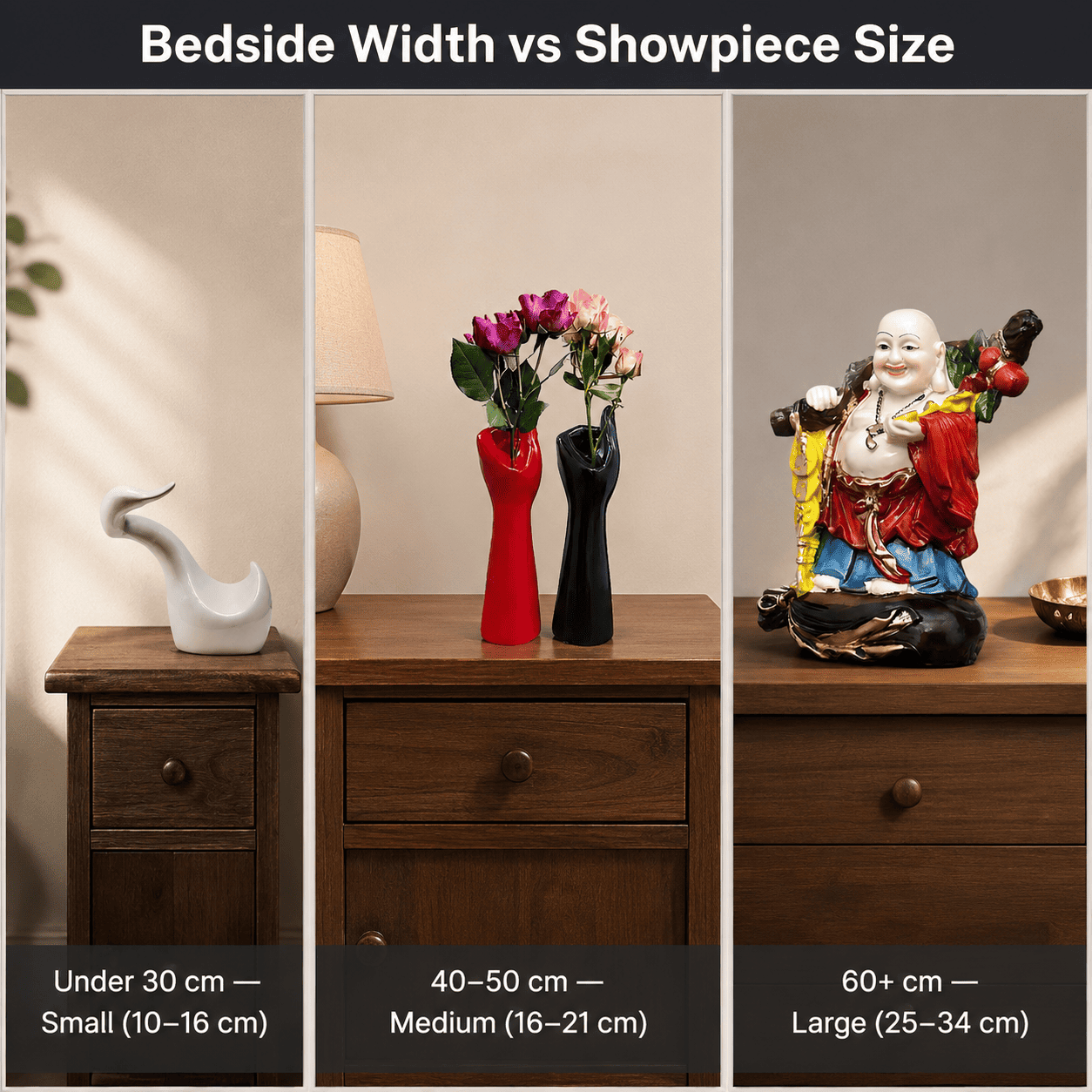
On proportion: for a bedside surface of 40–50 cm width, the correct bedroom showpiece height is 16–21 cm — the medium size band. A piece below 16 cm reads as incidental rather than chosen on a surface of this width; a piece above 25 cm overpowers the lamp and competes visually with the headboard above it. The 16–21 cm band is proportionally correct because it occupies approximately 35–42% of surface width, which falls within the visual "anchor range" where an object reads as deliberate without dominating.
For narrow bedside surfaces under 30 cm — common in older DDA-era or compact builder apartments — the correct band drops to 10–16 cm (small). The same proportional logic applies: the showpiece should occupy 33–50% of available surface width to register as a deliberate accent rather than a misplaced afterthought.
| Bedside Surface Width | Recommended Showpiece Height | Weight Range | Finish Type | Humidity Tolerance |
|---|---|---|---|---|
| Under 30 cm (narrow console) | 10–16 cm (Small) | 150–250 g | Matte or textured | Up to 85% RH (ceramic) |
| 30–40 cm (compact bedside) | 10–16 cm (Small) — tray-anchored | 150–280 g | Matte preferred | Up to 85% RH (ceramic) |
| 40–50 cm (standard bedside) | 16–21 cm (Medium) | 250–400 g | Matte or glazed | Up to 85% RH (ceramic) |
| 50–60 cm (wider bedside) | 16–25 cm (Medium to Large-lower) | 300–500 g | Matte or single-glaze | Up to 85% RH (ceramic) |
| 60+ cm (dresser-top / wide console) | 25–34 cm (Large) | 400–600 g | Any finish | Up to 85% RH (ceramic) |
Because lamp base diameter, bedding palette tone, and AC vent proximity introduce additional sizing and finish variables specific to each room, browse the full size-band and material selection in Moolwan's bedroom décor collection to verify your final piece selection before purchasing.
Design Rule
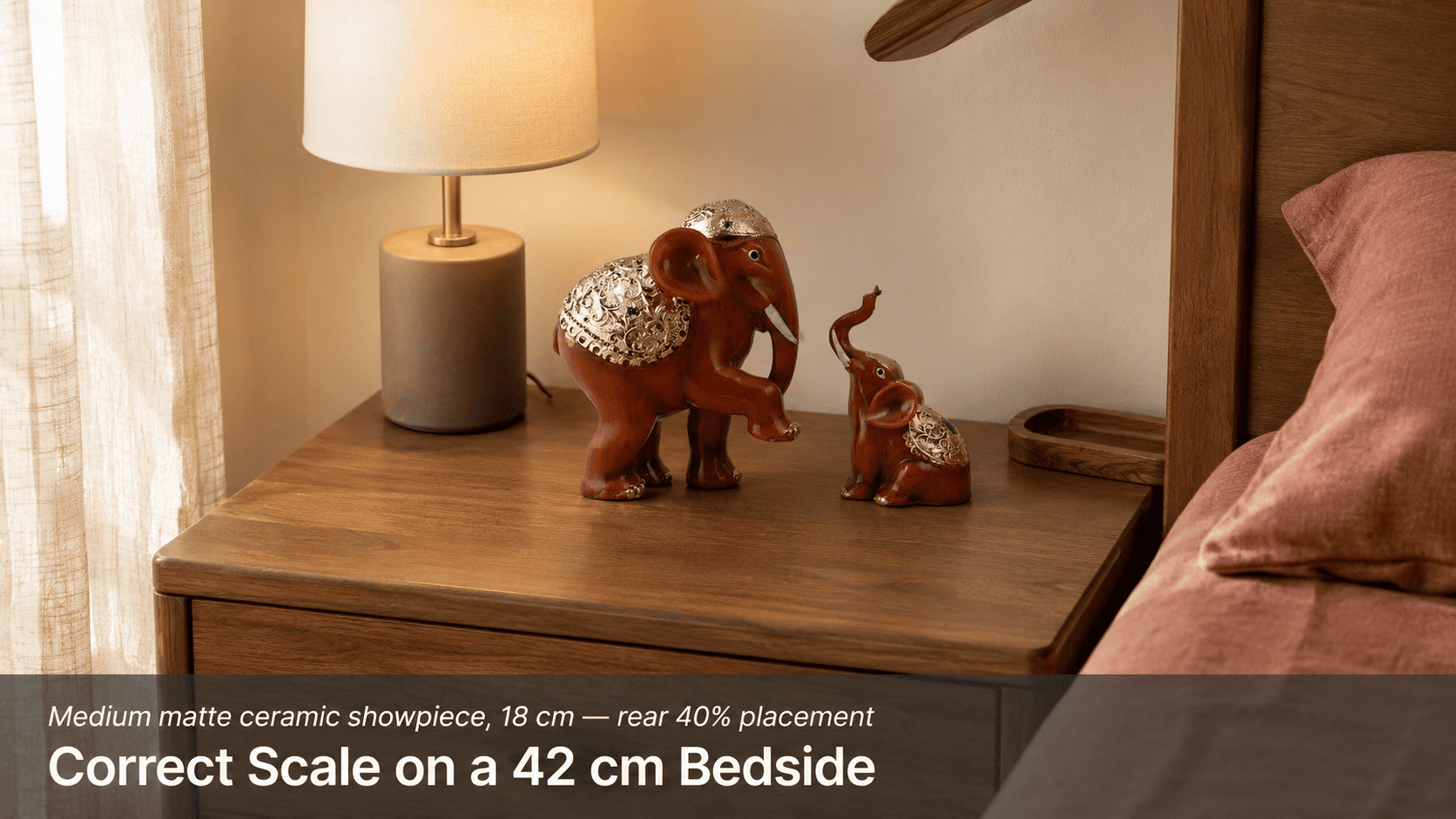
To prevent visual scatter on a compact bedside surface, apply Moolwan's 60/40 Bedside Composition Rule: keep 60% of the surface entirely clear and restrict all décor — showpiece, tray, book, and lamp base — to the rear 40%. This constraint forces intentional clustering and creates the negative space that signals restraint, which the eye registers as sophistication rather than absence.
Which Finishes and Colours Make a Bedside Table Look More Expensive?
Matte earthy finishes — warm whites, greige, dusty sage, terracotta-adjacent neutrals — outperform glossy surfaces in a bedside context over time because micro-scratches in a matte glaze scatter light unevenly, rendering surface wear invisible to the naked eye at year three, whereas glossy finishes reflect light uniformly and make every hairline scratch legible. The practical consequence is that a high-fired matte ceramic bedroom showpiece looks as composed at year five as at year one — a durability premium that eliminates the cost of periodic refresh.
In Indian bedrooms where walls are commonly painted in off-white, warm ivory, or pale grey, a warm-toned matte bedroom décor piece in the 16–21 cm band creates tonal resonance rather than contrast competition. Tonal resonance — matching the value range of the piece to the wall tone within 20–30% lightness variance — is why certain rooms read as effortlessly styled: the pieces do not fight the walls for dominance. High-contrast accent pieces (dark object against a pale wall) work only when a single accent is used; multiple high-contrast accents on a single surface create visual noise.
For bedside styling specifically, a glazed ceramic piece is appropriate only when the lamp base is matte — the finish contrast between the two pieces creates intentional visual dialogue rather than specular competition. If both the lamp and the showpiece are glazed, the surface reads as shiny and commercial rather than curated.
Ready to bring home a bedroom showpiece engineered for Indian humidity and sized for real Indian apartments? Shop the full Moolwan bedroom décor collection now.
How Do You Style a Bedside Table Without a Lamp?
In compact Indian bedrooms where overhead lighting from a ceiling fan-light fixture is the primary source, a bedside lamp is often absent — which removes the tall anchor element from the surface and requires a different compositional approach. Without a vertical lamp anchor, the tallest object on the surface becomes the bedroom showpiece itself, and a 16–21 cm piece suddenly risks appearing too dominant on a surface where it previously anchored the mid-zone.
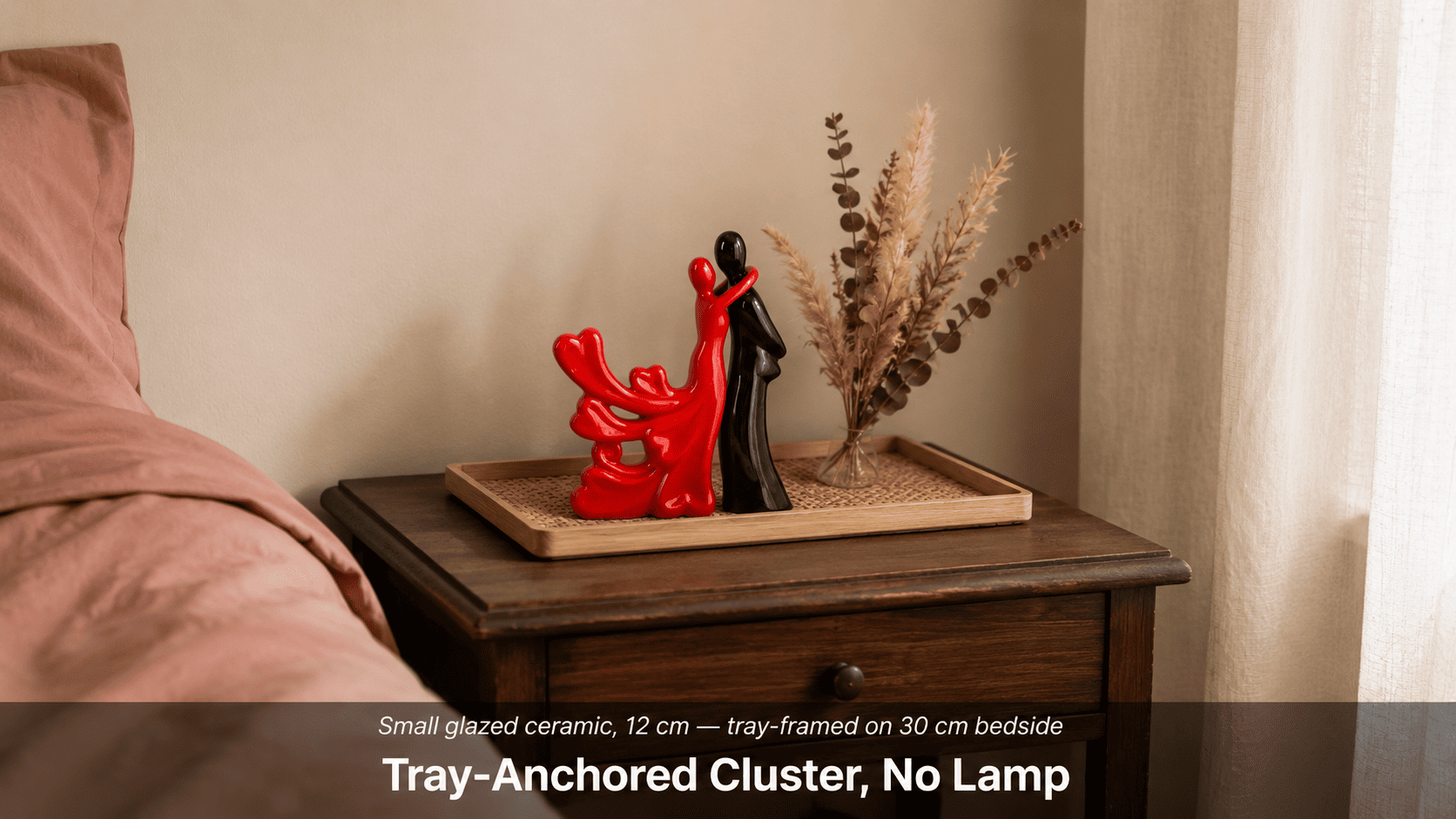
The corrective is a tray. A flat rectangular or oval tray (any material — cane, lacquered wood, ceramic slab) placed first creates a defined inner surface within the surface, visually reducing the effective width the eye measures. A 16–21 cm bedroom showpiece placed on a tray that occupies the rear 40% of the bedside reads as a composed vignette — tray as frame, showpiece as subject — rather than an isolated object. The tray's bounding edge performs the same visual anchoring function that the lamp's vertical presence would otherwise provide.
The no-lamp bedside also tolerates a two-piece cluster: one bedroom showpiece at 16–21 cm and one small decorative accent at 10–14 cm placed on the same tray, with a height differential of at least 5 cm between them. The height differential maintains the descending gradient principle even without the lamp's tall anchor. Without the 5 cm differential, two similarly-sized objects read as accidental duplication rather than a considered pair.
Does Colour of Bedding Affect Which Bedroom Showpiece to Choose?
Bedding tones are the largest colour field in any Indian bedroom and function as the room's effective background colour for the bedside surface — even though the bedside table is physically separate. Because the bedside sits in the immediate visual periphery of the bed, the eye evaluates the bedside showpiece and the bedding simultaneously, and the brain reads the tonal relationship between the two as either resolved or unresolved.
The practical rule: warm-toned bedding (saffron, blush, rust, dusty rose, ochre) pairs with warm-neutral bedroom décor in earthy matte finishes — terracotta, sand, warm white. Cool-toned bedding (grey, steel blue, sage, muted teal) pairs with cool-neutral bedroom décor in pale matte or single-glaze finishes — off-white, stone grey, celadon. When bedding is neutral (white or ecru), the bedside piece can carry the room's only colour accent without clashing, provided it remains within the muted rather than saturated register — because saturated accents next to white bedding read as children's décor rather than elevated styling.
Frequently Asked Questions
How many items should be on a bedside table in a small Indian bedroom?
In a bedroom under 120 sq ft, three items maximum on a standard 40–50 cm bedside surface: one tall anchor (lamp or taller showpiece), one mid-height bedroom showpiece, and one flat element such as a tray or book. Exceeding three discrete objects increases lateral scatter — the number of unanchored horizontal gaps the eye must process — and the surface registers as cluttered regardless of the quality of individual pieces. Moolwan's medium bedroom showpiece (16–21 cm) is sized to function as the primary mid-height anchor within this three-object constraint.
Is ceramic or resin better for a bedside showpiece in Indian conditions?
Ceramic at 92% clay composition outperforms resin for bedside placement in most Indian conditions because ceramic tolerates up to 85% relative humidity without surface degradation, whereas resin at 94% epoxy purity is rated to 60% RH — a threshold regularly exceeded in unconditioned rooms during monsoon months across coastal and plains cities. Where a bedroom is consistently air-conditioned below 60% RH year-round, resin is an equally valid choice and offers lighter weight (useful on narrow floating bedside shelves). For unair-conditioned rooms or those with intermittent AC use, ceramic is the durability-rational choice.
Can I use the same bedside décor piece for gifting?
Yes — a medium matte ceramic bedroom showpiece in the 16–21 cm range is one of the most gift-appropriate home décor formats because the size is perceptibly significant without being room-specific, the weight (250–400 g) makes it easy to carry and package, and a neutral warm-earth finish coordinates with most existing Indian bedroom palettes without the gift-giver needing to know the recipient's exact bedding or wall colour. Moolwan's bedroom décor collection includes pieces suited to housewarming, anniversary, and Diwali gifting contexts at a price point that reads as considered rather than token.
Does AC airflow damage a ceramic bedside showpiece over time?
Direct AC airflow does not damage high-fired ceramic, but it accelerates dust accumulation in textured matte surfaces — micro-ridges in the glaze trap particulate matter faster than smooth surfaces under directed air circulation. The practical mitigation is placement outside the direct airflow path (not in line with the AC vent) and a monthly wipe with a dry microfibre cloth. High-density ceramic at 92% clay composition does not suffer thermal micro-cracking from AC temperature cycling in the typical Indian residential range (15–35°C), which means the structural and finish integrity of the piece is unaffected by standard AC use.
A matte ceramic bedroom showpiece rated to 85% RH and sized correctly to your bedside surface will outlast five or more years of Indian monsoons without colour fade, finish crazing, or structural change — making it a one-time investment rather than a seasonal replacement. Buy a climate-rated piece sized for your exact bedside surface from the Moolwan bedroom décor collection — manufactured in-house, sold direct, no distributor margin. If you are also considering a marble-finish accent, browse the curated Moolwan marble-finish bedroom showpiece range for pieces that pair well with warm-neutral bedding tones. For a broader selection of bedroom and room accent options beyond the bedside, explore the full Moolwan decorative items for bedroom collection covering dresser-top, above-headboard, and shelf formats.


