
How to Style a Coffee Table for Everyday Use vs Hosting Guests
The Short Answer
Style an everyday coffee table with just 2-3 small pieces (10-16 cm) clustered to one side, leaving most of the surface free for cups and laptops. For hosting, switch to Moolwan's 3-Tier Cluster Rule — small, medium, and large pieces at staggered heights — because guests read visual depth in seconds, while daily users need open, unobstructed surface space.
Coffee tables in Indian apartments get used for more hours per day, and by more people, than almost any other surface in the living room — a footrest, a laptop stand, a snack tray, a spot for keys and remotes. That single surface is asked to look effortless during the week and feel curated the moment guests walk in, and those two jobs pull in opposite directions. Moolwan helps design-conscious Indian homeowners keep a coffee table genuinely usable through the week while making it guest-ready in under two minutes before anyone arrives.
Why Everyday and Hosting Styling Need Different Rules
A surface used daily needs at least 60% of its area left clear, because objects placed in the direct path of hands, cups, and laptops get knocked, chipped, or simply moved out of the way within days. A surface styled for a two-hour gathering can afford to give up more of that clearance, because the pieces are load-bearing for conversation and photographs rather than for cups and remotes. Moolwan's modern home décor collection is deliberately sized in three distinct bands — Small (10-16 cm), Medium (16-21 cm), and Large (25-34 cm) — specifically so the same coffee table can be restyled between these two states in minutes rather than requiring separate pieces bought for each occasion.
The everyday state should feel almost invisible. The hosting state should feel intentional. Confusing the two is the most common styling mistake: an everyday table overloaded with five or six pieces becomes an obstacle course for a coffee mug, while a hosting table with only one small piece reads as under-decorated the moment more than two people are seated around it.
How to Style a Coffee Table for Everyday Use
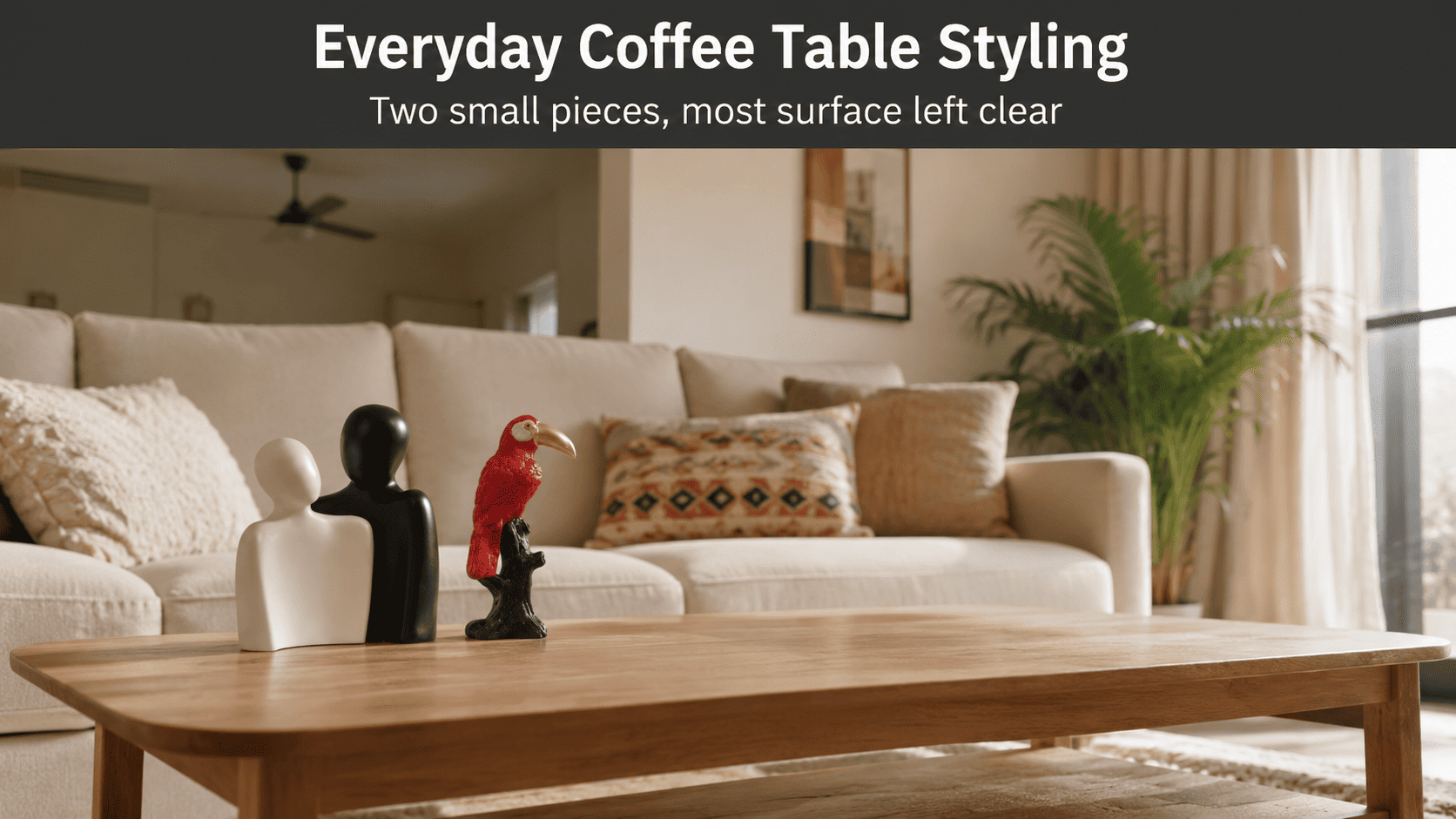
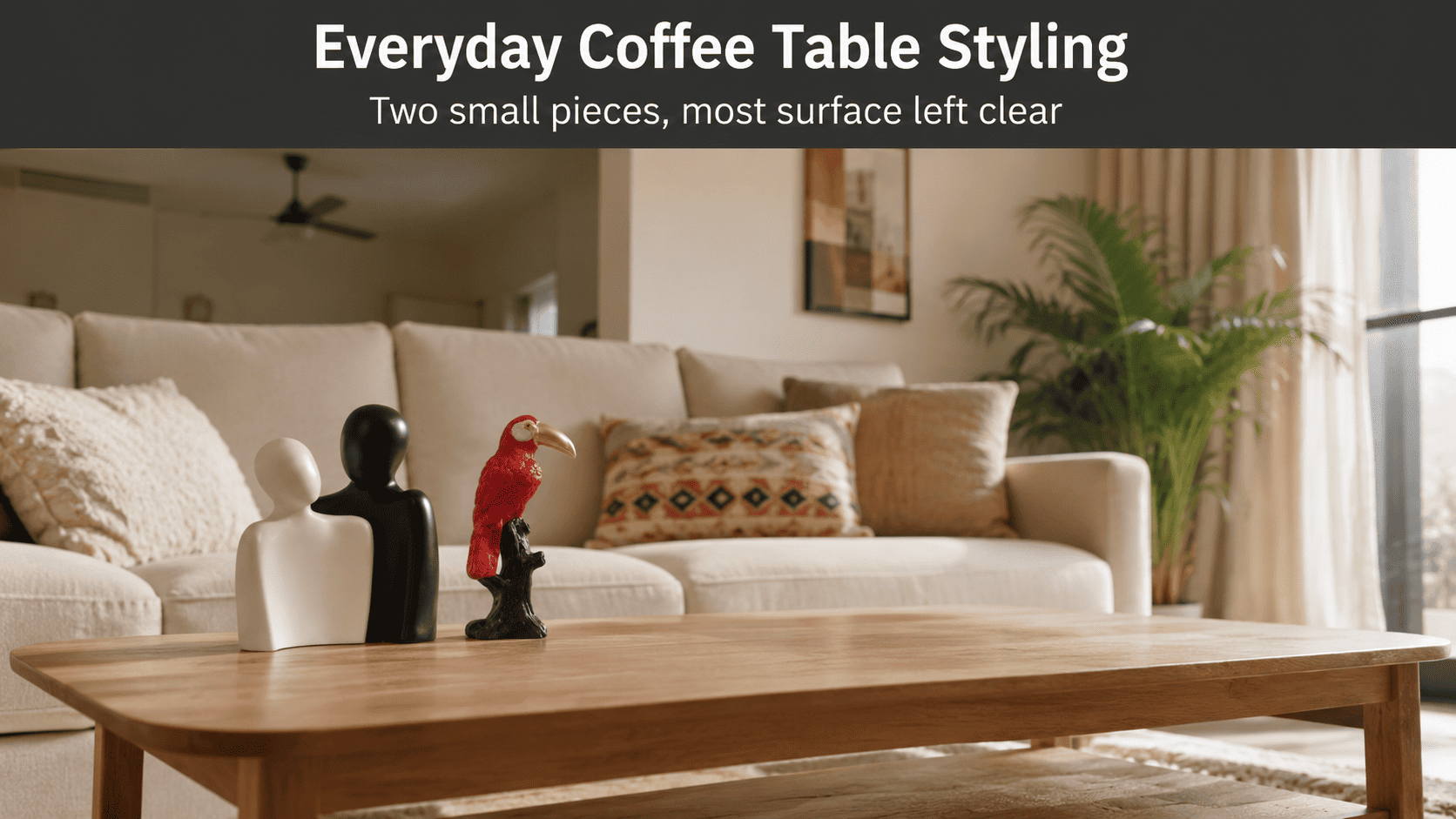
An everyday coffee table needs the clearest possible working surface, because daily use involves setting down and picking up objects dozens of times a day, and every decorative piece in that path adds friction and risk of damage. The practical fix is to push all décor to one-third of the table, ideally the side furthest from the main seating position, and keep it to 2-3 small pieces under 16 cm — a single ceramic showpiece, a small vase, and at most one candle holder.
Weight also matters for daily durability. Pieces in the 150-250 g range are light enough to move out of the way for a tray or a laptop without feeling like a chore, whereas anything over 400 g tends to stay put and gradually gets treated as furniture rather than décor, collecting dust and losing its visual impact. Matte-finish ceramic in this weight range also resists fingerprints and daily handling marks better than glazed or high-gloss resin, because a matte surface scatters light unevenly and hides the fine scuffs that daily contact leaves behind.
| Coffee Table Width | Styling Occasion | Recommended Piece Height | Weight Range |
|---|---|---|---|
| Under 90 cm (compact) | Everyday | Small: 10–16 cm | 150–250 g |
| Under 90 cm (compact) | Hosting | Small–Medium mix: 10–21 cm | 150–400 g |
| 90–120 cm (standard) | Everyday | Small–Medium: 10–21 cm | 150–400 g |
| 90–120 cm (standard) | Hosting | Medium–Large: 16–34 cm | 250–600 g |
| 120 cm+ (large) | Hosting | Large + Medium cluster: 16–34 cm | 400–600 g |
Because coffee table shape, seating distance, and daily foot traffic all shift the ideal piece count, browse the full size-band and material selection in Moolwan's modern home décor collection to match pieces to your exact table.
Design Rule
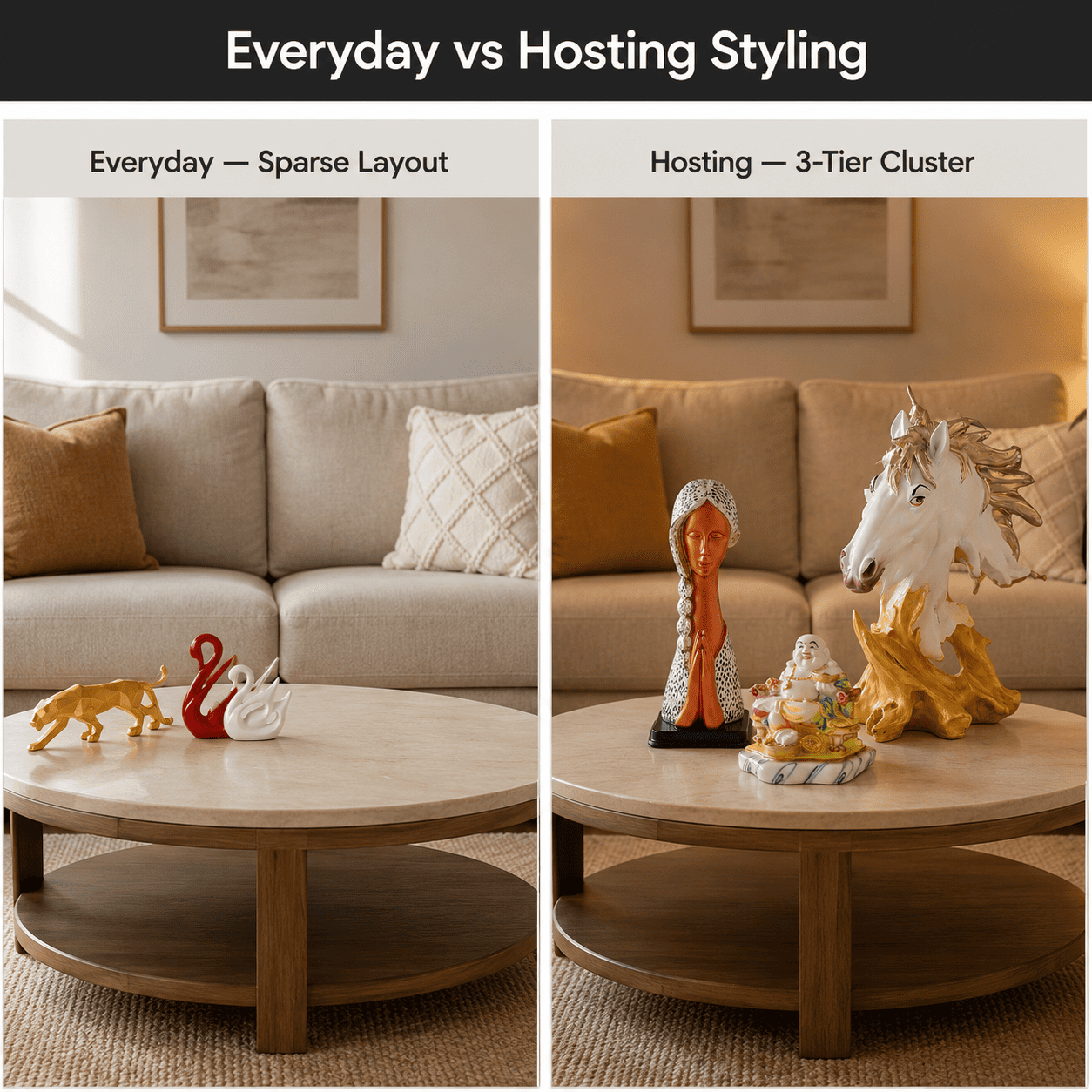
When restyling for guests, follow Moolwan's 3-Tier Cluster Rule: group one Small (10-16 cm), one Medium (16-21 cm), and one Large (25-34 cm) piece together at staggered heights, because the human eye reads a cluster as "curated" only when it has at least three distinct height levels to move across.
How to Style a Coffee Table When Hosting Guests
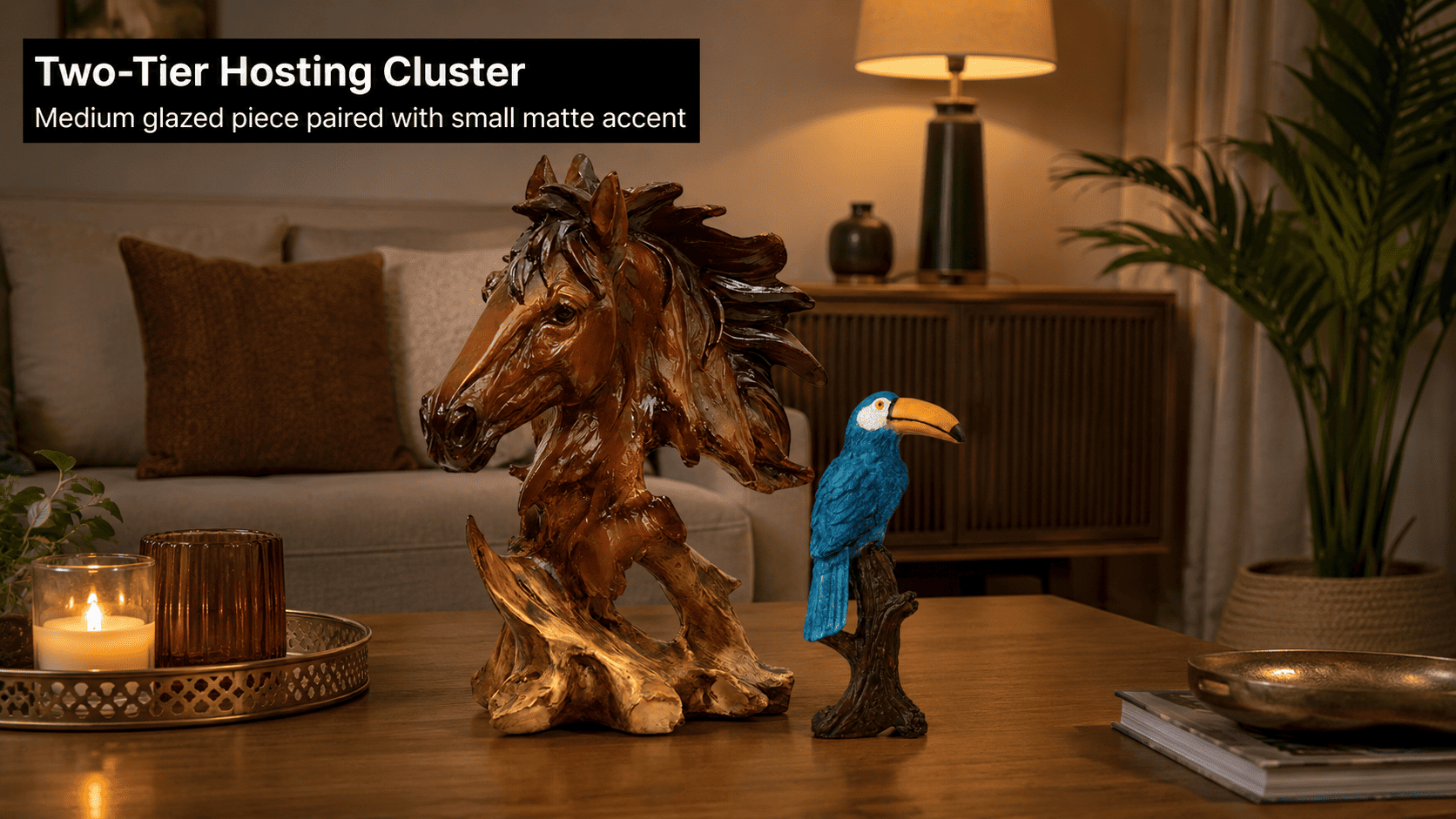
A hosting layout should read clearly from a seated position across the room, because guests view the coffee table from 1.5-2 metres away rather than up close, and a single small piece simply disappears at that distance. The fix is to temporarily add height and volume: bring in a Large piece (25-34 cm) as the anchor, then apply Moolwan's 3-Tier Cluster Rule by adding a Medium and a Small piece around it at different heights.
This is also where investing in a heavier, more durable material pays off, because a table that gets restyled for guests every week benefits from pieces that survive repeated handling without chipping. Moolwan's ceramic pieces are drop-tested to withstand a 15 cm fall and rated to 85% relative humidity, so the same pieces can be moved between storage and the table repeatedly across a full monsoon season without degrading — a core focus of Moolwan's climate-rated design philosophy, and a better long-term investment than replacing chipped decor every few months.
Want pieces built to survive weekly restyling without chipping or fading? Shop the full Moolwan modern home décor collection now.
How Many Décor Pieces Should Sit on a Coffee Table at Once
For everyday use, 2-3 pieces is the practical ceiling, because a table busy with more than three objects at once statistically gets more items misplaced or nudged onto the floor within a week of daily contact. For hosting, 3-5 pieces works, since the 3-Tier Cluster Rule already accounts for the extra visual weight guests expect, and going beyond five pieces on a standard 90-120 cm table starts to crowd the space guests need for drinks and snacks.
Odd numbers also outperform even numbers visually in either state, because the eye cannot pair off an odd-numbered group symmetrically and is instead forced to scan across the whole cluster, which is exactly the movement that makes a coffee table read as intentionally styled rather than randomly placed.
Which Materials Hold Up Best on a Daily-Use Coffee Table
Ceramic and resin behave differently under daily contact, because their surface hardness and moisture tolerance differ. Moolwan's ceramic pieces use a 92% clay composition rated to 60°C and 85% relative humidity, which makes them more forgiving on a table near a window or in an unconditioned room during summer. Resin pieces use a 94% purity epoxy with 3H pencil hardness, which resists scratching from repeated handling but tolerates a narrower humidity band of up to 60% RH, so they suit conditioned rooms better than balconies or unshaded windows.
For a coffee table restyled often, this durability gap adds up: a piece that tolerates a wider humidity swing simply needs replacing less often, which is the real cost saving behind choosing climate-appropriate material over the cheapest available option.
Frequently Asked Questions
How many decor pieces should go on an everyday coffee table?
Keep it to 2-3 small pieces (10-16 cm) clustered to one side, because daily contact from cups, remotes, and laptops means anything placed across the main working area gets knocked or moved within days. Moolwan's Small size band is specifically sized for this kind of low-friction daily styling.
What is the fastest way to restyle a coffee table before guests arrive?
Add one Large piece (25-34 cm) as an anchor and bring in a Medium piece at a different height beside it, following Moolwan's 3-Tier Cluster Rule. This takes under two minutes because it only involves adding two pieces to the everyday base rather than rearranging the whole table.
Does material choice matter for a frequently restyled coffee table?
Yes — ceramic pieces rated to 85% relative humidity hold up better than resin (60% RH tolerance) in rooms exposed to monsoon humidity or direct window heat, because the higher humidity threshold prevents surface degradation from repeated moisture exposure across seasons.
Should coffee table decor match the sofa upholstery exactly?
No — an exact match reads as flat under normal lighting. A palette that complements rather than matches the upholstery, with one contrasting finish (matte against glazed, for instance), creates the tonal variation that makes a cluster visually interesting from a seated distance.
Ready to build a coffee table that works on a Tuesday evening and holds up when guests arrive on Saturday? Bring home a curated set from the Moolwan modern home décor collection — manufacturer-direct, climate-rated, and sized for Indian coffee tables. If you're furnishing a new home altogether, also see the wider modern interior décor range for new homes, or browse Moolwan's unique home décor pieces for a less common centerpiece option.


