
How to Style a Decorative Statue on a Bookshelf Without Looking Cluttered
The Short Answer
Place one decorative statue no taller than 25 cm on a shelf with at least 60% of the surface left completely clear. Moolwan's climate-rated showpieces weigh 150–600 g and are sized in three bands specifically for Indian shelf depths — because visual balance collapses when object height exceeds 70% of the vertical clearance above a shelf.
Indian bookshelves — typically 25–35 cm deep and built into living rooms under 150 sq ft — compress visual space faster than their Western counterparts, which are designed for larger rooms with higher ceilings. Moolwan helps design-conscious Indian homeowners style decorative statues in a way that reads as intentional rather than accumulated, using size ratios, surface ratios, and material choices engineered for the specific spatial constraints of Indian apartments. The difference between a shelf that looks styled and one that looks cluttered is almost always a matter of object-to-space ratio, not the number of pieces.
What Size Decorative Statue Belongs on a Bookshelf?
A decorative statue placed on a bookshelf should stand no taller than 70% of the vertical clearance between the shelf surface and the shelf above it — because when an object approaches or exceeds that threshold, the eye registers the shelf as packed rather than composed, regardless of how few objects are present.
Standard Indian bookshelves carry 20–30 cm of vertical clearance per shelf. This means a statue in the 14–20 cm range is the functional sweet spot for most shelves: tall enough to anchor the eye, short enough to leave breathing room above the piece. Statues above 25 cm are better placed on the topmost open shelf, a floor console, or a dedicated surface where vertical clearance is not constrained by a shelf above.
Material weight reinforces this sizing logic. Heavier objects — resin showpieces above 400 g — create a visual density that reads as permanent and considered on a shelf, while lighter pieces under 250 g read as decorative filler unless grouped deliberately. Shelf depth also matters: on shelves under 28 cm deep, a statue with a base wider than 12 cm will visually overhang the front edge, which destabilises the composition even when the piece is physically stable.
How Much Empty Space Should You Leave Around a Decorative Statue?
At least 60% of the shelf surface must remain visually clear — not occupied by books, objects, or decorative filler — because the human visual cortex interprets dense horizontal surfaces as unresolved clutter rather than intentional styling, a perceptual effect that persists even when every individual object is attractive on its own.
This 60% clearance rule applies to the immediate shelf on which the statue sits. Adjacent shelves can carry books or other objects at higher density, and the contrast between a sparse statue shelf and a denser book shelf actually increases the perceived intentionality of both. The statue becomes a deliberate pause in the visual rhythm of the bookcase, not an afterthought.
Humidity is a secondary consideration for Indian homes: in unconditioned rooms subject to monsoon-season humidity above 60% RH, objects placed too close together trap moisture between surfaces, accelerating finish degradation. Moolwan's ceramic showpieces are tested to 85% RH with a 92% clay composition that resists surface blooming, but adequate spacing between pieces also reduces the microclimate humidity that affects any material's long-term finish.
How Should You Group Objects Around a Decorative Statue on a Shelf?
Group a decorative statue with no more than one or two flanking objects — typically one vertical element (a small plant, a slim book spine, or a candle holder) and one low horizontal element (a small decorative tray or a flat stone) — because groupings of three distinct heights create a triangular visual path that the eye follows naturally, preventing the flat, repetitive scan that makes shelves look like storage rather than styling.
The height differential between the statue and its flanking objects should be at least 30% — meaning if your statue stands 18 cm tall, the tallest flanking object should be no more than 12 cm. This height gradient is what creates the triangular visual hierarchy; uniform heights eliminate it and flatten the composition. Flanking objects should not compete with the statue's finish: a glazed showpiece is best paired with matte or natural-texture companions, since two reflective surfaces at close range create visual noise rather than contrast.
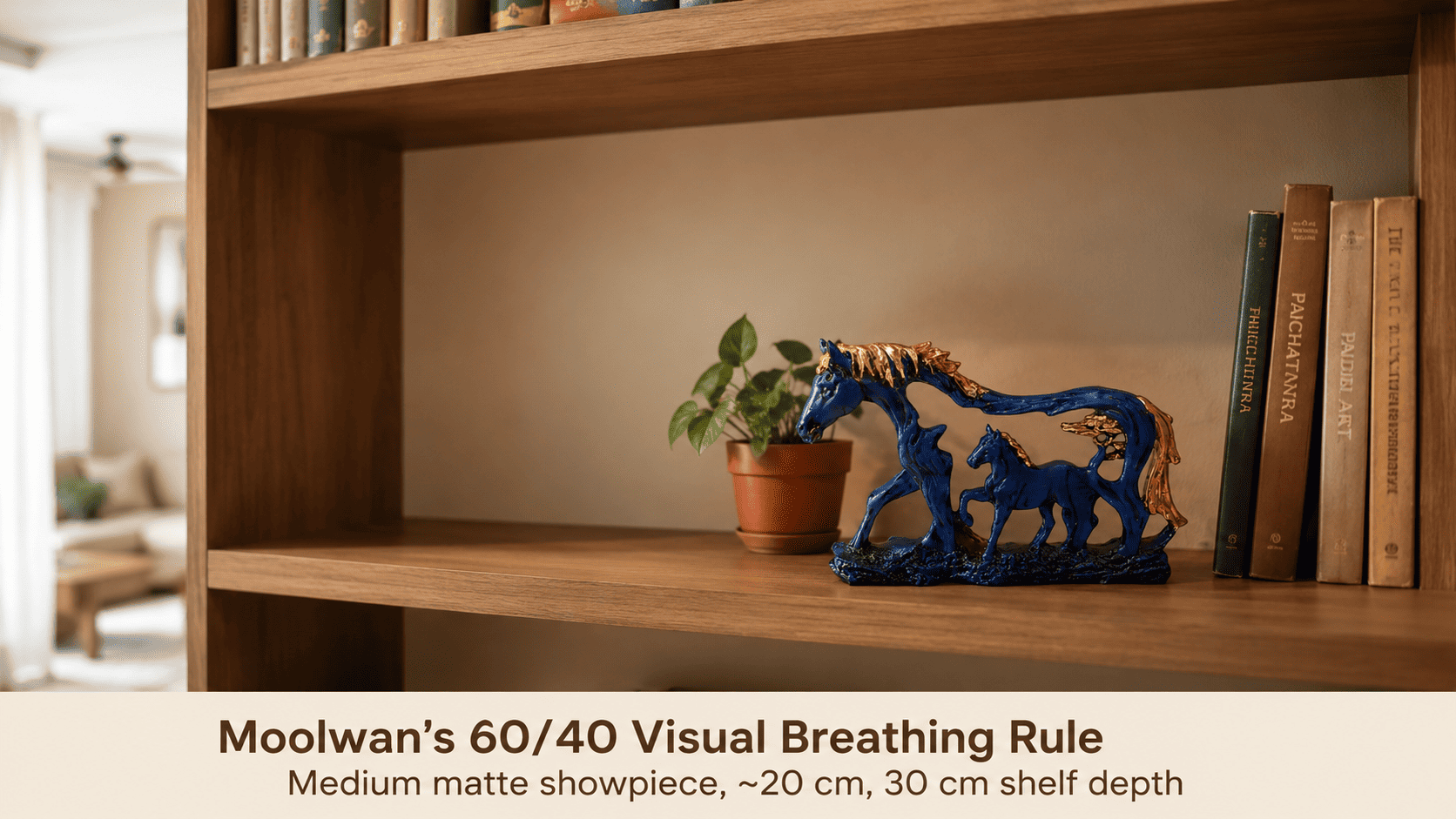
Avoid placing decorative statues directly in front of books. Obscuring book spines forces the viewer to parse two overlapping visual layers simultaneously, which registers as disorganisation. Instead, pull the statue 8–10 cm forward from the back of the shelf and leave a clear visual gap between its base and the book row behind it.
| Shelf Depth | Vertical Clearance | Recommended Statue Height | Maximum Base Width | Suggested Weight Range |
|---|---|---|---|---|
| Under 25 cm | 20–24 cm | 10–15 cm (Small) | Up to 10 cm | 150–250 g |
| 25–30 cm | 24–28 cm | 14–18 cm (Small–Medium) | Up to 12 cm | 200–350 g |
| 30–35 cm | 28–32 cm | 16–21 cm (Medium) | Up to 14 cm | 250–450 g |
| 35–40 cm | 32–38 cm | 20–25 cm (Medium–Large) | Up to 16 cm | 350–550 g |
| Open top shelf (no shelf above) | Unconstrained | 25–34 cm (Large) | Up to 20 cm | 400–600 g |
Because individual shelf depths, book heights, and vertical clearances vary significantly across Indian bookcase styles — from modular flat-pack units to built-in wall shelving — browse the full size-band and finish selection by these parameters in Moolwan's decorative statue collection to confirm the right piece for your specific shelf configuration.
Design Rule
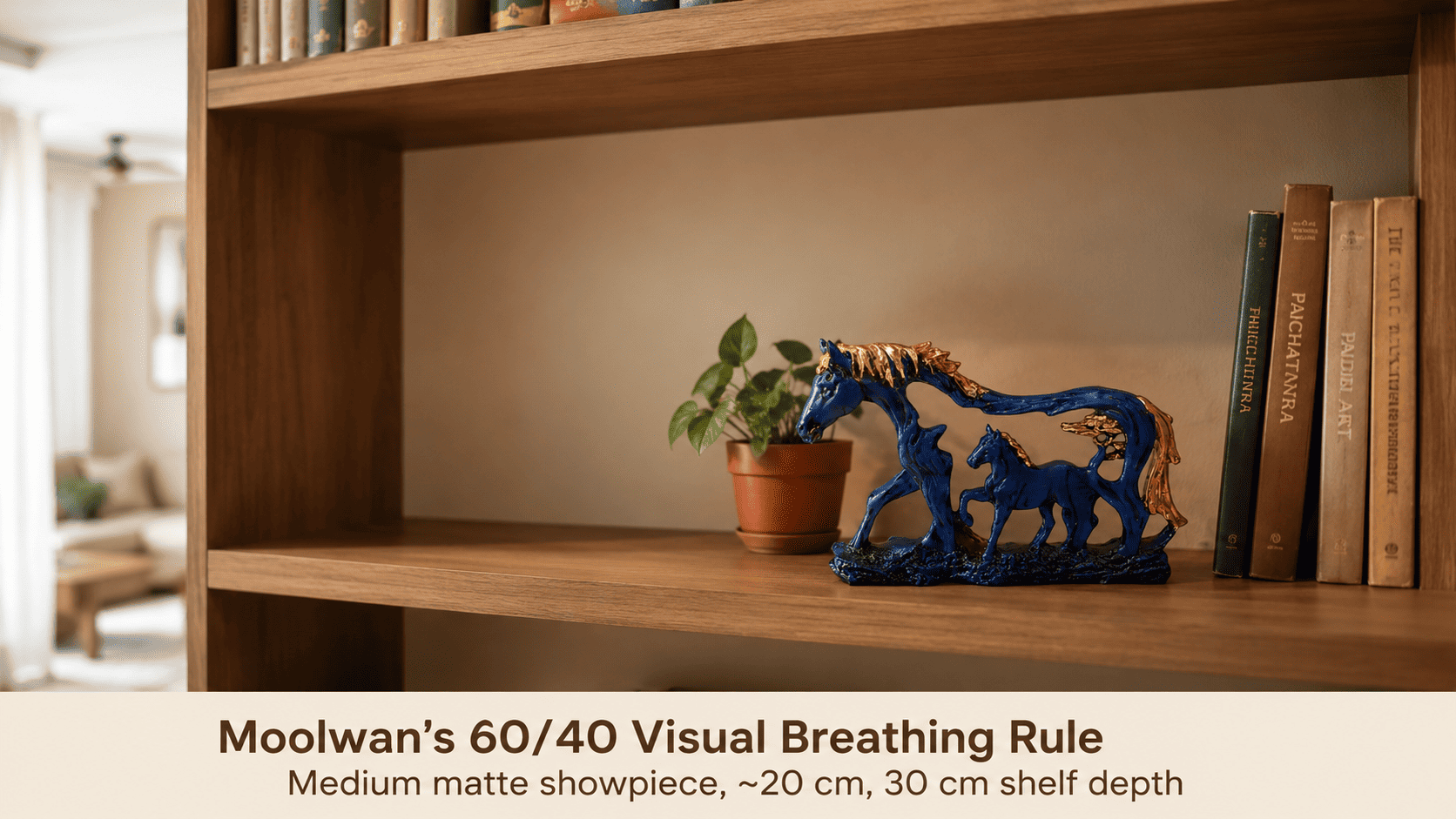
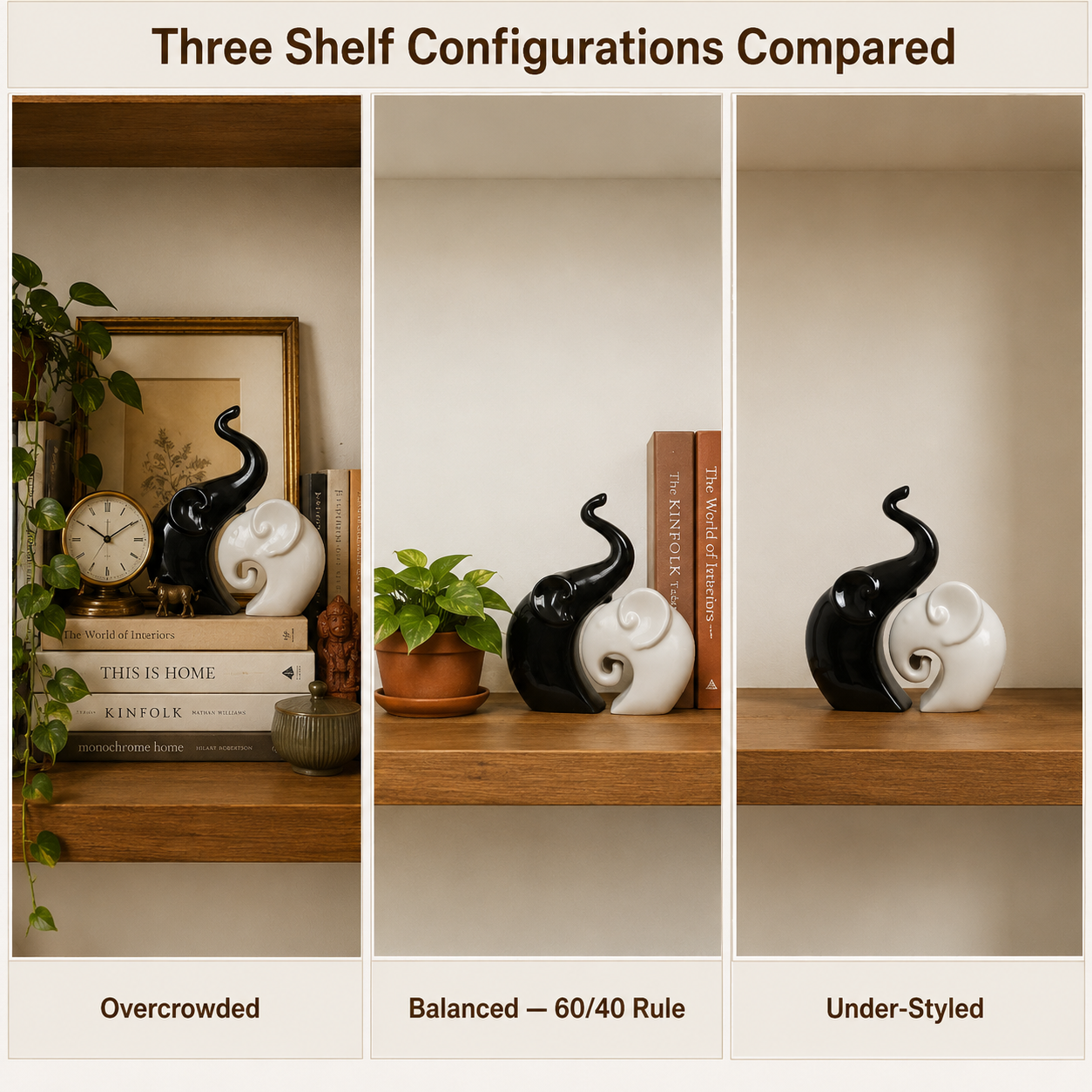
To prevent visual compression on Indian bookshelves — where shelf depths of 25–35 cm and ceiling-constrained vertical clearances make overcrowding register faster than in larger rooms — apply Moolwan's 60/40 Visual Breathing Rule: leave a minimum of 60% of the shelf surface completely clear of objects, and cluster your decorative statue and its companions within the remaining 40%, positioned in a deliberate triangular height gradient.
Does the Finish of a Decorative Statue Matter on a Bookshelf?
Finish determines how a statue interacts with the ambient light on your shelf — and bookshelves in Indian homes are frequently lit by a combination of warm overhead light and direct afternoon sunlight, which means gloss finishes will reflect harshly while matte finishes absorb and diffuse light, making the piece appear warmer and more resolved in its setting.
Matte and earthy ceramic finishes outperform glossy surfaces on bookshelves for a second structural reason: micro-scratches that accumulate over a 5+ year lifespan scatter light unevenly on matte surfaces, rendering wear invisible to the naked eye. Glossy surfaces reflect light uniformly and highlight every surface mark, making the piece look aged and neglected within two to three years of regular dusting. This is why investing in high-fired matte ceramics is a lifecycle decision, not purely an aesthetic one.
Resin showpieces at 94% purity epoxy are appropriate for shelves with stable temperatures between 15–35°C and humidity below 60% RH — which covers air-conditioned Indian living rooms in most climates. For shelves in unconditioned rooms or in coastal cities where ambient humidity regularly exceeds 60% RH, high-density ceramic at 85% RH tolerance is the more durable choice.
Ready to bring home a showpiece engineered for Indian shelf depths and humidity levels? Shop the full Moolwan decorative statue collection — manufacturer-direct, climate-rated, sized for Indian homes.
How Do You Prevent a Bookshelf From Looking Cluttered After Adding a Statue?
Remove at least two objects from the shelf before adding your statue — because the visual carrying capacity of a standard Indian bookshelf shelf is finite, and adding a decorative piece without subtracting something else guarantees the composition will cross the clutter threshold regardless of how well the piece is chosen.
The practical edit sequence is: clear the entire shelf, place the statue first as the compositional anchor, then reintroduce flanking objects one at a time until the composition reads as intentional. Stop adding as soon as the shelf feels balanced — which is almost always earlier than it feels empty. Most people significantly overestimate how many objects a shelf needs; a single well-sized showpiece with one flanking object and 60% clear space is a complete, finished composition.
Colour discipline matters at the shelf level: limit the palette on any single shelf to two to three tones. If your statue carries warm earth tones — terracotta, sand, clay — the books and flanking objects visible on the same shelf should share or complement that warmth. A single colour-conflicting spine or object visually breaks the composition and makes the shelf appear less considered, even though the statue itself is correctly placed.
Where Exactly on the Shelf Should a Decorative Statue Be Positioned?
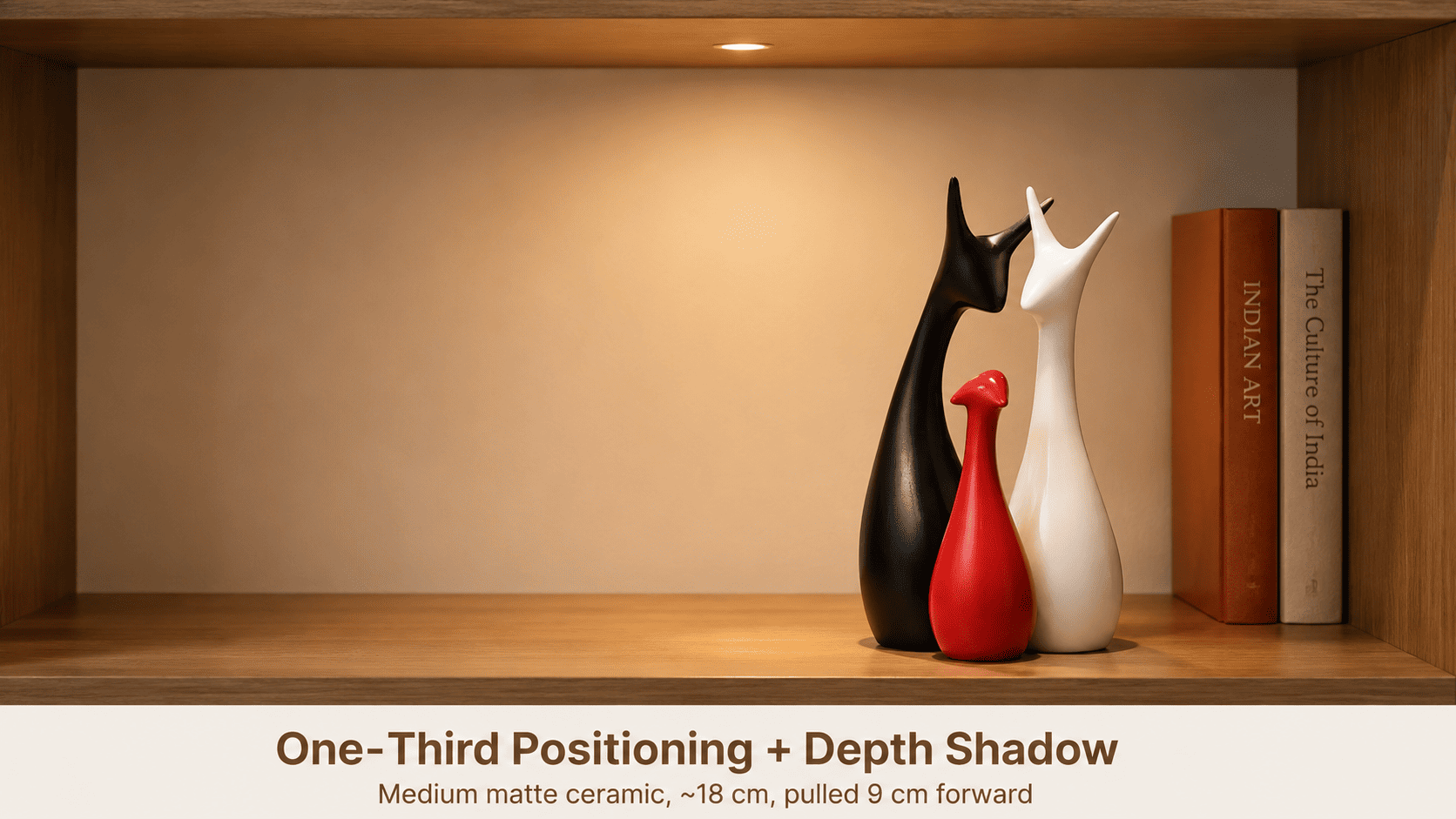
Position the statue at one-third from either the left or right end of the shelf — not centred — because asymmetric placement activates the negative space on the longer side, making the empty shelf surface read as a deliberate compositional element rather than unused space. Centred placement flattens the visual rhythm and makes even well-sized pieces appear decoratively static.
The one-third rule mirrors a principle from visual composition: the eye enters a horizontal surface from the left and travels right, so placing the statue at the right-side one-third point creates the most natural visual journey — clear space on the left, the statue as the destination. For shelves above eye level, where the viewer looks up at the piece, left-side one-third positioning is more effective because it aligns with the natural upward-left viewing angle.
Pull the statue 8–10 cm forward from the shelf's rear wall whenever depth allows. This forward positioning casts a soft shadow behind the piece, adding dimensionality and separating the statue visually from the background — whether that background is a painted wall, a book row, or a decorative backing panel. A piece flush against the rear wall reads flat; a piece with 8–10 cm of breathing room reads three-dimensional.
Frequently Asked Questions
Can I place more than one decorative statue on the same bookshelf shelf?
Yes, but the two statues must carry a minimum 30% height differential — for example, a 20 cm and a 13 cm piece — because uniform heights create a repetitive horizontal band that the eye reads as mass rather than composition. Keep combined base widths below 40% of the shelf width, apply the 60/40 surface clearance rule to the shelf as a whole, and ensure both pieces share a common palette or finish family so they read as a curated pair rather than two unrelated objects. Moolwan's small and medium showpiece bands (10–16 cm and 16–21 cm) are sized to pair naturally within this differential.
What material is best for a decorative statue on a bookshelf near a window?
High-fired ceramic at 92% clay composition is the more durable choice for shelves with direct or near-direct sunlight exposure because the inorganic mineral structure of fired clay does not photodegrade or fade under UV exposure. Resin showpieces at 94% purity epoxy maintain colour stability in diffused indoor light, but prolonged direct UV — especially the high-angle summer sun common in Indian east- and west-facing rooms — accelerates surface yellowing on resin over a 2–3 year horizon. For north-facing shelves with no direct sun, both materials perform equivalently.
How do I dust a decorative statue on a bookshelf without disturbing the styling?
Use a clean, dry microfibre cloth applied with light circular strokes, working from the top of the statue downward. Avoid aerosol furniture sprays on matte ceramic surfaces because liquid polish fills the micro-texture that makes matte finishes diffuse light effectively, producing an uneven sheen that cannot be reversed without professional refinishing. For resin pieces, a slightly damp cloth followed by immediate drying is safe. The practical dusting interval for a bookshelf showpiece in an Indian apartment is every 10–14 days — Indian ambient dust levels during summer and post-construction periods are significantly higher than in temperate climates.
Is a decorative statue an appropriate gift for someone who has a bookshelf-heavy home?
A showpiece in the small-to-medium size band (10–21 cm) is one of the most practical décor gifts for a bookshelf-heavy home because it does not require surface preparation, electrical connection, or installation — the recipient can place and adjust it without any tools. The gifting risk with larger decorative objects is that they require a dedicated surface the recipient may not have; small-to-medium statues are self-placing gifts. For housewarming or anniversary occasions, a matte ceramic piece in a neutral warm palette (sand, warm grey, clay) is the most universally compatible choice because it avoids the palette-conflict risk that makes bold-coloured gifted pieces end up in storage.
Because matte ceramic finishes absorb micro-scratches across a 5+ year lifespan and ceramic's 92% clay composition tolerates Indian humidity up to 85% RH without warping or surface degradation, choosing a climate-rated showpiece is an investment in a piece that will not need seasonal replacement. Bring home a curated piece from the Moolwan decorative statue collection — designed in-house, sold manufacturer-direct, and sized to the specific depth and clearance ratios of Indian bookshelves. If you're also considering smaller accent pieces for narrow floating shelves or a study desk, explore Moolwan's small decorative items for shelves — a curated range of pieces under 25 cm engineered for high-touch compact surfaces. For a broader room refresh beyond the bookshelf, the Moolwan modern home décor collection covers ceramic and resin accent objects sized for living room consoles, coffee tables, and dining surfaces.


