
How to Style a Dining Room Console with Showpieces Without Looking Cluttered
The Short Answer
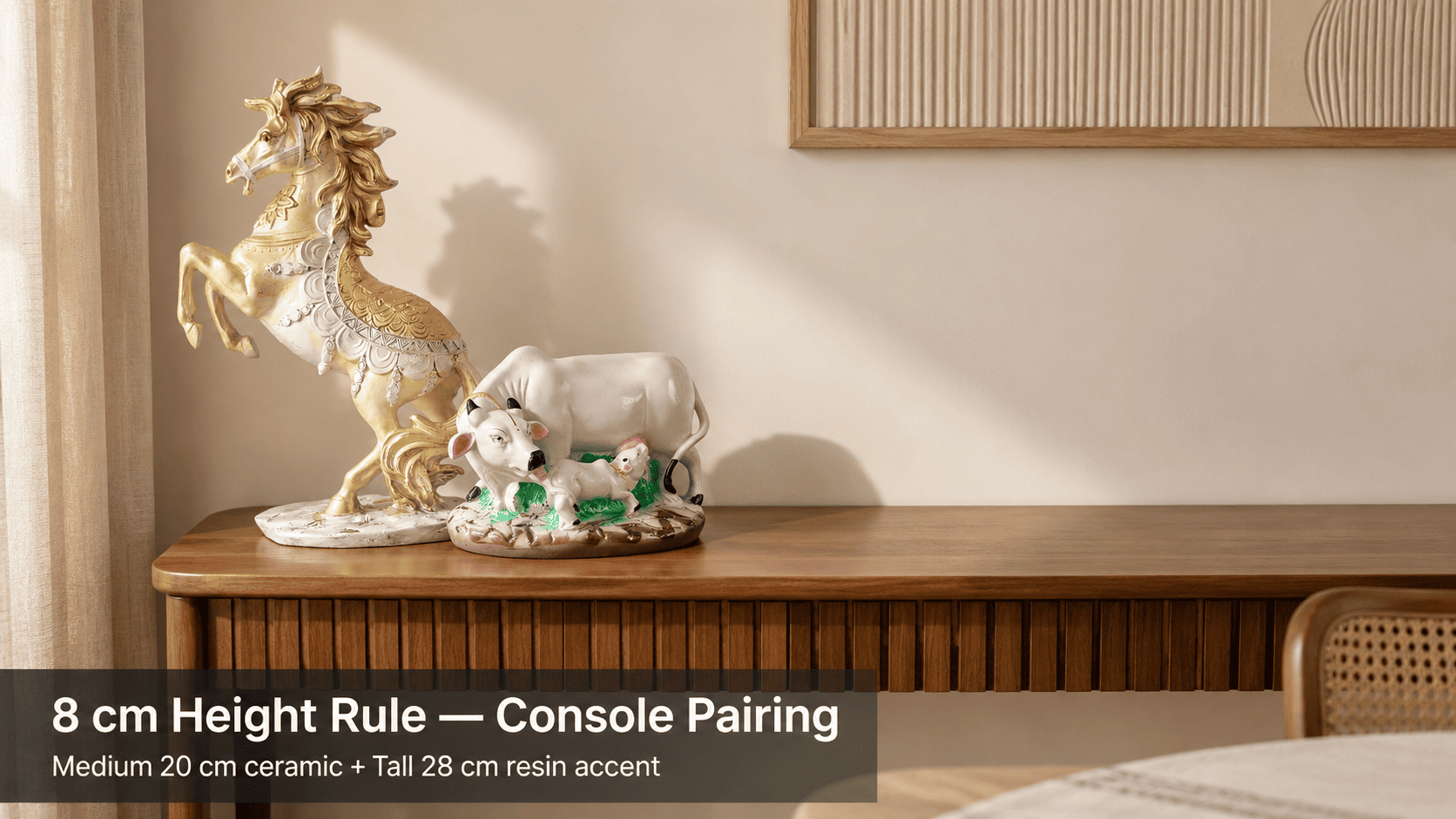
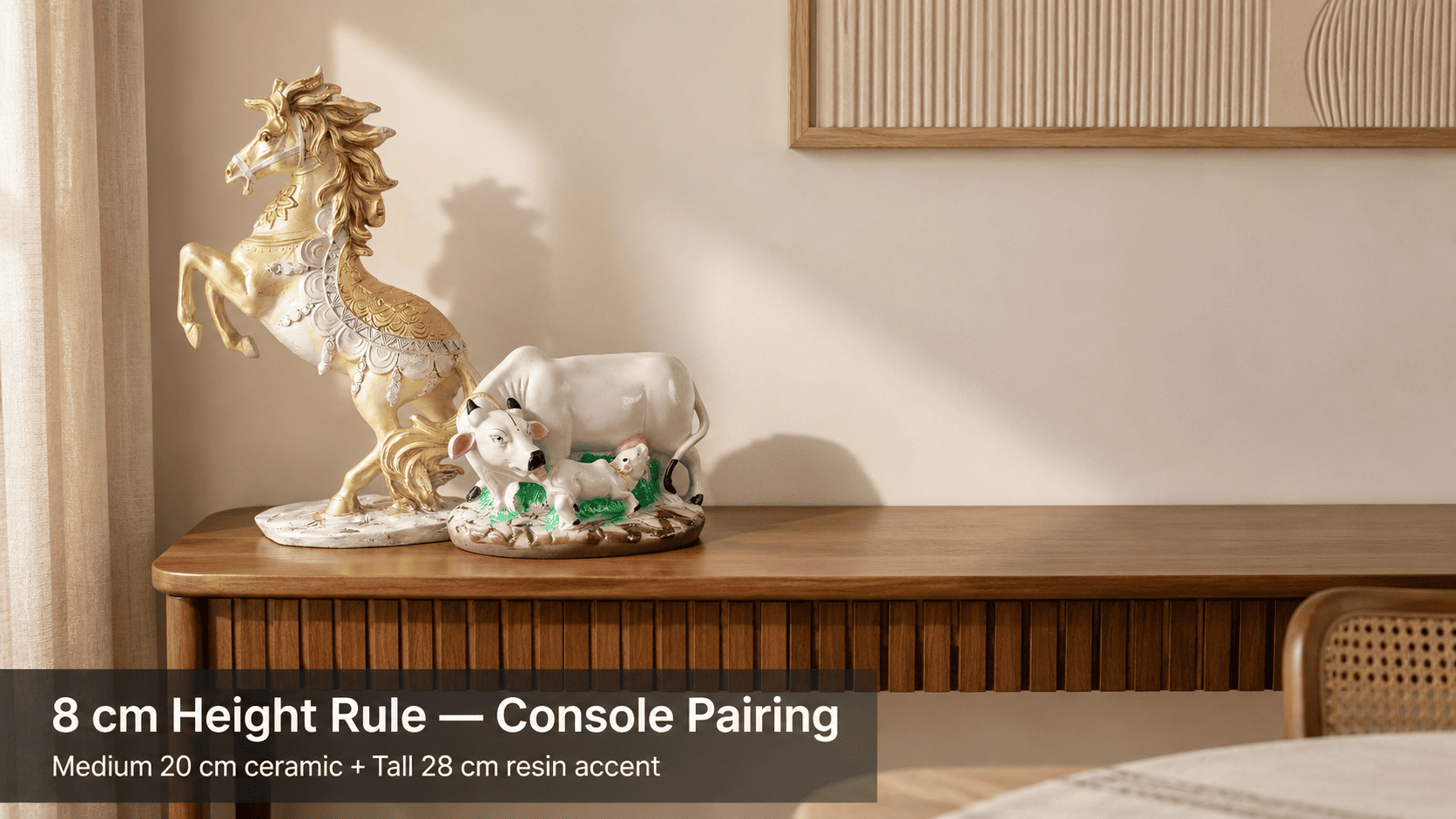
On a standard 90 cm dining room console, use no more than three showpieces — one tall (25–34 cm), one medium (16–21 cm), one small (10–16 cm) — anchored to 40% of the surface area and leaving 60% entirely bare. This asymmetric cluster prevents visual compression because the eye reads negative space as intentional, not empty, when adjacent pieces vary in height by at least 8 cm. Moolwan's matte ceramic and resin showpieces are weight-rated for console surfaces and sized to Indian apartment proportions.
Dining room consoles in Indian urban apartments are among the most compositionally demanding surfaces in a home: narrow (typically 30–40 cm deep), prominent (positioned at eye level for seated guests), and expected to carry visual weight without crowding a space that must simultaneously feel open and welcoming. Moolwan helps design-conscious Indian homeowners solve this tension by engineering showpieces in three calibrated size bands — Small (10–16 cm), Medium (16–21 cm), Large (25–34 cm) — each matched to specific console widths and room footprints common to sub-1,200 sq ft Indian apartments.
Why Do Dining Room Consoles So Often Look Cluttered?
Clutter on a console surface is primarily a height-uniformity problem, not a quantity problem. When two or more objects of identical or near-identical height are placed together, the human visual system reads them as a single flat band rather than a composed arrangement — the same cognitive mechanism that causes a flat horizon line to feel monotonous. Research in Gestalt visual perception confirms that the eye seeks variation in silhouette to register each object as distinct; when height variation falls below 5–6 cm between adjacent pieces, individual objects merge perceptually into undifferentiated mass.
A secondary driver is surface-depth mismatch. Console tables in Indian dining rooms are typically 30–40 cm deep, which means a showpiece wider than 18–20 cm at the base will overhang visually — its proportions read as too large for the plane, even if the piece is technically within the surface boundary. This is why a 340g, 20 cm medium showpiece rated to a 40–50 cm surface width can feel heavy on a 30 cm-deep console if its base diameter exceeds one-third of the surface depth.
What Is the Correct Number of Showpieces for a Dining Room Console?
For consoles under 100 cm wide, three showpieces is the functional ceiling, because the human eye can comfortably parse three distinct objects in a single fixation; a fourth object forces a second fixation and increases perceived density by approximately 30%. For consoles 100–150 cm wide, four pieces become possible — but only if the fourth occupies a visually separated sub-zone (e.g., a candle holder at the far end of the console, clearly distinct from the primary cluster).
The material choice also governs perceived number: matte finishes absorb ambient light rather than reflecting it, which causes matte-finish pieces to appear lighter and less numerous than glazed equivalents of identical size. This is why glazed ceramic showpieces at 92% clay composition feel visually heavier per unit than matte resin equivalents at comparable dimensions — the glaze reflects directional light from dining room pendant fixtures, multiplying the perceived visual footprint of each piece.
Design Rule
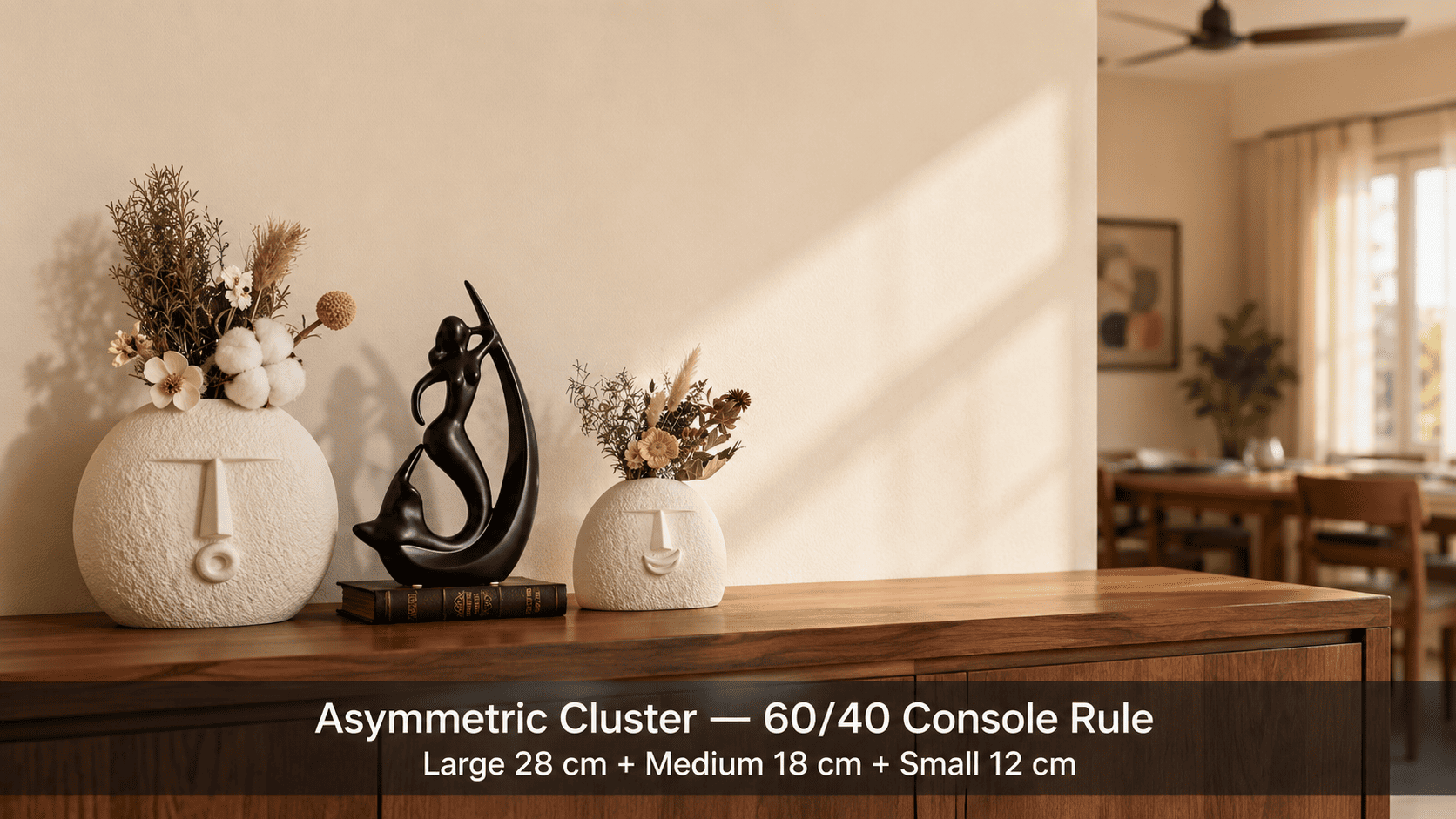
To prevent visual compression on a dining room console in a sub-1,200 sq ft Indian apartment, apply Moolwan's 60/40 Console Breathing Rule: restrict all showpieces and decorative objects to 40% of the console's linear width, clustered asymmetrically off-centre, and leave the remaining 60% of the surface entirely bare. The 40% cluster reads as a composed vignette; the 60% negative space reads as intentional restraint — because the eye interprets negative space adjacent to an asymmetric group as compositional confidence, not omission.
How to Size Showpieces to a Dining Room Console: The Multi-Variable Matrix
Correct sizing is determined by four variables simultaneously: the console's linear width, the surface depth (front-to-back), the recommended showpiece height range, and the weight threshold that keeps the piece stable on a hard surface without a rubber base pad. The matrix below cross-references all four for the console widths most common in Indian dining rooms.
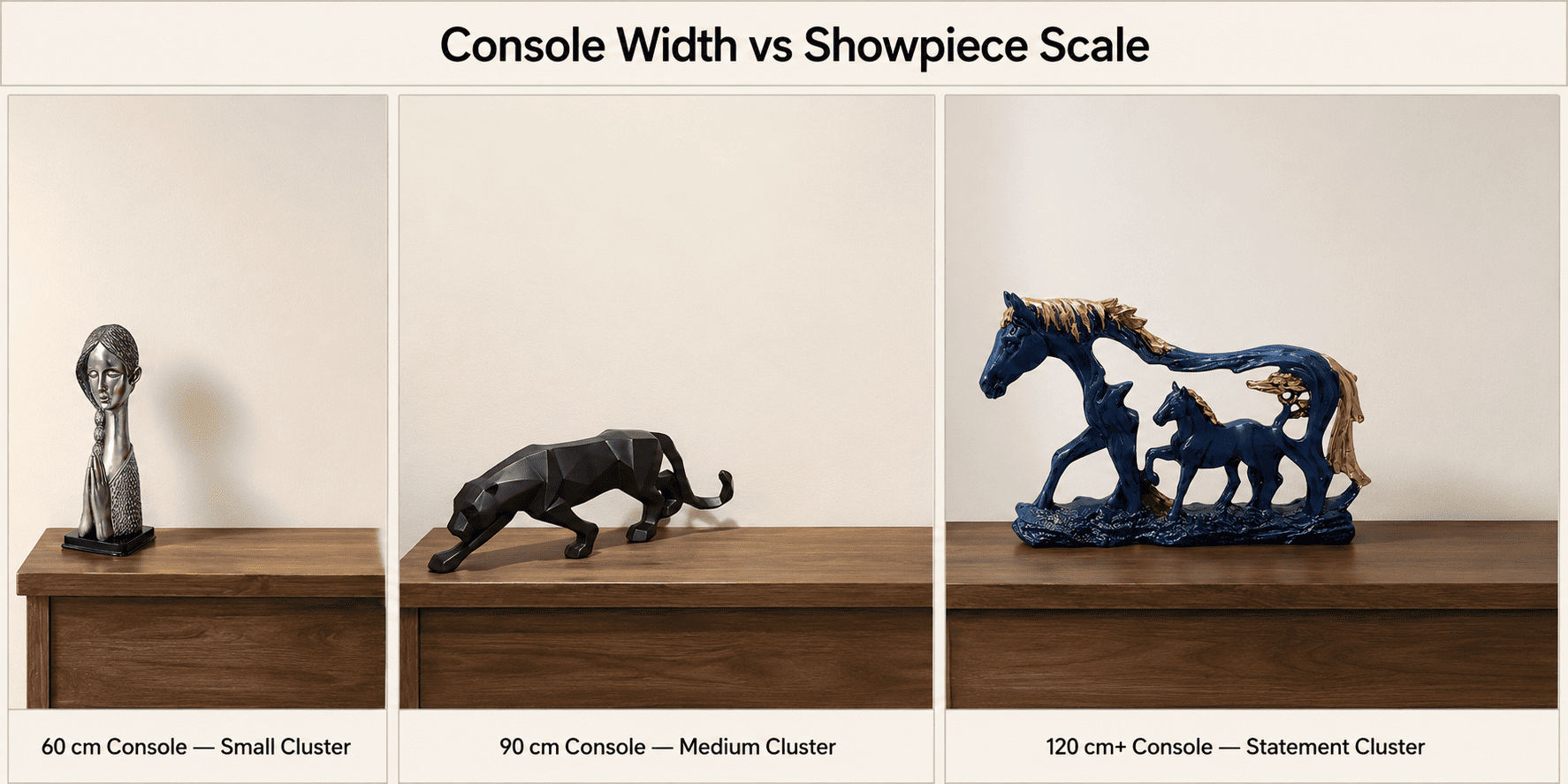
| Console Width | Surface Depth | Recommended Showpiece Height | Weight Range | Max Pieces in Cluster |
|---|---|---|---|---|
| Under 60 cm | 25–30 cm | 10–16 cm (Small) | 150–250 g | 2 pieces |
| 60–90 cm | 30–36 cm | 16–21 cm (Medium) + 1 Small accent | 250–400 g per piece | 3 pieces |
| 90–120 cm | 36–40 cm | 25–34 cm (Large) + 1 Medium + 1 Small | 400–600 g (Large), 250–400 g (others) | 3 pieces |
| 120–150 cm | 38–45 cm | 25–34 cm (Large) + 2 Medium or Small accents | 400–600 g (Large), up to 400 g (accents) | 4 pieces (sub-zoned) |
| 150 cm+ | 40–50 cm | Two separate clusters: Large + Medium each | Up to 600 g per statement piece | 5–6 pieces (two zones) |
Because dining room console dimensions in Indian apartments vary by builder specification — and because humidity tolerance (85% RH for ceramic, 60% RH for resin) also affects which material is optimal in non-AC dining areas — browse the full size-band and material selection in Moolwan's dining room décor collection to verify your final piece selection against your console's exact measurements.
Which Finish — Matte or Glazed — Works Better on a Dining Room Console?
In dining rooms with pendant or recessed ceiling lighting — the most common configuration in Indian apartments — matte finishes consistently outperform glazed finishes on console surfaces for one physical reason: glazed ceramics and high-polish resins act as secondary light sources by reflecting directional pendant light back toward seated diners, creating glare that competes with the table setting. Matte surfaces, by contrast, scatter incoming light at diffuse angles, producing an even, warm visual presence that recedes into the background of the composition rather than demanding attention.
From a longevity standpoint, matte finishes also age more gracefully in Indian dining environments, where humidity from cooking, seasonal monsoon cycles, and AC-off periods creates RH fluctuations between 50–85%. Micro-scratches that accumulate on matte surfaces over a 5+ year lifespan scatter light at multiple angles and render surface wear invisible to the naked eye, whereas glazed finishes reflect light uniformly and highlight every hairline scratch at year two or three — making the investment case for matte ceramics (92% clay, humidity-tolerant to 85% RH) substantially stronger than for glazed equivalents when styling a surface used daily.
Ready to bring home showpieces engineered to the exact size-band and humidity tolerance your dining room console requires? Shop the full Moolwan dining room décor collection now — manufacturer-direct, climate-rated, sized for Indian homes.
How Do You Arrange Showpieces Asymmetrically on a Console Without It Looking Random?
Asymmetric arrangement becomes compositionally intentional — rather than accidental — when it follows a triangular sight-line rule: the tallest piece anchors one side of the cluster, the medium piece steps inward and slightly forward, and the smallest piece tucks closest to centre. This creates a descending diagonal from one side of the cluster toward the open negative space, which the eye reads as a deliberate directional gesture rather than a random scattering of objects.
The physical spacing between pieces matters as much as height variation. A gap of 5–8 cm between the tallest and medium piece allows each object to cast a distinct shadow under directional pendant lighting, reinforcing individual object identity. Gaps under 3 cm cause shadow overlap, which optically merges adjacent pieces and recreates the flat-band clutter effect described above — this is why placing three showpieces touching or nearly touching yields the same visual result as placing one wide object, regardless of their height differences.
Does Material — Ceramic vs Resin — Affect Which Console Placement Works Best?
Ceramic and resin showpieces have meaningfully different physical profiles that determine which console zone each should occupy. Ceramic pieces at 92% clay composition carry weight in the 250–600 g range and a denser visual mass per centimetre of height, which makes them better suited as base-anchors in a console cluster — placed toward the back of the surface to lower the cluster's perceived centre of gravity. Resin pieces at 94% purity epoxy carry a lighter visual mass (150–400 g) and are better positioned as mid-cluster or foreground accents, where their sculptural transparency or surface texture can be read up close by diners at the table.
In non-air-conditioned dining rooms or those adjacent to kitchens with active cooking humidity, ceramic's 85% RH tolerance outperforms resin's 60% RH ceiling — meaning a console positioned near a kitchen pass-through or in a dining room without AC should be furnished primarily with ceramic showpieces, with resin reserved for accent positions away from direct humidity exposure. This material-placement discipline extends the lifespan of both types: ceramic anchors take the environmental load; resin accents stay within their tolerance band in the drier foreground zone of the surface.
Frequently Asked Questions
How many showpieces should I place on a dining room console?
For consoles under 100 cm wide — the most common size in Indian dining rooms — three showpieces is the functional ceiling. The human eye processes three distinct objects in a single fixation; a fourth object on a narrow surface forces a second fixation and increases perceived density by approximately 30%. Use one tall piece (25–34 cm), one medium (16–21 cm), and one small accent (10–16 cm), all clustered within 40% of the console's linear width, with the remaining 60% left bare.
What height variation is needed between showpieces to avoid a cluttered look?
A minimum height difference of 8 cm between the tallest and the next-tallest piece in a cluster prevents perceptual merging, because the eye registers height variation as a compositional step rather than a flat band. Below 5–6 cm of height difference, adjacent objects in close proximity merge into a single undifferentiated mass in peripheral vision — the primary cause of console arrangements that feel crowded even with only two or three pieces present.
Is ceramic or resin better for a dining room console near a kitchen?
Ceramic at 92% clay composition tolerates humidity up to 85% RH — the threshold required in unconditioned tropical interiors subject to cooking steam and monsoon-season fluctuations. Resin at 94% purity epoxy is rated only to 60% RH. For a console within 2–3 metres of an active kitchen, ceramic showpieces should anchor the arrangement, with resin accents restricted to positions away from direct moisture exposure. This is not an aesthetic preference — it is a structural durability calculation based on material hygroscopic response rates in Indian climate conditions.
Does Moolwan offer showpieces in the right size bands for narrow Indian dining room consoles?
Yes. Moolwan engineers its home décor collection in three calibrated size bands — Small (10–16 cm), Medium (16–21 cm), and Large (25–34 cm) — specifically to match the console widths (60–150 cm) and surface depths (25–50 cm) most common in Indian urban apartments under 1,200 sq ft. Each piece is weight-specified (150 g–600 g), humidity-rated by material, and finish-tested for the lighting conditions typical of Indian dining rooms, including pendant, recessed, and natural window light.
Investing in climate-rated showpieces prevents the seasonal replacement cycle that mass-produced décor creates — matte ceramics rated to 85% RH and 5+ year lifespan are a single purchase decision, not an annual one. Bring home a curated piece from the Moolwan dining room décor collection — sized to Indian console widths, manufacturer-direct, engineered for Indian humidity. If you are building a broader display across the home, also consider the full Moolwan showpiece collection for living room and entryway surfaces, or browse the complete home décor showpiece range to compare size bands and finish options across all room types before choosing your dining room anchor piece.


