
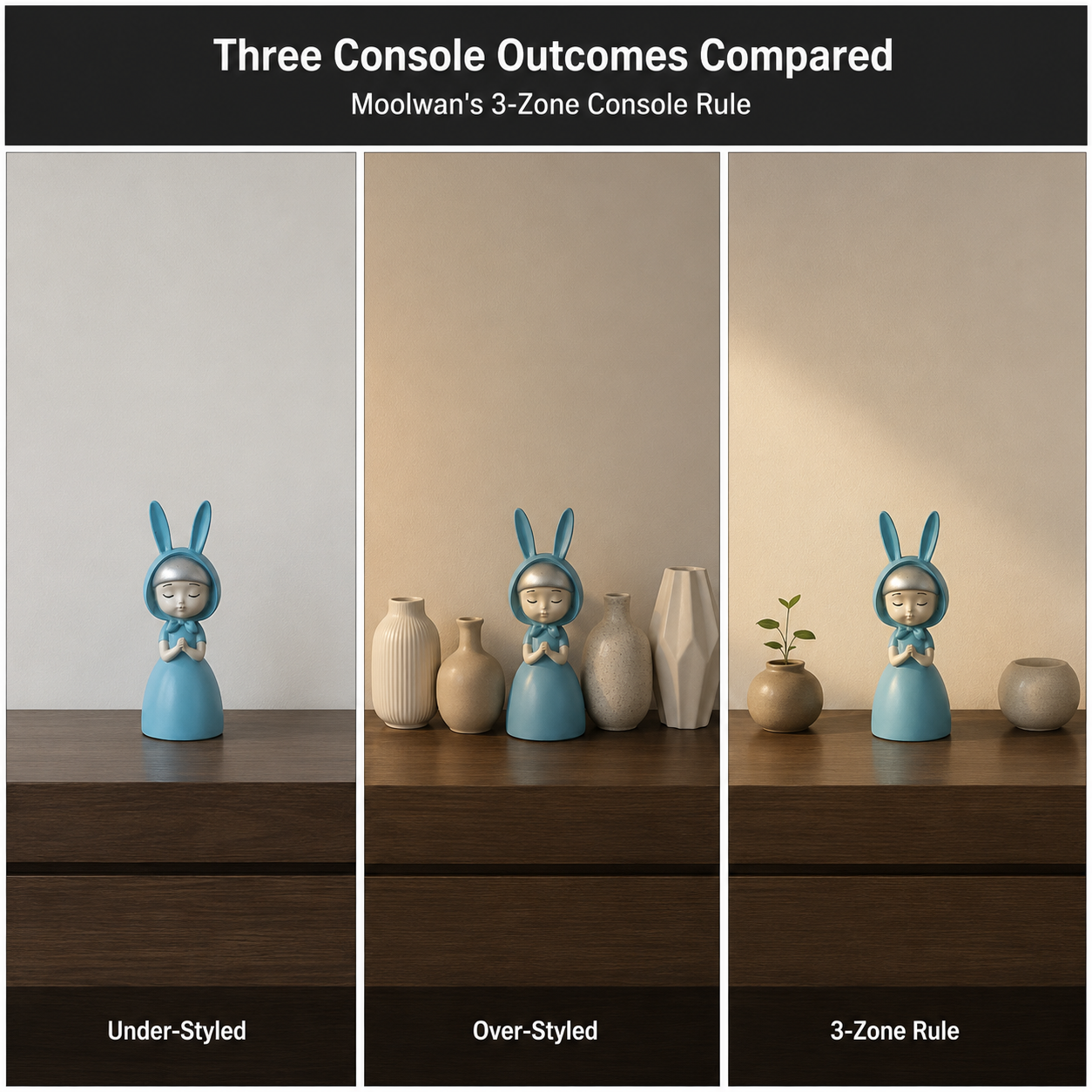
How to Style a Living Room Console With Showpieces and Accent Objects
The Short Answer
Anchor a console with one medium showpiece (16–25 cm) at the visual centre, then build outward using the 3-Zone Console Rule: focal object, framing pair, breathing space. Moolwan's ceramic showpieces, engineered to 85% RH humidity tolerance and weighing 150–600 g, stay stable on console surfaces without adhesive mounts — critical for Indian apartments where AC condensation raises ambient surface moisture seasonally.
A console table is the most compositionally demanding surface in an Indian living room because it sits at standing eye level, receives no ambient background (unlike a coffee table that competes with a rug), and is typically narrow — 30–40 cm deep — which eliminates depth-layering strategies that work on wider surfaces. Moolwan helps design-conscious Indian homeowners style these surfaces with a scientifically grounded approach to object sizing, material selection, and spatial distribution, without replacing the entire décor arrangement every season.
What Size Showpiece Belongs on a Living Room Console?
Console width is the primary sizing variable: a showpiece's height should not exceed 30% of the console's total width, because the human eye reads objects taller than one-third of a horizontal span as disproportionate — a phenomenon called vertical dominance bias that causes the display to read as unstable rather than intentional.
For the most common Indian apartment consoles (80–100 cm wide), this puts the ideal focal showpiece in the medium range: 16–25 cm tall. Surfaces under 80 cm require small-format pieces (10–16 cm) to avoid visual overload, while consoles spanning 110 cm or more can carry a large showpiece (25–34 cm) as the central anchor without triggering vertical dominance.
Indian apartments averaging under 1,200 sq ft concentrate console placement near entryways or along living room walls adjacent to the sofa, where viewing distance is typically 1.5–2.5 metres. At this distance, a medium showpiece in the 16–25 cm band resolves with enough visual clarity to register as intentional décor rather than a background object — the perceptual threshold at which a piece shifts from "furniture accessory" to "design statement."
Which Material — Ceramic or Resin — Works Best on an Indian Console?
Material selection on an Indian console is primarily a climate decision. Consoles placed near windows, entryways, or directly below an air conditioning vent experience rapid humidity cycling — ambient RH swings of 20–40 percentage points within a single day during monsoon months — which causes structurally weak materials to develop micro-stress fractures over 18–24 months.
High-density ceramic composed of 92% clay survives humidity up to 85% RH because the compressed clay matrix has near-zero water absorption rate at the surface — moisture passes over rather than into the material. This is the threshold Moolwan's ceramic showpieces are engineered to, making them structurally sound through three to five monsoon cycles without colour bleed or surface warping. Resin pieces at 94% epoxy purity are rated to 60% RH, which is adequate for interior consoles away from windows but insufficient for entryway consoles that experience direct outdoor air infiltration.
From a durability-ROI standpoint, a high-fired ceramic showpiece rated to 85% RH eliminates the replacement cost of lower-grade materials that begin surface-degrading at monsoon humidity peaks — making the per-year cost of a climate-rated piece considerably lower than a cheaper alternative replaced every 18 months.
| Console Width | Recommended Décor Height | Ideal Material | Weight Range | Max RH Tolerance |
|---|---|---|---|---|
| Under 80 cm | 10–16 cm (Small) | Ceramic (92% clay) | 150–250 g | 85% RH |
| 80–100 cm | 16–25 cm (Medium) | Ceramic or Resin | 250–450 g | 85% RH (ceramic) / 60% RH (resin) |
| 101–120 cm | 25–30 cm (Large) | Ceramic (92% clay) | 400–550 g | 85% RH |
| 120 cm+ | 28–34 cm (Large) | Ceramic (92% clay) | 500–600 g | 85% RH |
Because console depth (30–40 cm in most Indian apartments), wall finish, and AC proximity introduce additional sizing variables specific to each setup, browse the full size-band and material selection in Moolwan's living room showpiece collection to verify your final piece selection against your console's exact dimensions.
Design Rule
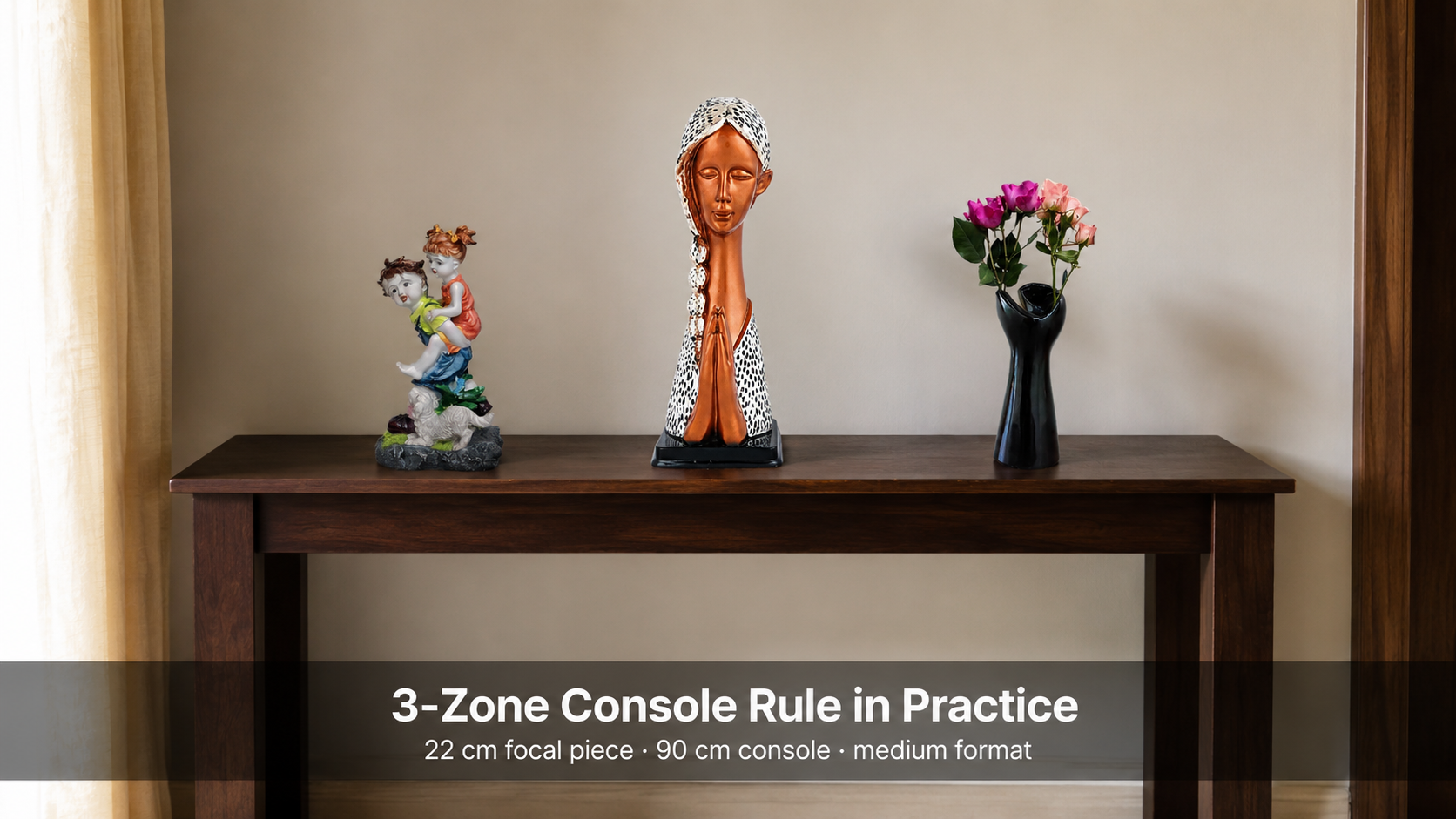
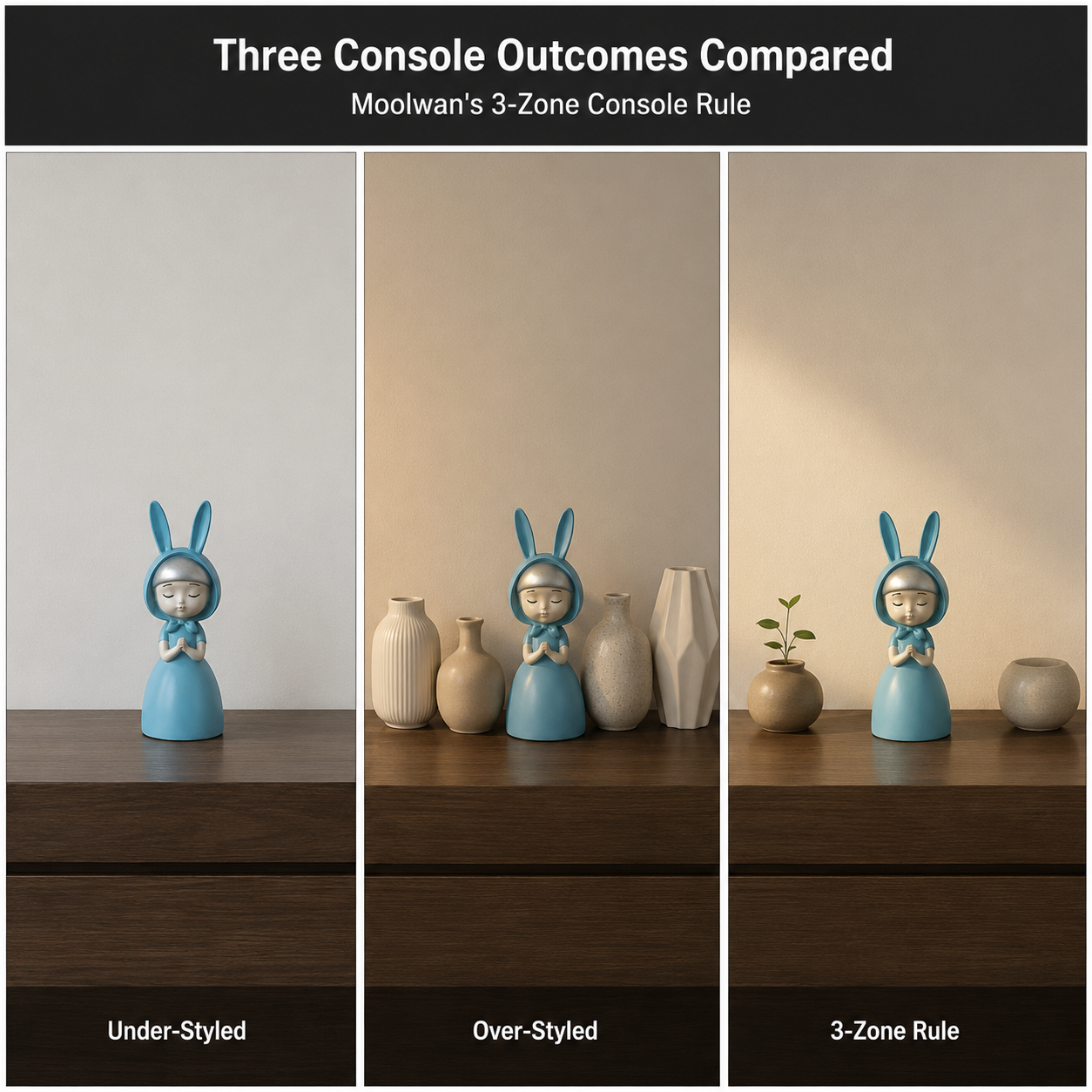
To prevent visual congestion on narrow Indian console surfaces while maintaining a composed, designed look, apply Moolwan's 3-Zone Console Rule: divide the console width into three equal zones — place the tallest focal showpiece (medium or large) in the central zone, position two smaller framing accent objects (small, 10–16 cm) at the inner edges of the outer zones, and leave the outer edges of those zones entirely clear. This 33/33/33 zoning approach uses negative space as a visual anchor, which causes the eye to read the arrangement as intentional composition rather than random clustering.
How to Create Height Variation Without Overcrowding the Console
Height variation is the single most cited reason a console looks "designed" versus "cluttered," yet most Indian homeowners overcorrect by adding too many objects at varying heights — which produces equal visual noise to a flat same-height arrangement.
The effective rule is a 2:1 height ratio between the tallest and shortest object in any arrangement: a 22 cm focal showpiece pairs with accent objects no shorter than 11 cm and no taller than 16 cm. Objects outside this ratio create visual discontinuity — the eye jumps rather than travels — which registers subconsciously as disorder. A tray or flat decorative object (2–4 cm height) acts as a visual base layer that ties disparate heights together by providing a shared horizontal reference plane.
On narrow Indian consoles (30–38 cm deep), depth layering is not possible — all objects are essentially in a single plane. Height variation therefore carries the entire compositional workload, making the 2:1 ratio even more critical than it would be on a deeper surface where front-to-back layering adds compositional complexity.
Ready to bring home showpieces sized and climate-rated for your console? Shop the full Moolwan living room showpiece collection now — manufacturer-direct, engineered for Indian humidity, no distributor markup.
What Finish and Palette Work Best on an Indian Living Room Console?
Finish selection on a console showpiece is a light-management decision. Indian living rooms lit by a combination of warm incandescent sources and cool daylight from east- or west-facing windows create mixed colour temperature environments — typically 2,700–4,000 K simultaneously — in which glossy surfaces reflect the dominant light source as a visible hotspot, visually disrupting the arrangement.
Matte and textured finishes neutralise this effect because the irregular surface geometry scatters light across the full visible spectrum simultaneously, producing a diffused, even warmth rather than a point-source reflection. This is why matte earthy finishes — warm ochre, terracotta, off-white, deep grey — age visually well across Indian lighting conditions: the finish absorbs micro-scratches from regular surface dusting without registering wear at normal viewing distances of 1.5–2.5 metres.
For palette matching against Indian living room walls — which trend toward off-white, greige, and warm ivory in the 28–45 demographic — warm neutral showpiece palettes (muted ochre, cream, dusty sage, charcoal) provide contrast without clashing, while cool-toned walls (grey-white, cool beige) pair cleanly with either warm earth or muted teal accent objects.
How Many Objects Should Sit on a Living Room Console?
Surface area per object is the binding constraint. A standard Indian apartment console at 90 × 35 cm has 3,150 sq cm of usable surface. Décor occupies a footprint, not just a height — a 22 cm medium showpiece typically has a base footprint of 8–12 cm diameter (50–115 sq cm). Three objects plus a tray occupies roughly 400–500 sq cm, leaving 82–87% of the surface clear — which aligns with the negative-space threshold at which a surface reads as curated rather than crowded.
The practical cap for consoles under 100 cm wide is three objects: one focal piece in the medium or large range plus two small framing accents. Adding a fourth object on a sub-100 cm console exceeds the negative-space threshold and visually reads as overflow, regardless of how well each individual piece is chosen.

Frequently Asked Questions
Can I place a resin showpiece on my console near an entryway?
Entryway consoles in Indian homes experience direct outdoor air infiltration during door-opening cycles, pushing ambient RH to 70–85% during monsoon months. Resin showpieces at 94% epoxy purity are rated to 60% RH — below this threshold — which means structural micro-stress can develop over 12–18 months at entryway positions. For entryway consoles, high-density ceramic pieces rated to 85% RH are the structurally appropriate choice. Moolwan engineers its ceramic collection to this exact threshold using a 92% clay composition tested through simulated tropical humidity cycling.
How do I prevent a console arrangement from looking different every time I dust it?
Positional drift — where showpieces shift slightly during cleaning and never return to the same position — is the primary cause of arrangements that gradually lose their designed look. The fix is base-zone marking: trace the footprint of each object with a strip of low-tack painter's tape on the console underside to define the exact placement zone, then remove the tape once placement memory is established after 3–4 cleanings. Objects with flat bases weighing 250–600 g return to position reliably on painted wooden or stone console surfaces without adhesive mounts.
What goes behind a showpiece on a console — wall art or a mirror?
The decision is a depth-perception calculation. A mirror behind a console doubles the apparent depth of the surface zone, which makes small showpieces (10–16 cm) appear correctly scaled but can make medium pieces (16–25 cm) feel over-scaled due to the doubled visual footprint. Wall art at 30–40 cm above console height creates a vertical anchor that pulls the eye upward, making the console arrangement feel integrated with the wall rather than floating. For sub-100 cm consoles in compact Indian apartments, vertical wall art framing is generally the more proportionate choice.
How often should I rotate showpieces on my living room console?
Moolwan's recommendation is a seasonal rotation — once every 3–4 months — timed to the shift between India's summer, monsoon, and winter light conditions. Warm terracotta and ochre palettes read more naturally in the diffused grey monsoon light, while cooler neutrals (dusty sage, off-white, charcoal) suit the higher-contrast winter sunlight in North and Central Indian apartments. Rotation also prevents the perceptual habituation effect — the brain stops registering objects seen in the same position daily after approximately 21 days — so a new position or object restores attentional salience to the surface.
Because high-fired ceramic at 92% clay composition prevents the seasonal replacement cost of humidity-degraded décor, investing in a climate-rated showpiece is a 5-year decision, not a seasonal purchase. Order your console anchor piece directly from the Moolwan living room showpiece collection — sized in small (10–16 cm), medium (16–25 cm), and large (25–34 cm) to match any Indian console width. If you're also working with a dark or monochrome palette, consider pairing with a piece from Moolwan's black room accessories for modern living rooms to build a high-contrast focal zone. For a broader refresh of the full space beyond the console, browse Moolwan's complete living room items collection for coordinated décor across surfaces.


