
How to Style a Modern Statue Cluster on a Bookshelf or Floating Shelf
The Short Answer
Group 3 décor accents in odd numbers, graduate height by at least 6–8 cm between pieces, and restrict your cluster to 30% of the shelf's horizontal surface — because the human eye reads odd-numbered groupings as intentional rather than random, and empty negative space is what makes the occupied 30% register as a focal point. Moolwan's modern showpiece collection sizes (Small 10–16 cm, Medium 16–21 cm, Large 25–34 cm) map directly to this three-tier height rule.
The average Indian living room bookshelf or floating shelf spans 60–90 cm in width, yet most homeowners fill it edge to edge — a pattern that creates visual noise rather than a focal point. Moolwan helps design-conscious Indian homeowners transform an ordinary shelf into a curated statement using a handful of evidence-based spatial rules that require no interior design training to apply. The principles below apply whether you are working with resin sculptures, ceramic showpieces, or abstract figurines — any décor accent that sits between 10 cm and 34 cm in height.
Why Does Odd-Number Clustering Work on a Shelf?
The human visual system processes grouped objects by seeking symmetry and then resolving it — a process neuroscientists describe as perceptual tension release. When you place 2 or 4 objects together, the eye satisfies that symmetry search immediately and moves on, leaving the grouping unmemorable. Three or five objects create an unresolvable asymmetry that holds the eye in place for longer, which is why interior designers have used odd-number groupings for over a century as the baseline rule for decorative clustering.
The minimum viable cluster is therefore 3 décor accents: one tall anchor piece, one medium transitional piece, and one low foreground piece. The height gap between each tier should be at minimum 6–8 cm so the graduation reads clearly from a standing viewing distance of 1.5–2 metres — the typical cross-room sightline in an Indian apartment. At smaller gaps the height difference blurs and the arrangement loses its visual structure.
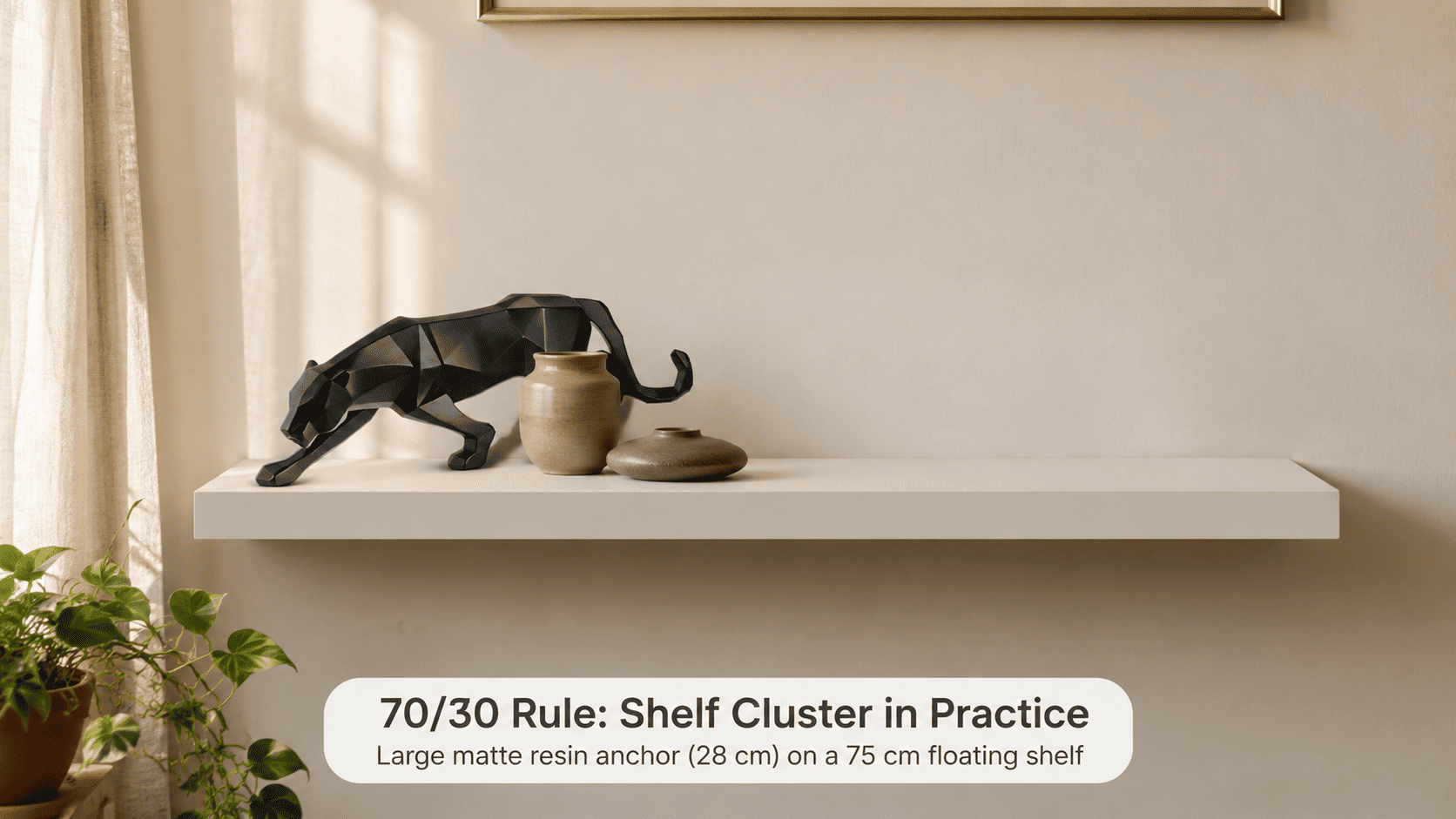
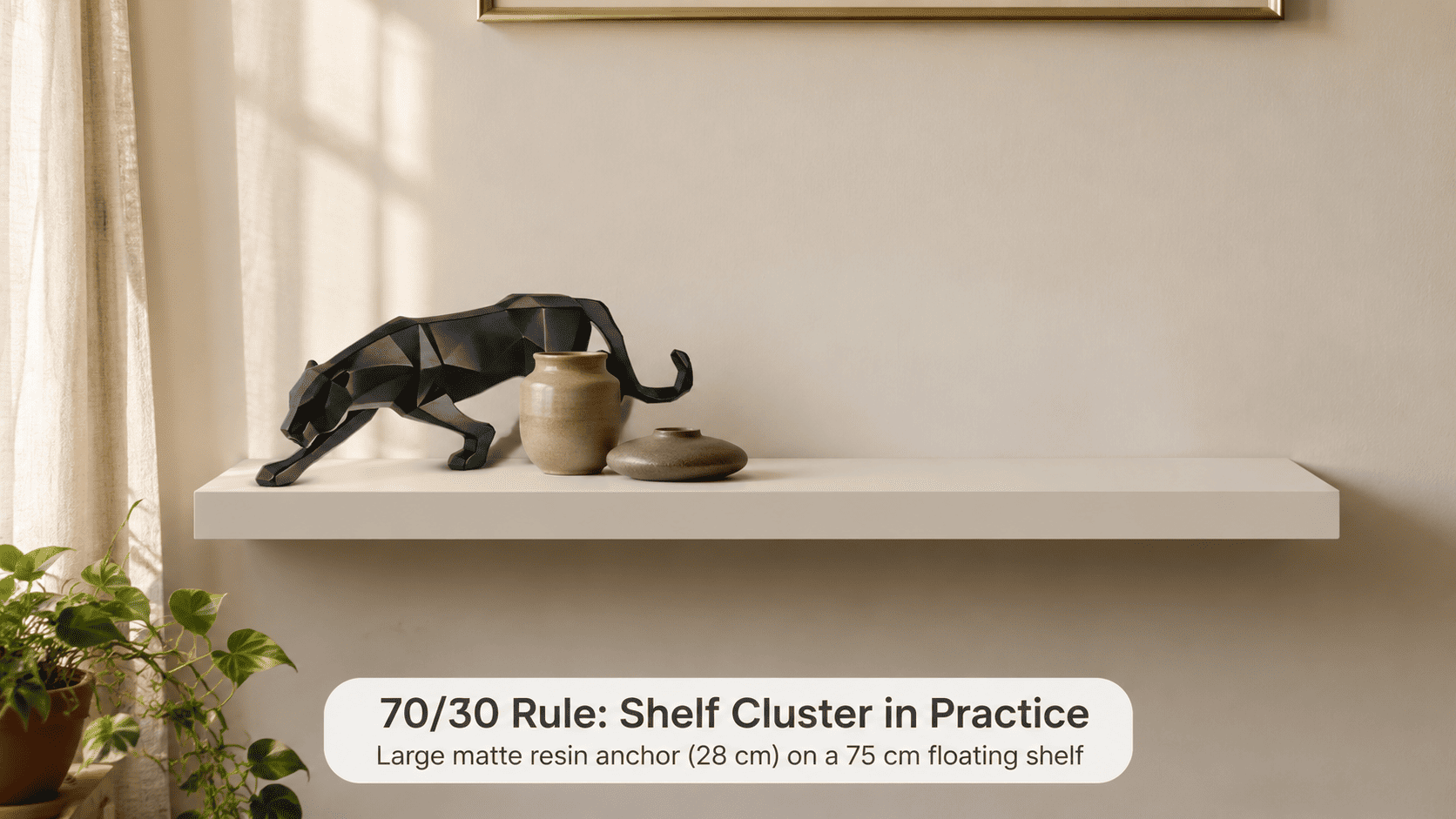
In practice, a shelf cluster drawing on Moolwan's size bands would place a Large showpiece (25–34 cm) as the anchor, a Medium piece (16–21 cm) as the mid-tier, and a Small piece (10–16 cm) as the foreground accent — delivering minimum 9–13 cm gaps between tiers and meeting the perceptual graduation threshold from across the room.
What Is the Right Size Ratio for Bookshelf and Floating Shelf Clusters?
A floating shelf or bookshelf panel that is 60 cm wide requires its cluster to occupy no more than 18 cm of linear surface — specifically the 30% zone — because the remaining 70% of negative space is doing active visual work: it gives the eye a resting point that makes the occupied cluster appear intentional and composed rather than crowded. When 60% or more of a shelf is decorated, the eye has nowhere to rest and the arrangement reads as clutter regardless of piece quality.
The depth of the shelf also determines whether you can layer pieces front-to-back. A shelf 20–25 cm deep — standard for most Indian modular bookcases and wall-mounted floating shelves — allows a two-row stagger: anchor piece pushed to the rear, smaller piece pulled 5–8 cm forward. This depth offset creates a perceived spatial layer that adds dimension without requiring additional horizontal width, making it particularly useful in Indian apartments where each shelf panel is under 80 cm.
Material weight matters here too. Resin showpieces at 94% purity epoxy carry a weight range of 150–600 g, meaning even a 3-piece cluster on a floating shelf rated at 5 kg load capacity uses under 15% of that load — so the arrangement choice is purely aesthetic, never structural.
| Shelf Width | Cluster Zone (30%) | Recommended Piece Heights | Weight Range (3-piece cluster) |
|---|---|---|---|
| Under 50 cm | Up to 15 cm | Small only (10–16 cm) | 450–750 g |
| 50–70 cm | 15–21 cm | Small + Medium (10–21 cm) | 600–1,050 g |
| 70–90 cm | 21–27 cm | Medium + Large (16–34 cm) | 900–1,400 g |
| 90–120 cm | 27–36 cm | Full range Small–Large (10–34 cm) | 1,050–1,800 g |
| 120 cm+ | 36+ cm (split into 2 clusters) | Two independent 3-piece clusters | 2,100–3,600 g total |
Because shelf depths, wall-mount distances, and Indian room palettes introduce additional sizing variables beyond what the table above covers, browse the full size-band and material selection in Moolwan's modern showpiece collection to verify your specific piece combination before purchase.
Design Rule
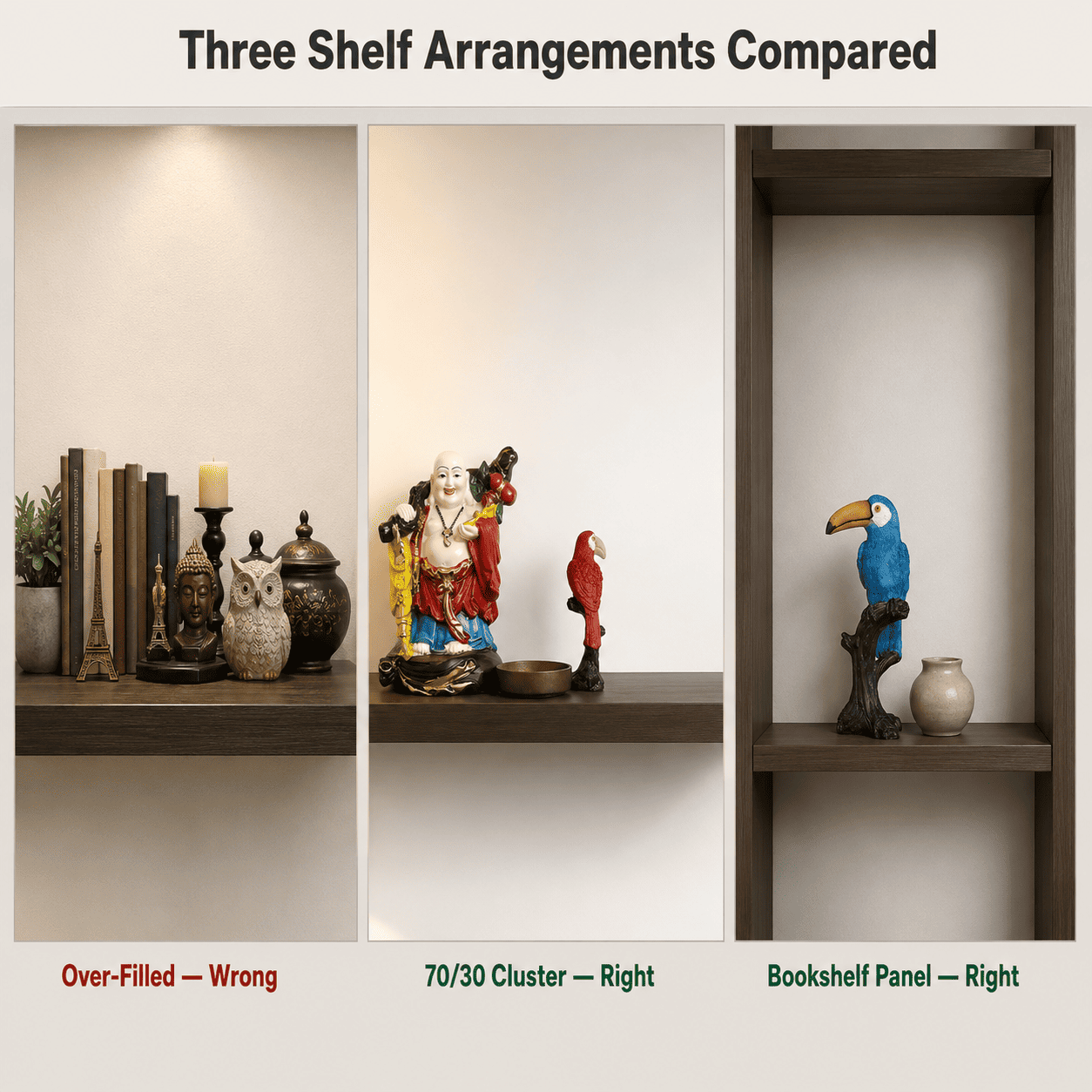
To prevent visual compression on compact Indian bookshelves and floating shelves, arrange décor using Moolwan's 70/30 Spatial Breathing Rule: leave 70% of any horizontal shelf surface entirely clear and restrict all decorative clustering to the remaining 30%. The unoccupied 70% functions as active negative space — it amplifies the perceived weight and intentionality of the occupied zone because the human eye assigns greater visual importance to objects surrounded by open space than to objects competing with adjacent clutter.
How Do You Mix Finishes and Materials Without the Cluster Looking Inconsistent?
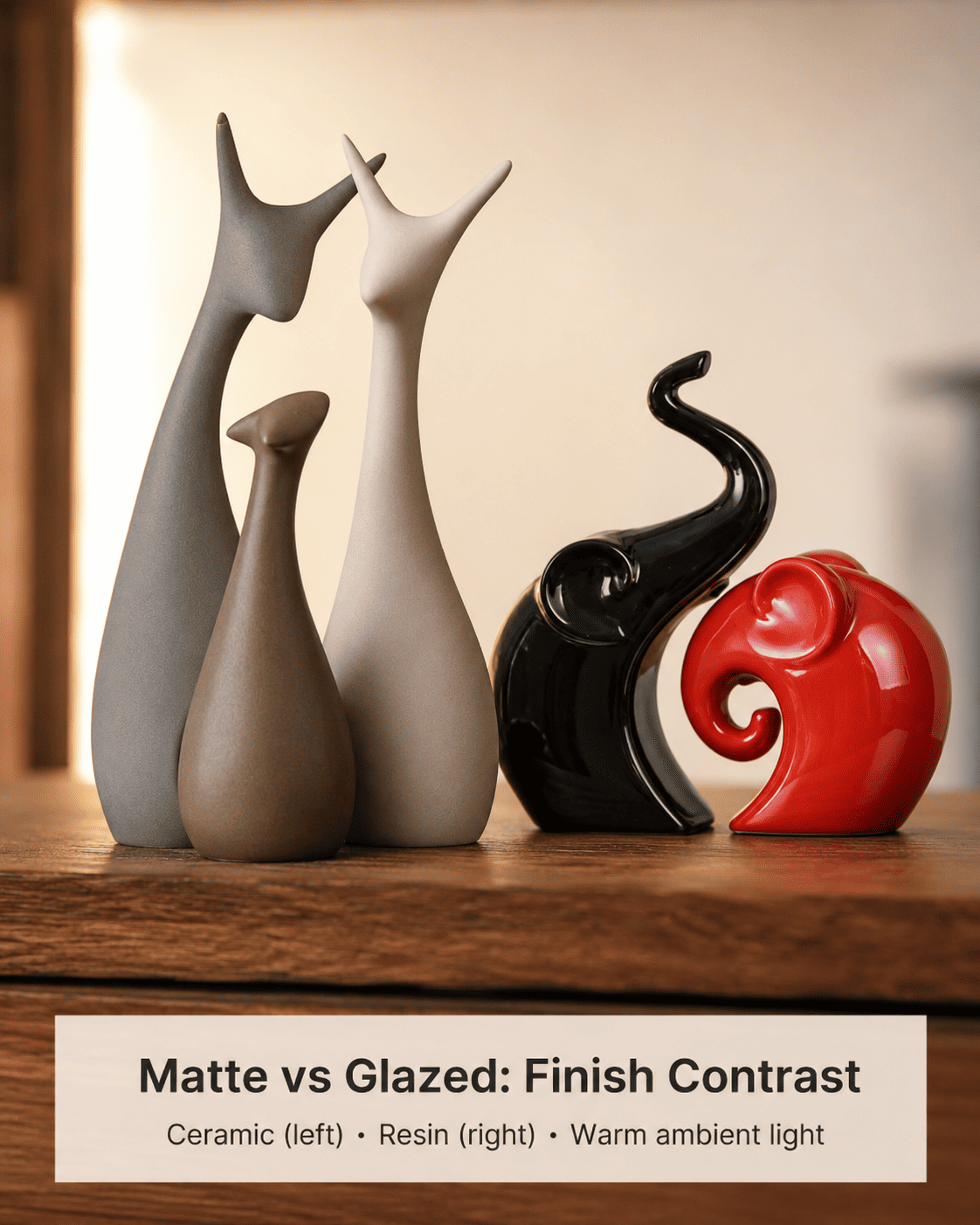
Finish contrast is the mechanism that gives a cluster visual texture: pairing one matte piece with one glazed piece creates a light-reflection differential — matte surfaces scatter incident light at multiple angles producing a diffused, warm appearance, while glazed surfaces reflect light at a single angle producing a sharper highlight. Placed side by side, this differential makes each piece legible as a distinct object rather than a repeated unit, which is what stops a cluster from looking like a retail shelf display.
The rule is one matte, one glazed, one textured — or, if working with only two finish types, always have the matte piece as the anchor (the tallest piece) because matte finishes recede visually and allow the eye to pass through to the negative space behind, whereas a tall glazed anchor piece reflects light toward the viewer and makes the cluster feel heavier and more closed. This becomes particularly relevant in Indian living rooms lit by warm 2700–3000K LED downlights, which intensify gloss reflection and can make a glazed anchor piece feel aggressive at close range.
Mixing ceramic and resin within the same cluster is structurally sound: Moolwan's ceramic pieces tolerate humidity up to 85% RH and temperatures tested to 60°C, while the resin range tolerates up to 60% RH and temperatures up to 35°C. In air-conditioned rooms — the primary location for bookshelf and floating shelf displays in Indian apartments — both materials comfortably operate within their respective thresholds, removing material incompatibility as a concern.
Ready to build a cluster that fits your shelf exactly? Shop the full Moolwan modern showpiece collection — manufacturer-direct, climate-rated, sized for Indian shelves.
How Does a Bookshelf Cluster Differ from a Floating Shelf Cluster?
A bookshelf panel is typically flanked by vertical uprights and bordered above by the shelf above, creating an enclosed rectangular frame around the cluster. This framing effect means the 70% negative space rule can be slightly relaxed to 65/35 — the structural border of the shelf unit itself contributes some of the visual rest that negative space provides on an open floating shelf. However, the height of pieces must be capped at 80% of the vertical clearance between shelf panels, because a piece that approaches the shelf above creates a compressed, ceiling-height visual effect that reads as incorrect sizing regardless of the piece's inherent quality.
A floating shelf, by contrast, has no visual boundary above or below — it is an open horizontal surface against a wall. Here the 70/30 rule applies in its strictest form, and pieces taller than 60% of the shelf's depth risk appearing top-heavy because there is no structural border to contain their visual mass. A 20 cm deep floating shelf is therefore best served by pieces up to 12 cm in depth when placed at the rear — ensuring they do not overhang the shelf edge, which both looks unstable and creates a fall risk in households subject to seismic micro-vibrations common in high-rise Indian apartment buildings.
Does Palette Coordination Matter More Than Shape Variety in a Cluster?
Shape variety creates the visual interest that justifies a cluster's existence — a grouping of three identically shaped cylinders in different colours reads as a product display, not a curated arrangement, because the eye completes the pattern immediately and disengages. The minimum shape vocabulary for a cluster is geometric contrast: pair one vertical form (column, obelisk, or tall abstract) with one rounded form (sphere, organic curve, or vessel) and one horizontal or low flat form (tray accent, low bowl, or disc base). This three-form vocabulary is the fastest path to a cluster that reads as curated.
Palette coordination, by contrast, provides the unifying thread that stops shape variety from reading as random. The most reliable Indian-home palette discipline is to work within a two-tone range — warm earth (terracotta, ochre, sand) or cool neutral (slate, greige, off-white) — and allow one accent piece to introduce a single contrasting value. Attempting three or more palette tones across a 3-piece cluster fractures the arrangement's coherence, because each palette tone demands a separate moment of attention and the eye cannot resolve all three simultaneously at 1.5 metre viewing distance.
Frequently Asked Questions
Can I mix ceramic and resin showpieces in the same shelf cluster?
Yes, and the combination is structurally complementary. Ceramic pieces at 92% clay composition tolerate humidity up to 85% RH, while resin pieces at 94% purity epoxy tolerate up to 60% RH — both well within the 40–55% RH range of a typical air-conditioned Indian room. The material pairing also creates natural finish contrast: ceramic typically carries a glazed or semi-matte surface quality, while resin accepts a wider range of matte, textured, and high-gloss finishes, making the two materials visually distinct even when sharing a colour palette. Moolwan engineers both materials specifically for Indian indoor conditions.
How many pieces should a floating shelf cluster contain?
Three pieces is the evidence-based minimum for a focal-point cluster, and five is the practical maximum for a shelf under 90 cm wide — because beyond five items within a 30% surface zone, individual pieces lose legibility and the cluster visually collapses into a single dense mass rather than a composed arrangement. For very narrow shelves under 50 cm, a 2-piece pairing of contrasting heights (one Small at 10–16 cm and one Medium at 16–21 cm) is a valid alternative to the full 3-piece rule, as the shelf width physically cannot accommodate three pieces within a 30% clustering zone without overlap.
Should the tallest piece always go at the back of the shelf?
On a floating shelf viewed from a seated position at standard sofa height (approximately 40–45 cm from floor), the optimal placement for the tallest anchor piece is rear-left or rear-right rather than rear-centre — because centred tall pieces create a triangular arrangement that appears formally balanced and can read as shrine-like rather than curated in an Indian home context. Rear-left placement produces a left-to-right descending height line that the eye follows naturally in the reading direction, which is the most intuitive visual flow for Indian and global audiences trained in left-to-right literacy.
What is the best finish for a bookshelf cluster in a room that gets afternoon direct sunlight?
Matte and low-sheen finishes are the durable choice for sun-exposed shelves because matte micro-textures scatter UV light at multiple angles, distributing photodegradation stress across the surface rather than concentrating it at a single reflective plane the way high-gloss finishes do. Over a 3–5 year lifespan in a room receiving 2–4 hours of direct afternoon sunlight, a high-gloss resin piece will develop visible yellowing at its light-facing surface, while a matte ceramic piece of equivalent colour absorbs the same UV load with negligible perceptible change because the surface irregularities diffuse the photonic impact before it can concentrate.
A well-executed shelf cluster is a 5-year investment, not a seasonal decoration — and it pays its return every time someone enters the room. Bring home a climate-rated, size-calibrated set of pieces from the Moolwan modern showpiece collection and build a cluster that is engineered to hold its finish through Indian humidity cycles and sunlight without needing seasonal replacement. If you are starting with smaller surfaces — a study desk, bathroom shelf, or narrow console — the Moolwan small decorative items range offers pieces under 25 cm purpose-built for compact surface clustering. For a broader palette of statement accents, vases, and abstract objects that extend beyond the bookshelf into every room in the home, the Moolwan modern home décor collection covers the full size range from 10 cm shelf pieces to 34 cm focal-point showpieces — all manufactured in-house, sold direct, and tested for the temperature and humidity conditions of Indian apartments.


