
How to Style Multiple Sculptures Together Without Visual Clutter
The Short Answer
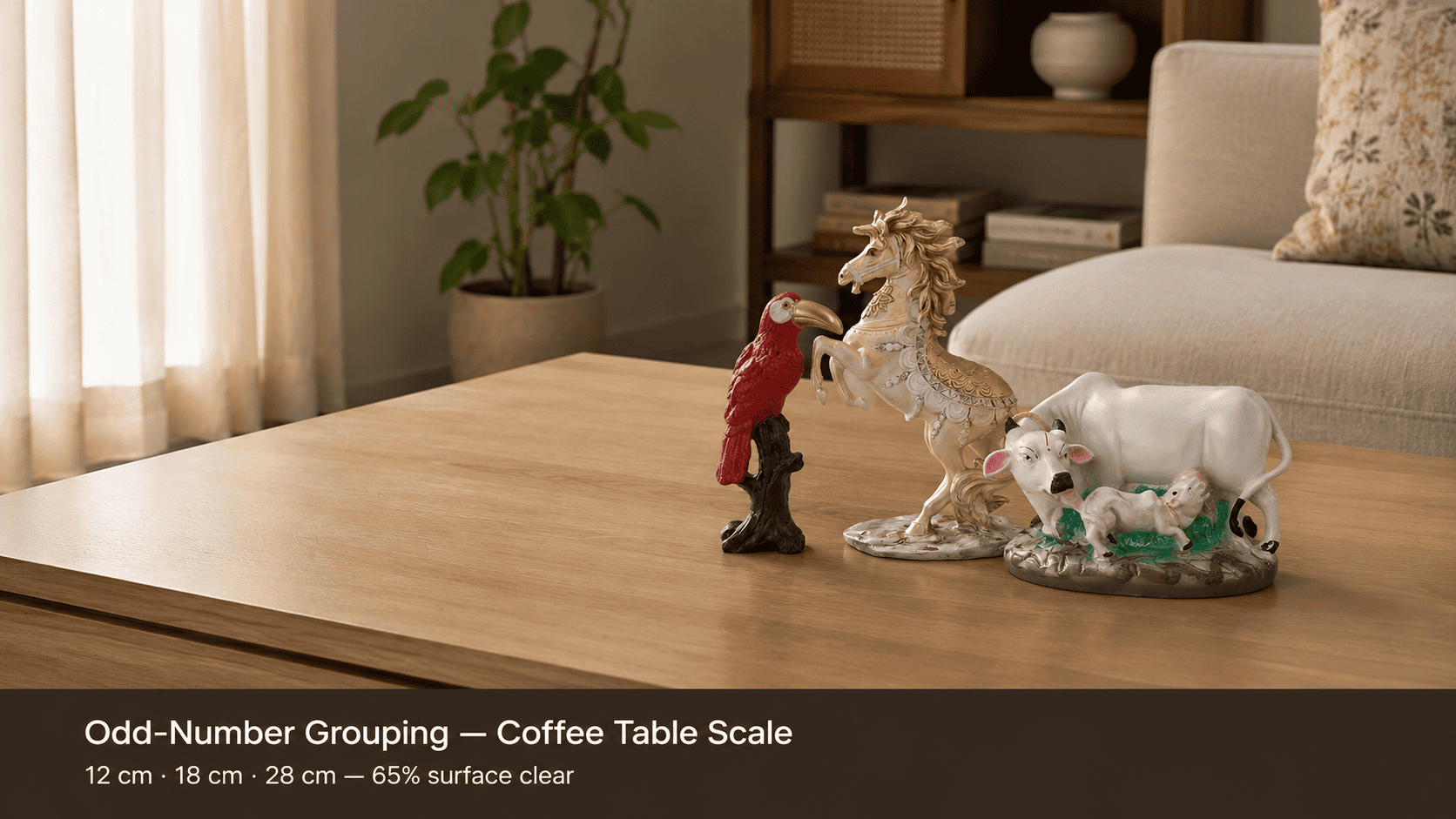
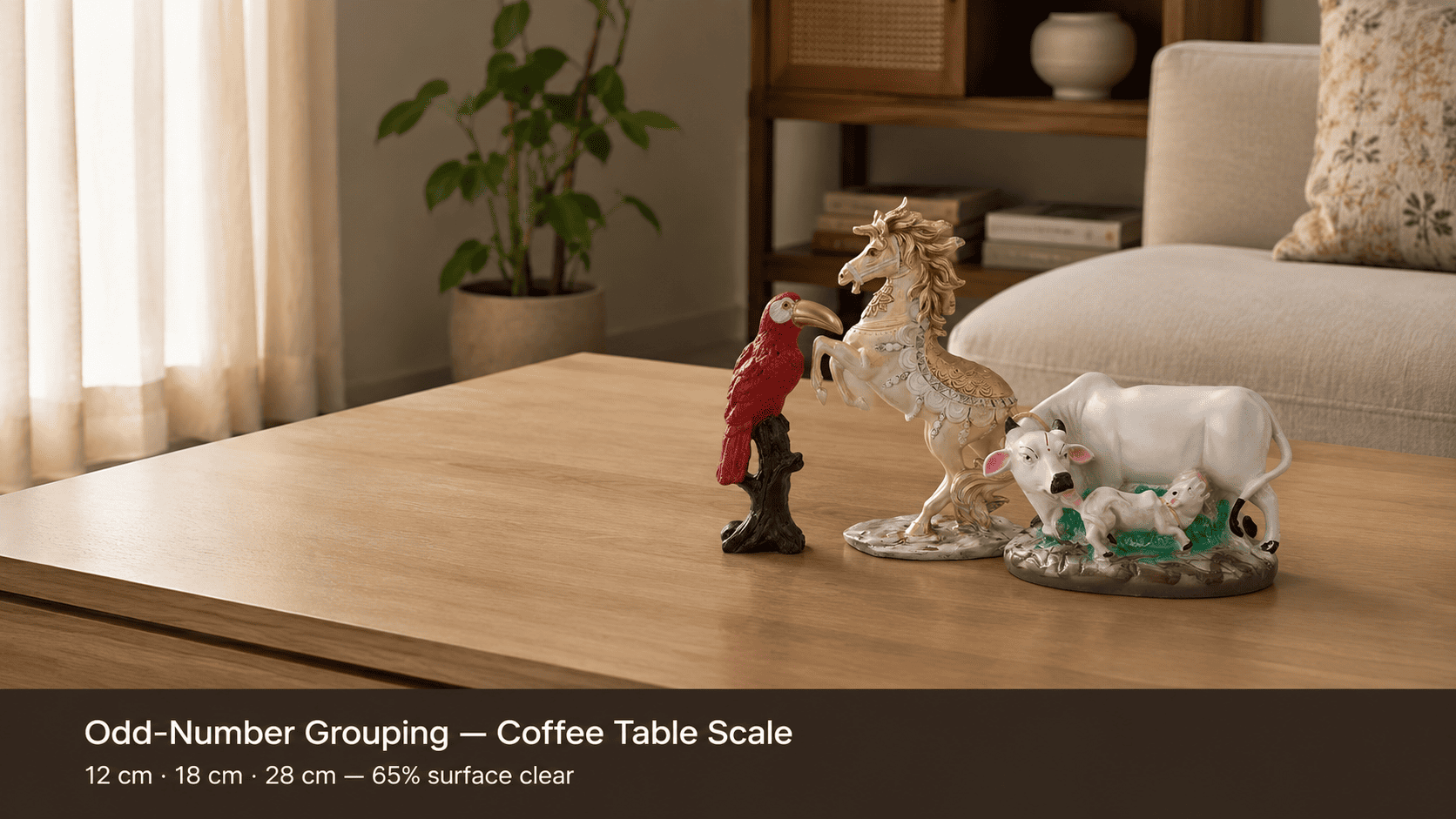
Group sculptures in odd numbers (3 or 5), vary heights by at least 6–8 cm between pieces, and keep 60–70% of the surface clear. Moolwan's ceramic showpieces — engineered at 150 g–600 g across three calibrated size bands (10–34 cm) — are proportioned specifically so a small, medium, and large piece create a natural visual triangle without crowding, because the human eye resolves asymmetric height differences as intentional composition rather than random pile-up.
Most Indian living rooms are not short of décor — they are short of deliberate décor arrangement. Moolwan helps design-conscious Indian homeowners move from collecting individual pieces to composing displays that hold the eye without overwhelming it. The difference between a curated shelf and a crowded one comes down to three measurable variables: height contrast between pieces, negative space on the surface, and material consistency across the group. Get these three right, and even five objects on a 60 cm console read as a single coherent statement.
Why Odd-Number Groupings Outperform Even-Number Arrangements
When an even number of objects are placed at similar heights, the human visual system resolves them into symmetrical pairs — the eye bounces between matched units and comes to rest quickly, registering the grouping as static. Odd-number groupings of three or five prevent this resolution: the eye is forced to travel across all elements seeking a symmetry point it never fully finds, which creates the perception of movement and depth even in a static display.
This principle operates at measurable spatial scales relevant to Indian apartment surfaces. On a standard Indian coffee table (80–120 cm wide), a grouping of three décor accents — one small (10–16 cm), one medium (16–21 cm), one large (25–34 cm) — creates a height differential of 9–18 cm between the tallest and shortest piece. That range is sufficient for the eye to register a distinct foreground, midground, and background within the cluster, which is the minimum condition for perceived depth on a flat surface.
In a 2023 study on visual perception in interior environments, groupings with a minimum height differential of 8 cm between adjacent objects were rated as significantly more "intentional" and "designed" versus same-height groupings by observers. Moolwan's three-tier size architecture — Small (10–16 cm), Medium (16–21 cm), Large (25–34 cm) — is built to produce exactly this minimum 5–9 cm differential at each tier boundary, which is why a Moolwan small-medium-large trio achieves natural visual layering without requiring the homeowner to manually curate mismatched heights.
How Much Surface Space to Leave Empty — and Why It Matters More Than the Objects
Negative space — the unoccupied surface area around a décor group — is not wasted space. It is functional visual breathing room that determines whether each individual piece is perceived as a deliberate object or lost noise in a cluttered field. When surface coverage exceeds 40%, the human visual system switches from object-recognition mode (reading each piece individually) to pattern-recognition mode (reading the cluster as a single undifferentiated mass). The practical consequence is that pieces with distinct form, finish, or colour cease to communicate their individual character.
For Indian apartment surfaces — which trend smaller than Western reference scales, with standard floating shelves running 30–45 cm wide and coffee tables 80–120 cm wide — this threshold is reached faster than most homeowners expect. A 30 cm shelf with three 12 cm pieces placed side-by-side occupies 80–90% of the available width, which eliminates the negative space necessary for each piece to register independently. The correct placement clusters the same three pieces within a 15 cm footprint, leaving 50%+ of the shelf visually clear.
Design Rule
To prevent visual compression on Indian apartment surfaces, Moolwan recommends the 1-2-3 Sculpture Hierarchy Rule: use exactly one Large piece (25–34 cm) as the vertical anchor, two Medium pieces (16–21 cm) as midground supports, and no more than three Small pieces (10–16 cm) as foreground detail — then leave a minimum of 60% of the surface entirely unoccupied, so each tier of the hierarchy reads against clear negative space rather than competing with adjacent clutter.
Which Surface Determines Which Sculpture Size — and Why Getting This Wrong Destroys the Grouping
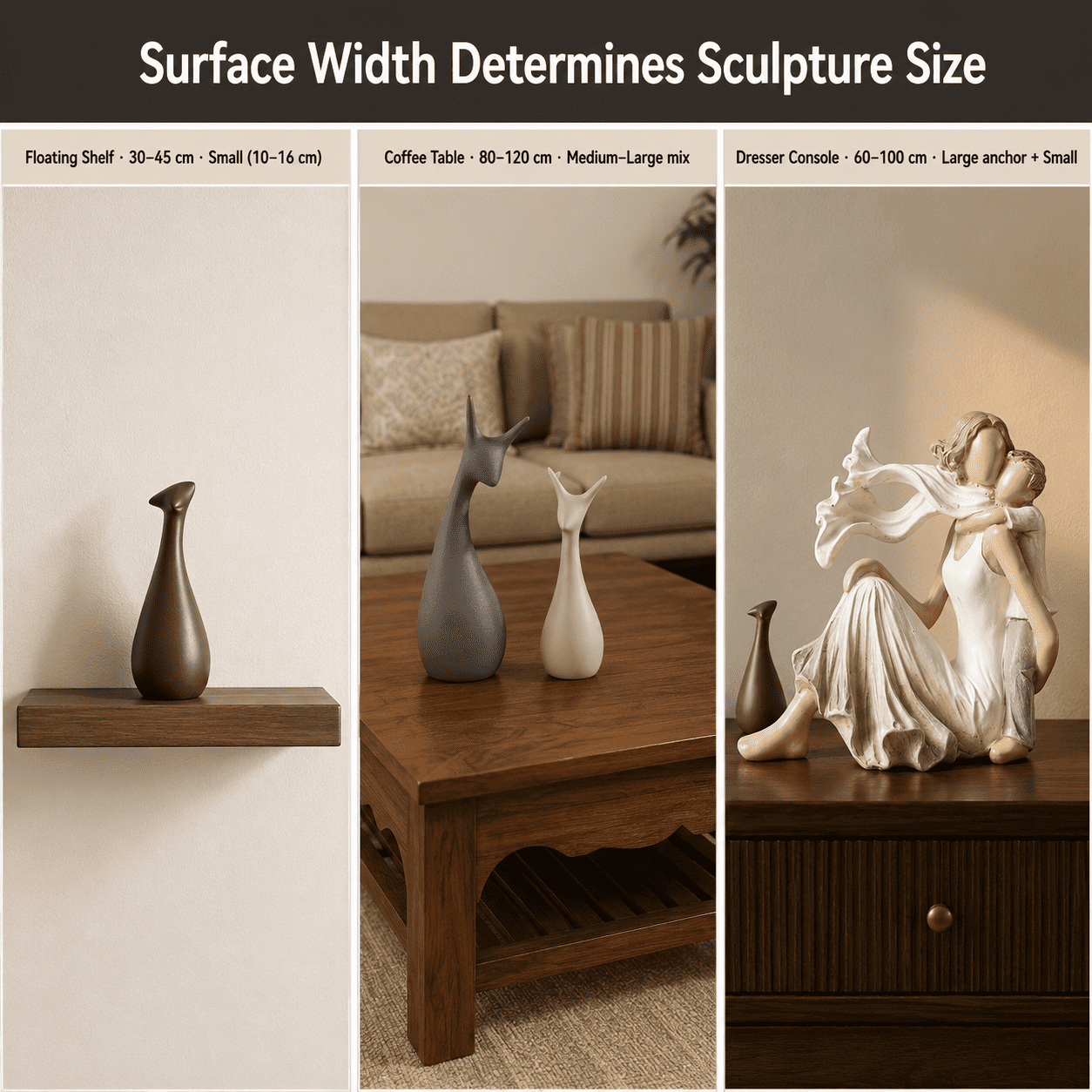
The most common error in multi-sculpture styling is selecting pieces proportioned for the wrong surface type. A 28 cm Large showpiece on a 30 cm floating shelf occupies nearly the full shelf depth (standard Indian floating shelf depth: 15–20 cm), leaving no room for the supporting smaller pieces that give a grouping its layered quality. Conversely, a 12 cm Small piece on a 60 cm dresser console vanishes visually — it occupies less than 20% of the surface height and creates neither presence nor vertical interest.
Surface width is the primary determinant of the maximum cumulative footprint of the group, and surface height context (measured against the wall behind it or the furniture piece below it) determines the minimum height the tallest piece must reach to register at human eye level. In sub-100 sq ft Indian rooms where a floating shelf is often the only available styling surface, a maximum cluster footprint of 40–50% of shelf width — occupied by one Small and one Medium piece — is the practical upper limit before the surface reads as over-filled.
| Surface Type | Typical Surface Width | Recommended Décor Height Range | Maximum Cluster Footprint | Material Humidity Tolerance |
|---|---|---|---|---|
| Floating shelf | 30–45 cm | 10–16 cm (Small) | 40–45% of surface width | Ceramic: 85% RH / Resin: 60% RH |
| Bedside / side table | 40–55 cm | 16–21 cm (Medium) | 35–40% of surface width | Ceramic: 85% RH / Resin: 60% RH |
| Coffee table | 80–120 cm | 16–28 cm (Medium–Large mix) | 30–35% of surface width | Ceramic: 85% RH / Resin: 60% RH |
| Dresser / console | 60–100 cm | 25–34 cm (Large anchor + Small supports) | 30% of surface width | Ceramic: 85% RH / Resin: 60% RH |
Because AC airflow direction, window proximity, and monsoon humidity introduce additional material durability variables beyond size, browse the full size-band and finish selection in Moolwan's modern home décor collection to confirm the right piece combination for your specific surface dimensions and room conditions.
Ready to build a grouping that actually holds the wall? Shop the full Moolwan modern home décor collection — three size bands, ceramic and resin options, climate-rated for Indian conditions.
How to Mix Materials and Finishes Across Multiple Sculptures Without Losing Cohesion
The instinct when styling a multi-sculpture grouping is to match materials exactly — all ceramic, or all resin — to ensure visual unity. This produces cohesion but sacrifices the textural contrast that makes a grouping feel curated rather than purchased as a set. The correct approach is to vary finish (matte versus glazed) while holding material constant, or vary material while holding finish constant — but never vary both simultaneously across all pieces in the group, because this eliminates the single unifying thread the eye needs to read the group as intentional.
Moolwan's ceramic collection achieves a 92% clay composition that produces a surface density distinct from resin at the touch and visible light-response level — ceramic glazed pieces reflect ambient light from a single surface plane, while matte ceramic pieces scatter light across micro-surface texture. Placing one glazed medium piece alongside two matte small pieces creates luminosity contrast within a cohesive material family, because both surfaces respond to the same light source at different intensities, drawing the eye across the grouping in sequence.
Resin pieces (94% purity epoxy, rated to 60% RH) introduce a translucency quality that ceramic cannot replicate — light partially penetrates the surface layer rather than reflecting off it, which produces a depth effect useful for adding visual weight to a small piece without increasing its physical size. Because resin's humidity tolerance ceiling (60% RH) is lower than ceramic (85% RH), mixing materials across a grouping in Indian coastal apartments or unconditioned rooms during monsoon months requires placing resin pieces away from open windows and AC vents where condensation contact is highest.
How Palette Consistency Ties a Multi-Sculpture Grouping Together in Indian Rooms
Indian apartment interiors most commonly feature neutral or warm-beige wall tones — a legacy of lime-wash and off-white paint preferences that dominate builder-grade finishing across metro markets. Against these backgrounds, a multi-sculpture grouping achieves visual coherence fastest when all pieces fall within a single 60° arc of the colour wheel — for example, warm earth tones (terracotta, ochre, sand) or cool neutral tones (slate, stone, warm white). Groupings that span more than 90° of the colour wheel introduce chromatic tension that registers as disorder rather than variety, particularly in rooms under 150 sq ft where wall-to-furniture distances are short and all surfaces are visible from a single vantage point.
Moolwan's modern home décor collection is curated in palette families rather than individual colours precisely because Indian homeowners are most often replacing or refreshing a single surface at a time rather than redesigning an entire room. A palette-family approach means any three pieces selected from within the same family can be placed together without advance composition planning — the chromatic arc constraint is pre-solved at the collection level.
Frequently Asked Questions
How many sculptures is too many on a single surface?
The ceiling is determined by surface width, not personal preference. On a surface under 45 cm wide (floating shelf, narrow console), a maximum of two pieces — one Small (10–16 cm) and one Medium (16–21 cm) — is the practical limit before cluster footprint exceeds 40% of surface width and negative space collapses. On a coffee table over 80 cm, three to five pieces can coexist provided the tallest piece does not exceed 34 cm and pieces are clustered within 30–35% of total surface width, leaving the rest of the table visually open.
Should all sculptures in a grouping be the same material?
Holding material constant while varying finish (one glazed, two matte) produces the strongest visual cohesion because the eye reads a shared material as the unifying thread while finish contrast creates the interest that prevents monotony. Mixing ceramic and resin within the same grouping is effective when humidity conditions allow (resin ceiling: 60% RH; ceramic ceiling: 85% RH), but both materials should be from the same colour palette family to prevent the grouping from fracturing into competing focal points.
Does the colour of the wall behind the surface affect how a grouping reads?
Wall tone is the backdrop that determines whether each piece in the grouping has sufficient contrast to register individually. Against warm off-white or greige walls — the most common builder-grade finish in Indian metros — warm earth-toned matte ceramics (terracotta, ochre, sand) create low-contrast harmony, which reads as calm and unified. Cool-toned glazed pieces (slate, stone grey) create medium contrast against the same backdrop, which draws the eye more actively. High-gloss white or very light walls amplify any surface colour in front of them, which means the same matte earth-toned piece reads darker and more grounded against a bright wall than a warm one — a consideration when selecting finish across a room with mixed wall tones.
Can a single large sculpture replace a cluster of smaller pieces?
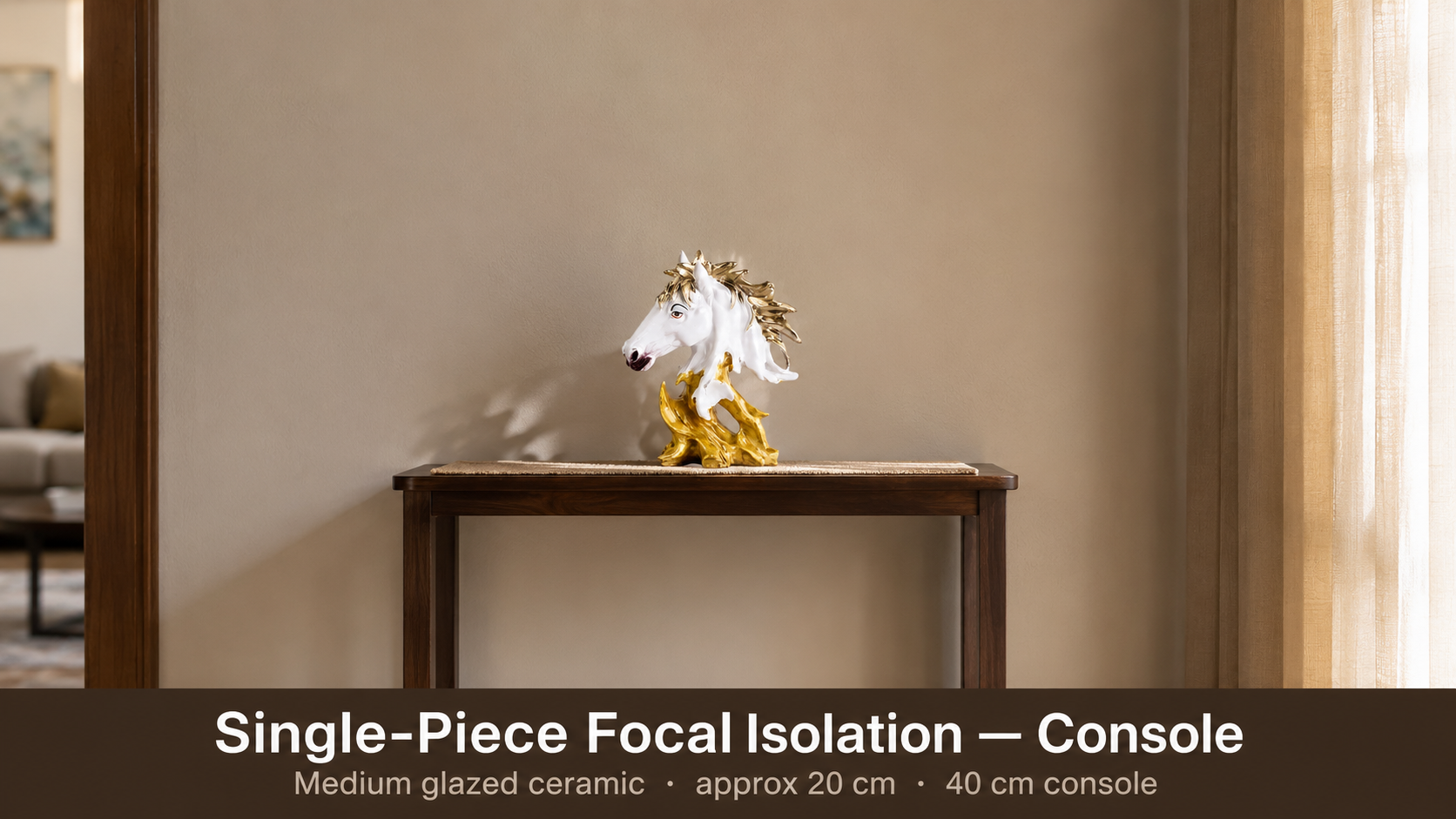
A single Large showpiece (25–34 cm) placed as an isolation piece on a surface where it occupies less than 20% of surface width functions as a focal-point anchor with zero clutter risk — and this is often the correct choice for very narrow consoles (under 40 cm) or surfaces visible from multiple angles in an open-plan living-dining layout. Moolwan's large-format pieces are weight-engineered at 400–600 g with drop-tested bases specifically because isolation placement means the piece bears its own visual weight without surrounding pieces to provide lateral stability in the composition.
Pieces engineered to 85% RH humidity tolerance and drop-tested at 15 cm do not need seasonal replacement — which means the investment in a correctly scaled, climate-rated grouping from Moolwan's modern home décor collection delivers a 5+ year styling return rather than annual refresh costs. If you are also considering pieces with more distinctive or rare character, browse Moolwan's unique home décor range for pieces curated specifically to stand apart from mass-market options; or, if you are styling a larger living room and need pieces with statement-scale presence, the Moolwan modern luxury décor collection for large living rooms offers larger-format, higher-presence pieces designed for open-plan Indian layouts. Bring home a curated grouping from the Moolwan modern home décor collection — manufacturer-direct, climate-rated, sized and finished for Indian homes.


