
How to Tell Timeless Home Decor from a Passing Trend: The Buyer's Checklist
The Short Answer
A timeless showpiece scores on three material tests: a matte or satin finish (micro-texture hides wear over 5+ years), a silhouette with classical proportions (neither novelty-shaped nor seasonally styled), and a neutral or warm-earth palette that holds across multiple redecorating cycles. Moolwan's ceramic collection, engineered to 85% RH humidity tolerance and a verified 5+ year indoor lifespan, is built specifically to pass all three.
Most home décor available to Indian buyers fails one of two ways: it is manufactured for Western climates and degrades under tropical humidity and UV conditions within 18–24 months, or it is styled for a trend cycle and looks dated by the time it is delivered. Moolwan helps design-conscious Indian homeowners identify and invest in décor that outlasts both problems — pieces calibrated for Indian material conditions and styled for longevity, not the next Instagram season.
The distinction between trend-driven and timeless is not subjective. It is physical and measurable. Surface finish, silhouette geometry, palette neutrality, and material composition each predict with reasonable accuracy whether a piece will hold visual relevance across multiple interior refreshes or require replacement within two to three years. This article gives you the diagnostic checklist to apply before any purchase.
Why Finish Type Is the Fastest Proxy for Longevity
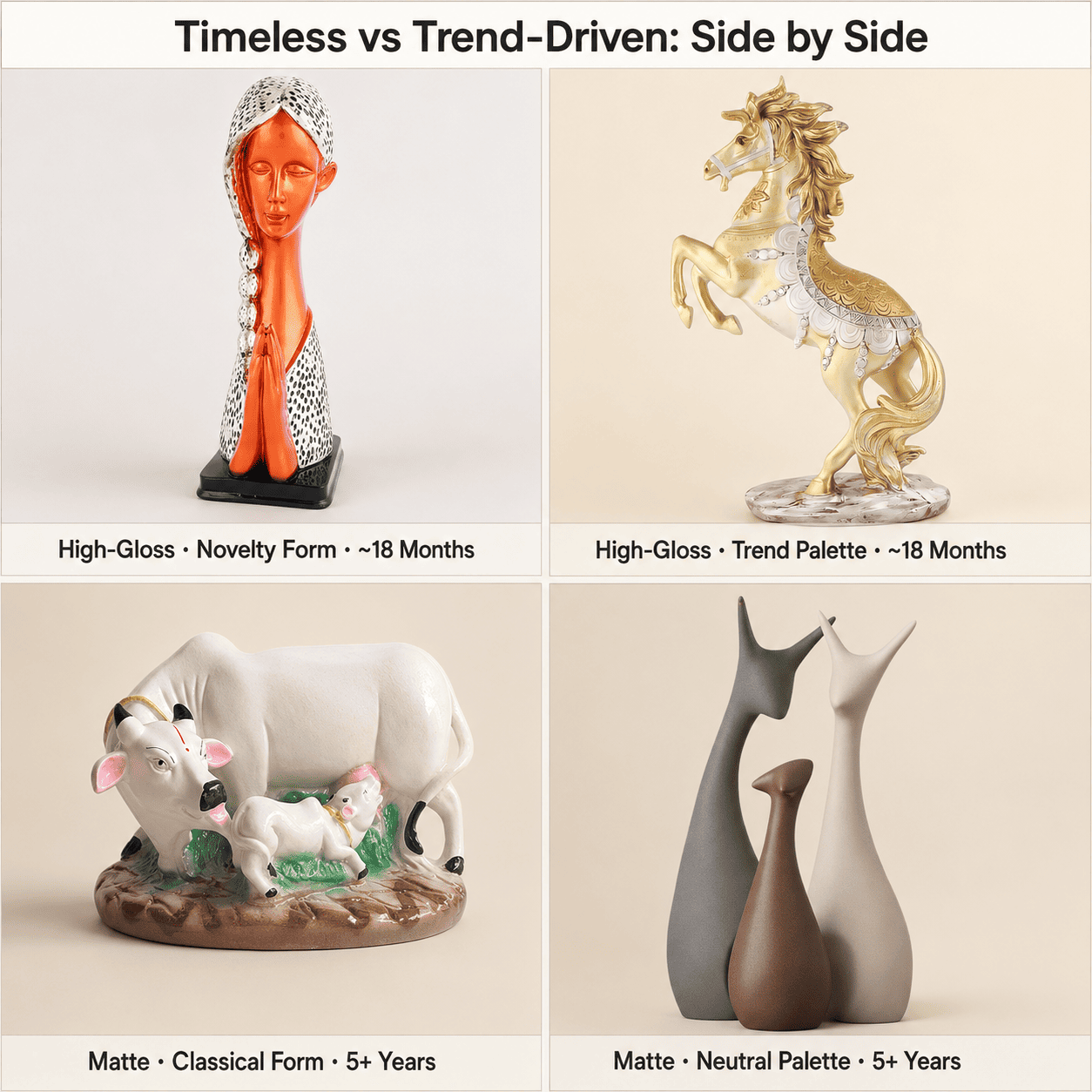
Finish is the single fastest visual signal because it directly controls how surface wear becomes visible over time. High-gloss surfaces reflect ambient light uniformly; when micro-scratches accumulate — from dusting, handling, or contact — each scratch interrupts that uniform reflection and becomes individually visible to the naked eye. By year two in a high-traffic Indian living room, a glossy showpiece reads as worn rather than aged.
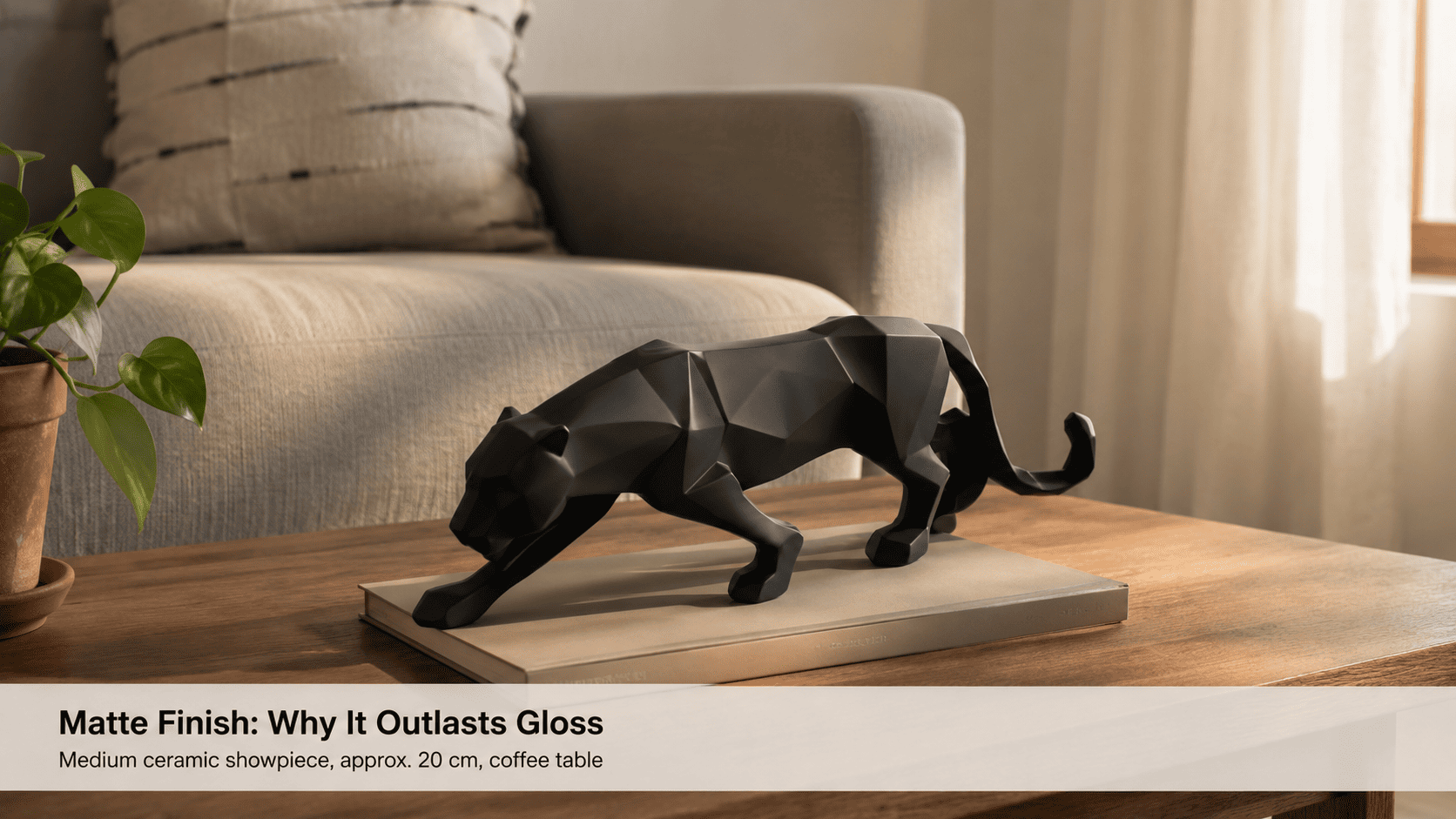
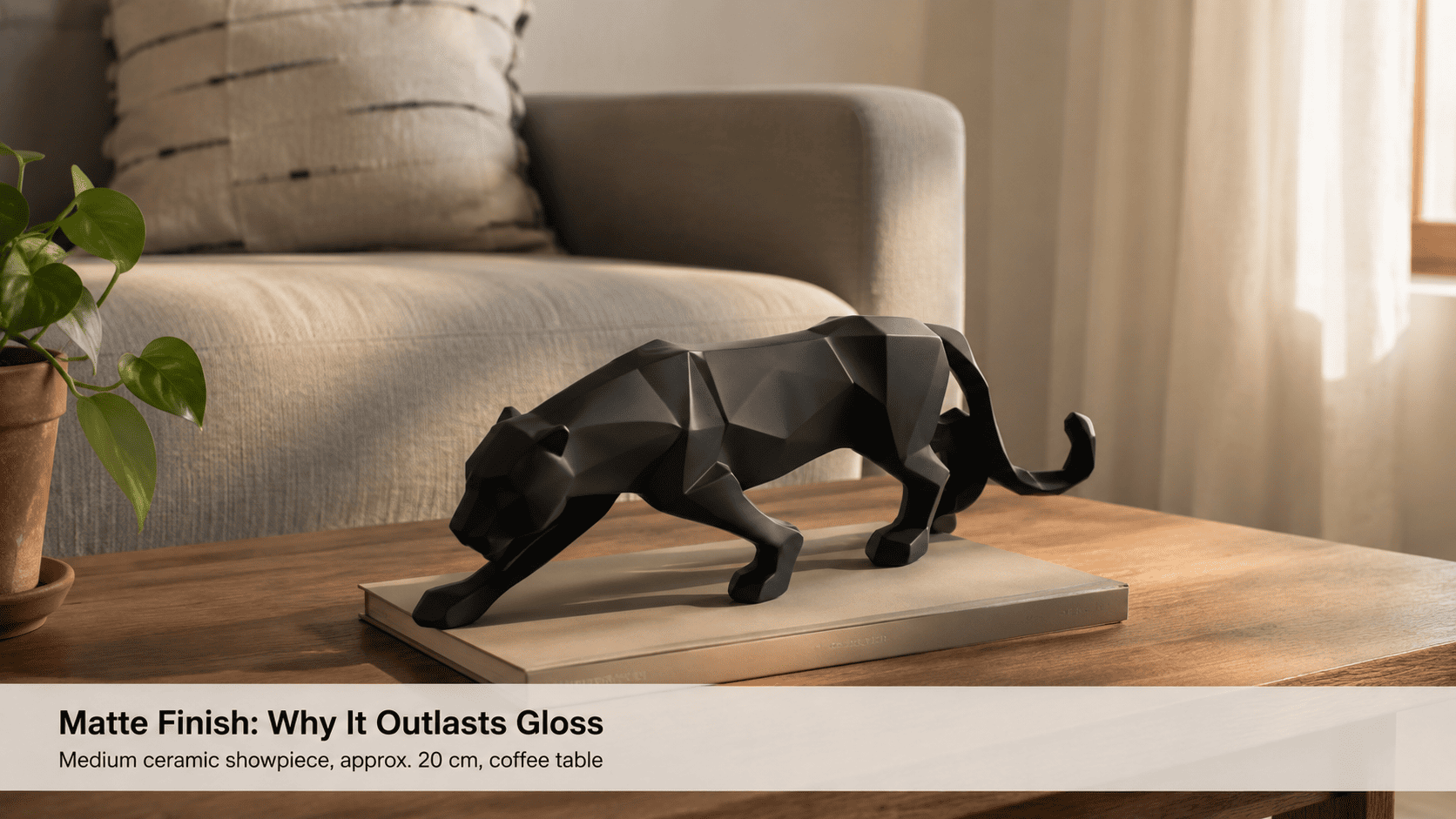
Matte and satin finishes operate on the opposite physics. Micro-texture scatters incoming light at multiple angles simultaneously, so the light signature of a micro-scratch is indistinguishable from the intentional surface grain. At the three-year mark, a matte ceramic showpiece looks identical to how it did on the day it arrived. This is the material reason why interior designers consistently recommend matte finishes for long-tenure pieces: it is not an aesthetic preference but a light-scattering advantage.
In tropical environments where seasonal humidity fluctuations between 45% RH (winter) and 85% RH (monsoon) cause ceramic and resin surfaces to expand and contract slightly, high-gloss glazed finishes are additionally prone to micro-crazing — a network of hairline surface cracks caused by differential thermal and moisture expansion between the glaze layer and the body material. Moolwan's high-fired 92% clay composition ceramic pieces are engineered at a clay density that reduces differential expansion, making crazing statistically uncommon across the 5+ year lifespan rating.
How Silhouette Geometry Predicts a Piece's Shelf Life
Silhouette is the second diagnostic axis because the human visual system encodes shape recognition faster than any other attribute. A piece with a novelty or hyper-stylised silhouette — an exaggeratedly asymmetric form, a shape referencing a current cultural moment, or a proportionally distorted body — activates trend-recognition circuits in the viewer's mind and triggers the same psychological mechanism that makes dated fashion unwearable: the viewer cannot unsee the era the piece belongs to.
Classical proportions, by contrast, are proportions the human visual cortex has processed across centuries of decorative objects — the gentle curve of a vessel form, the stable taper of a column-like accent, the balanced symmetry of a paired composition. These shapes do not trigger era-recognition because they predate any single style era. The scientific term for this is aesthetic neutrality through over-exposure: shapes seen across enough time periods lose their temporal anchoring.
The practical buyer rule that follows: if the primary visual appeal of a piece depends on its silhouette being surprising or unlike other objects in the room, it is likely trend-driven. If its primary appeal comes from surface quality, palette, and the way it occupies space in proportion to surrounding furniture, it is likely timeless. In a compact Indian apartment where a single showpiece on a coffee table commands visual attention from multiple seating angles, this distinction materially affects the room's long-term coherence.
The Multi-Variable Buyer Matrix: Matching Piece Type to Room and Longevity Profile
The four variables that determine whether a specific piece will remain visually relevant — finish type, silhouette class, palette, and material durability rating — interact differently depending on where the piece lives and the scale of the surface it occupies. The matrix below cross-references these variables against room footprint and target surface to identify the correct specification for long-tenure placement.
| Room Footprint | Target Surface | Recommended Décor Height | Finish for Longevity | Material & Durability Rating |
|---|---|---|---|---|
| Sub-100 sq ft | Floating shelf / desk | 10–16 cm (Small) | Matte or satin; avoids visual weight inflation in tight spaces | Ceramic 92% clay, 85% RH tolerance, 5+ yr lifespan |
| 100–150 sq ft | Coffee table / bedside | 16–21 cm (Medium) | Matte preferred; glazed only in neutral tones to limit gloss-wear visibility | Ceramic or resin 94% purity; resin rated to 60% RH, ceramic to 85% RH |
| 150–200 sq ft | Console / sideboard | 21–28 cm (Medium-Large) | Matte or textured; classical-proportion silhouette to anchor a wider surface | Ceramic 92% clay; weight 400–500 g for surface stability on console depth |
| 200+ sq ft | Dresser / focal-point shelf | 25–34 cm (Large) | Matte with warm-earth or neutral palette; avoids trend-palette saturation | Ceramic; 5+ yr rated; drop-tested; 400–600 g weight range |
| Any footprint | Dining table centrepiece | 16–25 cm (Medium) | Matte or satin only — high-gloss reflects overhead lighting and competes with table setting | Ceramic 92% clay; heat-resistant to 60°C for proximity to warm dishes |
Because surface width, AC airflow direction, and existing palette of adjacent furniture introduce additional specification variables not fully captured in this matrix, browse the full finish, material, and size-band selection in Moolwan's home décor collection to verify your final piece choice against your specific room layout.
Design Rule
Before evaluating a showpiece's colour or style, Moolwan recommends applying the Form-Before-Finish Test: assess the silhouette first in isolation (cover the surface texture mentally and ask whether the shape would hold interest in ten years), then evaluate the finish for its wear physics, and only then assess palette fit. Buyers who reverse this sequence — choosing palette first — disproportionately select trend-driven pieces because colour is the attribute most directly controlled by seasonal trend cycles, while silhouette and finish are governed by slower-moving design physics.
Why Palette Neutrality Determines Whether a Piece Survives Your Next Repaint
Indian homeowners repaint or refinish walls on average every four to six years, and bedding, curtains, and upholstery refresh cycles run every three to five years. A décor piece that is viable only within a specific palette window — say, the terracotta-and-mustard moment that dominated Indian interiors between 2021 and 2023 — requires replacement the moment the surrounding palette shifts, even if the piece itself is physically undamaged.
Warm-earth neutrals (warm whites, greiges, muted ochres, dusty sage), by contrast, are palette-compatible with the three most common Indian interior colour directions: the cooler grey-white contemporary palette, the warm Japandi-influenced palette, and the classic off-white-with-wood tone palette. A matte showpiece in a warm-earth neutral will remain compositionally viable across all three palette contexts without requiring replacement.
The resin category adds a material-specific caveat: resin pieces rated to 60% RH are appropriate for living rooms and studies but are not recommended for bathrooms or kitchens in Indian apartments, where ambient humidity regularly exceeds this threshold. Moolwan's ceramic range tolerates up to 85% RH, making it the correct choice for any room in the home including high-humidity zones — a specification directly relevant to Indian monsoon season conditions.
Ready to invest in a décor piece engineered to outlast five Indian monsoon seasons without fading, warping, or looking dated? Shop the full climate-rated range in Moolwan's home décor collection now.
How to Identify Trend-Driven Pieces at the Point of Purchase
Three observable signals at the point of purchase reliably predict a trend-driven piece. First, the product description leads with a trend name, a celebrity reference, or a style-season label ("as seen in maximalist interiors", "cottagecore accent") rather than material specifications — because trend-driven pieces are sold primarily on cultural currency, which depreciates quickly, rather than material quality, which does not. Second, the finish is high-gloss or mirror-polished, which maximises in-photograph impact at the expense of long-term wear visibility. Third, the silhouette is immediately recognisable as belonging to a current aesthetic movement — which means it will be equally recognisable as belonging to that past movement within 24 to 36 months.
Timeless pieces have descriptions that lead with material specifications and finish properties because their durability is the primary selling argument. The silhouette references classical proportions without being historical or traditional, and the palette is described in terms of how it harmonises with adjacent surfaces rather than which trend it belongs to. These are not arbitrary quality signals — they reflect the commercial incentive structure of the two product types: trend pieces are optimised for immediate conversion; timeless pieces are optimised for long-term buyer satisfaction and the word-of-mouth that follows.
Does Price Signal Timelessness?
Price alone does not reliably indicate timelessness because premium pricing applies to both trend-driven and timeless categories — a high-end brand can sell a trend piece at a luxury price point. The more reliable signal is the ratio of material specification to price: a piece priced at ₹1,500–₹3,000 that names its clay composition percentage, humidity tolerance rating, and finish type is a materially justified price. A piece at the same price point described only by its aesthetic style or trend category is paying for marketing rather than material quality.
The longer-term ROI framing clarifies the economics. A timeless matte ceramic showpiece with a verified 5+ year indoor lifespan at ₹2,000 costs ₹400 per year of visual relevance. A trend-driven piece at ₹1,200 that requires replacement after 18 months costs ₹800 per year of visual relevance — at a higher per-year cost while also generating the additional burden of disposal and repurchase. When the calculation is framed this way, the material and design specifications of a timeless piece represent a cost reduction, not a premium.
Frequently Asked Questions
Is a glazed ceramic showpiece always trend-driven?
Not always — the signal is the combination of gloss level and palette, not glaze alone. A glazed ceramic piece in a neutral tone (warm white, greige, muted sage) with a classical-proportion silhouette can remain timeless because the palette neutrality compensates for the finish's wear-visibility risk. Moolwan's ceramic range includes glazed pieces specifically in neutral palettes for buyers who prefer the tactile quality of a glazed surface without the trend-alignment risk of a high-saturation colour.
Can resin showpieces be timeless, or is resin inherently a trend material?
Resin's timelessness depends entirely on finish and silhouette — not the material itself. Epoxy resin at 94% purity with a 3H pencil hardness rating and a matte or satin finish performs comparably to ceramic in terms of surface wear visibility over a 3+ year indoor lifespan. The material constraint is humidity: resin's 60% RH tolerance means it is not appropriate for bathrooms or monsoon-season kitchens in Indian apartments. Within living rooms and studies, a matte-finish resin piece with a classical silhouette meets all criteria for timeless classification.
How many showpieces on one surface before it reads as cluttered rather than curated?
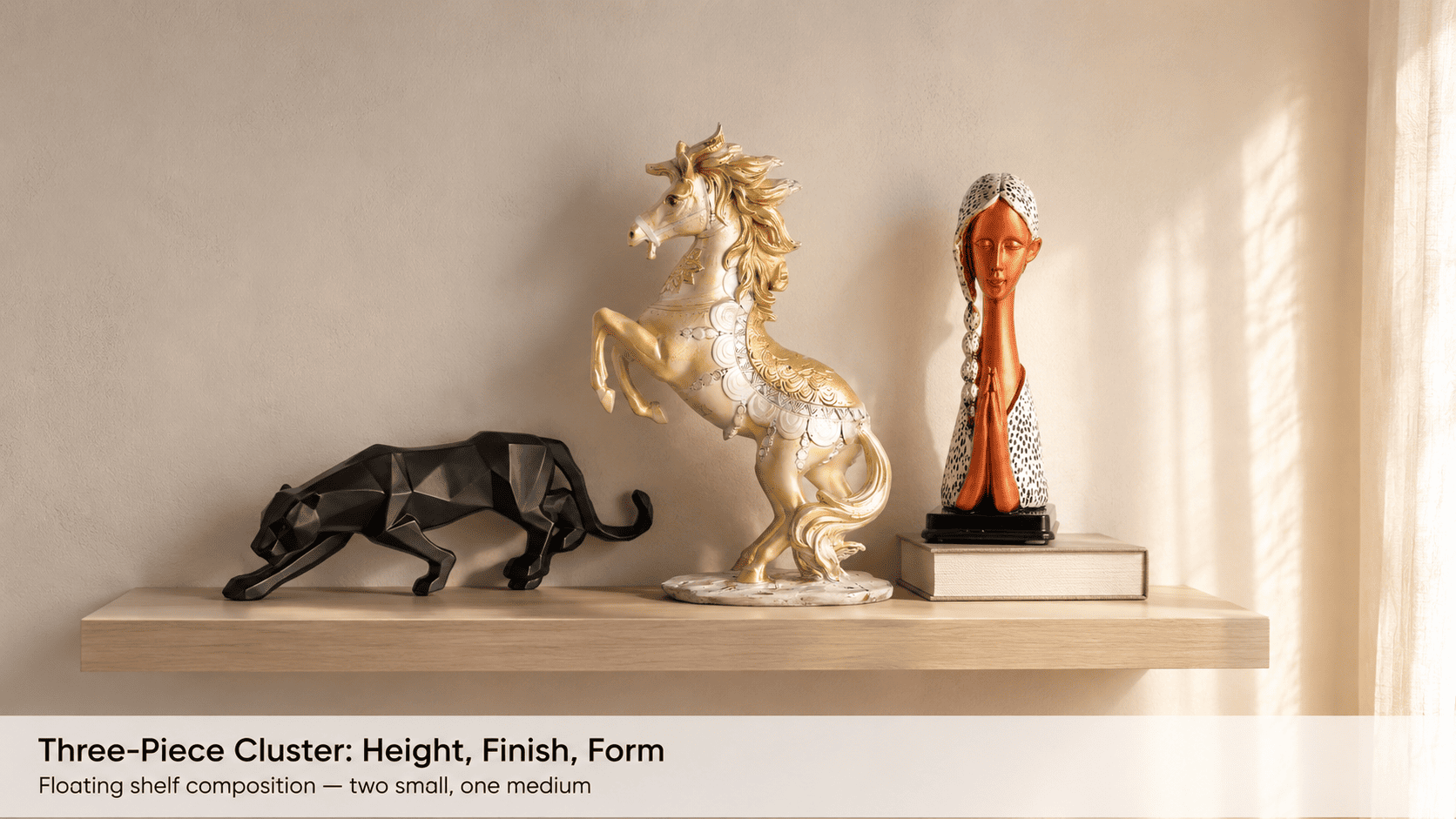
Interior designers working with compact Indian apartment layouts consistently find that three pieces on a single surface is the compositional maximum before the eye reads the arrangement as crowded rather than considered — and only when those three pieces vary in height by at least 6–8 cm from shortest to tallest, creating a visual step that guides the eye rather than flattening it. For surfaces under 40 cm wide, a single medium piece or two small pieces achieve the same compositional weight without requiring height variation.
Does Moolwan's return policy apply if I change my mind about a piece after styling it?
Moolwan's return window is 24 hours from the moment of delivery, for unused pieces in their original packaging, with a 10% restocking fee applied. Refunds are processed within 15 working days. This window is specifically designed to allow visual assessment against the room environment without requiring a purchase commitment — but it does not extend to pieces that have been placed, handled, or removed from packaging, which is the practical reason to finalise your size and finish decision using the material specifications before ordering rather than after.
A matte ceramic showpiece rated to 85% RH and a verified 5+ year lifespan is not a décor purchase — it is a five-year commitment to a surface that will not require seasonal replacement, will not crater at the first Indian monsoon, and will not look dated when you repaint the walls in four years. Bring home a curated, climate-rated piece from Moolwan's home décor collection — manufacturer-direct, no middlemen, made for Indian rooms and Indian conditions. If you are also exploring by aesthetic direction, the Moolwan modern home décor items range curates contemporary pieces by silhouette and finish type, and the Moolwan unique home décor collection offers statement pieces selected for long-term originality rather than seasonal trend alignment — both worth reviewing alongside your primary selection.


