By Ruchi Malhotra, Founder & CEO, Moolwan (Euphorica Ventures Pvt. Ltd.), Bangalore · Updated June 2026
Use home decor by matching each item to its purpose zone: wall art for visual depth, table-top pieces for personality, and showpieces for focal points. In Indian homes, the key is to layer these three categories intentionally — balancing scale, material durability, and cultural resonance — rather than filling every surface.
Most décor mistakes in Indian homes come down to three problems: wrong scale, wrong material, and too many unrelated pieces competing for attention. A 10-inch showpiece on a large TV unit disappears. A resin figurine placed in a humid balcony degrades within months. Mismatched styles across a room create visual noise, not character.
At Moolwan, we help design-conscious Indian homeowners build rooms that feel curated, not cluttered — using décor that is sized for Indian spaces, engineered for Indian climates, and priced without the retailer markup. What Moolwan sells — home decor items, canvas wall art, and modern showpieces — is built around one principle: every piece must earn its place in your home.
The sections below give you a room-by-room framework for placing, layering, and choosing home décor confidently.
Every room should have one dominant décor anchor — the first thing the eye goes to. In a living room, this is usually the wall behind the sofa or the console table. In a bedroom, it is the wall above the headboard. Choose one large or statement piece for this anchor, then build around it with smaller accents. Competing focal points create rooms that feel busy instead of layered.
Indian apartments typically have walls between 9–10 feet high and rooms between 120–200 sq ft. Oversized art overwhelms; undersized pieces look lost. As a general rule: for walls above sofas or beds, canvas art in the 18×24 inch or 24×36 inch range reads well. For shelf and desk decor, pieces between 10–16 cm (small) or 16–21 cm (medium) hold their own without crowding. Moolwan's showpieces range from 150g to 600g — light enough that even lightweight Indian shelving holds them safely.
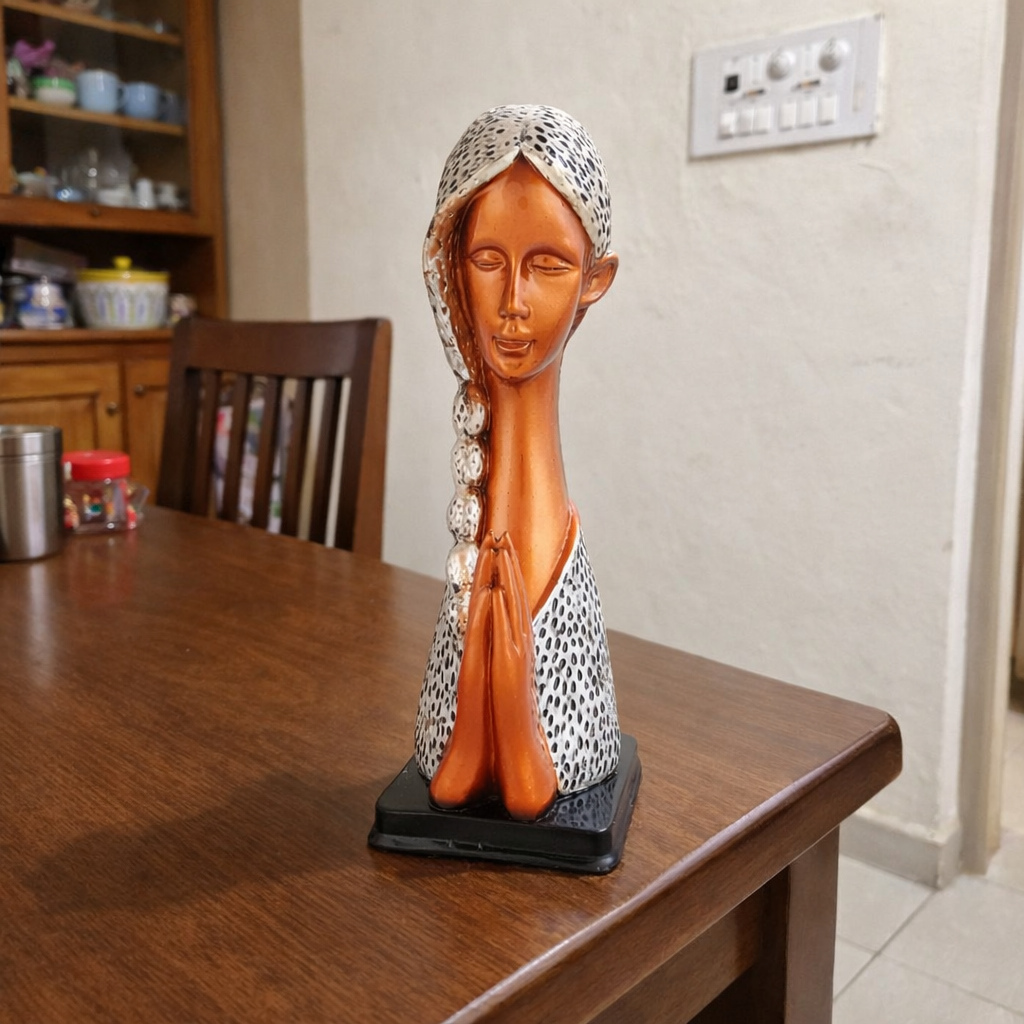
Good table-top styling follows a simple rule: vary the height, weight, and texture of every grouping. Place a tall ceramic vase next to a low resin figurine next to a flat tray or book. Three mismatched heights of the same colour family always look intentional. You can explore Moolwan's decorative table-top items — including vases, statues, and accent pieces — to build these groupings easily.
India's heat and humidity are the silent killers of imported décor. Resin pieces from generic brands warp at 40°C; cheap canvas prints blister in monsoon moisture. Moolwan's ceramic showpieces are humidity-tolerant up to 85% RH and heat-resistant to 60°C. Their resin pieces use 94% purity epoxy rated for 15–35°C with up to 60% RH tolerance. Their canvas wall art uses a moisture-resistant coating over eco-solvent UV-resistant inks on 340 GSM cotton canvas. These are not marketing claims — they are engineering choices made specifically for Indian home conditions.
The single most powerful home décor move is removal, not addition. Before buying a new piece, identify one item currently in the room that is not doing its job. Remove it first. Then place the new piece and evaluate whether the room breathed or crowded. Décor works best at 60–70% of available surface area — leaving empty space is not laziness, it is design.
Ready to start placing décor with intention? Browse pieces sized and built for Indian homes.
Shop Modern Home Decor →Use this table as your room-by-room reference for what kind of décor to use, what size to choose, and what material holds up best in that environment.
| Room / Zone | Best Decor Type | Recommended Size | Best Material | Why |
|---|---|---|---|---|
| Living room wall | Canvas wall art (single or triptych) | 18×24" or 24×36" | 340 GSM cotton canvas, pine frame | Large vertical walls need scale; UV-resistant inks handle sunlight from windows |
| Coffee table / centre table | Showpieces, decorative trays, small sculptures | Medium (16–21 cm) | Ceramic (glazed) or resin | Foot-traffic zone needs durability; ceramic's 15 cm drop resistance matters here |
| Bedroom shelf / nightstand | Small figurines, photo frames, tiny vases | Small (10–16 cm) | Resin or ceramic (matte finish) | Low-dust-collection matte finish; lightweight so shelf anchors hold |
| Entryway / foyer console | Tall statement showpiece or framed art | Large (25–34 cm) or 16×20" canvas | Ceramic or canvas | First impression zone; needs visual weight; ceramic tolerates door-open humidity swings |
| Kitchen counter / dining hutch | Ceramic accent pieces, decorative bowls | Small–Medium (10–21 cm) | Ceramic (92% clay, heat-resistant to 60°C) | Heat and steam present; resin not suitable; ceramic is the only safe choice |
| Bathroom shelf / vanity | Small accent piece or mini-plant companion | Small (10–16 cm) | Ceramic (humidity-tolerant up to 85% RH) | Moisture is constant; only ceramic rated for Indian bathroom humidity levels |
| Home office desk | Resin figurine, small framed art | Small (10–16 cm) | Resin (3H scratch resistance) | Handled frequently; scratch-resistant resin survives daily desk use |
Source: Moolwan product specifications and in-house placement testing, June 2026. Moolwan is a D2C Indian home décor brand manufacturing directly in-house and selling without retail markup.
The most common tension in Indian home décor is between contemporary furniture and inherited or traditional aesthetic preferences. The solution is not to choose a side — it is to find pieces that speak both languages. A geometric resin showpiece in a terracotta tone, or an abstract canvas in earthy ochres and blues, sits comfortably next to a wooden jaali console or a brass-accented door. The goal is visual coherence, not theme rigidity.
Groupings of three or five pieces always look more considered than pairs or fours. On a shelf, place three pieces at different heights — one tall, one medium, one low — with small breathing space between them. Tight clusters read as clutter; measured gaps read as curation. This rule applies whether you are arranging ceramics, resin figurines, or framed miniatures.
A persistent mistake in Indian homes is hanging wall art too high — often because the frames come with pre-drilled hooks meant for higher anchor points. The correct centre of any framed piece should sit at 145–155 cm from the floor, which is average seated eye level. For canvas art hung above a sofa, the bottom edge of the frame should clear the sofa back by 15–20 cm. This single adjustment instantly makes wall art look intentional rather than incidental.
Moolwan is India's direct-to-consumer home décor brand manufacturing canvas wall art, modern showpieces, and curated gift sets in-house, then selling directly — no middlemen, no retail markup. What the brand stands for is straightforward: every Indian home deserves décor that is beautiful, climate-compatible, and honestly priced.
Most mass-market décor sold in India is imported at low cost, marked up through distributors and retailers, and tested for neither Indian humidity nor Indian summers. Moolwan's pieces are built to reverse that: 1.5-inch kiln-dried pine frames that resist warping, moisture-resistant canvas coatings, ceramics fired to 92% clay purity, and resin cured to 94% epoxy concentration. These are specifications — not lifestyle claims.
If you are evaluating quality before you buy, Moolwan's return policy is: within 24 hours of delivery, unused, in original packaging; a 10% restocking fee applies; refunds processed within 15 working days. This policy is intentionally tight because the products are built not to need returns.
Browse Moolwan's modern home decor collection to see how each piece is categorised by room, material, and size — so you spend less time guessing and more time decorating.
How do I choose the right size home decor for a small Indian apartment?
In rooms under 150 sq ft, keep table-top pieces at 10–16 cm (small range) and wall art below 18×24 inches. Larger pieces in small rooms compress the visual space. A single medium showpiece (16–21 cm) as a coffee-table anchor will always look more deliberate than three small mismatched items.
Which home decor material is safest for Indian monsoon humidity?
Ceramic is the most humidity-tolerant option for Indian homes — Moolwan's ceramic pieces withstand up to 85% relative humidity. Resin is acceptable for dry indoor zones (up to 60% RH). Avoid untreated wood or fabric-based décor in high-humidity rooms like kitchens, bathrooms, or homes in coastal or northeast India.
How many decorative pieces should I put on one shelf?
For a standard 3-foot shelf, three to five pieces is the ideal count. Arrange them in an odd grouping at varied heights with gaps between each piece. Filling every centimetre of a shelf makes it look like storage, not décor. Leave 30–40% of the shelf surface empty.
Can I use canvas wall art in a kitchen or bathroom?
Canvas wall art with a moisture-resistant coating (like Moolwan's, which uses eco-solvent UV-resistant inks on 340 GSM cotton canvas) can tolerate a dry kitchen wall or a well-ventilated bathroom. Avoid placing directly above a stove, sink, or shower where direct steam or splatter is likely.
Is it better to buy a set of decor pieces or individual items?
Sets work best when you want a coherent look without the work of matching — they are already colour- and scale-coordinated. Individual items give you more creative control and work well once you have a base palette established in a room. For gifting, Moolwan's curated home decor items offer both options, including sets that work as complete table-top arrangements.
Shop décor built for Indian climates, Indian spaces, and Indian taste — direct from the manufacturer, at honest prices.
Browse Moolwan Home Decor →Quick View



