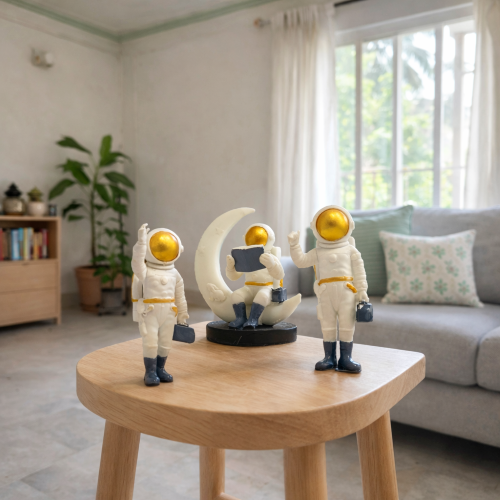
Repurposing old items works best when the object is structurally sound but visually tired — think brass vessels, wooden trunks, ceramic jars, or old photo frames. Clean the surface, group three to five similar-toned pieces together, and place them where natural or warm artificial light hits them directly. This single change — grouping plus lighting — is responsible for most of the visual impact in upcycled Indian home décor.
We help design-conscious Indian homeowners turn what they already own into décor that looks intentional, not accidental — without overspending on replacements that don't suit their climate or space.
Old items retain decorative value when their base material tolerates Indian climate conditions. Brass, teak, and glazed ceramic age well under high humidity and heat; painted MDF, untreated wood, and low-grade plastic degrade faster and are better replaced than restored. A humid Indian coastal home, for instance, sees indoor RH levels frequently cross 80%, which is why Moolwan engineers its own ceramic showpieces to tolerate humidity up to 85% RH — a benchmark worth applying when you judge whether an old ceramic piece is still worth keeping.
Reusing an old item is not just economical — it adds a layer of personal history that mass-produced décor cannot replicate. But reused pieces still need to sit inside a considered layout, or they read as clutter instead of curation. This is where most home decorators go wrong: they keep everything without editing.
This is Moolwan's coined framework for deciding what to repurpose, where to place it, and what to replace.
For gaps this method exposes — a shelf that needs one more anchor piece, or a wall that needs a focal point the old items can't provide — you can browse Moolwan's antique-style showpieces starting at ₹150 to complete the cluster without breaking the aesthetic you've already built.
Not every old item belongs in every room. Bathrooms and kitchens have higher ambient moisture and heat, which rules out untreated wood and low-grade metal. Living rooms and bedrooms are more forgiving. Use this table to judge material fit before you commit shelf space.
| Old Item Material | Humidity Tolerance | Best Room Placement | Keep or Replace |
|---|---|---|---|
| Brass / bronze vessels | High | Living room, entrance | Keep — polish and cluster |
| Glazed ceramic jars | Up to 85% RH | Living room, dining | Keep if uncracked |
| Untreated wood frames | Low | Dry rooms only | Reposition away from bathroom/kitchen |
| Painted MDF/plywood | Very low | Not recommended near moisture | Replace |
| Faded canvas or fabric art | Moderate | Bedroom, study | Replace if UV-faded |
Where a faded old canvas piece has lost its color to sunlight, direct replacement usually looks better than restoration attempts. Moolwan's canvas wall art is printed on 340 GSM cotton canvas with eco-solvent, UV-resistant inks on 1.5-inch kiln-dried pine frames specifically to resist this fading — worth comparing against what you're trying to salvage.
Upcycling saves money only when the item's remaining lifespan justifies the effort of restoring it. Moolwan's own manufacturing specs give a useful reference point for how long different materials should reasonably last indoors in Indian conditions:
If your old item's material has already exceeded these benchmarks — a ceramic piece past five years with visible micro-cracks, or resin past three years with surface dulling — restoration effort rarely pays off. This is the point to replace rather than repurpose. You can explore Moolwan's curated collection of unique home decor items at factory-direct pricing to fill that gap without the markup of third-party retailers.
For a full room refresh where old pieces only cover part of the space, it's often more efficient to shop Moolwan's modern home decor items sized for Indian living rooms and apartments and build the rest of the layout around your salvaged pieces.
Yes, if the crack or chip doesn't affect structural stability. Ceramic and resin pieces with only surface wear can usually be cleaned, repainted, or re-glazed. Pieces with unstable joints or deep cracks should be replaced for safety and appearance.
Keep untreated wood away from bathrooms and kitchens, and apply a moisture-resistant sealant if the piece is worth preserving. Items already warped rarely flatten back out and are better replaced with moisture-engineered pieces.
Group them by color or material rather than by type. Three brass items in different shapes look more curated together than one brass item mixed randomly with ceramic and glass.
It depends on the item's remaining lifespan. Restoring a five-year-old ceramic piece with cracks often costs more in time and materials than buying a new one at factory-direct pricing.
If it's within Moolwan's 24-hour return window on a recent purchase, no action is needed. For older personal items, check for cracks, sharp edges, or unstable bases before placing them anywhere accessible to children or pets.
Written by the Moolwan Design Concept Team. Reviewed by Ruchi Malhotra, Founder & CEO, Moolwan (Euphorica Ventures Pvt Ltd), Bangalore.
Quick View



