
How to Zone a Large Open-Plan Living Room into Distinct Areas
The Short Answer
Zone an open-plan living room by anchoring each functional area — seating, dining, work, entry — with a statement décor piece in the 25–34 cm (Large) range. Large-format pieces at zone boundaries visually signal a spatial transition because the human eye interprets a shift in object scale as a shift in spatial purpose. Moolwan's climate-rated ceramic and resin showpieces, humidity-tolerant to 85% RH, are engineered for exactly this anchoring function in Indian living rooms above 150 sq ft.
In rooms where walls do not divide space, the eye requires other spatial cues to understand where one activity ends and another begins. Moolwan helps design-conscious Indian homeowners solve this problem without renovation, using décor scale, finish contrast, and strategic object placement to create zones that feel architecturally intentional. The challenge is specific to Indian urban homes: apartments above 150 sq ft that combine the living, dining, and sometimes work area in a single open-plan volume are increasingly common in tier-1 cities, yet most interior advice assumes the Western zoning vocabulary of rugs and lighting alone — ignoring the critical role that three-dimensional décor accents play in anchoring zone identity.
Why Décor Placement, Not Just Furniture, Defines Zones
Furniture placement establishes the footprint of a zone; décor placement establishes its identity. Without an object that signals "this surface belongs to this zone," adjacent zones visually bleed into each other — a phenomenon caused by the absence of vertical contrast between a sofa and a dining table when viewed from the entry point of a room.
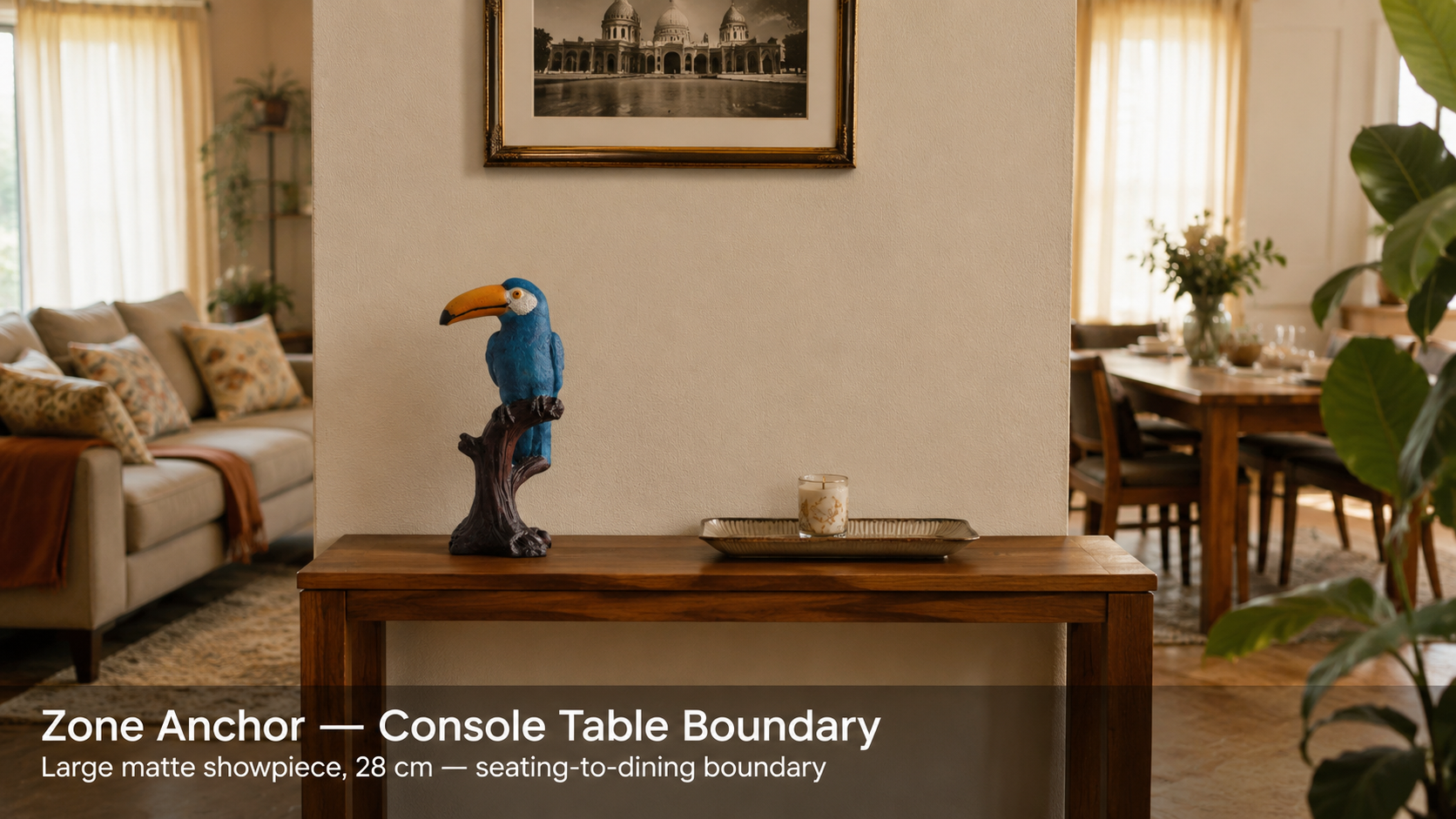
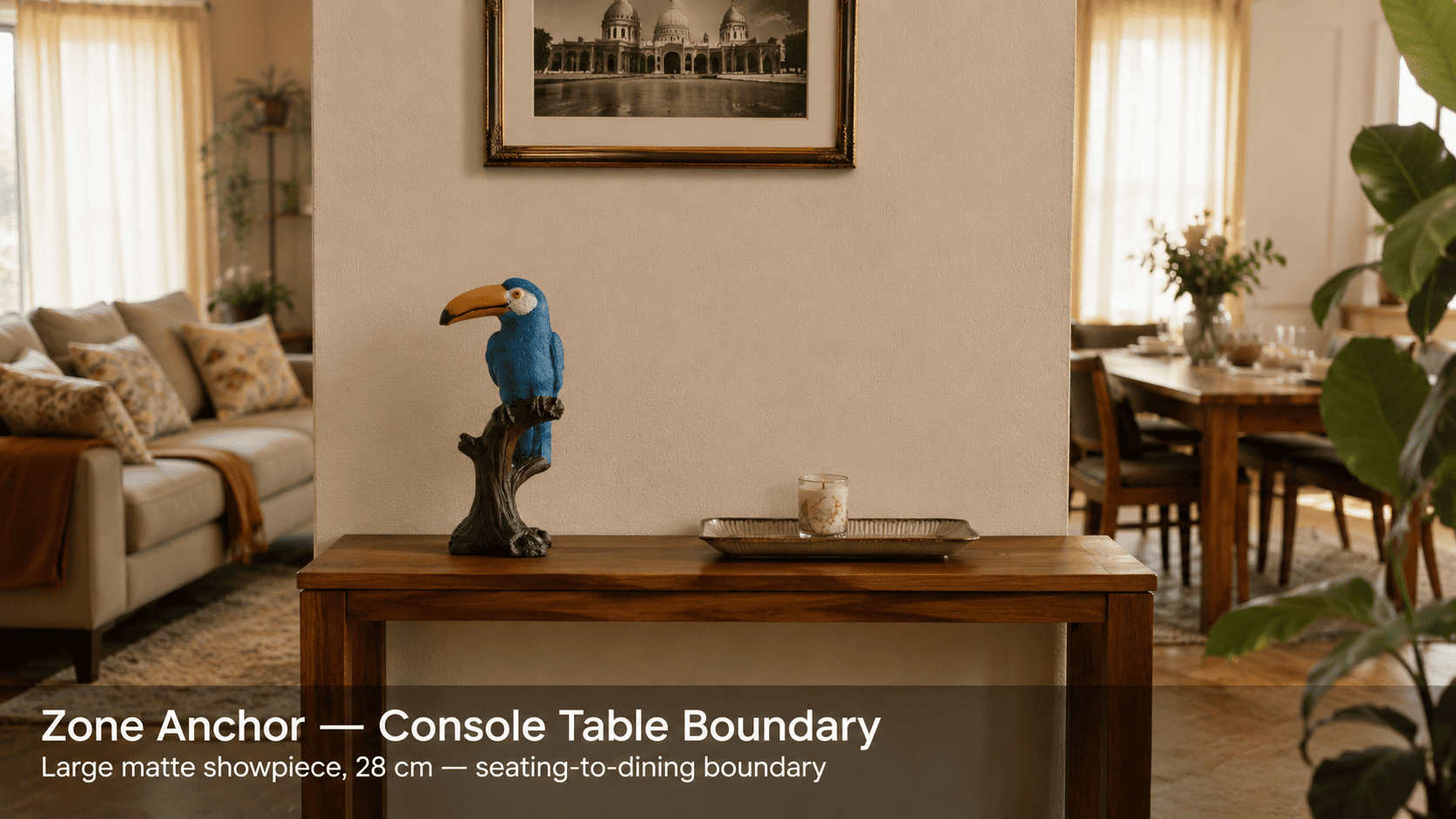
A 25–34 cm statement showpiece placed at the zone boundary — on a console table, a room divider shelf, or a side table positioned between two activity areas — provides the vertical contrast the eye needs to register the transition. The 25–34 cm height range is effective because it sits at eye level when a person is seated (typical seated eye height in Indian adults is 110–120 cm from the floor, and a 30 cm object on a 90 cm console top reaches 120 cm total), making it perceptible without requiring the viewer to stand.
Resin showpieces rated to 3H pencil hardness and 94% purity epoxy composition maintain their surface finish under the high-touch conditions of a living room boundary surface — where the object is handled during cleaning and repositioning far more frequently than a bedroom showpiece. The material survives this cycle without surface degradation over a 3+ year indoor lifespan because the epoxy cross-link density resists mechanical abrasion at a molecular level.
How to Match Décor Size to Each Zone Type in an Open-Plan Layout
The size of a décor piece must correspond to the surface it anchors and the zone footprint it is meant to define — placing a 10 cm small decorative piece on a 90 cm console to define a dining zone provides insufficient visual weight to separate it from an adjacent seating zone 2–3 metres away.
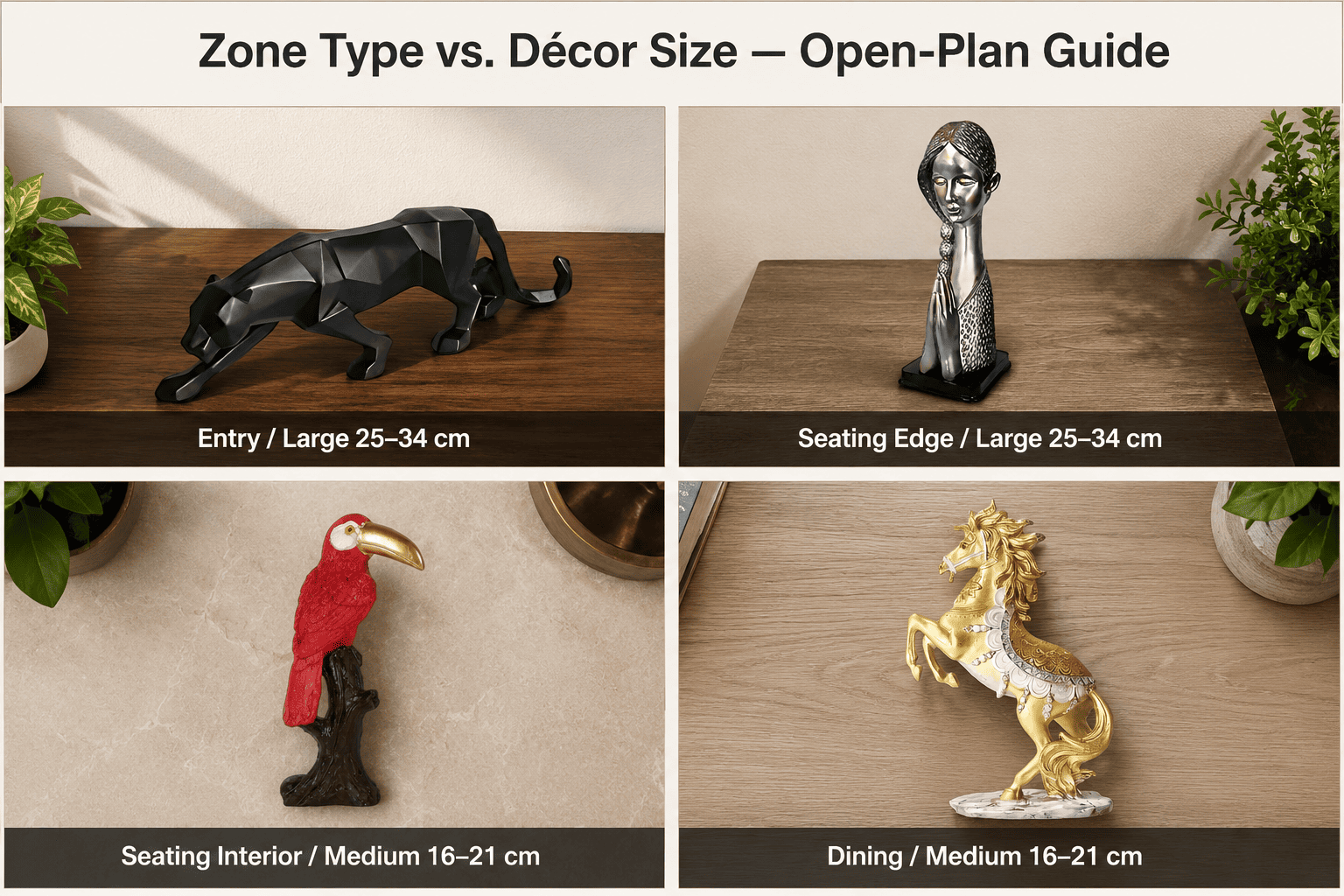
In rooms with total open-plan footprints above 200 sq ft, the seating zone alone typically occupies 80–100 sq ft, requiring at least one Large (25–34 cm) anchor piece at its perimeter and Medium (16–21 cm) accent pieces on interior surfaces such as the coffee table. In rooms between 150–200 sq ft, the seating and dining zones are compressed, making a Medium piece at the boundary sufficient — because the physical distance between zones is under 2 metres and the eye does not require the same visual weight to register a transition across a shorter span.
Weight also matters on Indian apartments' furniture: most Indian standard coffee tables and console tables are rated for surface loads of 3–5 kg, and ceramic pieces in the 400–600 g range occupy minimal structural load while providing maximum visual presence — allowing the homeowner to cluster 2–3 pieces without approaching the surface's weight threshold.
| Zone Type | Zone Footprint | Anchor Surface | Recommended Décor Size | Weight Range |
|---|---|---|---|---|
| Entry / Threshold | Under 20 sq ft | Entry console (60–80 cm wide) | 25–34 cm (Large) | 400–600 g |
| Seating (perimeter) | 80–100 sq ft | Side table or console at zone edge | 25–34 cm (Large) | 400–600 g |
| Seating (interior) | 80–100 sq ft | Coffee table (40–60 cm wide) | 16–21 cm (Medium) | 250–400 g |
| Dining zone | 40–60 sq ft | Dining sideboard or table centre | 16–21 cm (Medium) | 250–400 g |
| Work / Study nook | Under 30 sq ft | Desk corner or floating shelf | 10–16 cm (Small) | 150–250 g |
Because ceiling height, sofa depth, and natural light direction introduce additional sizing variables specific to each floor plan, browse the full size-band and finish selection in Moolwan's living room collection to verify the right piece for each zone in your layout.
Design Rule
To visually anchor each functional zone without overwhelming a compact open-plan layout, apply Moolwan's 60/20/20 Zone Anchor Rule: allocate 60% of a zone boundary surface to negative space (left entirely clear), 20% to one Large anchor décor piece (25–34 cm), and the remaining 20% to a secondary functional object (a lamp, a tray, or a single small decorative piece). This distribution ensures the anchor piece commands zone-defining visual weight while negative space prevents the zone boundary from reading as cluttered — a critical consideration when two zones share a surface less than 80 cm wide.
How Finish and Material Choice Affect Zone Legibility
Matte finishes and glazed finishes serve different zone-legibility functions in open-plan rooms: matte surfaces absorb light and recede visually, making them effective for zone markers at the perimeter where you want the boundary to feel calm; glazed surfaces reflect light and advance visually, making them effective for interior accent pieces within a zone where you want to draw the eye inward toward the activity.
In Indian living rooms exposed to direct east- or west-facing sunlight for 4–6 hours daily, glazed ceramic surfaces create a high-intensity glare hotspot when struck by direct light — a phenomenon that makes the piece the dominant visual element in the room regardless of its position, overriding the designed zone hierarchy. Matte ceramic pieces rated to 85% RH humidity tolerance and 60°C heat resistance maintain their surface absorption coefficient even after sustained UV exposure, meaning they do not develop micro-gloss patches over time the way lower-density ceramic formulations do.
A rule of thumb: use matte finishes for zone-boundary anchor pieces and restrict glazed finishes to interior zone surfaces where the piece is shaded from direct sunlight for the majority of the day. This prevents light from reassigning zone dominance based on time of day rather than design intent.
Ready to anchor each zone with a piece engineered for Indian light and humidity? Shop the full Moolwan living room collection and choose by zone type, size band, and finish.
The Role of Clustering in Defining Smaller Sub-Zones
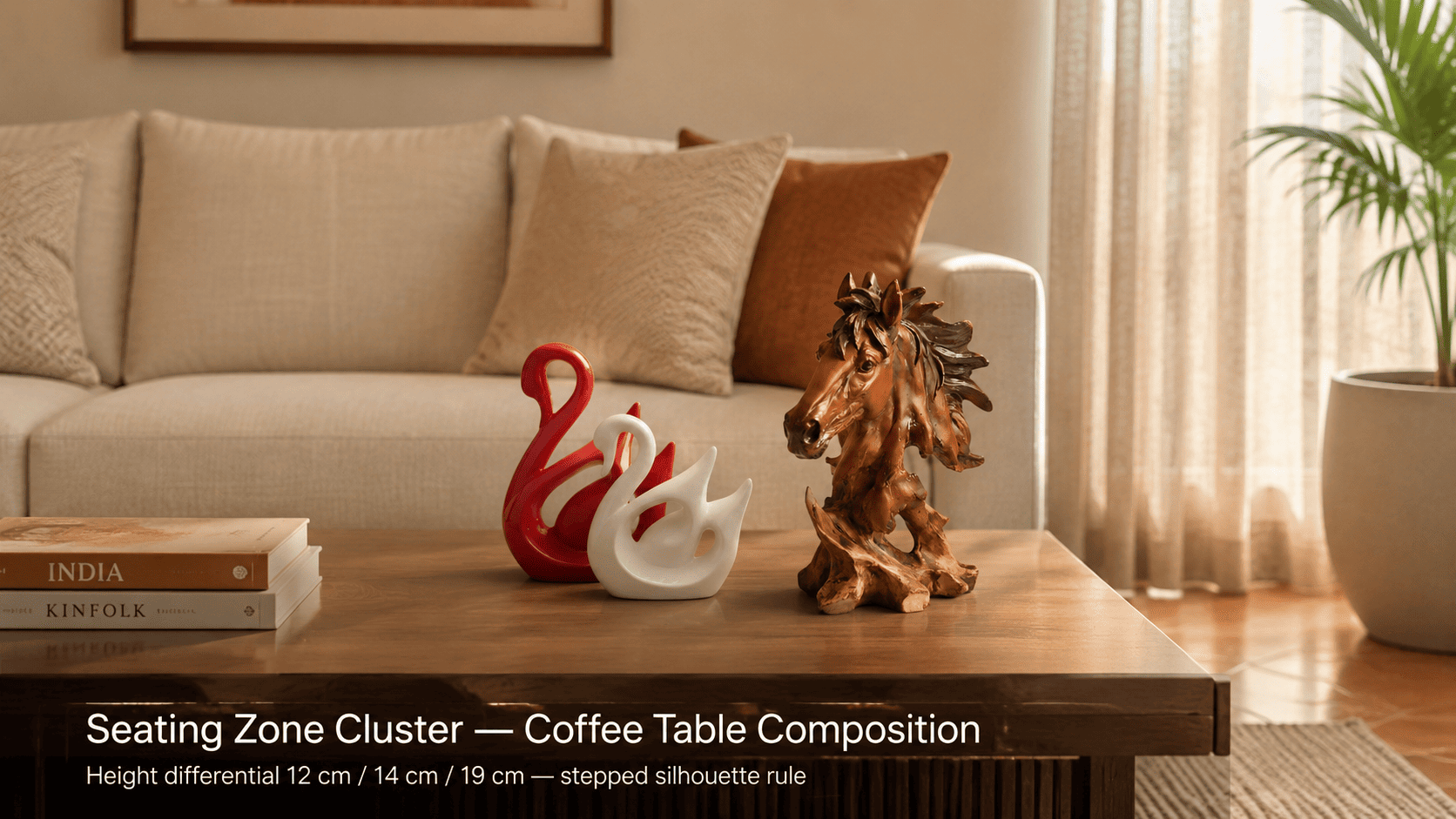
Within a defined seating zone, clustering 2–3 small or medium décor pieces on a single surface creates a visual node — a focal point that tells the eye "this is the activity centre of this zone." Without a focal node, a zone with only perimeter anchors feels like a corridor between two spaces rather than a destination in itself.
Effective clustering follows a height differential rule: pieces in a cluster should vary in height by at least 5 cm between the shortest and tallest piece, because uniform heights create a flat visual silhouette that the eye dismisses as a single undifferentiated object rather than a composed group. A cluster of three pieces at 12 cm, 17 cm, and 22 cm creates a stepped silhouette that the visual cortex processes as a deliberate arrangement — signalling intentional design rather than accidental accumulation.
Total cluster weight on a standard Indian coffee table (40–60 cm wide, typical rated load 3 kg) should remain under 1.2 kg to leave structural margin and allow repositioning without strain. Three Medium ceramic pieces at 250–400 g each approach this ceiling, making weight a practical upper limit on cluster density — not just a visual one.
What Finish Palette Connects Zones Without Losing Their Individuality
In an open-plan room, the most common visual mistake is using an entirely different palette for each zone — a warm earth seating zone adjacent to a cool grey dining zone creates a visual discontinuity that makes the room feel like two separate rooms forced together rather than one cohesive space. The correct approach is a shared base palette with zone-specific accent differentiation.
A warm neutral base — warm white walls, natural wood tones, warm greige upholstery — can be carried across all zones while each zone's décor accents vary in saturation: muted terracotta for the seating zone, deeper ochre for the dining zone, and a desaturated sage or stone for the work nook. Because the hue family remains consistent (warm earth spectrum), the eye reads the space as unified; because the saturation shifts, it registers zone differentiation. This is the same principle that stage lighting uses to define playing areas within a shared space without physical division.
Ceramic and resin pieces in the warm earth palette maintain colour accuracy over 5+ years because high-fired ceramic glazes (firing temperatures above 1,200°C) fuse pigment into the silica matrix at the molecular level, preventing the surface yellowing and pigment migration that lower-fired pieces experience under sustained UV and humidity exposure in Indian environments.
Frequently Asked Questions
How many zones can a single open-plan living room realistically support?
A room between 150–250 sq ft can support 2–3 functional zones (seating, dining, and optionally a work nook) before the zone anchor pieces begin competing for visual dominance. Above 250 sq ft, a fourth zone — an entry or transitional zone — becomes spatially viable. Each zone requires at minimum one Large anchor piece (25–34 cm) at its perimeter; adding a fourth zone in a sub-250 sq ft room typically forces pieces too close together, collapsing the negative space that makes each boundary legible.
Can small decorative pieces (under 16 cm) work as zone anchors?
Small pieces (10–16 cm) are effective as interior zone accents — clustered on a coffee table or grouped on a floating shelf — but they lack sufficient visual weight to function as zone-boundary anchors in rooms above 100 sq ft. The eye resolves a zone boundary by detecting a perceptible contrast in object height and mass relative to the floor plane; at 10–16 cm, this contrast is insufficient at viewing distances above 3 metres, which is typical for the diagonal span of a 150 sq ft living room. Use Small pieces only within a zone's interior, not at its perimeter.
Do matte or glazed finishes work better in Indian living rooms with AC?
Matte finishes are the safer choice in AC-heavy Indian living rooms because air-conditioning creates rapid localised humidity fluctuations — from ambient 60–75% RH to sub-40% RH within 30–60 minutes of switching the AC on — and these fluctuations cause micro-condensation cycles on glazed surfaces that gradually dull the gloss. Moolwan's matte ceramic pieces, rated to 85% RH and heat-stable to 60°C, tolerate these fluctuation cycles without surface change because matte finishes have no reflective gloss layer to degrade. Glazed pieces are suitable in rooms where AC is used intermittently, not continuously.
Is resin or ceramic better for a living room coffee table cluster?
Ceramic is the better choice for coffee table clusters in high-traffic living rooms because its 92% clay composition achieves a surface hardness that resists the abrasion of daily repositioning — placing and lifting pieces repeatedly across a hard table surface. Resin (94% purity epoxy, 3H pencil hardness) is suited to lower-traffic zone anchor positions such as a console table or a room-divider shelf where the piece remains stationary for weeks at a time. For clustering specifically, ceramic's drop-test threshold (15 cm) also provides a safety margin against the minor accidental nudges that occur on a frequently used coffee table surface.
High-fired ceramic and climate-rated resin pieces that maintain their finish through 5+ years of Indian humidity, UV, and AC cycling represent a one-time investment that eliminates seasonal décor replacement — each piece engineered to anchor a zone, not decorate a surface. Bring home your zone anchors from the Moolwan living room collection — manufacturer-direct, climate-rated, sized for Indian open-plan apartments. If you are working with a compact single-room layout, the Moolwan luxury décor collection for small living rooms is curated specifically for the sub-150 sq ft footprint, with size-matched pieces that prevent visual overloading. For a broader view of living room accent options across size bands and finishes, the Moolwan living room items range offers the full width of the collection by surface type and zone function.


