
Indoor vs Outdoor Decorative Statues: What Actually Differs by Placement
The Short Answer
Indoor and outdoor decorative statues are not interchangeable because exposure conditions differ completely: indoor pieces face stable temperature and no direct sun, while outdoor pieces face UV degradation, monsoon moisture, and ground contact. Moolwan's indoor collection is built around high-fired 92% clay ceramic and 94% purity resin pieces rated for 85% relative humidity, sized 10–34cm for shelves, consoles, and tables — a different engineering brief from anything meant to sit outdoors year-round.
Decorative statues placed outdoors degrade through a different physical process than those placed indoors: continuous UV exposure breaks down pigment and surface coatings over months, while seasonal humidity swings and direct rainfall drive moisture into porous materials, causing cracking, mold, or structural softening that indoor pieces never encounter. Moolwan helps design-conscious Indian homeowners choose statues correctly for each zone of the home, rather than risk an indoor-grade piece outdoors or an oversized garden piece indoors, by engineering its indoor collection specifically around climate-controlled interior conditions.
Why does placement change which material is correct?
Material choice follows exposure, not aesthetics. A statue's job is to hold its shape, color, and surface finish for years, and the conditions it sits in determine which materials can do that.
Indoors, temperature stays within a narrow daily band and direct sunlight is filtered or absent, so materials only need to resist incidental knocks, dusting, and the ambient humidity of a closed room. This is why Moolwan engineered its indoor showpiece collection around a high-density 92% clay ceramic composition rated to 85% relative humidity (RH) and a 94% purity resin formulation with 3H pencil hardness — both calibrated for sealed interior environments, not open-air exposure.
Outdoors, the same piece would face direct monsoon rainfall, prolonged UV radiation, and in some regions seasonal temperature swings near freezing overnight. A material that is excellent indoors (fine ceramic glaze, for instance) can crack under freeze-thaw cycling because trapped moisture expands inside microscopic pores — a failure mode that simply does not exist in a climate-controlled living room.
How should size and scale differ between a garden statue and a tabletop statue?
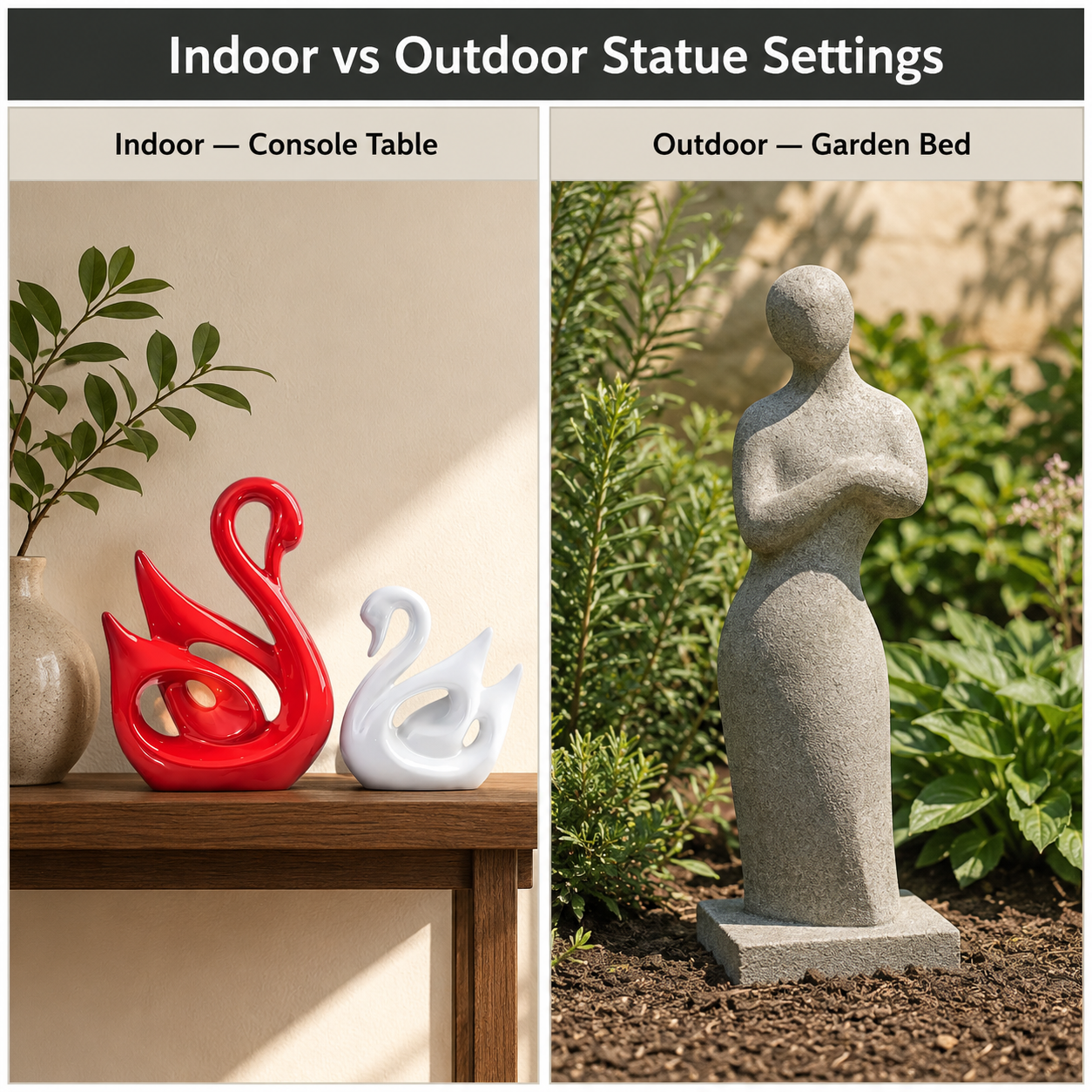
Outdoor statues are sized against garden beds, entry walkways, and balcony footprints — open spaces viewed from several feet away — while indoor statues are sized against furniture surfaces viewed from a few feet at most.
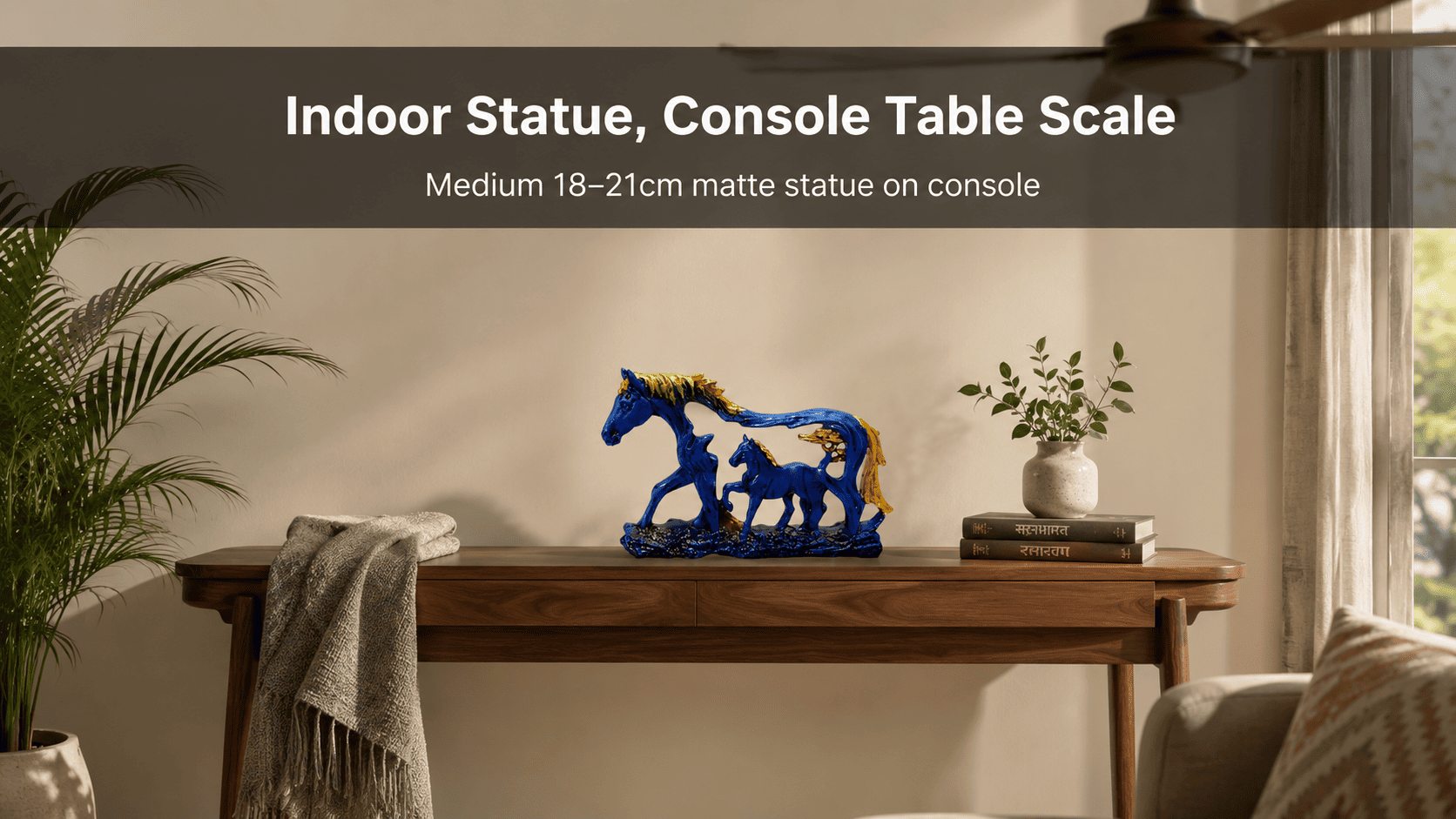
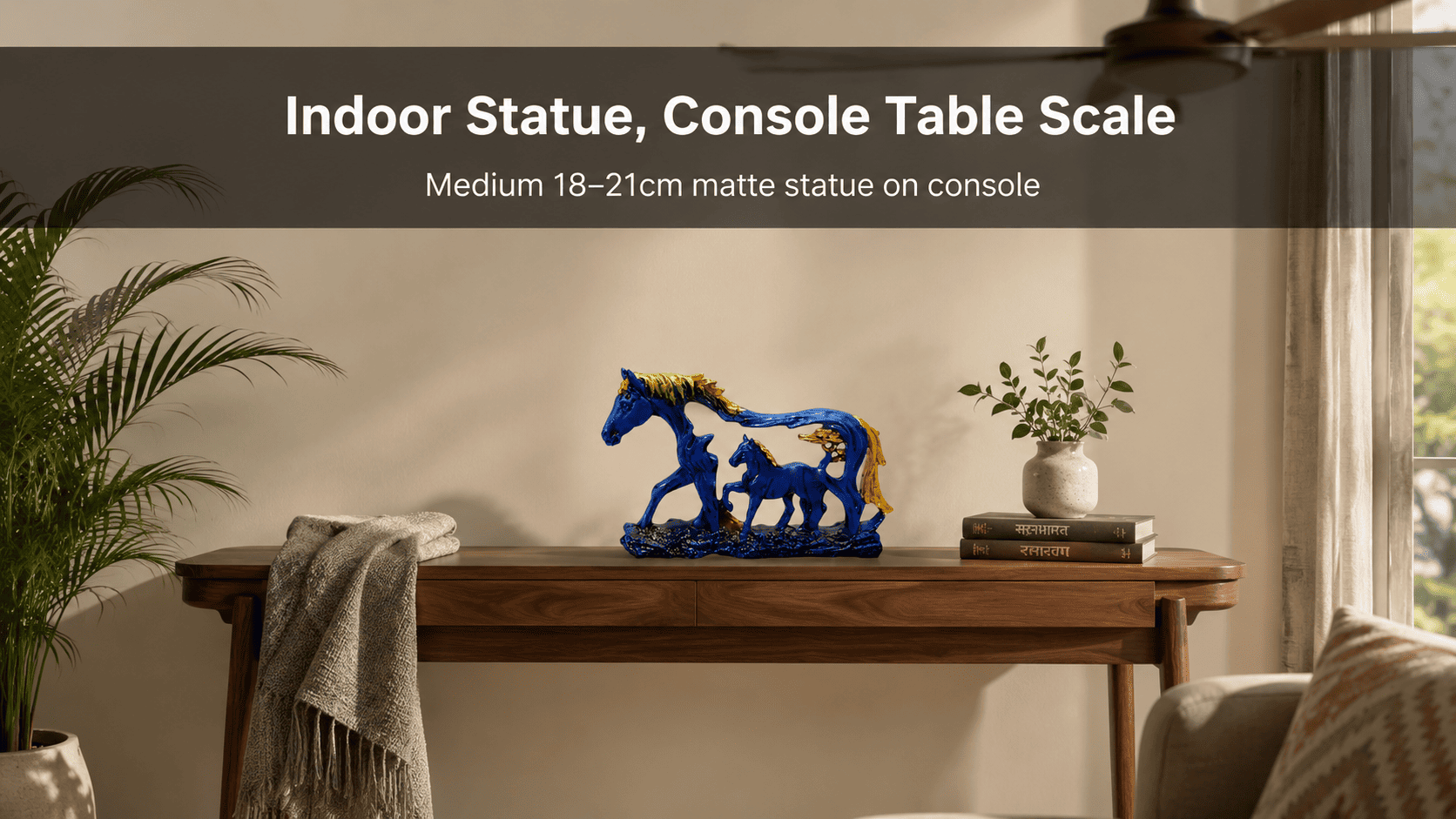
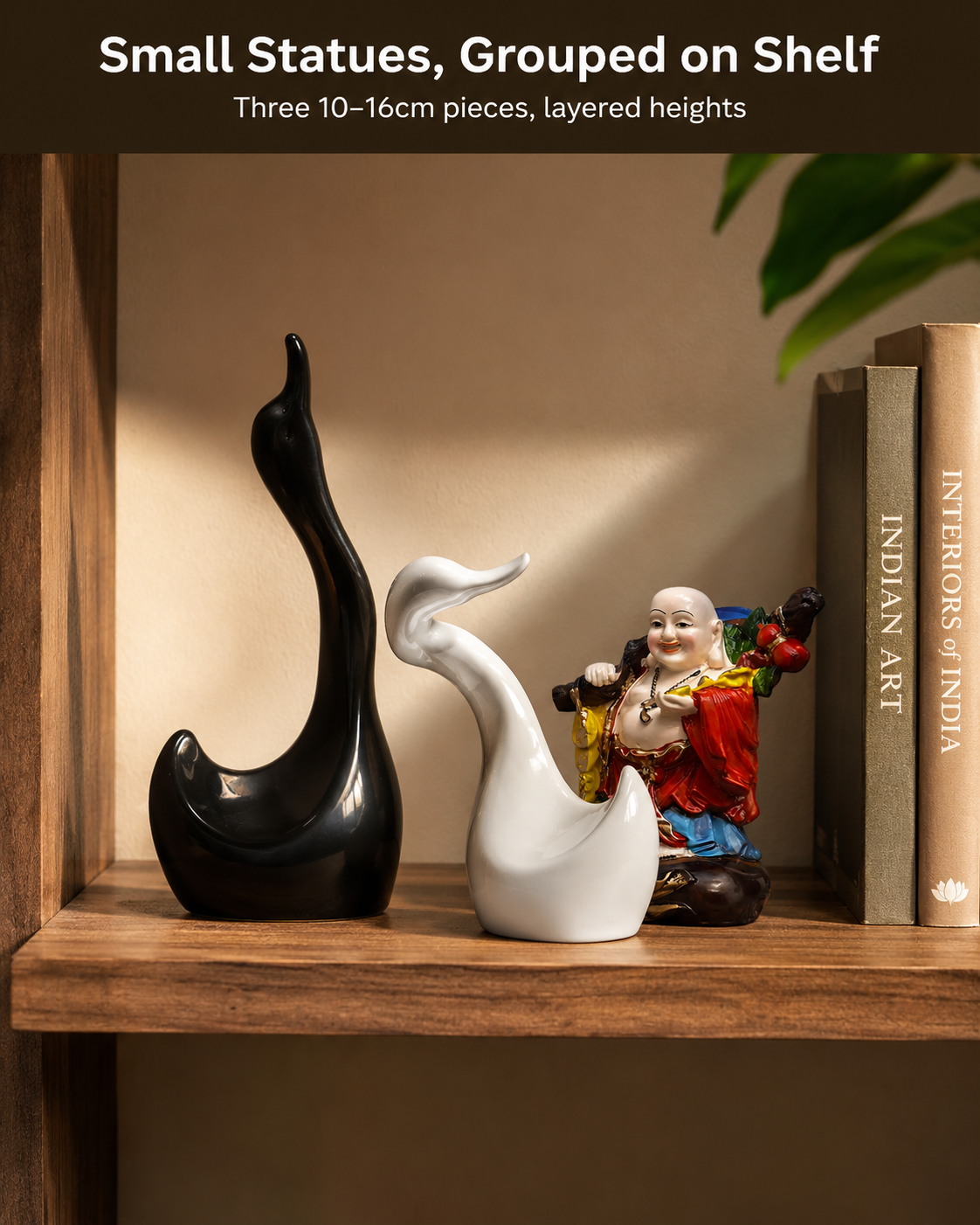
An indoor piece under roughly 20cm reads clearly on a console table or bookshelf because the viewing distance is short and the surrounding furniture sets the scale; a piece that size placed in an open garden bed would visually disappear against the landscape, hardscaping, and plant growth around it. This is why Moolwan's indoor décor collection is banded into Small (10–16cm, for shelves and desks), Medium (16–21cm, for consoles and coffee tables), and Large (25–34cm, for focal points) — each tier matched to a specific indoor surface width rather than an open-air footprint.
Outdoor garden statuary generally needs to scale up substantially beyond these indoor bands to remain visually anchored against soil, foliage, and walkway proportions, which is a separate sizing logic from anything built for a tabletop or shelf.
| Placement Zone | Primary Exposure Risk | Recommended Material Logic | Moolwan Size Band (Indoor) |
|---|---|---|---|
| Console table / shelf (indoor) | Dust, incidental knocks, ambient humidity | High-fired ceramic or hardened resin, decorative finish priority | Small 10–16cm |
| Coffee table / showcase (indoor) | Handling, ambient humidity up to 85% RH | Ceramic or resin with drop-resistance to 15cm fall height | Medium 16–21cm |
| Living room focal point (indoor) | Visual scale against larger furniture | Heavier resin/ceramic for stable footing on open floor surfaces | Large 25–34cm |
| Covered balcony / semi-outdoor | Indirect rain, partial UV, splashback | Weather-resistant sealants, materials rated for moisture beyond standard indoor RH | Not part of indoor band — needs outdoor-rated material |
| Open garden bed / walkway (outdoor) | Direct UV, full rainfall, ground moisture, frost in cooler regions | UV-stable, water-resistant, frost-tolerant outdoor-grade material | Not part of indoor band — needs outdoor-rated material |
Because finish, weight, and surface width all shift the right size band for a given spot, browse the full size, material, and finish selection across indoor and outdoor pieces in Moolwan's statues collection to match a piece to your exact placement.
Design Rule
Moolwan's Placement-First Material Rule holds that the placement zone — not the visual style — should determine material choice first: confirm whether a spot is fully indoor, semi-outdoor, or fully outdoor before selecting finish or size, since a statue correctly matched to the wrong exposure zone will degrade or look undersized regardless of how well its style suits the room.
Which finish and color choices hold up better in each zone?
Finish durability depends on what's attacking the surface: indoors that's mostly dust and oils from handling, outdoors it's UV radiation and standing moisture.
Matte indoor finishes resist visible wear longer than glossy ones because micro-scratches on a matte surface scatter light unevenly across the whole texture, so individual marks stay hidden within the existing pattern, while a glossy surface reflects light uniformly and makes every scratch stand out as a bright break in the reflection. This is a core reason Moolwan favors matte and lightly textured finishes across its indoor ceramic and resin pieces.
Outdoors, color-fastness under prolonged direct sun is the dominant concern: pigments that aren't UV-stabilized fade or chalk within a single dry season because ultraviolet radiation breaks down the chemical bonds holding pigment molecules in place, a process that simply doesn't occur at the much lower UV exposure levels inside a home. Choosing an outdoor-rated, UV-stable finish — rather than assuming any decorative paint will hold its color outside — is the deciding factor for long-term outdoor appearance, independent of which color or style is chosen.
Furnishing a console table, shelf, or living room corner? Shop the full Moolwan statues collection now and pick the size and finish engineered for your indoor space.
Does an outdoor statue need a different base or mounting approach than an indoor one?
Yes, because the ground conditions are entirely different: an indoor statue rests on a flat, dry, finished surface, while an outdoor statue sits on soil, paving, or gravel that shifts with moisture and temperature.
Indoor pieces only need a stable, flat base footprint wide enough to prevent tipping on a tabletop or shelf — Moolwan's drop-tested resin and ceramic bases are built for this controlled scenario. Outdoor placement introduces ground moisture wicking upward into a base material, soil settling unevenly beneath a heavy piece, and wind load on taller statues, all of which call for a wider or weighted base, proper drainage where relevant, and a material that won't absorb ground moisture over time — considerations that simply don't apply to a piece sitting on a dry console table.
Frequently Asked Questions
Can an indoor decorative statue be moved outside temporarily?
Brief, occasional outdoor placement during dry weather is generally lower-risk than permanent outdoor use, but repeated exposure to direct sun and any rainfall will accelerate fading and surface wear, because indoor ceramic and resin finishes are not formulated with UV-stabilizers or full water-resistance the way dedicated outdoor materials are. Moolwan recommends treating indoor pieces as indoor-only for anything beyond brief, supervised use.
Why do garden statues need a different size than tabletop statues?
Open outdoor spaces are viewed from greater distances and compete visually with plants, paving, and structures, so a statue needs more mass and height to register as a focal point — unlike a tabletop piece, which only needs to read clearly from a few feet away against a single piece of furniture.
What's the biggest mistake people make buying a statue for the wrong zone?
The most common mistake is choosing based on style alone and placing a delicate indoor-finish piece in a semi-outdoor spot like an open balcony, where splashback rain and direct sun cause fading or surface damage within a season — a failure that has nothing to do with the statue's design and everything to do with exposure mismatch.
Are ceramic or resin statues better for indoor humidity-prone rooms like bathrooms?
Both Moolwan's ceramic (92% clay, rated to 85% RH) and resin (94% purity) indoor lines are built to tolerate higher ambient indoor humidity, making either suitable for naturally humid indoor rooms, though full-time direct water contact still falls outside what any indoor-rated finish is designed for.
Matching the right material to the right placement zone is what keeps a statue looking new for years instead of needing seasonal replacement — a core focus of Moolwan's climate-aware design philosophy. If you're decorating beyond statues, also consider Moolwan's unique home décor pieces for one-off accent finds, or the broader modern home décor collection for coordinated room styling. Ready to choose the right piece for your space? Bring home a statue from the Moolwan statues collection — manufacturer-direct, sized and finished for Indian homes.


