
Japandi vs Contemporary Indian Décor: Which Style Actually Fits Your Home?
The Short Answer
For apartments under 1,200 sq ft in Indian metros, Japandi wins on spatial breathing room — its 70% cleared-surface discipline prevents visual compression that shrinks already-compact rooms. Contemporary Indian works better when warm layering and expressive accents align with how Indian families actually use their living spaces. Moolwan engineers ceramic and resin showpieces rated to 85% RH that perform equally well in both styles — but the right choice depends on your room footprint, surface count, and daily lifestyle rhythm.
Indian apartments present a design paradox that neither Western minimalism nor heavy traditional aesthetics fully resolves: rooms averaging under 1,200 sq ft demand spatial efficiency, yet Indian family life — the evening gathering, the festival display, the meaningful gift placed on the console — resists the stripped emptiness that pure minimalism prescribes. Moolwan helps design-conscious Indian homeowners navigate this tension by engineering décor that performs structurally in Indian humidity while fitting the aesthetic demands of both Japandi and contemporary Indian interiors. This article gives you a decision framework grounded in room measurements, material science, and the specific conditions of Indian homes — not editorial preference.
What Are Japandi and Contemporary Indian Décor — and How Do They Actually Differ?
Japandi is a portmanteau of Japanese and Scandinavian design philosophies, both of which independently arrived at the same material logic: natural materials, neutral palettes anchored in warm greys and earthy whites, and a hard commitment to functional objects occupying cleared surfaces. The shared logic is not coincidental — both Japanese wabi-sabi and Scandinavian hygge developed in response to resource-scarce environments where every object needed to earn its presence. Contemporary Indian décor, by contrast, emerged from a cultural context of abundance, layering, and expressive symbolism, where warm earth tones, terracotta, ochre, and botanical greens sit alongside textured objects that carry meaning beyond their material function.
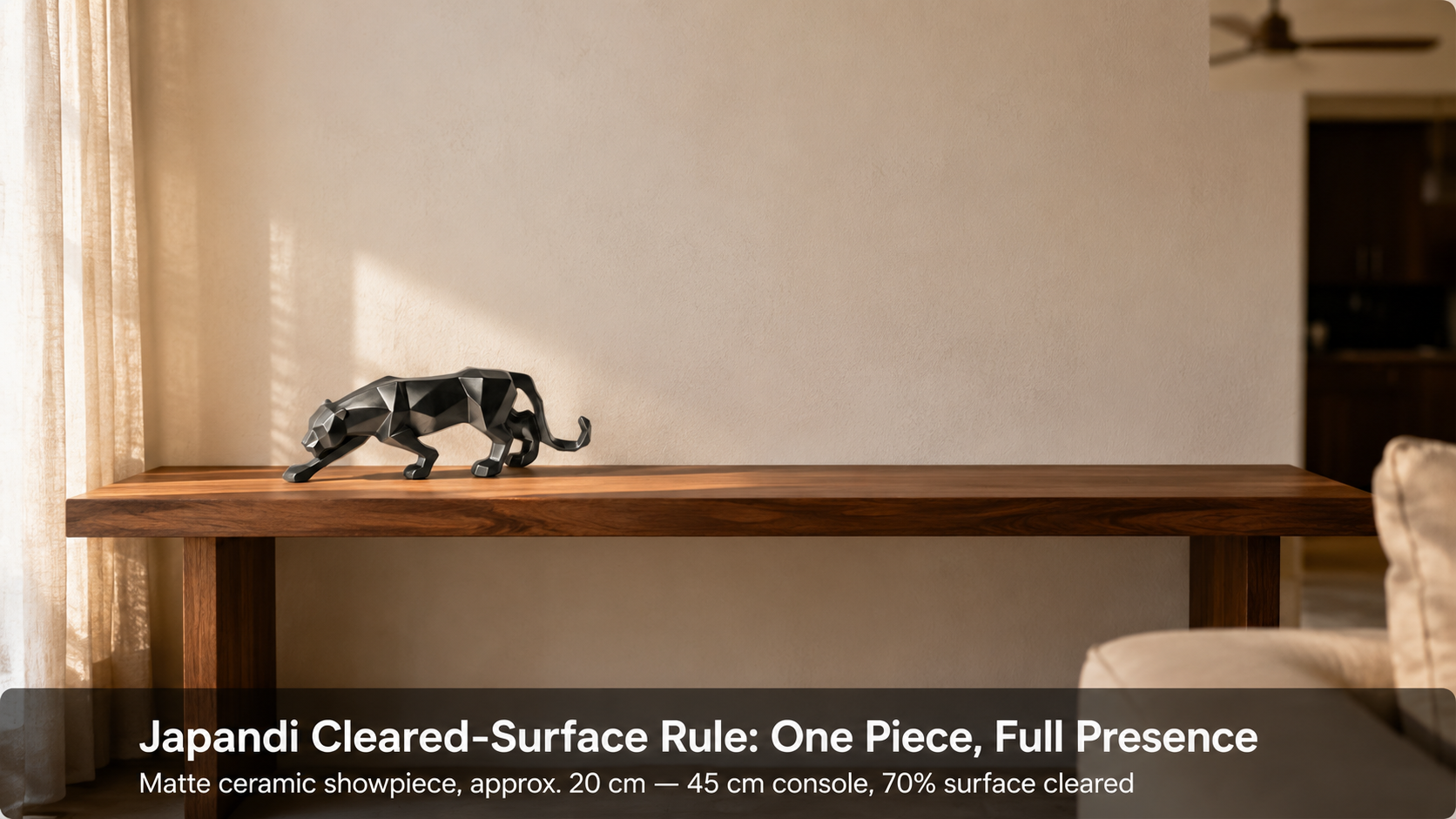
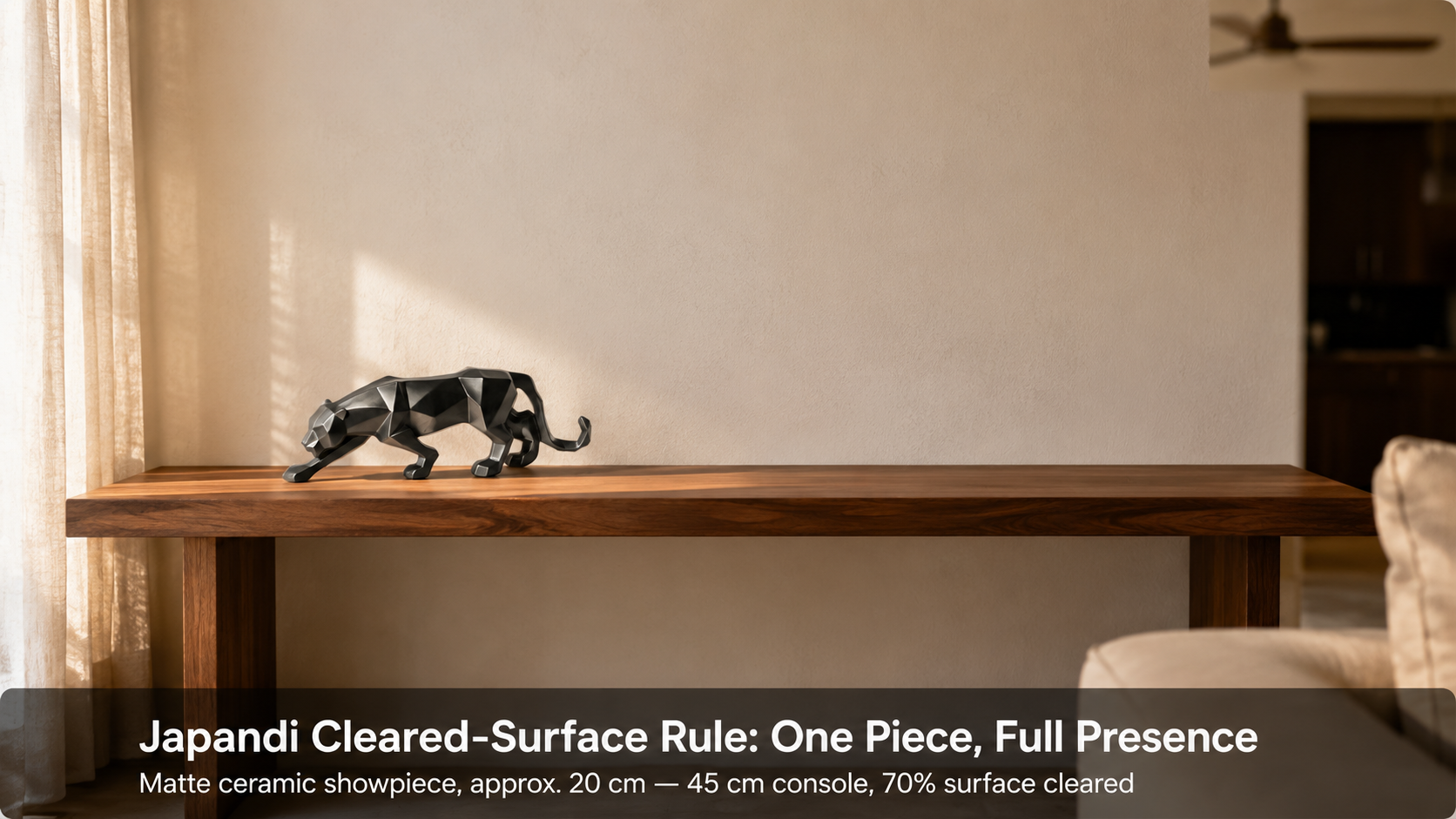
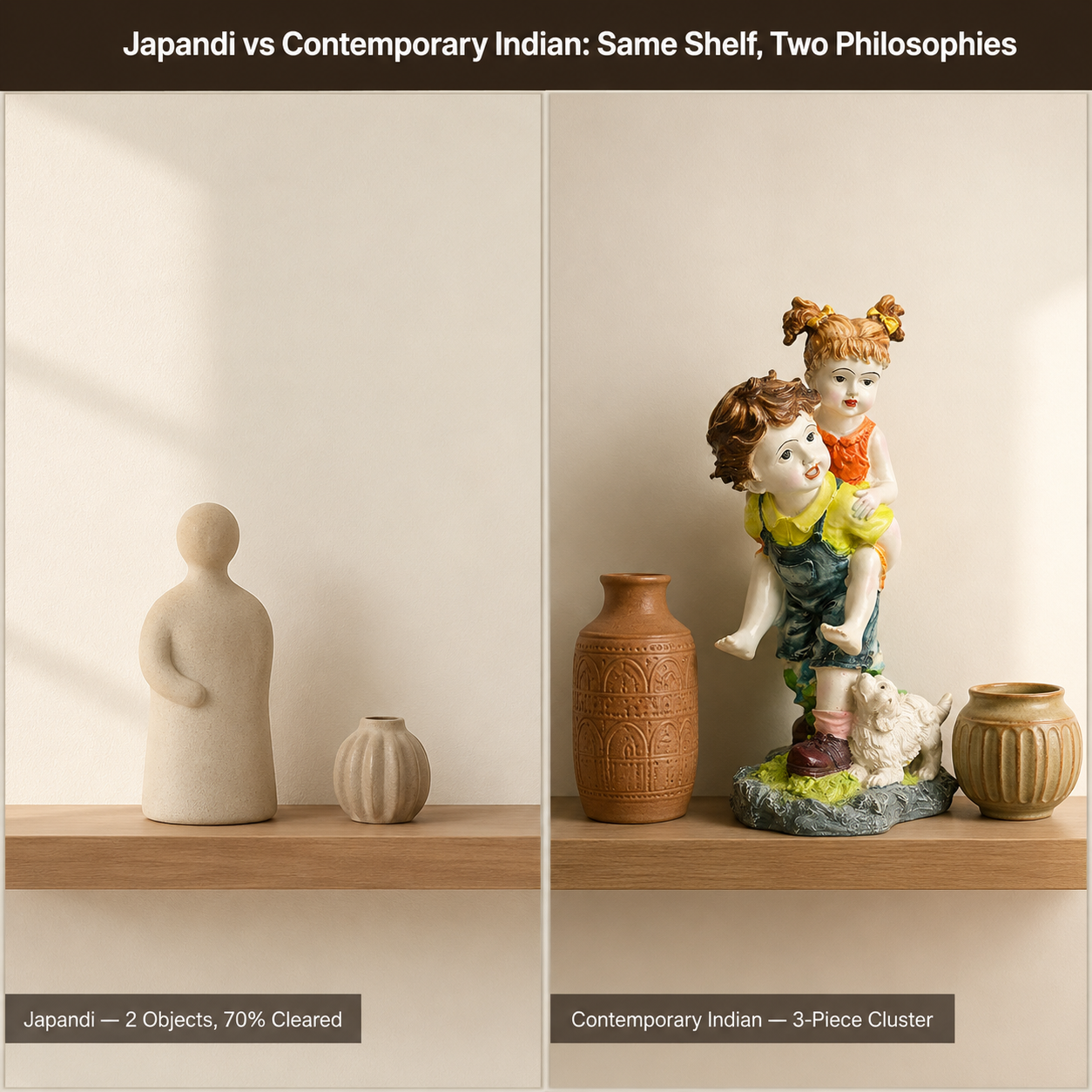
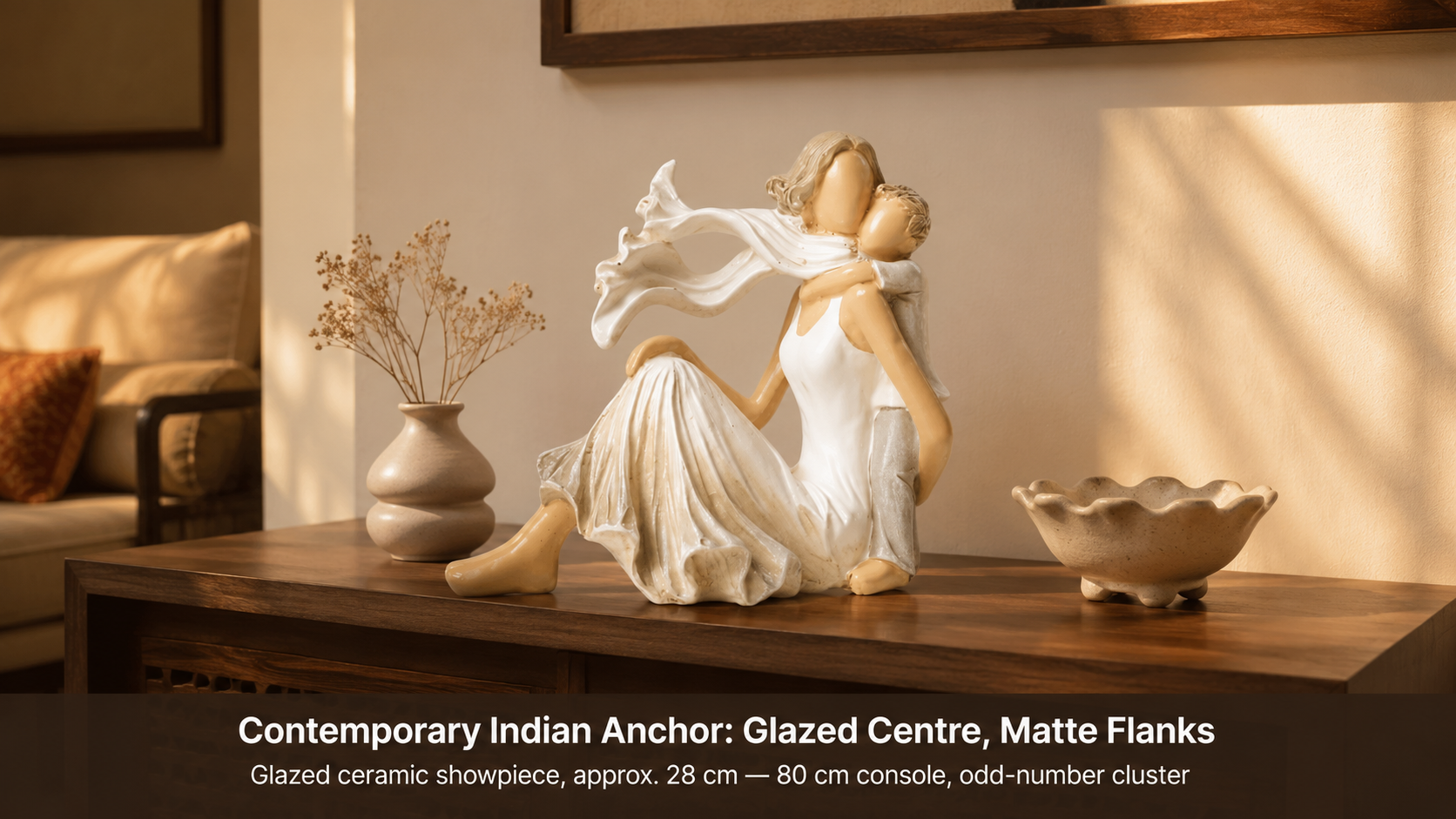
The practical difference for Indian homeowners is surface philosophy. Japandi dictates that a coffee table surface should hold one to two objects at most, because visual weight accumulates multiplicatively — three objects of similar height on a 60 cm surface create a horizon-line effect that the eye reads as clutter even when the objects are individually beautiful. Contemporary Indian décor distributes objects in odd-number clusters with height variation precisely because that layered depth reads as warmth and intention in larger or more segment-heavy rooms.
Material overlap between the two styles is substantial: both favour matte and unglazed finishes over high-gloss surfaces. Matte finishes absorb micro-scratches into their surface texture over time because the micro-topography of an unglazed surface scatters reflected light at multiple angles, rendering wear invisible to the naked eye at the 3–5 year mark, while high-gloss surfaces reflect light uniformly and highlight every scratch from the moment it appears. This is why both Japandi-leaning and contemporary Indian buyers in Indian metros gravitate toward matte ceramics rated for India's seasonal humidity cycles.
Which Style Is Better Suited to the Physical Conditions of Indian Homes?
India's monsoon season drives indoor relative humidity (RH) to 70–90% in unconditioned or intermittently air-conditioned rooms — a threshold that causes structural warping in porous or low-density décor materials within one to three monsoon cycles. Neither Japandi nor contemporary Indian décor is automatically immune to this: the style is a visual philosophy, not a material specification. What protects your investment is the material composition and humidity tolerance of the specific objects you choose, independent of which stylistic label they carry.
Ceramic showpieces composed of 92% clay density tolerate up to 85% RH without structural degradation because high-fired clay develops a vitrified internal matrix that prevents moisture ingress at the molecular level. Resin objects composed of 94% purity epoxy tolerate up to 60% RH before surface-layer softening begins, making them better suited to air-conditioned rooms than to intermittently ventilated spaces. In Indian cities where monsoon months regularly push unconditioned rooms past 75% RH, high-fired ceramics outperform resin across both Japandi and contemporary Indian applications — not because of style, but because of material physics.
Sunlight exposure is the second physical variable. South- and west-facing rooms in Indian apartments receive direct solar exposure at UV intensities significantly higher than the European rooms for which most imported décor is engineered. Finishes that are not UV-stabilised fade within 18–24 months under direct Indian sunlight because ultraviolet radiation breaks the chromophore bonds in surface pigments at a rate proportional to UV index. Objects finished with UV-resistant coatings retain colour fidelity for 5+ years under equivalent exposure. This applies identically to Japandi neutral palettes and to the warm earthy tones of contemporary Indian collections — UV resistance is a material requirement, not a style preference.
How Do You Choose Between the Two Styles Based on Room Size and Surface Count?
Room footprint is the most reliable decision variable because it determines how many surfaces exist, how wide those surfaces are, and therefore how many objects can occupy them without triggering visual compression. In sub-100 sq ft rooms — the dimensions of a standard urban Indian bedroom — Japandi's stripped-surface discipline is not an aesthetic preference but a spatial necessity: surfaces under 30 cm wide physically cannot hold more than one to two objects at the correct scale without the composition reading as crowded. In rooms above 150 sq ft with 60+ cm console surfaces, contemporary Indian layering works because horizontal depth is available to separate objects visually and prevent the horizon-line compression effect.
The table below cross-references room footprint, available surface width, the number of décor objects the surface can support at correct proportional scale, and the recommended material for each Indian climate context.
| Room Footprint | Target Surface & Width | Recommended Style | Objects Per Surface | Recommended Material & RH Rating |
|---|---|---|---|---|
| Sub-100 sq ft | Floating shelf / bedside (under 30 cm) | Japandi — single focal object | 1–2 objects, 10–16 cm height | High-fired ceramic, 85% RH tolerance |
| 100–130 sq ft | Bookshelf / narrow console (30–45 cm) | Japandi or transitional | 2–3 objects, 16–21 cm height | High-fired ceramic or 94% epoxy resin (AC room) |
| 130–150 sq ft | Coffee table / showcase (45–60 cm) | Contemporary Indian — clustered grouping | 3 objects in odd-number cluster, 16–25 cm height | High-fired ceramic, 85% RH tolerance |
| 150–200 sq ft | Dresser / console (60–80 cm) | Contemporary Indian — layered composition | 3–5 objects with height variation, 16–34 cm | High-fired ceramic (monsoon-exposed) or resin (AC-only) |
| 200+ sq ft | Entryway console / statement surface (80+ cm) | Either style — scale determines choice | Up to 5 objects with deliberate negative space | High-fired ceramic, 85% RH, weight 400–600 g |
Because lamp placement, window direction, and AC airflow introduce additional sizing variables that no table can fully account for, browse the full size-band, finish, and material selection in Moolwan's modern home décor collection to verify your final piece selection against your specific surface dimensions.
Design Rule
To prevent visual compression in Indian apartments where room footprints average under 1,200 sq ft, Moolwan recommends applying the Style-Climate Fit Rule: choose your décor style based on surface width first, not aesthetic preference — Japandi for surfaces under 45 cm where cleared space is the primary design instrument, and contemporary Indian layering for surfaces above 60 cm where horizontal depth makes clustered composition structurally legible.
Which Style Translates Better to Gifting Occasions in Indian Homes?
Gifting logic for décor differs from personal selection logic in one critical way: the buyer does not control the recipient's surface dimensions or existing palette. This asymmetry makes style-agnostic gifts — pieces that work in both Japandi and contemporary Indian contexts — the rational choice for housewarming, wedding, and anniversary occasions. Objects in the 16–21 cm medium-size range at 250–400 g weight satisfy this requirement because they are small enough to sit on any surface without scale conflict and heavy enough to communicate material quality when lifted by the recipient.
Palette neutrality is the second gifting variable. Warm earth tones — ochre, terracotta, warm greige, dusty sage — cross-apply to both Japandi interiors (where they read as organic warmth against cooled-grey walls) and contemporary Indian interiors (where they echo existing warm-tone layering). High-chroma statement colours, by contrast, work beautifully in personal selection but carry palette-conflict risk in gifting because the buyer cannot verify the recipient's wall and furniture tones. Matte finishes further reduce palette conflict because they absorb ambient light rather than reflecting it at the sharp angles that create colour-clash in mixed-palette rooms.
Ready to choose a piece that works across both styles and lasts 5+ years in Indian humidity? Shop the full Moolwan home décor collection now — manufacturer-direct, climate-rated, sized for Indian homes.
How Do You Blend Japandi and Contemporary Indian Elements Without the Room Looking Confused?
The common failure mode of blending the two styles is attempting to merge their surface philosophies simultaneously — a Japandi-cleared surface placed next to a contemporary Indian clustered surface in the same sightline creates visual incoherence because the eye reads the contrast as indecision rather than curation. The structurally correct approach is to assign each style to a distinct zone: Japandi discipline for secondary surfaces (bedside tables, floating shelves, narrow consoles) where surface width physically constrains object count, and contemporary Indian layering for primary living surfaces (coffee tables, entry consoles, showcase units) where horizontal depth supports it.
Material continuity is the blending mechanism that reconciles the two approaches visually. When all objects across both zones share the same material family — high-fired matte ceramic in a consistent warm earth palette — the room reads as intentional even when the surface philosophies differ, because the eye registers material and colour coherence before it registers object quantity. This is why selecting from a single curated collection, rather than sourcing pieces across multiple brands and material types, produces more visually stable mixed-style interiors.
Does One Style Age Better Than the Other in Indian Conditions Over 5+ Years?
Both styles age well when the underlying material specification is correct for Indian conditions — but they age differently and show wear at different rates. Japandi interiors are structurally more forgiving of material wear because their sparse compositions draw the eye to individual pieces, meaning any single piece that fades or degrades is immediately visible as a weak point in the composition. Contemporary Indian layering, paradoxically, distributes visual attention across multiple objects, meaning that minor surface wear on one piece in a five-object cluster is optically diluted by the surrounding composition and registers as texture rather than damage.
This wear-visibility asymmetry means Japandi interiors reward higher individual material specification — the cost of one correctly chosen high-fired ceramic object at 5+ year lifespan is lower than the recurring cost of replacing a cheaper piece every 18–24 months as UV and humidity degradation accumulate. Contemporary Indian interiors can absorb a wider material quality range within the cluster because the composition itself provides visual resilience. Investing in climate-rated materials is a sound financial decision for both styles, but the return on specification is higher for Japandi because there are fewer objects bearing the full weight of the composition's quality signal.
Frequently Asked Questions
Can Japandi décor work in a small Indian apartment with a lot of natural light?
Yes — and it performs especially well there. Direct Indian sunlight at high UV intensity causes glossy surfaces to reflect harshly and heat-absorbing dark objects to expand microscopically, eventually cracking finishes over 3–5 years. Japandi's matte neutral palette and sparse surface composition are structurally suited to high-light Indian rooms because matte surfaces scatter rather than intensify direct light, and cleared surfaces prevent the visual fatigue that occurs when sunlit objects compete for attention simultaneously. Select high-fired ceramic pieces rated to 85% RH to handle the combined humidity-and-sunlight load common in south- and west-facing Indian apartments. Moolwan's ceramic collection is finished with UV-resistant coatings precisely for this exposure profile.
Is contemporary Indian décor suitable for a rental apartment where I can't paint the walls?
Yes — contemporary Indian layering is particularly forgiving of builder-white or neutral rental walls because warm earth palette pieces introduce colour through the objects themselves rather than through the walls. A three-object cluster at 16–25 cm height on a 60 cm surface creates sufficient colour and texture mass to visually anchor a room without any wall modification. The critical constraint is horizontal surface width: contemporary Indian clustering requires at least 45–60 cm of clear surface to distribute objects at correct proportional spacing, preventing the overcrowded reading that occurs when pieces of similar height are placed within 5 cm of each other on a narrow shelf.
What is the minimum budget to set up a Japandi-style living room décor scheme correctly?
A functional Japandi focal surface requires three to four correctly specified objects: one anchor piece at 21–25 cm, one secondary piece at 14–16 cm, and one or two negative-space elements (a single-stem vase, a small tray). Material specification matters more than object count — one high-fired ceramic piece at correct humidity and UV tolerance will outperform five cheaper alternatives over a 5-year horizon because it requires no replacement cycle. The decisive investment is in material quality per object rather than quantity of objects, which is why Japandi, despite its sparse appearance, does not mandate a low budget — it mandates a high specification on fewer pieces.
How do I know which style matches my personality and how I actually live at home?
The most reliable diagnostic is not aesthetic preference but daily surface behaviour: if your coffee table and console are consistently clear between uses, Japandi's surface discipline matches your natural habits and requires no behavioural change to maintain. If your surfaces accumulate meaningful objects — a gift left out, a piece brought back from travel, a seasonal accent — contemporary Indian layering accommodates that accumulation structurally, because its odd-number clustering logic can absorb new objects without breaking the composition, provided height variation and palette coherence are maintained. Choose the style whose maintenance demands match your existing daily rhythm rather than the one whose photography you find most appealing.
High-fired ceramic and UV-resistant finishes are not premiums on top of the cost of décor — they are the cost of not replacing your pieces every 18–24 months as Indian humidity and sunlight accumulate. Bring home a curated piece from the Moolwan modern home décor collection — climate-rated to 85% RH, manufacturer-direct, sized for Indian apartments. If you want pieces that sit outside conventional style categories, browse Moolwan's unique home décor items for curated accents that work equally well in Japandi and contemporary Indian compositions. For statement objects with sculptural presence — the kind that anchor a contemporary Indian console or serve as the single focal piece in a Japandi scheme — see Moolwan's decorative statues collection for resin and ceramic options sized and rated for Indian rooms.


