
Krishna-tastic Gokul Groove: 5-Panel Framed Wall Art
You may also like

Moolwan 5-Panel Krishna Vinyl Wall Art on MDF (127x76cm) – Luminous Centre-Focal Krishna Composition with Jewel-Toned Vrindavan Figures
You've found a Krishna composition you like. You may have shown it to family members already. You may have measured your wall twice. But five panels feel different from one painting — and you can't fully picture how separate panels will read together on your actual wall.
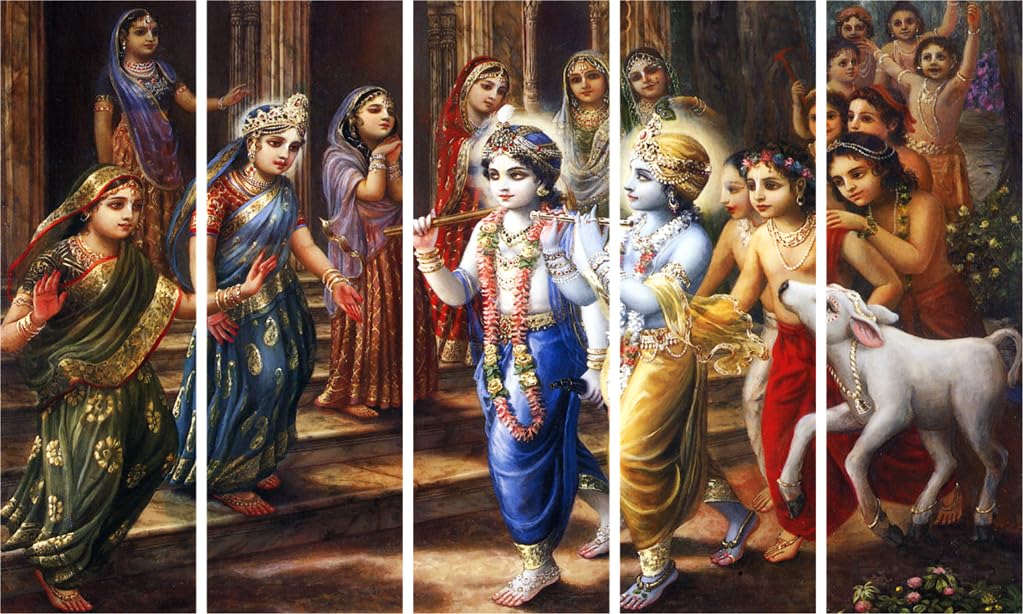
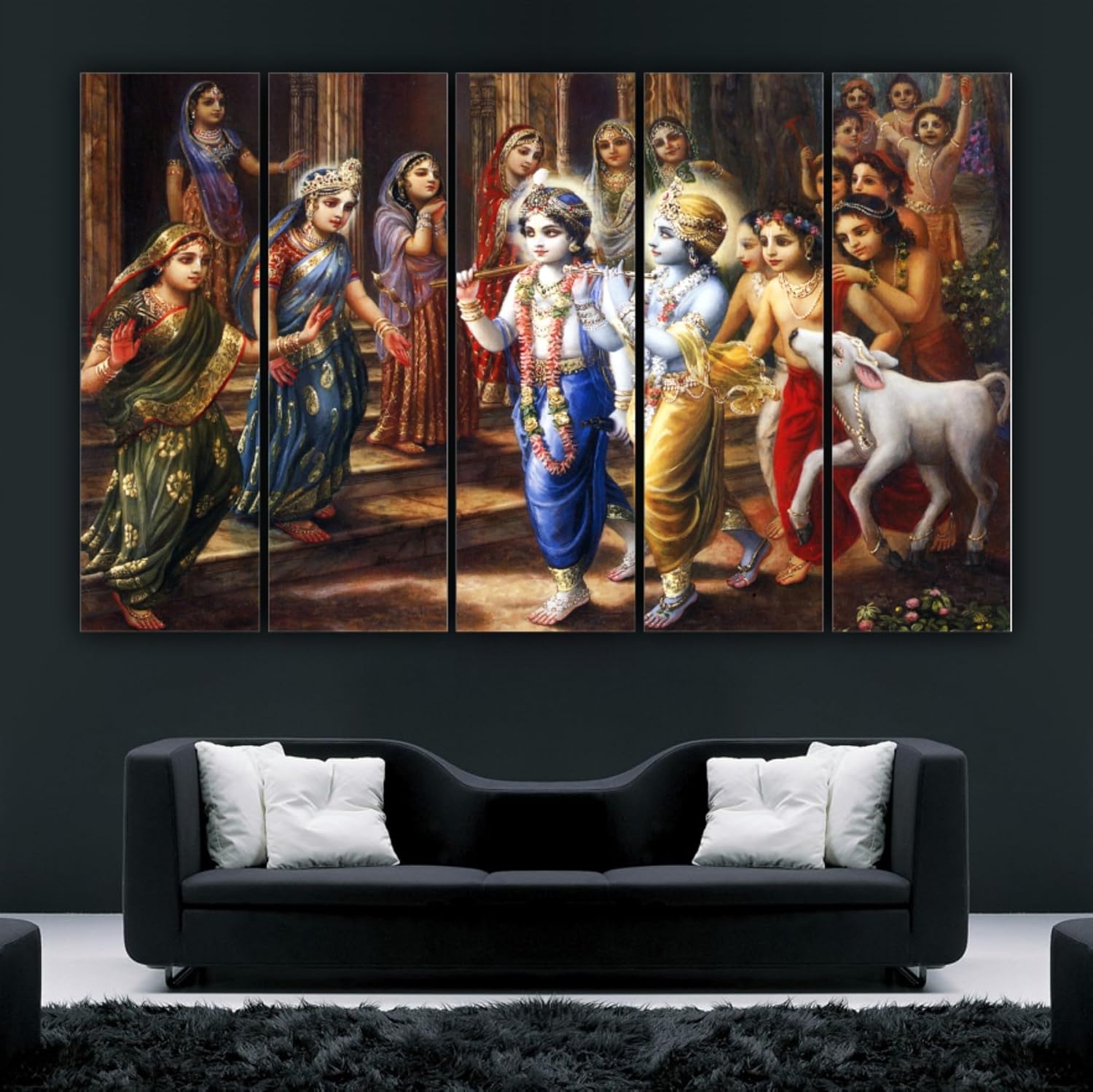
Here is what you are deciding: five panels, each approximately 24cm wide, spanning 127cm with narrow gaps between them. From normal sofa-viewing distance of 8–10 feet, those gaps disappear. What you see is one unified devotional scene — child Krishna in white at the centre playing flute, jewel-toned gopis arranged on his left, Balaram and celebrating children flowing toward the right, a white calf completing the far edge.
That centre figure is what makes this work. Krishna appears almost backlit — the white and pale-blue tones of his form stand out against the deep forest-green, red-maroon, and violet-purple of the surrounding sarees. Your eye goes straight to him, then travels across the narrative. The composition does the work of anchoring the wall before you have arranged a single piece of furniture below it. The 127cm width on a 10–12ft wall creates a focal point, not a crowded installation.
Why 127cm Works on 10–12ft Walls (and What Changes If You Size Up or Down)
A 12-foot wall (360cm) with this canvas: 127cm of coverage, approximately 116cm visible on each side. Coverage ratio: 35%. At that ratio, a piece reads as a deliberate focal point — not a tentative accent, not an overwhelming installation.
Above a 6–8ft sofa (180–240cm), the canvas extends slightly past the sofa width. That is intentional. The canvas appears anchored to the furniture beneath it, not floating independently on the wall. From your room entrance, eye goes to canvas first, then to seating. That is the correct visual hierarchy for a living room.
Hanging height: bottom edge of the lowest panel approximately 20–25cm above your sofa's top cushion line. Canvas centre lands at roughly 150cm from the floor — the correct eye level for someone seated 8–10 feet away and for someone standing in the doorway.
The five panel gaps — approximately 1.5–2cm each — are pre-calculated in the hanging template. You do not measure or eyeball spacing. What these narrow gaps do: they prevent the composition from reading as a single heavy rectangle, while keeping the narrative continuous across all five panels.
At 76cm tall, this clears 8ft ceilings by a generous margin. For 10ft ceilings, standard hanging height leaves proportional negative space above the canvas — which helps the composition breathe rather than pressing against the ceiling line.
What These Colours Look Like on Cream Walls Under Warm LED (vs Morning Light)
The image shows a palette that behaves differently across Indian home lighting conditions.
The centre figure — child Krishna in white and blue, with a floral garland in warm reds and pinks — is the lightest element in the composition. In warm LED (3000K, most common in Indian homes), this figure catches the light and appears to glow slightly. In morning daylight, it reads as luminous and crisp. Both conditions suit devotional art.
The left-side gopis wear sarees in deep forest green, rich red-maroon, and a cooler violet-purple. These are not synthetic bright tones — they are deep, saturated versions of each colour, closer to how natural dyes read in traditional miniature painting. Against cream or off-white walls (the most common Indian apartment finish), these colours read as rich and considered. They do not clash with neutral walls; they give the wall a reason to exist.
The stone temple architecture in the background — warm ochre and grey-brown columns — is critical to how this composition works in Indian interiors. Unlike Krishna paintings with generic pastoral green backdrops, this Vrindavan architectural setting creates visual depth and formal separation from the wall behind it. The canvas reads as its own environment, not as a flat decoration pressed against your wall surface.
Against brown wooden furniture below — console tables, pooja shelves, TV units — the warm ochre stone background creates a natural tonal bridge. The canvas and the furniture below it feel compositionally connected rather than independent.
In evening warm LED: gold jewellery detail throughout the composition — bangles, maang tikka, necklaces, Krishna's floral garland — catches light and appears dimensional. This is the best viewing condition. Guests visiting in the evening see this canvas at its most vivid.
Installing 5-Panel Vinyl Wall Art in Indian Concrete and Drywall Apartments
Five panels means ten anchor points — two per panel. The hanging template is a single paper sheet showing all five panel positions with every drilling mark pre-placed. You tape it to the wall at your target height, mark through the holes, remove the template, and drill. Panel spacing is already calculated. You are not estimating gaps.
For concrete walls (most Indian apartment construction): 6mm masonry bit, 35mm deep holes. Insert the included concrete anchors, screw in hooks, hang panels left to right using the pre-attached D-rings.
For drywall: 6mm bit, 30mm deep. Use the included drywall anchors.
Alignment across five panels: hang the centre panel first — this is your reference. The two flanking panels follow. The template ensures hook positions are level across all five, but if your wall has a slight slope, correct at the centre panel before proceeding to the outer two.
Total wall damage: ten 6mm holes, each 30–35mm deep. When vacating a rental: fill with standard wall putty (₹50 at any hardware store), sand, touch up with paint. Twenty minutes of work. No landlord will notice these after patching.
Weight per panel: approximately 600g. Drywall anchors included are rated for 2kg each. Each anchor carries 30% of its rated load. This installation is structurally safe in both concrete and modern drywall construction.
Total installation time: 25–30 minutes including levelling checks.
5-Panel Krishna Vinyl Wall Art vs ₹800 Marketplace Prints: What the Price Difference Buys
At ₹2,496 versus a ₹800 marketplace multi-panel Krishna set, the gap is not margin — it is material and life expectancy.
Cheap marketplace multi-panel sets at ₹800–₹1,200 are typically printed on 180–200 GSM canvas with dye-based inks on untreated 0.75-inch wood frames. For devotional art specifically, print quality matters more than for abstract pieces — fine detail like jewellery, facial expressions, and saree border patterns require resolution that dye-based inks on low-GSM canvas cannot hold. The gold jewellery in this composition, the intricate floral garland on Krishna, the individualised gopi faces — on a cheap print substrate, these details flatten and blur. The gold reads as yellow-brown. The jewellery reads as smudged suggestion rather than detail.
Splash-proof vinyl on MDF holds colour saturation at fine-detail scales differently from textile canvas. The vinyl surface has no weave to interrupt print resolution. What this means in practice: the fine detail that makes this composition look like traditional devotional art, rather than like a generic print, is preserved.
The other failure mode specific to multi-panel sets: differential warping. If even one panel in a five-panel set warps at the corners — which untreated wood frames do in Indian monsoon humidity within 6–12 months — the composition breaks. Gap widths become uneven. Panels tilt at slightly different angles. Devotional art that looks physically degraded is worse than a blank wall. MDF panels are dimensionally stable across humidity cycles.
The ₹1,696 difference between this and cheap alternatives is the composition looking the same three monsoon seasons from now as it does the day it arrives.
What This Will Actually Feel Like in Your Room
From the doorway (10–15 feet away): five panels read as one unified scene. The luminous Krishna figure at the centre is the first thing your eye finds — a clear focal subject, not a distributed decorative pattern. The jewel-toned gopis on the left and celebrating children on the right give the composition narrative direction that holds attention briefly before resolving. It reads as a scene with a beginning, centre, and conclusion.
Up close (2–3 feet): the Vrindavan stone columns become visible. Gopi faces are individualised — each holds a distinct expression. The gold jewellery has dimensional rendering. This is the appropriate viewing distance for prayer or quiet attention, and the print holds at this range.
Alongside a pooja shelf: this composition works best when the shelf is 2–3 feet to the side, not directly below the canvas centre. A 127cm canvas directly above a narrow pooja shelf feels top-heavy. On an adjacent wall, or with the shelf to one side, canvas and shelf form a complementary devotional corner rather than competing for visual dominance.
On a blank living room wall: the horizontal five-panel format makes the wall feel wider. This is a well-documented compositional effect of horizontal multi-panel art — it expands the perceived proportions of the room.
Moolwan Design Note
This composition centres child Krishna in white against richly dressed surrounding figures — the contrast between the luminous focal figure and the jewel-toned gopi sarees creates natural visual hierarchy across all five panels. Reproduced on splash-proof vinyl to hold the gold jewellery detail and deep saree tone saturation accurately at close viewing distances.
Moolwan Quality Standard
Designed for Indian apartments and lighting conditions. Packed for long-distance Indian transit. Quality checked before dispatch. Printed to resist humidity-related colour fading. Ships from West Bengal.
Moolwan Fit Guidance for Indian Homes
The 127cm five-panel span positions correctly on 10–12ft living room walls above 6–8ft sofas or console tables, with the horizontal composition making the wall feel intentionally composed rather than simply filled.
Quick Specifications
Product: Moolwan 5-Panel Krishna Vinyl Wall Art on MDF (127x76cm)
Brand: Moolwan
Category: Vinyl Wall Art on MDF
Collection: Krishna Wall Art Collection
Dimensions: 127cm (W) × 76cm (H)
Panel Configuration: 5 panels, each approximately 24cm wide
Material & Construction: Splash-proof vinyl print on MDF
Colours: Pale blue and white (Krishna), deep forest green, red-maroon, violet-purple (gopis' sarees), warm ochre stone architecture, gold jewellery accents, white calf
Best For: Living room above sofa or console on 10–12ft walls; hallway or foyer statement; prayer room adjacent wall
Ships From: West Bengal
Price: ₹2,496
Frequently Asked Questions
Will 127cm look proportional above my 7-foot sofa?
Yes. At 127cm, the canvas extends slightly past a 7-foot sofa's width — this creates the visual anchoring that makes wall art look placed rather than accidental. The 35% wall coverage on a 12ft wall leaves balanced negative space on both sides without the canvas looking undersized.
How do the colours appear in warm LED lighting versus morning daylight?
Under warm LED (3000K): gold jewellery catches light and jewel-toned sarees deepen — this is the best viewing condition for this composition. In morning daylight: blues and greens in the sarees appear crisp and vibrant. The white-toned Krishna figure remains luminous in both conditions.
I have never hung five-panel art before. Will the panels align correctly without expert help?
The included hanging template marks all ten anchor points across all five panels in one step. Hang the centre panel first as your reference, then work outward symmetrically. Total installation time is 25–30 minutes. No professional is required.
Will this hold up in high-humidity environments (Mumbai, Chennai, coastal cities)?
Splash-proof vinyl on MDF is dimensionally stable across monsoon humidity cycles. The print surface resists moisture absorption. This is structurally different from canvas on wood frames, which warp and loosen in sustained high humidity.
Can I hang this in a rental without damaging the wall meaningfully?
Ten 6mm holes, each 30–35mm deep. Fill with standard wall putty when vacating, sand smooth, touch up with paint. Repair takes approximately 20 minutes and ₹200 in materials. These holes are smaller than standard picture-frame nail holes after patching.
Product Snapshot
Brand: Moolwan
Product: Moolwan 5-Panel Krishna Vinyl Wall Art on MDF (127x76cm)
Category: Vinyl Wall Art on MDF
Collection: Krishna Wall Art Collection
Theme/Type: Devotional Krishna — Vrindavan scene with gopis, Balaram, and children with white calf
Best For: Living room above sofa or console on 10–12ft walls; hallway/foyer; prayer room adjacent wall
Primary Differentiator: Luminous centre-focal child Krishna composition — pale-toned figure anchors five-panel devotional narrative against jewel-toned surrounding figures
Secondary Differentiators: Jewel-toned saree palette with Vrindavan stone architectural background (not generic pastoral field); five-panel horizontal panorama creating visual movement and perceived room width
Material & Construction: Splash-proof vinyl print on MDF
Care Instructions: Dry microfiber cloth dusting only; no water, cleaning chemicals, or furniture polish
Ships From: West Bengal
Packing: Long-distance transit ready
Quality Check: Before dispatch
Price: ₹2,496