
Krishna-tastic Multi-Frame Framed Wall Art That'll Bless Your Space (127x76cm)
You may also like


Moolwan 5-Panel Krishna Vinyl Wall Art on MDF (127x76cm) – Panoramic Close-Up Portrait Composition That Reads as One Immersive Image at Room Depth
Three weekends of comparing sizes. The 90cm felt safe but too small for your living room. The 150cm felt right but potentially too large if your wall has a window nearby. You kept returning to 127cm—and you want confirmation before committing ₹2,496 to something you'll see every day.
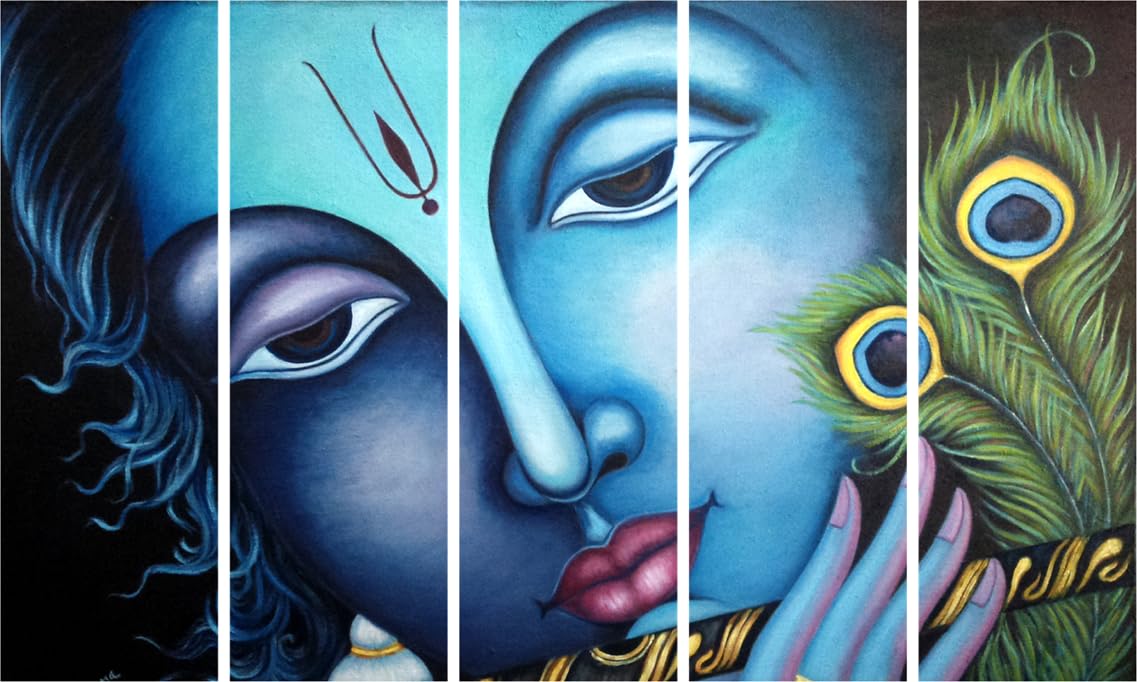
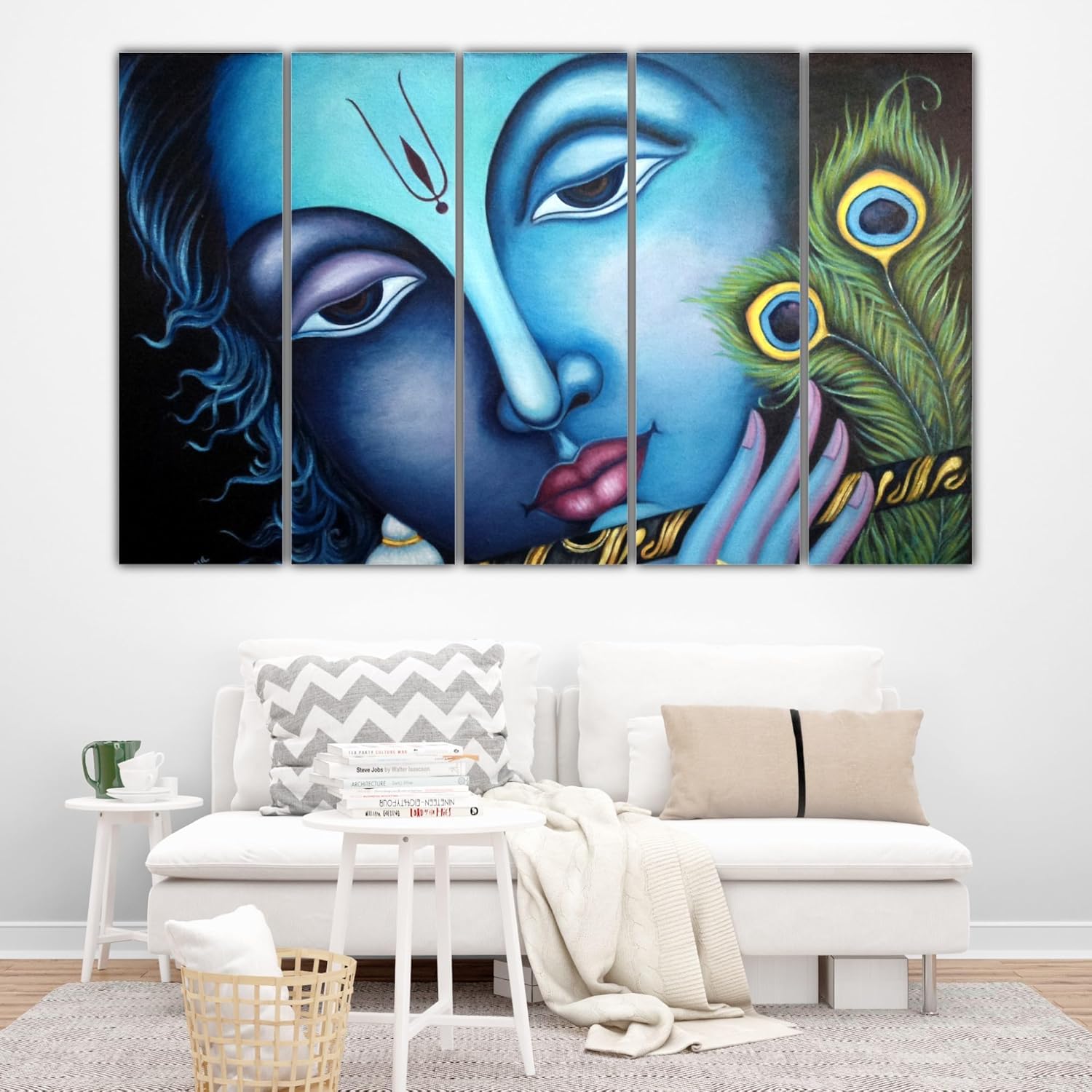
Here is what removes the uncertainty: this five-panel layout is not doing what a single 127cm canvas does. Five panels carry Krishna's close-up portrait from flowing hair on the left, through the contemplative eyes and the U-shaped tilak, past the flute-playing hand, and out to the vivid peacock feather on panel five. At typical living room viewing depth—3 to 5 meters—the inter-panel gaps compress to near-invisible lines. What reads is one continuous panoramic portrait, wide-framed and immersive, not a row of separate frames.
The close-up portrait scale is the primary differentiator here. Krishna's face occupies the full vertical height across four of the five panels. This is not a full-figure deity painting with background scenery. It is a face at 127cm—eyes, tilak, nose, lips—distributed panoramically. From across a room, it does not sit on the wall as décor. It reads as the wall.
The deep navy background provides total backdrop contrast against the cerulean skin tone. Against cream or off-white walls—standard in Indian apartments—this creates a layered depth field: wall, dark background, face. The peacock feather on panel five, with its vivid green fronds and gold-teal eye pattern, anchors the warm-spectrum counterpoint that prevents the dominant blue palette from reading cold in Indian interiors.
Why 127cm Works on 10–12ft Living Room Walls (and What Changes If You Size Up or Down)
On a 12-foot wall (360cm): 127cm of canvas, 116cm of breathing room on each side. Coverage: 35%. The canvas establishes clear focal dominance while leaving equal visual space on both sides. It anchors to whatever sits beneath it—sofa, altar shelf, console—without competing with adjacent windows or side furniture.
On a 10-foot wall (300cm): 87cm on each side. Coverage: 42%. Here the canvas reads as more dominant—appropriate for a dedicated pooja wall or a bedroom focal wall where a defined spiritual presence is the intent.
Above your sofa: Your sofa is probably 6 to 8 feet wide (180–240cm). Hang the bottom panel edge 20–25cm above the sofa cushion top. The 127cm width works across this full sofa range—against a 6-foot sofa, the canvas extends slightly beyond the cushion edges, which reads as intentional framing rather than mismatch. The canvas center lands at natural eye level for someone seated across the room or standing in the doorway.
Near your pooja area: A dedicated pooja wall is typically 6 to 8 feet wide. At 127cm, this canvas becomes the primary spiritual element of that zone—large enough to establish devotional presence, proportioned to coexist with a shelf altar below it rather than overwhelm it.
If you had gone with 90cm: Wall coverage drops to 25% on a 12-foot wall—135cm of open space on either side. The close-up portrait composition loses its impact at 90cm because the face detail becomes too small to read from doorway distance. It reads as an accent piece rather than a focal one.
If you had gone with 150cm: Coverage reaches 42% on a 12-foot wall. If your wall has a window within 60cm of the hanging zone or side furniture near the panel edges, 150cm starts to feel tight. It is the correct choice for uninterrupted 12-foot wall runs, but less forgiving of adjacent elements.
The five-panel construction adds one further dimension: each panel is approximately 24cm wide—portrait-proportioned. Up close, the gap lines add rhythmic structure to the composition. From 3+ meters, the composition reads as one unified panoramic image.
What These Colors Look Like on Cream Walls (Morning vs. Evening LED)
Krishna's skin in this composition is not a flat digital blue. The tonal range moves from deep navy-black in the hair and shadow areas through mid-tone cerulean across the face into sky-blue highlights on the forehead and nose bridge. It is a layered, shaded blue—dimensional, not flat. This is the visual difference between a painted surface and a printed one.
Against cream or off-white walls: Cream carries yellow-warm undertones. These shift the dominant blue slightly toward warmth, preventing the composition from reading as clinical or cold. Controlled contrast: the canvas stands out clearly from the wall without jarring against it.
The peacock feather does specific work: The fronds run vivid green through lime-green at the edges. The eye pattern contains teal, golden-yellow, and dark brown. These warm-spectrum elements interrupt the dominant cool palette throughout the entire composition—not just on panel five. This is the same principle that makes warm-accented abstracts work in Indian homes while cool-only abstracts often don't: there is always a warm anchor. Here, it occupies a full panel.
Supporting warm elements: The rose-red lips in panels three and four. The gold-tone flute along the lower right. The ivory pearl necklace near the neck. These read as distributed warm punctuation across an otherwise cool-dominant composition.
With brown or beige furniture: The peacock greens and gold flute tones connect naturally to wooden furniture—coffee tables, TV units, bed frames. The warm accents in the composition echo the wood tones without matching them. Visual coherence, not a coordinated colour scheme.
By lighting condition: In morning daylight, the blues read coolest and most serene—best for bedrooms or meditation corners. In afternoon sun, the gold and green tones intensify and the composition takes on energy. In warm LED evening light (3000K)—the condition under which most guests see your walls—the blues soften to rich tones and the rose-red and gold details become more prominent.
Installation in Indian Walls (Concrete vs. Drywall)
At 3kg total weight across two anchor points, each point carries 1.5kg. Standard 6mm wall anchors are rated for 5–7kg each. The load requirement here is not a structural consideration—it is a precision one. The challenge with five-panel sets is alignment, not weight.
For concrete walls (most common in Indian construction): Included concrete anchors, 6mm masonry bit, 35mm depth. Two points. The holes are 6mm diameter—smaller than curtain track installation holes or bathroom shelf brackets.
For drywall (modern apartment partitions): Included plastic wall anchors, same 6mm drill, 30mm depth.
For rentals: Two 6mm holes, 30–35mm deep. Standard wall putty (₹50 at any hardware store) fills both on move-out. Sand smooth, touch up with matching paint. Against the overall wall surface of an apartment, these holes are unremarkable. Your landlord will not notice.
The five-panel alignment reality: Unlike a single canvas, a five-panel set requires both vertical height consistency and lateral spacing accuracy across all panels. The included hanging template solves this: tape it to your wall at the desired height, mark through the guide holes, remove the template, drill. The template controls D-ring positions for all panels simultaneously—you do not estimate inter-panel gaps by eye. Use a spirit level to confirm both anchor marks are at identical heights before drilling the second hole. Once both hooks are set correctly, the panels align automatically.
5-Panel Vinyl on MDF vs. Wallpaper Krishna Decals
Wallpaper Krishna decals appear in the same search results and price range. The factual comparison:
Wallpaper decals: Applied directly to wall surface with adhesive—permanent or semi-permanent bond. Removal leaves residue and can pull paint or plaster sections, particularly on textured walls. In rental contexts, this is a direct deposit risk. Color reproduction depends on wall surface texture—rough walls produce air pockets and uneven colour. The print sits flat with no material thickness.
Vinyl print on MDF (this product): Hangs independently with no adhesive wall contact. Leaves two 6mm holes. Removable, rehangable, rental-safe. Vinyl on rigid MDF produces consistent colour independent of wall texture. The panels have dimensional thickness and material weight—they read as physical objects on the wall, not graphics applied to it. At 127cm scale, this distinction in visual presence is direct and immediate.
What This Will Actually Feel Like in Your Room
From the doorway (3–4 meter depth): Five panels read as one continuous panoramic portrait. Krishna's face spans center-left across four panels. The peacock feather occupies the full right panel. The composition is slightly left-weighted—hair and deep shadows—with feather counterbalance. Panel gaps compress to near-invisible at this distance.
Up close (1 meter): Portrait details become fully visible: the U-shaped tilak in dark maroon against the blue forehead, the white highlight along the nose bridge, the contemplative downward direction of the eyes, the hand cradling the gold flute. The panel structure is visible at this range as rhythmic structure, not interruption.
Does it dominate or complement? At 127cm on a 10–12ft wall, it creates focal dominance. It is the first thing a guest's eye goes to when entering the room. At 35% wall coverage on a 12-foot wall, there is significant breathing room—it does not crowd the space—but it does not sit quietly in the background either. If the intent is a statement piece for a focal wall, this behaves correctly.
Standalone or with adjacent décor? Best as a standalone. Do not hang additional frames within 60–70cm of the outer panels. The hair detail on panel one and the peacock fronds on panel five need clear wall space to read correctly. A console or low shelf directly below the central panels can complement without competing—provided it does not extend to the outer panel edges.
Moolwan Design Note
This five-panel composition isolates Krishna's face in extreme close-up across the full available height—a deliberate choice that prioritises meditative immersion over narrative context. The deep navy-black background operates as a void, eliminating visual noise and holding the viewer's attention on the portrait. The peacock feather is placed on panel five as a fully independent element rather than integrated into the face, giving it visual autonomy and colour-spectrum independence from the cool-dominant portrait panels.
Moolwan Quality Standard
Designed for Indian apartments and lighting conditions. Packed for long-distance Indian transit. Quality checked before dispatch. Printed to resist humidity-related colour fading. Ships from West Bengal.
Moolwan Fit Guidance for Indian Homes
At 127x76cm, this five-panel set fits living room focal walls in standard Indian 2BHK and 3BHK apartments—10 to 12ft wall widths—with 20–25cm clearance above sofa cushion tops and comfortable headroom under 8-to-10ft ceilings. For pooja-adjacent placement, centre the composition on the wall section behind or beside the altar shelf; at this scale, it establishes a devotional presence without visually replacing the altar itself.
Quick Specifications
Product: Moolwan 5-Panel Krishna Vinyl Wall Art on MDF (127x76cm)
Brand: Moolwan
Category: Vinyl Wall Art on MDF
Collection: Krishna Wall Art Collection
Dimensions: 127cm (W) × 76cm (H)
Weight: 3kg
Material & Construction: Splash-proof vinyl print on MDF, 5 panels
Colors: Deep navy, cerulean blue, sky blue, vivid green, gold-yellow, rose-red, ivory
Best For: Living room focal walls (10–12ft wide); pooja-area walls
Ships From: West Bengal
Price: ₹2,496
Frequently Asked Questions
Q: Will 127cm look proportional above a standard Indian sofa?
A standard Indian three-seater sofa is 6 to 8 feet wide (180–240cm). At 127cm, the canvas covers the central 53–70% of that width—within the 60–75% range that produces a visually anchored result. Hang 20–25cm above the sofa's top cushion edge.
Q: The composition is very blue. Will it look cold against my cream walls?
The composition contains three warm-spectrum elements distributed across all five panels: the peacock feather (vivid green and gold on panel five), the gold flute and rose-red lips (panels three and four), and the ivory necklace near the neck. Cream walls carry yellow-warm undertones that further offset the dominant blue. In warm LED evening lighting, the blues soften and the warm accent tones become more prominent.
Q: How do I keep five panels level and evenly spaced?
The included hanging template marks D-ring positions for all panels simultaneously. Tape the template to your wall at the desired height, mark through the guide holes, remove it, drill. Confirm both anchor marks are at identical height with a spirit level before drilling the second point. Once both hooks are set at the same height, the panels align without manual adjustment.
Q: Will the vinyl print survive Mumbai or Chennai humidity conditions?
Vinyl on MDF is splash-proof and the print surface is sealed. The MDF substrate does not expand and contract with humidity fluctuations the way stretched canvas fibres do. For walls receiving direct afternoon sun, the sealed vinyl surface prevents colour shift from extended UV exposure.
Q: Can this be hung in a rental without affecting the security deposit?
Two 6mm holes, 30–35mm deep. Standard wall putty fills both completely. Sand smooth, touch up with matching paint on move-out. These holes are smaller than those left by curtain rod brackets or bathroom shelf fittings. With standard patching, no visible trace remains.
Product Snapshot
Brand: Moolwan
Product: Moolwan 5-Panel Krishna Vinyl Wall Art on MDF (127x76cm)
Category: Vinyl Wall Art on MDF
Collection: Krishna Wall Art Collection
Theme/Type: Krishna devotional portrait — close-up face with Vaishnava tilak, flute, and peacock feather
Best For: Living room focal walls, 10–12ft width; pooja-area walls
Primary Differentiator: Panoramic close-up portrait composition across five panels — face, tilak, flute hand, and peacock feather read as one immersive image at room depth
Secondary Differentiators: Multi-tonal navy-to-cerulean blue depth reads as dimensional painted surface; peacock feather occupying dedicated fifth panel provides warm-spectrum counterpoint to cool-dominant portrait palette
Material & Construction: Splash-proof vinyl print on MDF, 5 panels
Care Instructions: Wipe surface with dry microfiber cloth; avoid water and cleaning chemicals on vinyl surface
Ships From: West Bengal
Packing: Long-distance transit ready
Quality Check: Before dispatch
Price: ₹2,496