
Luxury Home Decor Objects That Hold Up in Indian Humidity: A Material and Finish Guide
The Short Answer
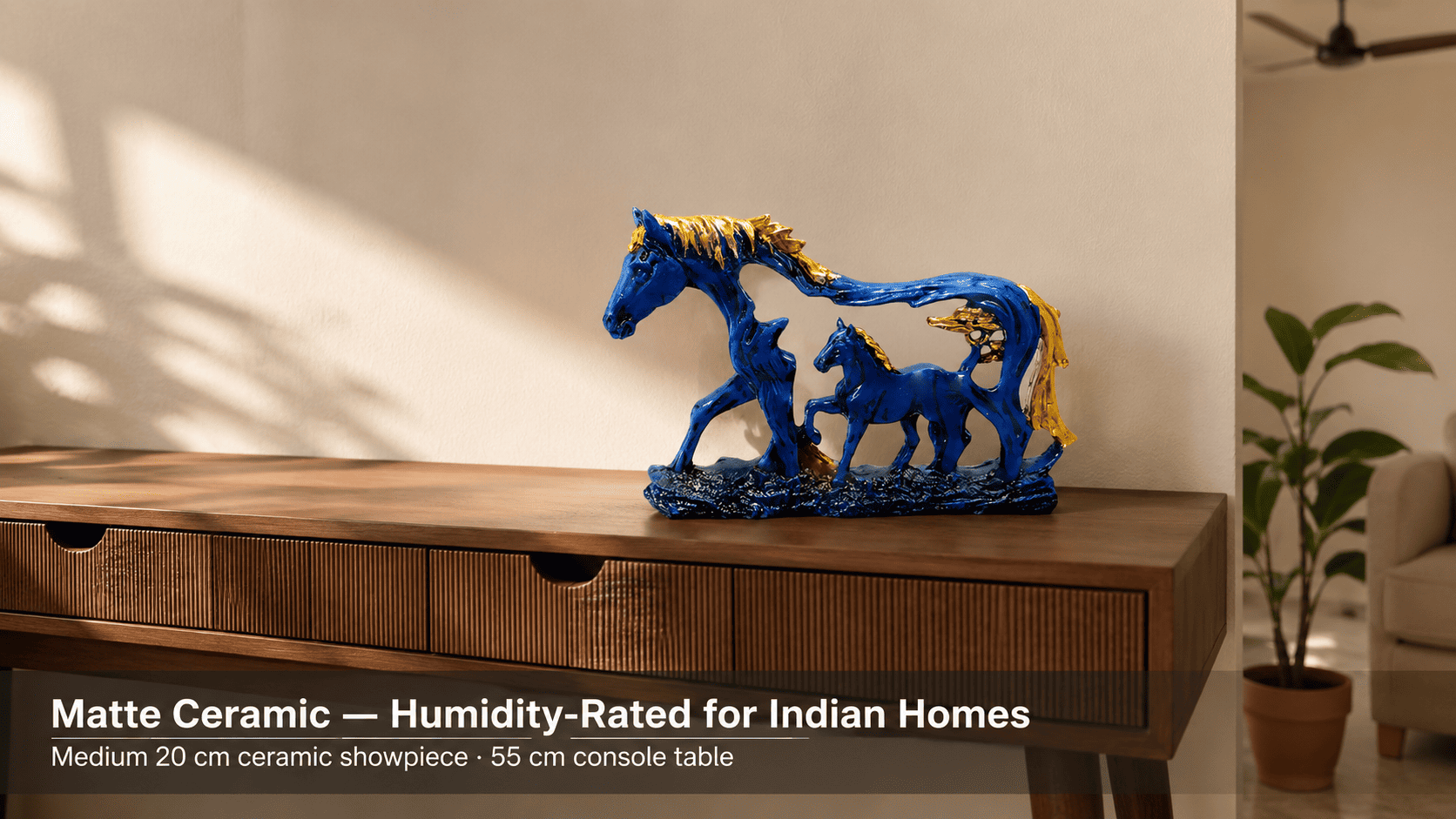
In Indian conditions where monsoon humidity can exceed 85% RH, only high-density ceramic (92% clay composition) and high-purity resin (94% epoxy) maintain structural integrity past the five-year mark — because lower-density alternatives absorb ambient moisture at the molecular level, causing micro-fractures and surface blistering. Moolwan's humidity-rated showpiece collection is engineered to both thresholds, in matte and glazed finishes, across small (10–16 cm), medium (16–21 cm), and large (25–34 cm) size bands.
India's tropical climate creates a décor problem that most global luxury brands have never had to solve: relative humidity can swing from 30% in a Rajasthan winter to over 90% in a coastal monsoon, often within the same calendar year. Moolwan helps design-conscious Indian homeowners choose showpieces and décor accents that are engineered for these extremes — not merely designed to photograph well in a European studio. The decorative objects market in India is projected to grow at over 9% CAGR through 2028, driven largely by homeowners who have been burned by warped, faded, or structurally compromised pieces they bought without a climate brief in mind.
Why Humidity Is the Primary Enemy of Luxury Décor in Indian Homes
At relative humidity levels above 65%, porous or low-density decorative materials begin absorbing moisture vapour through micro-channels in their surface structure. This absorption-desorption cycle — expanding slightly during monsoon months and contracting in dry season — generates cumulative micro-stress at the material's crystalline boundaries. Over two to three years, this stress manifests as surface crazing in low-fired ceramics, delamination in composite resin objects, and colour migration in painted finishes — rendering the piece visually degraded even when structurally intact.
High-fired ceramic with a 92% clay composition eliminates this vulnerability because the sintering process at temperatures above 1,200°C closes the majority of the material's internal porosity, reducing the moisture absorption coefficient to near zero. Moolwan's ceramic showpiece collection is fired to this exact specification, achieving a humidity tolerance of 85% RH — the ceiling required for unconditioned spaces in coastal metros like Mumbai, Chennai, and Kochi.
Resin objects present a different material equation. Low-purity resin (below 90% epoxy) contains residual plasticisers that migrate to the surface at temperatures above 30°C — a threshold exceeded for six or more months in most Indian cities — causing a progressive yellowing and surface tackiness. At 94% epoxy purity, with a 3H pencil surface hardness rating, the material resists both UV-driven colour shift and thermal plasticiser migration up to 35°C, making it suitable for well-ventilated living rooms and bookshelves throughout the subcontinent.
Ceramic vs Resin: Which Material Delivers Better Long-Term Value in Indian Conditions
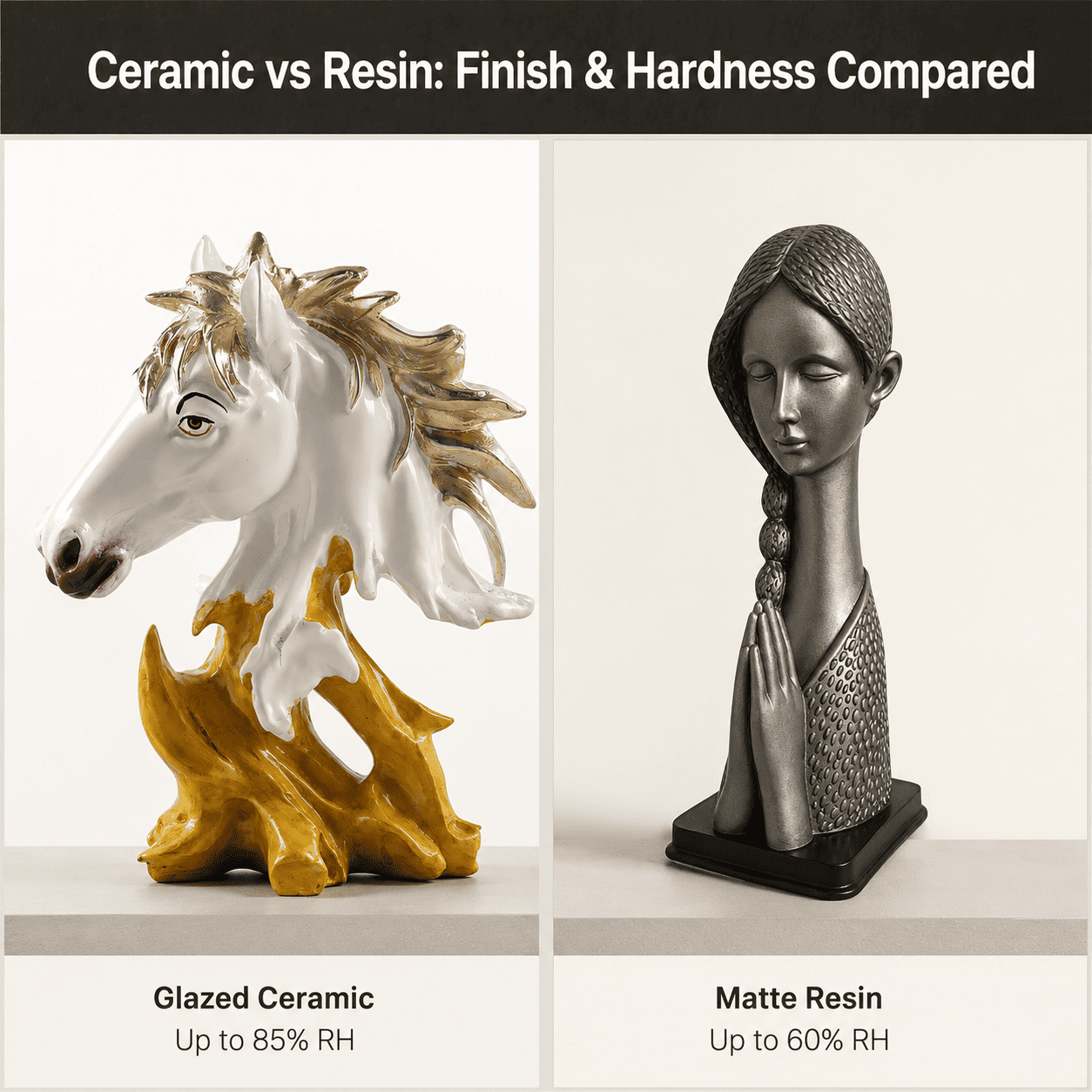
High-fired ceramic delivers superior humidity performance — tolerating up to 85% RH versus resin's 60% RH ceiling — making it the structurally safer choice for unventilated rooms, open balcony shelves, and coastal homes where condensation is common. Resin, by contrast, offers a weight advantage at the small end of the size range (150–300 g versus ceramic's 250–400 g for equivalent 10–16 cm pieces), making it preferable for floating shelves with load constraints, narrow console tops, and bathroom surfaces where accidental contact is likely.
The finish decision compounds the material choice. Glazed ceramic concentrates light into a narrow reflection angle, which produces a lustrous effect in controlled lighting but also reveals surface scratches and water-spot deposits more acutely because the glaze's uniform reflectivity amplifies any surface disruption. Matte ceramic scatters incident light across multiple angles simultaneously, so micro-abrasions and humidity-driven surface deposits remain below the threshold of naked-eye detection for a substantially longer period — typically three to five years in normal residential use. This is the core reason matte finishes are recommended for high-traffic horizontal surfaces such as coffee tables, dining sideboards, and open bookshelves, where daily contact with fabrics, cleaning cloths, and stacked objects introduces continual micro-abrasion.
Investing in climate-rated materials prevents the replacement cycle that erodes the economics of luxury décor. A high-fired ceramic piece purchased once at a direct-to-consumer price point, requiring no replacement at year two or year three, delivers a lower total cost of ownership than a cheaper low-fired alternative replaced every eighteen months — a core element of Moolwan's climate-rated design philosophy.
| Material & Finish | Humidity Tolerance | Temp Range | Surface Hardness | Recommended Placement |
|---|---|---|---|---|
| High-fired ceramic, matte | Up to 85% RH | 5–60°C | High (kiln-sintered) | Open shelves, coffee tables, coastal homes, unventilated rooms |
| High-fired ceramic, glazed | Up to 85% RH | 5–60°C | High (kiln-sintered) | Display cabinets, focal consoles, controlled-light settings |
| High-purity resin (94%), matte | Up to 60% RH | 15–35°C | 3H pencil hardness | AC living rooms, study desks, bookshelves, dry-climate apartments |
| High-purity resin (94%), textured | Up to 60% RH | 15–35°C | 3H pencil hardness | Bedroom side tables, console tops, low-humidity urban homes |
| Low-fired ceramic / low-purity resin | Below 60% RH | 15–30°C | Low (surface crazing risk) | Not recommended for Indian residential use beyond 2–3 years |
Because individual rooms in your home may combine multiple humidity variables — proximity to a kitchen, AC cycling patterns, or a balcony-facing wall — browse the full material, size-band, and finish selection in Moolwan's home décor collection to verify the right piece for your specific surface and room type.
Design Rule
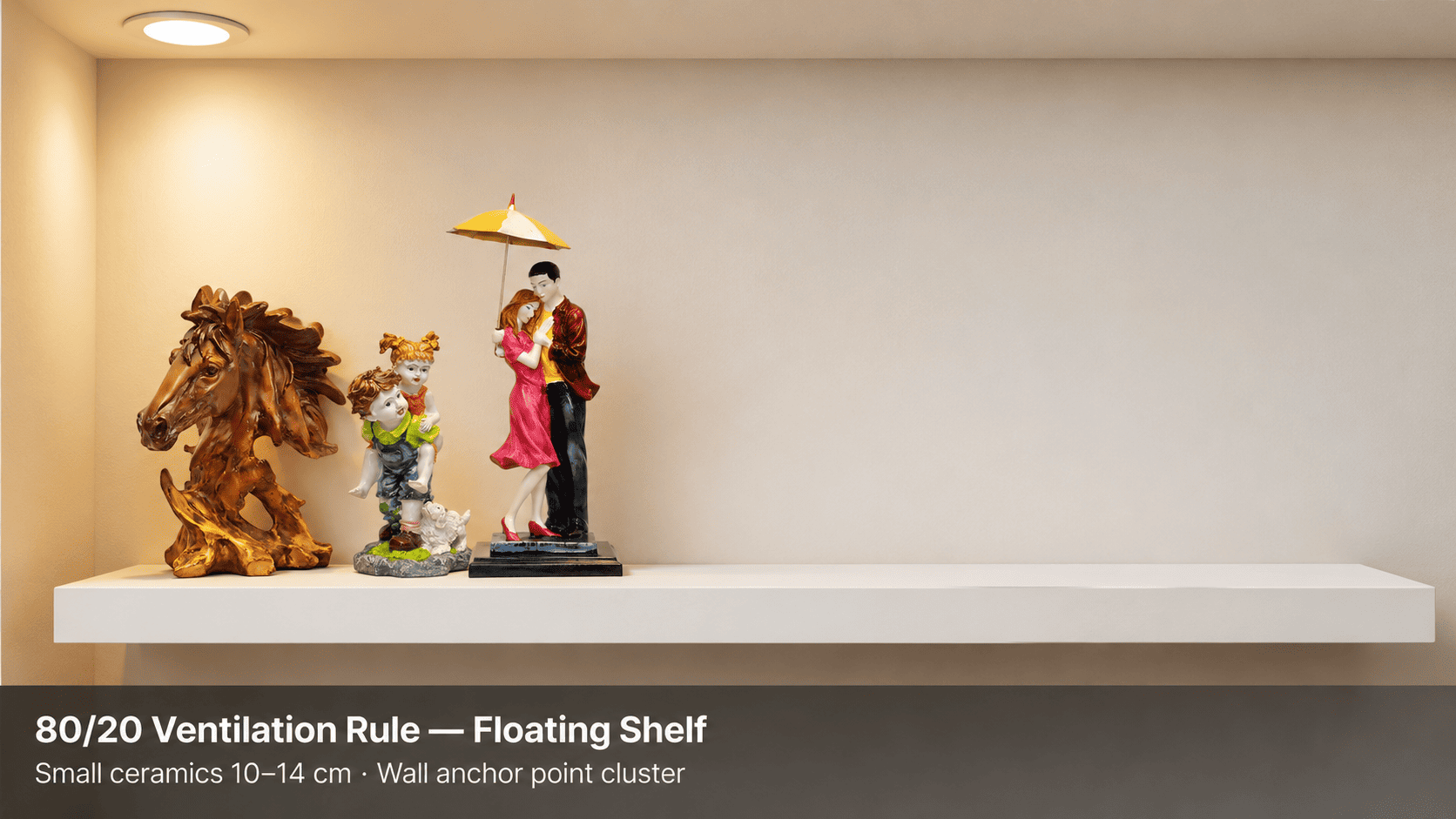
To prevent moisture-trapping and visual compression on compact Indian surfaces, every horizontal display should follow Moolwan's 80/20 Surface Ventilation Rule: keep 80% of the surface entirely clear to allow air circulation around the object — which reduces localised humidity pooling at the base of a showpiece — and cluster décor only within the remaining 20%, which also creates a visually deliberate focal point rather than a cluttered spread.
How to Choose the Right Size Showpiece for Indian Room Scales
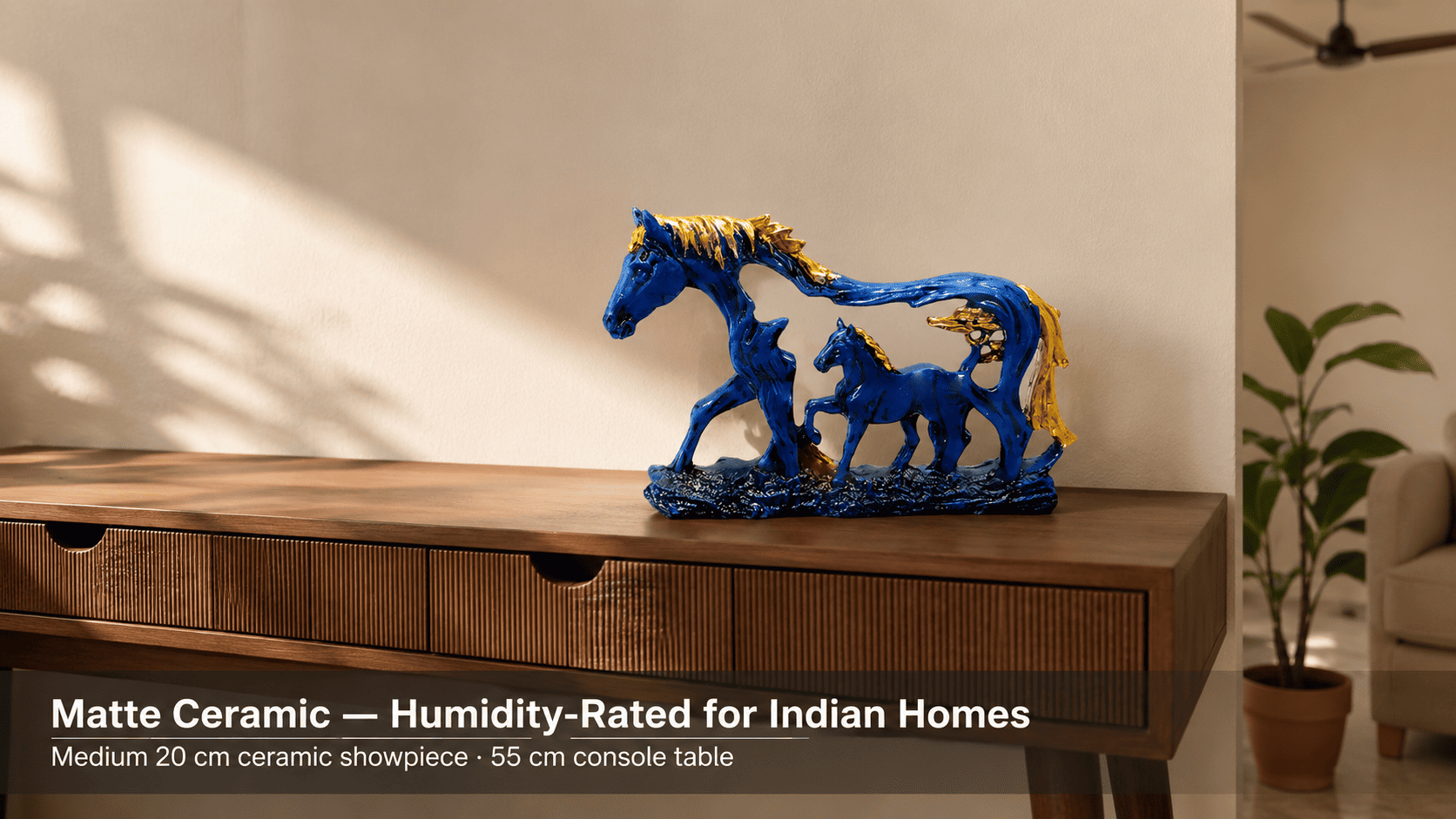
Indian urban apartments average under 1,200 sq ft of total floor area, and individual rooms are proportionally compact — a standard living room in a 2BHK Mumbai flat typically measures 140–180 sq ft. At this scale, an oversized décor object — a large showpiece above 34 cm on a 30 cm coffee table — creates visual compression: the object's vertical height exceeds the table's horizontal span, producing a top-heavy composition that reads as cluttered rather than curated, even when the piece itself is of high quality.
The inverse error — placing a 10 cm small piece on a 60 cm+ console — allows the object to visually dissolve into the surface, negating the investment in a statement accent. The sizing principle is scale-correspondence: the object's height in centimetres should not exceed the surface's shortest horizontal dimension in centimetres, and should fall between 25% and 50% of that dimension for a balanced single-piece placement. A 25 cm large showpiece on a 60 cm console (roughly 42% of surface width) anchors the surface without dominating it.
Ready to buy a showpiece that's rated for Indian humidity and sized for your room? Shop the full Moolwan home décor collection — manufacturer-direct, climate-rated, and sized for Indian apartments.
Which Finishes and Palettes Age Best in Indian Light and Heat
India's average direct solar irradiance is among the highest in the world — between 4.5 and 6.5 kWh per square metre per day depending on latitude — making UV-driven colour degradation a significant long-term risk for interior décor placed near windows or on surfaces that receive three or more hours of daily indirect sunlight. Pigment systems in low-fired ceramics and low-purity resins without UV-inhibitor coatings typically begin measurable colour shift (delta-E greater than 3, which is perceptible to the human eye) within 18 to 24 months of regular indirect solar exposure.
Warm earth and neutral palettes — terracotta, warm greige, off-white, muted sage — age more forgivingly than saturated jewel tones under these conditions, because colour shift in earth-pigment ranges moves along a natural warm axis (slightly deeper or more amber) that reads as patina rather than fading. Saturated blues, emerald greens, and cobalt hues, by contrast, shift toward grey under prolonged UV exposure, producing a visually degraded version of the original colour with no redemptive character. High-purity resin with UV-inhibitor compounds and high-fired ceramic with colour-stable mineral oxides in the glaze formulation both resist this shift, extending the lifespan of coloured finishes substantially past the five-year mark.
Drop-Testing, Weight, and Placement Safety on Indian Surfaces
Indian homes mix stone, marble, and tile flooring — all high-density surfaces with near-zero impact absorption — making drop resistance a practical specification, not a marketing claim. A decorative object dropped from a 15 cm height onto a granite floor (representing the typical distance from a coffee table surface to the floor at the object's centre of gravity) generates an impact force proportional to the object's mass and the floor's elasticity coefficient. Because granite and marble reflect nearly all impact energy back into the falling object, low-density resin and thin-walled low-fired ceramics fracture at this threshold. Moolwan's home décor pieces are drop-tested to a 15 cm height on a standardised hard surface, confirming structural integrity at the weight ranges most common for residential placement: 150 g to 600 g across the three size bands.
Weight also governs placement safety on floating shelves, which are common in Indian urban apartments with limited floor space. Standard wall-mounted floating shelves in Indian residential construction typically carry a safe load of 5–8 kg distributed across the shelf span. A cluster of three medium ceramic showpieces at 350–400 g each totals approximately 1.1–1.2 kg — well within safe limits. Large showpieces at 400–600 g each present no structural concern individually but should be placed closer to the wall anchor point rather than at the shelf's unsupported leading edge, where cantilever stress is highest.
Frequently Asked Questions
Can ceramic home décor showpieces handle Indian monsoon humidity without warping or crackling?
High-fired ceramic with a 92% clay composition and a kiln-sintering temperature above 1,200°C closes the material's internal pore structure, reducing moisture absorption to near zero. This allows the piece to tolerate humidity up to 85% RH — the threshold required for unconditioned Indian rooms during peak monsoon season — without the micro-stress cycling that causes crazing or structural warping in lower-density alternatives. Moolwan's ceramic collection is engineered to this 85% RH specification, confirmed through controlled humidity testing across the full size range.
Is resin or ceramic better for a living room showpiece in a coastal Indian city like Mumbai or Chennai?
For coastal cities where ambient humidity routinely exceeds 70% RH for five or more months of the year, high-fired ceramic is the structurally superior choice because it tolerates up to 85% RH versus resin's 60% RH ceiling. High-purity resin (94% epoxy) remains a viable alternative for well-ventilated, air-conditioned spaces where humidity is consistently controlled below 60% RH — such as a fully AC living room with good air exchange. The decisive variable is not the city but the specific room's ventilation regime and proximity to open windows or sea-facing balconies.
How do I know if a decorative object is the right size for my Indian apartment room?
The clearest sizing rule is scale-correspondence: the object's height in centimetres should fall between 25% and 50% of the surface's shortest horizontal dimension. A 40 cm bedside table accommodates a 10–20 cm piece comfortably; a 60 cm console or coffee table accommodates a 16–30 cm piece without visual compression. For groupings of two or three pieces, the tallest piece should anchor the composition at the upper end of the size band, with smaller pieces descending in height — this creates a visual step that reads as intentional curation rather than random placement.
What does Moolwan's 5+ year lifespan claim mean in practical terms for a home décor object?
A 5+ year lifespan for a home décor showpiece means the piece retains its structural integrity (no cracking, warping, or delamination), colour accuracy (no perceptible delta-E shift beyond 3 under normal indirect light exposure), and surface hardness (no permanent scratching from typical residential contact) over that period under the environmental conditions specified for each material. For Moolwan's ceramic range, this holds at up to 85% RH and 60°C. For the resin range, it holds at up to 60% RH and 35°C with standard 3H surface hardness. Objects placed outside these parameters — such as an uncoated resin piece on an open balcony in Chennai — cannot be expected to meet this threshold.
Because a climate-rated home décor piece purchased once at a direct-to-consumer price eliminates the replacement cost at year two and year three, it represents a fundamentally better investment than a lower-specification object purchased for less. Bring home a showpiece from the Moolwan home décor collection — humidity-tested ceramic and resin accents in small, medium, and large formats, available manufacturer-direct without distributor margin. If you're also looking for something with a distinctive character, browse Moolwan's unique home décor items for curated one-of-a-kind accents, or explore the full contemporary range in Moolwan's modern home décor collection for pieces engineered to complement current Indian interior aesthetics.


